Saturday December 6, 2025
Local Connection
 Weather
 Traffic
 @LouisvilleDispatch
 @LouisvilleDisp
 Subscribe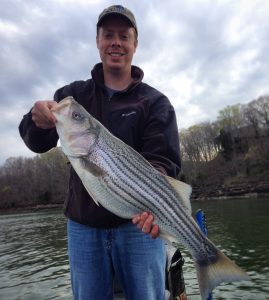
Photo: Kentucky Department Fish and Wildlife
The Kentucky Fish and Wildlife Commission proposed several new fishing regulations at a special called meeting today.
The commission recommends all hunting, fishing and boating regulations for approval by the General Assembly and approves all expenditures by the Kentucky Department of Fish and Wildlife Resources. All recommendations must be approved by legislators before they become law.
If approved by legislators, fisheries regulations proposed at the meeting would take effect March 1, 2018.
In fisheries-related business, commissioners recommended reducing the statewide daily creel limit on crappie to 20 fish per angler per day. They also proposed modifying the statewide daily creel limit on brown trout to one fish per day with a 16-inch minimum size limit. Rainbow trout will be under an 8-fish daily creel limit. Anglers will be able to use dip nets to collect baitfish statewide.
Commission members also proposed changing the way anglers tag jugs, limb lines or trot lines. Instead of using their name and address, anglers using these fishing methods can use the “Customer Identification Number” provided on their fishing licenses to tag their jugs, limb lines or trot lines.
In addition, the commission recommended increasing the crappie minimum size limit to 10 inches on Taylorsville Lake. They also proposed placing channel and blue catfish in Barren River Lake under a 15-fish daily creel limit; only one fish may be longer than 25 inches.
They also proposed removing the 15-inch minimum size limit on largemouth bass on Beaver Lake in Anderson County and placing Benjy Kinman Lake in Henry County under statewide regulations for crappie, bluegill and sunfish.
On Beech Fork Reservoir, also known as Staunton Reservoir, in Powell County, the commission recommended instituting a 15-inch minimum size limit on largemouth bass and a 15-fish daily creel limit on bluegill.
Another proposal recommended placing special regulations on Willisburg Park Pond in Washington County: a 4-fish daily creel limit on channel catfish with no minimum size limit; a 15-fish daily creel limit on sunfish with no minimum size limit; and a 1-fish daily creel limit, 15-inch minimum size limit on largemouth bass.
Recommendations also included restricting the use of live shad for bait on all Fishing in Neighborhoods (FINs) lakes. All restrictions on using shad for bait refer to live shad, not dead or packaged shad, used for bait.
In wildlife-related business, the commission recommended the implementation of a three-tiered classification system for wildlife management areas (WMAs). The system would allow the public to better understand whether an area is actively or passively managed, and the staffing levels for each area.
Finally, commissioners proposed implementation of regulations restricting the movement and rehabilitation of rabies-vector species the U.S. Department of Agriculture surveillance area in eastern Kentucky.
The next Kentucky Fish and Wildlife Commission meeting is currently scheduled for 8:30 a.m. (Eastern time), Friday, Sept. 8, 2017. Meetings are held at Kentucky Fish and Wildlife headquarters, 1 Sportsman’s Lane off U.S. 60 in Frankfort.
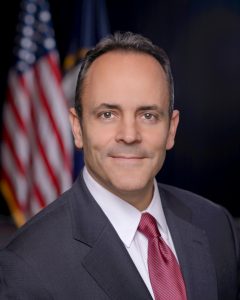 Gov. Matt Bevin signed a budget reduction today last week, meeting the Constitutional mandate that the Commonwealth of Kentucky end the fiscal year with a balanced budget. General Fund revenue receipts fell short of budgeted amounts by $138.5 million, requiring today’s action.
The Governor’s veto of a portion of the budget bill allowed an additional $5 million in lottery receipts to be dedicated to scholarships and not lapse to the General Fund. In addition, a lower than expected lapse of debt service raised the total resource requirements to meet the shortfall to $152.2 million.
“This year’s budget shortfall validates the need for conservative spending plans, and it dramatically underscores the critical need for fixing Kentucky’s broken pension systems and modernizing the state’s tax code,” said Gov. Bevin. “A solid financial foundation is essential before the Commonwealth can reach its full potential.”
The actions taken today to close the fiscal year 2017 budget gap included a combination of General Fund appropriation reductions and fund transfers from restricted funds. Also included were one-time savings in Medicaid costs due to the favorable renegotiation of contracts with the managed care organizations (MCOs) and lower than expected pharmacy costs. The Governor’s order to balance the budget does not include any reduction to the state’s Budget Reserve Trust Fund.
“We are expecting an ongoing challenge with revenues in the next fiscal year and the next biennium,” stated John Chilton, the State Budget Director. “Today’s actions by the Governor responsibly preserves the Rainy Day Fund as we prepare for the tight fiscal environment in front of us.”
In anticipation of the budget shortfall, the Office of the State Budget Director directed the Governor’s Cabinet Secretaries to identify a reduction in their General Fund expenditures. These reductions, plus reductions by the Legislative and Judicial branches, amounted to $59.3 million. Fund transfers of various excess restricted funds totaled $77.3 million. General fund lapses and fund transfers in excess of budgeted amounts accounts for the remaining $15.5 million of the total $152.2 million shortfall. Programs funded through coal severance revenues are automatically adjusted when receipts fall short of projections. That resulted in a $17 million reduction in money going to the Local Government Economic Assistance Fund.
The Medicaid portion of the original budget was based on MCO contract rates in effect in 2015. Prior to Governor Bevin taking office, Kentucky ranked number 1 in the nation in profits earned by MCO providers; their profits were more than 4 times the national average for all MCOs. As part of Governor Bevin’s Medicaid transformation, the administration renegotiated these contracts resulting in lower than budgeted cost.
Final fiscal year 2017 General Fund receipts were 1.3 percent less than the official estimate. If the fiscal year 2018 revenue shortfall approximates this year’s amount, significant additional spending reductions will be needed to balance the budget in fiscal year 2018. The current balance of the Budget Reserve Trust Fund, $150.5 million, remains unaffected by today’s action.

Photo: Kentucky Labor Department
Last month, the Labor Cabinet conducted 33 free on-site visits, or “consultative surveys,” for employers across Kentucky. As a result of these surveys, employers corrected 227 serious violations that could have resulted in enforcement penalties of up to $1,589,000.
The Labor Cabinet’s Division of Occupational Safety & Health Education & Training leads the Cabinet’s proactive efforts to create safe and healthful workplace conditions, including overseeing a new web-based training service called eTrain (www.KYSAFE.KY.GOV). This new online training module will offer a variety of safety and health training topics, certificates, and live and recorded webinars all at no cost.
In addition to eTrain, the Cabinet provides free consultative services to employers across Kentucky on ways to increase workplace safety – including how to improve Injury and Illness Rates. Services include free on-site consultations to all employers, as well as other compliance assistance, educational materials, and class-style training for all employers.
Last year, the Division conducted 350 free consultative surveys for employers across Kentucky. This resulted in employers correcting 3,813 serious conditions that could have affected up to 108,307 employees resulting in enforcement penalties of up to $26,691,000.
Additional information is available at http://labor.kentucky.gov.
Follow the Kentucky Labor Cabinet on Facebook and Twitter for all the latest updates.
 Over 10,000 street rods, customs, muscle cars and street machines will be on hand at the Kentucky Expo Center this summer as the National Street Rod Association® presents its 48th Annual Street Rod Nationals. The dates for the city’s largest vintage car show will be August 3, 4, 5, 6, 2017. This will be the 24th time the NSRA Street Rod Nationals has been held in Louisville and an all time high number of participants and spectators are expected this year. Almost all of the Kentucky Expo Center will be utilized for the event as well as many of the buildings, which will house over 350 manufacturer and dealer displays and other attractions.
The host organization, NSRA, defines a street rod as a modernized vintage vehicle that is of pre 1949 manufacture. These vehicles are equipped with the latest options available on the newest model vehicles, including but not limited to disc brakes, air conditioning, cruise control, and tilt steering wheel. Most of those attending have updated the engine and drive train to enable the owner to cruise down the highway in comfort and safely maintain the speeds traveled by more modern vehicles.
Included in this event are muscle cars, those factory produced high horsepower machines from the 60’s and 70’s along with the classics cars of the 50’s. This is truly unique mix of old and new together for the first time at Kentucky Expo Center and a national gathering of fine vintage automobiles of every description. The NSRA Street Rod Nationals is the area’s largest automotive participation event and spectators from around the area will attend the event.
The NSRA Street Rod Nationals is an excellent event for spectators to attend and those who take time to attend will be treated to the sights and sounds of some of the most beautiful, best constructed vintage vehicles ever assembled in one place. One of the special attractions for the spectators is that they can walk right up to the vehicles and check each one out close up as they are not roped-off or otherwise confined. All are in the open and can be examined top to bottom, front to back, inside and out. While the exquisite paint and other features of the car should not be touched, spectators are free to look to their heart’s content.
The big automotive show will be at the beautiful Kentucky Expo Center and is open to the public August 3, 4, 5, 6, 2017. Make your plans now to attend the 48th Annual Street Rod Nationals in Louisville, Kentucky. It promises to be one of the biggest vintage car shows in the city’s recent history and you can enjoy every exciting part of it. Those of us at NSRA know you won’t soon forget it.
Visit us online @ http://www.nsra-usa.com

Photo: Kentucky Labor Cabinet
Last month, the Labor Cabinet recouped $43,785.07 in unpaid wages for Kentucky workers.
Unpaid overtime, withheld final paychecks, illegal deductions of pay and lower pay than the legal minimum wage requirement are among the types of wage and hour violations that the Cabinet prosecutes. Other examples include unpaid breaks, time-clock shaving, mandatory tip-pooling and prevailing wage violations.
The Labor Cabinet’s Division of Wages, Hours, & Mediation is responsible for enforcing Kentucky’s wage and hour and child labor laws. It also enforces prevailing wage requirements that were in effect before the enactment of H.B. 3. Enforcement typically begins upon the receipt of a complaint. Investigators are then assigned to the case to determine compliance with the state’s wage and hour laws, monitor the correction of any violations, and collect back wages improperly withheld from employees. To find out more about the Commonwealth’s wage and hour laws, please check Division of Wages, Hours, & Mediation website by clicking HERE. An Employment Complaint Form can be found HERE.
Follow the Kentucky Labor Cabinet on Facebook and Twitter for all the latest updates.
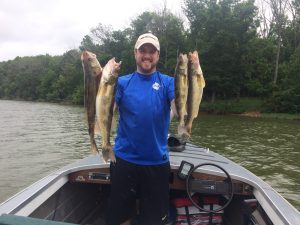
Photo: Kentucky Department Fish and Wildlife
With every passing season, anglers are building their knowledge base about how to catch saugeye stocked in a handful of central and northern Kentucky lakes.
A saugeye is a fast-growing cross between a walleye and sauger that can reach 15 to 19 inches in its second year. The hybridization is evident in the species’ physical appearance. Saugeye display the faint saddle markings of a sauger and the white fin tips of a walleye. Unlike either, it features black smudges on its dorsal fin.
Three lakes – 317-acre Guist Creek Lake in Shelby County, 148-acre Bullock Pen Lake in Owen County and 175-acre A.J. Jolly Lake in Campbell County – received experimental stockings of the species in 2013 and five have been stocked this year by the Kentucky Department of Fish and Wildlife Resources.
Guist Creek Lake received more than 15,000 fingerlings this spring. Anglers have reported good success in recent weeks fishing jigs off mud flats in 4 to 10 feet of water.
Paul Wilkes and Dane Balsman had never tried fishing for saugeye before they visited Guist Creek Lake one day in late June. They spoke with other anglers and studied bottom contour maps available on Kentucky Fish and Wildlife’s website at fw.ky.gov beforehand.
“We were able to identify some flats that we wanted to hit and then went out and graphed some baitfish near the drop-offs of those flats,” said Wilkes, fisheries program coordinator with Kentucky Fish and Wildlife. “We went out there with a mindset of if we caught one or two we were going to be pumped because this was a new species for us.”
The two reeled in 11 saugeye, including one that weighed 4.5 pounds and two others that weighed better than 3 pounds.
“We went out there and tried it and tried a few different drop-offs we mapped,” Wilkes said. “We stuck to the basics of jigging slowly in the areas we had identified. Strikes were kind of a thud, where you almost thought you were hung up until you really pulled it in. Once we found the fish, it seemed like they were in small schools. You’d catch several.”
Minnow or worm-tipped jigs or small shad-imitating crankbaits are good options for saugeye, as are small suspending jerkbaits or swimbaits in grey and white. Wilkes and Balsman, urban fisheries program coordinator with Kentucky Fish and Wildlife, found bladed jig heads with chartreuse bodies worked best for them.
Mike Hardin enjoyed similarly good fortune on Guist Creek Lake this spring fishing a little deeper in 8 to 10 feet of water.
“If you look at the fishing reports from saugeye lakes in Kentucky and Ohio, you see a lot of reports of anglers finding them in shallow water on crankbaits,” said Hardin, assistant Fisheries Division director with Kentucky Fish and Wildlife. “For a long time, I looked and looked and fished extremely shallow water jigging and picking up the occasional saugeye.
“We pulled off the bank and found wads of baitfish in 8- to 10-feet of water and it was game on. Fish close to the bottom, just like walleye fishing.”
He’s also had caught saugeye on Taylorsville Lake. Fisheries biologists believe good saugeye fishing could be in the cards this fall on Salt River above Taylorsville Lake based on population sampling from last fall.
“It seemed like there was definitely a push up there in the river. There’s going to be crappie and saugeye and bass, a little bit of everything,” said David Baker, Central Fisheries District biologist with Kentucky Fish and Wildlife. “Honestly, I think we’re going to be getting a lot of phone calls about saugeye in Taylorsville here in the next year or two.”
This year, the Kentucky Department of Fish and Wildlife Resources stocked more than 150,000 fingerlings in five lakes with Taylorsville Lake receiving more than 115,000 saugeye fingerlings.
Also receiving saugeye fingerlings were Guist Creek Lake, 92-acre Boltz Lake in Grant County and A.J. Jolly Lake in Campbell County. Lake Carnico, a 114-acre lake in Nicholas County, received its first saugeye stocking this year.
“It was a ton of fun and we were able to get on some really nice fish,” Wilkes said. “It definitely exceeded our expectations.”
For more information about saugeye fishing in Kentucky, including special regulations, consult the current Kentucky Fishing and Boating Guide. It is available online at fw.ky.gov and wherever licenses are sold.
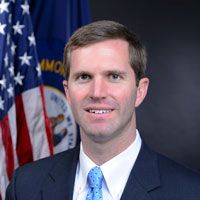 In 2015, more than 225 Kentuckians died from a drug overdose with Opana in their blood.
Now that the makers of the opioid painkiller announced July 6 that it will no longer sell the drug, Attorney General Andy Beshear is calling the move a “first step” in fighting against what he believes is the single greatest threat to Kentucky – the state’s drug epidemic.
Beshear sent his concerns on the potential for abuse by Kentuckians on a reformulation of the drug, Opana ER (extended release), to the U.S. Food and Drug Administration (FDA) in February during an open comment period on the drug.
“The FDA previously determined the reformulated Opana ER can still be readily prepared for injection and can be crushed with common items for snorting,” Beshear said in his comments to the agency. “‘Snortable’ or injectable drugs have crippled Kentucky, ranging from the widespread abuse of Oxycontin to the return of heroin. Where the reformulation has merely been found to impede one of many means of abuse, approving labeling Opana ER as ‘abuse deterrent’ may mislead patients and providers.”
In his comments, Beshear said he was “encouraged that the agency is taking a hard look at the safety of this powerful drug.”
The FDA requested on June 8 that Endo Pharmaceuticals remove Opana ER from the market.
Beshear’s comments to the FDA on Opana ER is part of his ongoing efforts to address the opioid crisis in Kentucky.
“Opana ER has already taken the lives of Kentuckians,” Beshear said. “Louisvillian Emily Walden, whose son, T.J., died of an Opana ER overdose in 2012, has led the charge to have the reformulated drug removed from the market. By working hand-in-hand with dedicated Kentuckians like Emily, we can and will end our opioid epidemic.”
On June 28, Beshear announced that his office intends to file multiple lawsuits against drug manufacturers, distributors and retailers where there is evidence that they contributed to the opioid epidemic by illegally marketing and selling opioids to Kentuckians.
To support this litigation, Beshear issued a request for proposal (RFP) for legal services to assist the Commonwealth in multiple lawsuits and to ensure that Kentucky tax dollars are not used for the costs of the litigations.
Beshear is co-chair on the National Association of Attorneys General Substance Abuse Committee.
The AG’s office previously settled a $24 million lawsuit with Purdue Pharma regarding OxyContin. Beshear’s office has provided $8 million from that settlement directly to 15 substance treatment centers across Kentucky.
From a different drug company settlement, the office dedicated $2 million to expand and enhance Rocket Docket programs that expedite drug cases, generate significant cost savings and allow select defendants rapid access to substance abuse treatment.
Recently, Beshear joined a multistate lawsuit alleging the drugmaker of Suboxone, a drug used for treating opioid addiction, tried to monopolize the market.
Beshear is currently working with local law enforcement and community leaders to host substance abuse awareness forums across the state. The office has also been instrumental in numerous drug related arrests, including working with federal authorities on arresting a fentanyl dealer whose drugs had killed several Kentuckians.
“The abuse and diversion of Opana and other strong opioids is devastating the health of many of our Commonwealth’s citizens, and they, as well as our Medicaid and corrections departments, pay an enormous financial price in the attempt to treat this epidemic,” Beshear told the FDA. “It would benefit public health for the FDA to create and implement deadlines for the pharmaceutical industry to develop more robust abuse deterrent formulations for these high-dose opioids and to require that development before granting abuse deterrent labeling.”