Sunday December 7, 2025
Local Connection
 Weather
 Traffic
 @LouisvilleDispatch
 @LouisvilleDisp
 Subscribe
Photo: Legal Aid Society of Louisville
A new telephone hotline gives qualifying parents free legal assistance related to their custody and visitation concerns. The toll-free Custody and Visitation Hotline number is 1-844-673-3470. Phone lines are open Monday-Friday: 9 a.m.-noon and 1-3 p.m. Eastern time.
The Kentucky Cabinet for Health and Family Services (CHFS) Office of Child Support Enforcement (CSE) has an agreement with the Legal Aid Society (LAS) to operate the “Custody and Visitation” Hotline. The statewide service is for eligible parents, on an income-based scale, who have concerns regarding custody and visitation issues with their children.
Steve Veno, Commissioner of the CHFS Department for Income Services, which oversees the CSE, said an LAS attorney will handle all hotline calls and provide legal advice or assistance to callers such as how to file a motion, how to file or change a child custody or visitation order in the appropriate court and how to work through visitation and custody issues.
“We have heard from many parents who ask about access to legal help, so we know the need is there,” Veno said. “Our agency isn’t able to address these issues, but now there is a resource for parents with simple legal questions or deeper concerns. We anticipate a lot of parents will take advantage of this new resource.”
LAS attorneys cannot file legal pleadings, appear in court or address child support issues.
Funding for the hotline comes from a grant from the federal Department of Health and Human Services’ Administration for Children and Families and provides for initial operation of the service through June 2018. CSE and LAS staff will meet regularly to evaluate the program, address challenges and ensure progress.
“Helping parents with their custody and visitation questions will give them more peace of mind,” concluded CHFS Secretary Vickie Yates Brown Glisson. “In turn, this will help children. The connection between parents having a relationship with their children and financially supporting their children is strong. Collection of court-ordered child support payments is another integral part of the Office of Child Support Enforcement’s mission.”
While this partnership deals specifically with custody and visitation issues, a number of separate resources are also available for parents dealing with child support issues.
The Child Support Enforcement Hotline – 800-248-1163 – is available from 8 a.m. to 4:30 p.m. Eastern time. The Child Support Interactive Voice Response Payment Line – 800-443-1576 – is available 24 hours a day, seven days a week.
The Kentucky Child Support Interactive website – https://csws.chfs.ky.gov/csws/ – is available for parents to access information about their cases and to make payments.
For more information about Kentucky Child Support Enforcement, log on to http://chfs.ky.gov/dis/cse.htm.
 Kentucky eighth-graders headed for high school in the fall might find “High School Basics,” a four-page flyer, helpful. The free flyer can be ordered from the Kentucky Higher Education Assistance Authority (KHEAA).
“High School Basics” has sections about:
- Credits and graduation requirements.
- Calculating a GPA.
- Reading a high school transcript.
- The Kentucky Educational Excellence Scholarship (KEES).
- Earning college credit while in high school.
Free copies are available by emailing publications@kheaa.com. Please remember to include a mailing address.
KHEAA is the state agency that administers KEES, need-based grants and other programs to help students pay their higher education expenses.
For more information about Kentucky scholarships and grants, visit www.kheaa.com; write KHEAA, P.O. Box 798, Frankfort, KY 40602; or call 800-928-8926, ext. 6-7214.
 As part of the 52 Weeks of Public Health campaign, the Kentucky Department for Public Health (DPH), within the Cabinet for Health and Family Services (CHFS), is calling on homeowners to help control mosquitoes by eliminating standing water from containers that can collect rainwater where insects breed.
“Everyone needs to do their part to help reduce the mosquito population,” said Hiram Polk Jr., MD, DPH commissioner. “As we are out in the garden getting ready for the growing season or after a rain shower, spend a moment or two thinking about other potential breeding areas for mosquitoes. Walk around your yard once a week or after a rain shower to see if there are any containers holding water and drain them.”
Female mosquitoes need only a teaspoon of water in which to lay eggs; can become an adult mosquito in just seven days; and have a lifespan of about two weeks. Mosquitoes will lay eggs in almost anything such as a bottle cap, a candy wrapper, folds of a plastic tarp or downspout, discarded tires, children’s toys or the seat of a riding lawn mower. Mosquitoes lay eggs on the walls of water-filled containers and the eggs stick like glue and remain attached until they are scrubbed off. The eggs can survive when they dry out up to 8 months. Once a week, empty and scrub, turn over, cover or throw out containers that can hold water.
Common household items that can be a home for mosquito larvae include buckets, garbage cans, tires, tarps, gutters and flexible downspout extensions, decks and porches, kiddie pools and pool covers, sand boxes, wagons and big plastic toys, planter saucers or planters without drainage holes, wheelbarrows, watering cans, bird baths, decorative ponds without fish and unscreened water barrels.
If you cannot eliminate or drain a breeding ground because it is too heavy to move, consider using a larvacide such as mosquito dunks containing a biological larvacide.
For more information about the mosquito proofing your yard to reduce mosquito populations, see this video featuring Dr. Anna Yaffee, CDC Epidemic Intelligence Service Officer, Kentucky Department for Public Health.
For further information visit the DPH website http://healthalerts.ky.gov/zika or the CDC website at www.cdc.gov/zika. Be sure to follow KYHealthAlerts on Twitter and DPH’s Zika mascot, Marty Mosquito, on Instagram, @martymosquito.
Throughout the planned 52 Weeks of Public Health promotion, DPH will spotlight a specific public health issue. Additional information about the campaign is available on the DPH website: http://chfs.ky.gov/dph/default.htm and will be posted on the CHFS Facebook page: http://www.facebook.com/kychfs where Kentuckians are encouraged to like and share posts among their networks of friends.
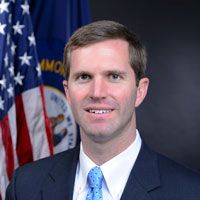 Attorney General Andy Beshear and the Kentucky Bankers Association (KBA) are teaming up to protect seniors statewide from financial exploitation by scam artists.
This is the latest in a series of partnerships Beshear has announced aimed at preventing scams targeting seniors. His office most recently announced a partnership with Kentucky’s faith-based community to help educate its senior ministries and the communities they serve on potential scams.
Through the KBA collaboration, Beshear’s office will work with member banks to host scam events across the state. Beshear’s office presented scam prevention information at KBA’s spring conference earlier this month. The AG’s Office of Senior Protection will present at the upcoming Owensboro Rotary Club on May 31 with South Central Bank in Daviess County; and will hold an upcoming training for bank tellers on the warning signs of scammers and financial elder abuse.
“Banks are an important line of defense in protecting seniors who may be in the process of falling for a scam and are requesting to withdraw large sums of money from their life savings at a bank,” Beshear said. “Now having bank employees on the front lines helping us monitor and prevent scams in their communities is monumental. I cannot think the KBA enough for its partnership with my office.”
“Senior Kentuckians are the bedrock of our communities,” said Ballard Cassady, president/CEO of KBA. “We are pleased to work with the Kentucky Attorney General to provide Kentuckians with the tools they need to prevent bad actors from taking advantage.”
“It is a privilege to bring this information to the Owensboro Rotary Club,” said David Fort, president/CEO of South Central Bank of Daviess County. “Seniors are a part of America’s Greatest Generation and through this program, we will help them guard against potential losses from those who will do them harm.”
Beshear is working to bring new solutions and ideas to address scams because of the severe harm they are having on Kentucky families. More than 3 million consumers were conned out of $765 million across the country in 2015. Seniors nationwide lose nearly $37 billion a year to elder financial exploitation.
To date, more than 100 nonprofit and retail organizations have joined Beshear’s initiative as a Scam Alerts partner, including Kroger, AARP of Kentucky, the Kentucky Council of Churches, Lexington-Fayette Urban County Government, University of Kentucky Cooperative Extension Service, the Better Business Bureau and the United States Postal Inspection Service.
To protect seniors, Beshear launched Scam Alerts last year as the state’s first direct messaging service that notifies Kentuckians of financial schemes by con artists attempting to steal a person’s money or identification.
Kentuckians may sign up for Scam Alerts by texting the words KYOAG Scam to GOV311 (468311), or enroll online at ag.ky.gov/scams and select text message or email alert.
Kentuckians can tap into free resources from the Kentucky Higher Education Assistance Authority (KHEAA).
“It’s Money, Baby,” a booklet about financial literacy, is available free from KHEAA.
The 32-page booklet includes sections about such topics as:
- Cash basics.
- Banking.
- Credit.
- Insurance.
- Fraud and identity theft.
To order a free copy, email publications@kheaa.com. Please include your mailing address. Only Kentucky schools and residents will be sent more than one copy.
An online version of the booklet is available on www.kheaa.com, while financial literacy videos can be found at http://itsmoney.kheaa.com.
In addition, KHEAA’s regional outreach counselors can provide “It’s Money, Baby” presentations for schools and other agencies. Call 800-928-8926, ext. 7577, to schedule a presentation.
KHEAA is the state agency that administers the Kentucky Educational Excellence Scholarship (KEES), need-based grants and other programs to help students pay their higher education expenses.
For more information about Kentucky scholarships and grants, visit www.kheaa.com; write KHEAA, P.O. Box 798, Frankfort, KY 40602; or call 800-928-8926, ext. 6-7214.
 The Kentucky Historical Society will crisscross the Commonwealth to dedicate five historical markers in May.
Here is the schedule:
May 4, Walton CCC Camp Bean Ridge, 1 p.m., 30 School Road, Walton
Civilian Conservation Corps company 3541 opened in 1935 in Walton. The 200 men stationed there specialized in soil conservation. They trained local farmers in contour farming, crop rotation and strip cropping; planted trees; built fences; and developed farm management plans. They also provided relief during the 1937 Ohio River flood.
May 8, Webster County Courthouse, 10:30 a.m., CDT, Webster County Courthouse, Dixon
The courthouse dates to 1941 and was a Works Progress Administration project during the Great Depression. Architect H. Lawrence Casner, from Webster County, designed the building, as well as the Caldwell County courthouse and the main vault at Fort Knox. His wife, Arminta Bowmer Casner, made the sculptured faces on the building’s exterior walls.
May 10, First Louisville Slugger Bat, 10 a.m., 118 S. First St., Louisville
This address is the site of the original J.F. Hillerich carpentry shop. The Louisville Slugger baseball bat has its roots with Louisville Eclipse player Pete Browning’s broken baseball bat. J.F. Hillerich’s son was at the game in 1884 when it broke and offered to make a new bat for Browning. Browning got three hits with the new bat, creating a demand from his teammates for their own bats. The company trademarked “Louisville Slugger” in 1884.
May 20, Ted Poston “Dean of Black Journalists,” 3:30 p.m. CDT, 9th and Main Streets, Hopkinsville
Hopkinsville native Theodore Roosevelt Poston began his journalism career in 1936 as a freelancer for the New York Post. He went on to spend most of his career there, covering major civil rights stories of his era. Among his many awards was a Pulitzer Prize (1949).
May 28, Bon Jellico, 2 p.m., Highway 92W and Bon Hollow Road, Whitley County
The Bon Jellico coal mine operated from 1912 to 1937 and employed 350 workers. It annually produced nearly 100,000 tons of Blue Gem coal. The town included 75 houses, a three-room school/church and a company store. Around 1,500 people lived in Bon Jellico over the 25-year period the mine operated. It closed primarily because the coal supply was depleted.
More than 2,400 historical markers statewide tell Kentucky’s history. More information about the marker application process and a database of markers and their text is available at history.ky.gov/markers. Also available on the site is the Explore Kentucky History app, a source of supplemental information about marker topics and virtual tours of markers by theme. KHS administers the Kentucky Historical Marker Program in cooperation with the Kentucky Transportation Cabinet.
Anglers with a bit of salt in their hair remember fondly the venerable Sassy Shad, the paddle-tailed, shad-shaped soft plastic wonder that caught practically anything that swims.
In the fishing lure world, what is old oftentimes becomes new again. Over the last decade or so, the soft-plastic swimbait stormed the fishing world, looking remarkably like a Sassy Shad with refinements.
With softer, lifelike soft plastic formulations and more realistic color schemes that closely resemble shad or other baitfish along with salt and scent fused into the lure, the modern swimbait is one of the most versatile lures you can throw.
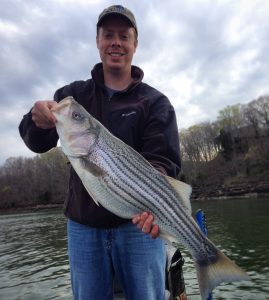
Photo: Kentucky Department Fish and Wildlife
“Anything looking to eat a baitfish will hit a swimbait,” said Chad Miles, host of the “Kentucky Afield” television show and swimbait expert. “I’ve caught everything from crappie to striped bass and all three species of black bass, smallmouths, largemouths and spotted bass on a swimbait.”
Spring through early summer is one of Miles’ favorite times to fish a swimbait for black bass. He had a great trip on Lake Cumberland last spring while filming an episode of “Kentucky Afield.” They caught several quality smallmouth bass, largemouth bass in the 5-pound range and Executive Producer Nathan Brooks caught a 37-inch striped bass.
A 4-inch white and silver swimbait rigged on a 3/8-ounce leadhead fooled them all. They caught most of their fish on secondary points in Difficulty and Harmon creeks.
“The fish are up shallow at this time of year,” he explained. “I downsize the weight of the leadhead to a 1/4-ounce and use no heavier than 3/8-ounce. You do not make a big splash on the cast with a lighter leadhead. It also allows you to keep the lure from getting hung on the bottom.”
Employ a steady retrieve and work a swimbait down sloping banks that fall off into deep water or across points in spring through early summer. These areas draw shad and other baitfish, what the swimbait emulates.
“The good thing about a swimbait is you can adjust your depth and speed, which you really can’t do with a crankbait,” Miles explained. “It is all about getting the right speed on the retrieve and adjusting it according to the aggressiveness of the fish.”
On deeper lakes, such as Dale Hollow, Lake Cumberland and Laurel River Lake, Miles used a nose-weighted swimbait hook and a solid body swimbait for bass. He rigs these swimbaits hook exposed, the way most anglers used to rig a Sassy Shad.
“I use the belly-weighted wide gap swimbait hook and a hollow body swimbait for shallow lakes with more cover such as Kentucky Lake or Lake Barkley,” Miles said. “This setup is weedless and works great over weedbeds or through cover for bass.”
In clear water, the natural shad color is hard to beat for swimbaits. White with silver flakes is also a good color. “In stained water, I like swimbaits with some chartreuse or orange in them,” Miles said. “In murky to muddy water, I don’t throw a swimbait. They are other lures much more effective than a swimbait in those conditions.”
Miles said resisting the temptation to set the hook when you first feel a bite is the most important aspect of fishing a swimbait. “Keep reeling through the strike and let the rod load up a bit before setting the hook,” he said. “If you set the hook immediately, you are pulling the swimbait away from the fish.”
A medium to medium-heavy power fast action baitcasting outfit spooled with 10- to 12-pound fluorocarbon line works well for handling swimbaits.
“You are throwing a good amount of weight with a swimbait,” Miles said. “You need a rod that can handle it.”
As the days lengthen and the water warms, Miles works 5- to 6-inch swimbaits over channel breaks, ledges and submerged humps just above the thermocline for big largemouth bass on Kentucky Lake and Nolin River Lake.
“The swimbait works well in summer for suspended bass that are hard to catch on anything else,” Miles said. He counts the swimbait down in the water column over likely fish holding structures such as ledges, humps or points that extend out into the lake. He retrieves his swimbait deeper on each cast until he finds fish.
In summer, anglers on lakes with flooded timber such as Lincoln County’s Cedar Creek Lake do well working swimbaits slow and deep for largemouth bass suspended in the flooded timber.
After the weather turns cold in fall, Miles falls back to fishing 3-inch swimbaits in the natural shad color for smallmouth and spotted bass.
You can watch Miles employ his excellent swimbait techniques on a productive spring day on Lake Cumberland from a segment filmed last April by clicking on the KY Afield tab at the top of the Kentucky Fish and Wildlife homepage at www.fw.ky.gov. Once on the “KY Afield” page, click on the link “Visit our Youtube channel,” then type “Fishing with Swimbaits on Lake Cumberland” in the search bar.