Sunday December 7, 2025
Local Connection
 Weather
 Traffic
 @LouisvilleDispatch
 @LouisvilleDisp
 Subscribe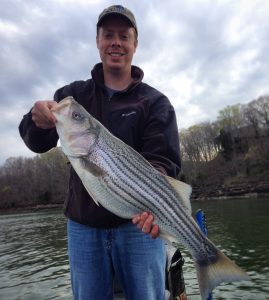
Photo: Kentucky Department Fish and Wildlife
The Kentucky Fish and Wildlife Commission proposed several new fishing regulations at a special called meeting today.
The commission recommends all hunting, fishing and boating regulations for approval by the General Assembly and approves all expenditures by the Kentucky Department of Fish and Wildlife Resources. All recommendations must be approved by legislators before they become law.
If approved by legislators, fisheries regulations proposed at the meeting would take effect March 1, 2018.
In fisheries-related business, commissioners recommended reducing the statewide daily creel limit on crappie to 20 fish per angler per day. They also proposed modifying the statewide daily creel limit on brown trout to one fish per day with a 16-inch minimum size limit. Rainbow trout will be under an 8-fish daily creel limit. Anglers will be able to use dip nets to collect baitfish statewide.
Commission members also proposed changing the way anglers tag jugs, limb lines or trot lines. Instead of using their name and address, anglers using these fishing methods can use the “Customer Identification Number” provided on their fishing licenses to tag their jugs, limb lines or trot lines.
In addition, the commission recommended increasing the crappie minimum size limit to 10 inches on Taylorsville Lake. They also proposed placing channel and blue catfish in Barren River Lake under a 15-fish daily creel limit; only one fish may be longer than 25 inches.
They also proposed removing the 15-inch minimum size limit on largemouth bass on Beaver Lake in Anderson County and placing Benjy Kinman Lake in Henry County under statewide regulations for crappie, bluegill and sunfish.
On Beech Fork Reservoir, also known as Staunton Reservoir, in Powell County, the commission recommended instituting a 15-inch minimum size limit on largemouth bass and a 15-fish daily creel limit on bluegill.
Another proposal recommended placing special regulations on Willisburg Park Pond in Washington County: a 4-fish daily creel limit on channel catfish with no minimum size limit; a 15-fish daily creel limit on sunfish with no minimum size limit; and a 1-fish daily creel limit, 15-inch minimum size limit on largemouth bass.
Recommendations also included restricting the use of live shad for bait on all Fishing in Neighborhoods (FINs) lakes. All restrictions on using shad for bait refer to live shad, not dead or packaged shad, used for bait.
In wildlife-related business, the commission recommended the implementation of a three-tiered classification system for wildlife management areas (WMAs). The system would allow the public to better understand whether an area is actively or passively managed, and the staffing levels for each area.
Finally, commissioners proposed implementation of regulations restricting the movement and rehabilitation of rabies-vector species the U.S. Department of Agriculture surveillance area in eastern Kentucky.
The next Kentucky Fish and Wildlife Commission meeting is currently scheduled for 8:30 a.m. (Eastern time), Friday, Sept. 8, 2017. Meetings are held at Kentucky Fish and Wildlife headquarters, 1 Sportsman’s Lane off U.S. 60 in Frankfort.
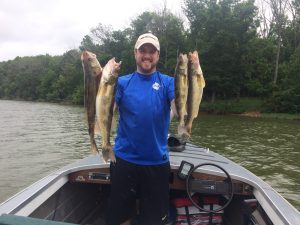
Photo: Kentucky Department Fish and Wildlife
With every passing season, anglers are building their knowledge base about how to catch saugeye stocked in a handful of central and northern Kentucky lakes.
A saugeye is a fast-growing cross between a walleye and sauger that can reach 15 to 19 inches in its second year. The hybridization is evident in the species’ physical appearance. Saugeye display the faint saddle markings of a sauger and the white fin tips of a walleye. Unlike either, it features black smudges on its dorsal fin.
Three lakes – 317-acre Guist Creek Lake in Shelby County, 148-acre Bullock Pen Lake in Owen County and 175-acre A.J. Jolly Lake in Campbell County – received experimental stockings of the species in 2013 and five have been stocked this year by the Kentucky Department of Fish and Wildlife Resources.
Guist Creek Lake received more than 15,000 fingerlings this spring. Anglers have reported good success in recent weeks fishing jigs off mud flats in 4 to 10 feet of water.
Paul Wilkes and Dane Balsman had never tried fishing for saugeye before they visited Guist Creek Lake one day in late June. They spoke with other anglers and studied bottom contour maps available on Kentucky Fish and Wildlife’s website at fw.ky.gov beforehand.
“We were able to identify some flats that we wanted to hit and then went out and graphed some baitfish near the drop-offs of those flats,” said Wilkes, fisheries program coordinator with Kentucky Fish and Wildlife. “We went out there with a mindset of if we caught one or two we were going to be pumped because this was a new species for us.”
The two reeled in 11 saugeye, including one that weighed 4.5 pounds and two others that weighed better than 3 pounds.
“We went out there and tried it and tried a few different drop-offs we mapped,” Wilkes said. “We stuck to the basics of jigging slowly in the areas we had identified. Strikes were kind of a thud, where you almost thought you were hung up until you really pulled it in. Once we found the fish, it seemed like they were in small schools. You’d catch several.”
Minnow or worm-tipped jigs or small shad-imitating crankbaits are good options for saugeye, as are small suspending jerkbaits or swimbaits in grey and white. Wilkes and Balsman, urban fisheries program coordinator with Kentucky Fish and Wildlife, found bladed jig heads with chartreuse bodies worked best for them.
Mike Hardin enjoyed similarly good fortune on Guist Creek Lake this spring fishing a little deeper in 8 to 10 feet of water.
“If you look at the fishing reports from saugeye lakes in Kentucky and Ohio, you see a lot of reports of anglers finding them in shallow water on crankbaits,” said Hardin, assistant Fisheries Division director with Kentucky Fish and Wildlife. “For a long time, I looked and looked and fished extremely shallow water jigging and picking up the occasional saugeye.
“We pulled off the bank and found wads of baitfish in 8- to 10-feet of water and it was game on. Fish close to the bottom, just like walleye fishing.”
He’s also had caught saugeye on Taylorsville Lake. Fisheries biologists believe good saugeye fishing could be in the cards this fall on Salt River above Taylorsville Lake based on population sampling from last fall.
“It seemed like there was definitely a push up there in the river. There’s going to be crappie and saugeye and bass, a little bit of everything,” said David Baker, Central Fisheries District biologist with Kentucky Fish and Wildlife. “Honestly, I think we’re going to be getting a lot of phone calls about saugeye in Taylorsville here in the next year or two.”
This year, the Kentucky Department of Fish and Wildlife Resources stocked more than 150,000 fingerlings in five lakes with Taylorsville Lake receiving more than 115,000 saugeye fingerlings.
Also receiving saugeye fingerlings were Guist Creek Lake, 92-acre Boltz Lake in Grant County and A.J. Jolly Lake in Campbell County. Lake Carnico, a 114-acre lake in Nicholas County, received its first saugeye stocking this year.
“It was a ton of fun and we were able to get on some really nice fish,” Wilkes said. “It definitely exceeded our expectations.”
For more information about saugeye fishing in Kentucky, including special regulations, consult the current Kentucky Fishing and Boating Guide. It is available online at fw.ky.gov and wherever licenses are sold.
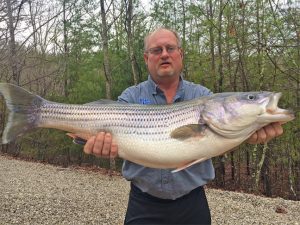
Photo: Kentucky Department Fish and Wildlife
Few things in the outdoors in Kentucky can top being on Lake Cumberland at daybreak on a summer morning, watching a planer board or large bobber disappear, followed by the sound of a slipping drag.
Striped bass pull like no other fish in Kentucky and landing a 22-inch or longer keeper brings a rush of adrenaline that gives you the shakes. Now in the fourth year of normal water levels since the drawdown to repair Wolf Creek Dam, the striped bass in Lake Cumberland are well on the way to returning to the glory days.
“The striped bass in Lake Cumberland are doing great,” said John Williams, Southeastern Fisheries District biologist for the Kentucky Department of Fish and Wildlife Resources. “There are multiple year classes in the lake with many keepers over 22 inches. We are getting more fish over 30 inches. Their body condition is fantastic.”
Although striped bass are in good numbers in Lake Cumberland, the spring fishing proved frustrating in the lake this year.
“Some guides had a hard time this spring finding fish, but now they are on fish, they found them,” Williams said. “Because we had so much rain this year and they released so much water from the lake, it spread the fish throughout the water column. This leads to spotty fishing.”
Williams said a recent temperature profile of the lake shows a gradual temperature change through the depths. “There is only a 10 degree temperature drop from 20 feet deep to 60 feet deep,” he said. “The water temperature is 70 degrees at 20 feet and 60 degrees at 60 feet deep. They have a wide range of the water column that changes only a few degrees. Usually, the temperature changes are much more abrupt as you descend in the water column in summer. They have 40 feet of depth to roam now.”
Anglers fishing live bait in the middle of this range are catching stripers. “I had my first ever triple on my boat this last weekend,” said Joe McWilliams, an avid striped bass angler who has a vacation home on the lake. “I’ve been fishing about 40 to 50 feet deep.”
McWilliams uses an old school method to judge his depth. “My rods are 7 feet long, so I do 7 pulls of line the length of the rod to get my depth right now,” he said. “In summer, I usually put two rods out at 10 to 15 feet, two more out from 28 to 35 feet and then two more out at 42 to 48 feet or so and adjust until I find fish.” McWilliams typically fishes the mid-lake region from Harmon Creek up to Fall Creek.
He employs three planer boards on each side of his boat with two large bobber rigs drifting off the back, all rigged with live threadfin shad or alewives on 3/0 circle hooks. A light drag helps keep the marauding stripers from snapping off the 20-pound leaders McWilliams uses.
A remote controlled trolling motor helps McWilliams slowly troll the bait he gathers in the pre-dawn via a casting net and a green light mounted under his boat slip. “I check my lines every 20 to 25 minutes or so,” McWilliams said. “I want fresh, lively bait on at all times.”
The river channel is key to finding the schools of baitfish stripers rip through with abandon. “The baitfish in summer seem to relate to the old Cumberland River channel,” Williams, the biologist, said. “The stripers will be close to the baitfish.”
A good sonar unit helps locate these schools. It is common in summer on Cumberland to see small scattered blobs of bait suspended over flats adjacent to the old river channel. However, once the boat cruises over the drop down into the river channel, the screen often fills with large blobs of bait. Study the depth of the blobs and start fishing.
“Modern sonar units are so good at finding schools of baitfish,” Williams said. “They really help narrow down where to fish.”
You do not have to troll to catch striped bass in summer. Once you find the baitfish, cast 1/2-ounce white and light blue doll flies down the points nearest the bait. Some anglers use downriggers to deep troll large white doll flies with a white or chartreuse curly tailed grub as a trailer.
No matter the technique employed, the early bird gets the worm for summer striped bass fishing. “You have to be out there early at this time of year,” Williams said. “You need to have your bait in the water before the sun rises. The bite is usually done by 9 a.m. or so.”
Lake Cumberland striped bass are under a 22-inch minimum size limit and a 2-fish daily creel limit. “Keep your keeper-sized fish and quit fishing when you reach your two fish daily limit,” Williams said. “Striped bass don’t release well anyway, but when you are pulling them out of deep water the pressure and temperature change really stresses them in summer.”
If you want a thrill like no other, get on Lake Cumberland this summer and hear your drag sing from a strong striped bass pulling with all its might.
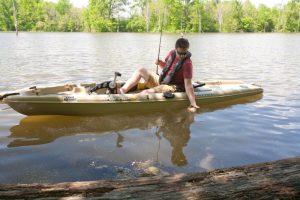
Photo: Kentucky Department Fish and Wildlife
A car, truck or sport utility vehicle with a couple of kayaks on the roof with fishing poles visible through the back window is an increasingly common sight on Kentucky highways.
Sales data shows kayak fishing and related kayak accessories increasing in popularity. Some of this popularity has to do with many baby boomers reaching retirement age and wanting a new hobby.
Price is another aspect of the rise in popularity of kayak fishing. They are a replacement for a fishing boat for many people scared off by the rising cost of power boats.
While many associate kayaks with flowing water, a huge number buy a kayak to fish small lakes, the backwaters of reservoirs, rivers and large farm ponds.
“If you want to fish mainly flatwater, the longer, the better for a kayak,” said Nathan Depenbrock, co-owner of Canoe Kentucky, an outfitter along the banks of famed Elkhorn Creek near Frankfort. “Length in a kayak gives you speed and tracking. By speed, we don’t mean miles per hour. Speed in a kayak how far you go without paddling. It is also called the glide.”
Length is relative to kayaks. Two feet of length makes a big difference in how the boat performs. “The ideal length for Kentucky is 12 to 13 feet,” Dependbrock, who’s paddled waters from Rio Grande River north to the Great Lakes, explained. “A major consideration is to buy a boat you can get to the water. Make sure it fits in the bed of your truck or on top of your vehicle. A kayak that is too heavy is no good because you won’t use it.”
As kayaks go longer than 14 feet, they also get narrower. “The long kayaks are designed for paddling long distances, not for stability,” Depenbrock said. “They can get squirrely at rest.”
This is why for fishing, the 12- to 13-foot long kayak makes the best choice. It is long enough for speed, but short enough for width and stability.
“I really would not go less than 11 feet long,” Depenbrock said. “Being in a boat of 10 or 11 feet is a really frustrating way to paddle on flatwater. They don’t perform well at all.”
He also prefers a sit-on-top or the relatively new hybrid kayaks for flatwater paddling and fishing. “Stay away from the sit in kayaks,” Depenbrock explained. “They are not meant to fish out of.”
Depenbrock also said anglers fishing lakes, rivers or reservoirs out of a kayak must keep in mind their low profile and short length makes a kayak hard to see.
“We blend in so much in kayaks, especially on our big lakes,” Depenbrock said. “Kayaks can get down in between waves and not be seen. Color is important. Make sure you have a safety flag, a bright paddle or even one of those bright safety vests so other boaters can see you. Always wear something bright.”
Practice getting back into your kayak from the water before launching. “On bigger lakes, it is really important,” Depenbrock said. “You have to be able to get back in the kayak if something happens and are far from the bank.”
Depenbrock enjoys flatwater kayaking on several spots in Kentucky. “Grayson Lake is one of my best places to paddle,” he said. “The scenery is unbelievable. A lot of the rock grottos and other really cool spots are only accessible by kayak.”
He also loves the Kentucky River. “Every pool in the Kentucky River has its own unique features,” Depenbrock said. “Everywhere on the Kentucky River is beautiful, but Pool 6 upstream to Pool 10 is some of the most spectacular scenery in Kentucky. The area in Pool 7 around Camp Nelson is unbelievable. The Kentucky River has a ton of access for paddlers to use as well.”
In fall, Depenbrock moves down river to Pool 2. “There is good wildlife in Pool 2,” he said. “We see bald eagles, coyotes, white-tailed deer, wild turkeys, waterfowl and other kinds of birds.”
Depenbrock is also exploring the forks of the Kentucky River. “The forks of the Kentucky are really looking good, especially the North Fork of the Kentucky River,” he said. “They are really improving. The cleanups are starting to show. I am going to enjoy exploring more of the forks in the coming years.”
No matter which of these scenic spots Depenbrock is paddling, he always wears his PFD (personal floatation device), commonly called a lifejacket. “No matter what time of year, I never paddle without my PFD,” he said.
Summer is a time of enjoying water sports. Keep these tips in mind if you plan to get a kayak to fish the many smaller state-owned lakes, reservoirs and rivers in Kentucky.

Photo: Kentucky Department Fish and Wildlife
Fast action by conservation officers with the Kentucky Department of Fish and Wildlife Resources saved the life of a volunteer who collapsed June 17 at a Northern Kentucky sporting event for children. An ambulance transported the victim to St. Elizabeth Hospital-Edgewood Campus for treatment.
“Everyone is proud of these officers,” said Kentucky Fish and Wildlife Commissioner Gregory Johnson. “Their training and quick response turned a potentially tragic situation into one of hope.”
The incident occurred Saturday morning during the annual Youthfest at Lloyd Wildlife Management Area (WMA) near Crittenden. Kentucky Fish and Wildlife Sgt. Scott Horn was assisting with the event when he saw a volunteer with the Boone County Bow Hunters Club collapse to the ground.
Horn summoned fellow department Sgt. Chris Fossitt, who radioed for an ambulance. Horn and Fossitt could detect no pulse on the victim. The two immediately began performing the chest compressions they learned as part of their professional training. Kentucky Fish and Wildlife Capt. Charles Phillips placed a CPR mask on the victim to assist with breathing.
The officers continued their CPR efforts 10-15 minutes. Phillips assisted with a defibrillator in an attempt to restart the victim’s heart, but it proved unsuccessful. The officers continued CPR efforts until the arrival of an ambulance. By this time, thanks to the continuous chest compressions applied by Horn and Fossitt, Phillips detected a pulse.
The victim, who is not being named due to federal privacy laws, is currently recovering at St. Elizabeth Hospital.
The Fifth District Federation of the League of Kentucky Sportsmen sponsors Youthfest. Fifth District Director Mike Coyle, who witnessed the events, credited the actions of the Kentucky Fish and Wildlife officers with saving the man’s life. “Without their superior training and quick action,” Coyle said, “I don’t believe the outcome would be the same.”
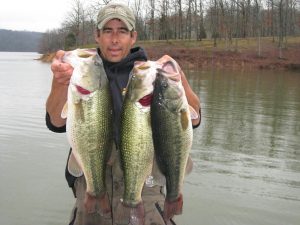
Photo: Kentucky Department Fish and Wildlife
June is one of the best months for outside activities such as fishing. However, many predator species, such as largemouth bass, have already completed their annual reproductive ritual and kind of sulk through June.
It can be a tough month for fishing in lakes and reservoirs, but two options will produce fishing that compares to the marvelous weather.
Largemouth bass in farm ponds:
June is a transitional month for largemouth bass in our larger lakes, but the confined nature of a farm pond ups the odds in the angler’s favor.
“You can catch largemouth bass all summer in a farm pond,” said Jeff Ross, assistant director of fisheries for the Kentucky Department of Fish and Wildlife Resources.
Successful summer largemouth bass fishing in farm ponds is all about timing and changing approaches as the day progresses. Wake up early enough that dew soaks your shoes as you walk to the pond.
Old school topwater lures such as the Hula Popper or a Jitterbug in the bullfrog color draw vicious strikes when slowly worked along the edge of vegetation in the low light of early morning.
As the sun rises, switch to fishing a weightless 7-inch ribbon-tailed worm in the junebug color. “Bass hold tight to cover during the middle of the day on a farm pond,” Ross said. “Fish the shady side of the pond if there is one.”
The weightless ribbon-tailed worm slowly falls through the cover attracting largemouth bass snuggled deeply in it. If the pond has no cover, fish the worm slowly along any weedlines or under any floating vegetation.
As day fades into night, the topwater bite again comes into play. Anglers also catch many farm pond bass in the dark on a 1/4-ounce black spinnerbait with a round Colorado blade.
Fish the spinnerbait just above bottom and let the Colorado blade thump. Hold on tight as largemouth bass often savage this presentation.
Channel catfish:
Channel catfish spawn in Kentucky mainly in June. “They are cavity spawners,” Ross said. “You often find them near riprap or chunk rock.”
Riprap consists of cantaloupe-sized rock used to protect the face of dams, bridge abutments and marinas from erosion caused by the pounding of waves. A 3/8-ounce slip-sinker rig with a 4/0 circle hook is a good choice for catfish when fished on or near riprap or areas of chunk rock lining the banks.
A slip-sinker rig consists of an 18-inch fluorocarbon or monofilament leader with the circle hook on one end. Tie the other end of the leader to a barrel swivel. After threading the main line coming from your rod through an egg sinker followed by a glass bead, tie the main line to the open loop of the barrel swivel.
A circle hook prevents gut hooking catfish. Resist the temptation to set the hook, simply reel in slack line until you feel the catfish swimming and keep your rod tip high. The catfish will hook itself in the side of the mouth with a circle hook.
“Hot dogs, shrimp, chicken liver or beef liver, channel catfish will eat practically anything,” Ross said. “I like chicken liver best for channels.”
Ross also said any cavity near a root wad or stump also holds channel catfish in June on our lakes and reservoirs.
The many creeks coursing through Kentucky hold surprising numbers of channel catfish. Those with rocky bottoms and water at least chest deep are best.
Undercut banks are key to finding channel catfish in streams. Use a slip-sinker rig with enough weight to hold it in place in current. Use a 3/0 circle hook with a piece of cleaning sponge impaled on it.
Drop the sponge into a tub of commercially made stink bait, also called dip bait, and push it to the bottom with a stick. Hold it there to soak up as much of the smelly dip bait as the sponge can hold and cast it to an undercut bank. The sponge emits a plume of funk downstream that channel catfish follow back to the sponge and eat it.
You can also use chicken livers, nightcrawlers or rancid cheese for this presentation, but the dip bait sponge is hard to beat in a stream. You will catch many 16- to 21-inch long channel catfish in streams, perfect size for a dinner. Channel catfish from a cool stream offer fantastic table fare.
June is a wonderful month weather wise, but a transition time as predator fish move into their summer locations. Farm pond largemouth bass and channel catfish provide excellent sport during this unpredictable month.
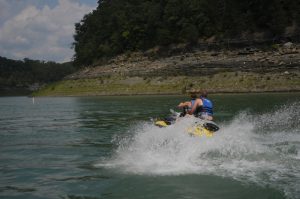
Photo: Kentucky Department Fish and Wildlife
Kentucky’s lakes and streams are bound to be crowded with anglers, paddlers and pleasure boaters during the upcoming Memorial Day holiday weekend.
Boating safety officials want everyone to have a safe and enjoyable experience on the water.
“On really busy holidays, the boat’s operator has to remain extremely attentive,” said Zac Campbell, boating education coordinator for the Kentucky Department of Fish and Wildlife Resources. “They need to go slower than they normally would, and they should be wearing a life jacket at all times, but especially while they are underway, day or night.”
Recreational boating statistics compiled annually by the U.S. Coast Guard show an overwhelming percentage of people who had been involved in boating accidents and drowned were not wearing a life jacket at the time.
Federal and state law require a Type I, II or III life jacket for each person on board a vessel. Anyone operating or riding on a personal watercraft must wear an approved life jacket. Children under 12 are required to wear an approved life jacket any time they’re in an open portion of a boat that’s underway. Boaters ages 12 and older aren’t required to wear a life jacket, but there should a readily accessible one for every person on board.
“If a person can’t swim, they really need to have a life jacket on at all times,” Campbell said. “People who are strong swimmers should try this test: dive in the lake then have someone throw them a vest. Now try to put it on – it’s difficult to do once you’re in the water.”
Operators should have passengers try on their life jackets beforehand to familiarize themselves with how they work and make any necessary adjustments.
A person must be 12 years or older to operate a motorboat or personal watercraft in Kentucky. To drive a motorboat or personal watercraft powered by a 10 horsepower or greater motor, children ages 12-17 years old will need either a Kentucky Safe Boating Certificate Card or a certificate showing successful completion of a National Association of State Boating Law Administrators (NASBLA)-approved boater education course.
A boater education course benefits novice and experienced boaters alike. Courses are offered in person around the state at no charge and online for a fee. Course schedules are posted on Kentucky Fish and Wildlife’s website at fw.ky.gov. Registration is required.
Visitors to the department’s boater education web page can find links to the online courses as well as a boating safety checklist.
Nobody wants to get to the launch ramp only to realize they forgot to renew their boat registration, or they don’t have enough life jackets or a throwable cushion, or they forgot to charge their boat batteries.
“For a lot of people, Memorial Day weekend is the first time their boat’s been on the water this year,” Campbell said. “Ideally, you should take your boat out on a smaller body of water to test everything out before the big weekend to make sure it’s mechanically sound.”
Either way, you will want to have your boat numbers and decals properly displayed. Slide the registration receipt into a sealable sandwich bag and stow it on board. If the boat has an engine, lantern, stove or other equipment fueled by a flammable liquid, you will need to have a fire extinguisher. A horn or a whistle is required for boats 16 feet or longer, but good to carry in smaller boats. Test the red, green and 360-degree white navigation lights to ensure they are in working order. One small thing that is easy to overlook is securing the boat’s plug. Always double check that it is in place before launching.
When lake and river levels are up, as they have been in recent weeks across Kentucky, boaters must also be on the lookout for floating debris and keep in mind that some hazards may be hidden just below the surface.
“The water might not be as clear when the water is up, so objects that aren’t normally submerged can be even harder to spot,” Campbell said. “The operator is in charge of everybody’s well-being on the boat, but a good operator will have a good spotter who can help identify any hazards.”
A log striking a lower unit can throw occupants overboard and capsize a boat. An ignition kill switch combined with wearing a life jacket can be a godsend in such an event.
Most boats are equipped with a flexible red cord or lanyard that attaches to the ignition or throttle and clips to the boat operator’s life jacket or is worn around the wrist. Should the operator be ejected from the boat, the kill switch trips and stops the engine. If your boat’s lanyard or cord is missing, replacements are available through retailers that sell boating equipment.
The Memorial Day holiday weekend revs up the summer boating season and is one of the busiest boating weekends of the year. Make it a safe one by preparing ahead of time and operating responsibly while on the water.
