Friday January 30, 2026
Local Connection
 Weather
 Traffic
 @LouisvilleDispatch
 @LouisvilleDisp
 Subscribe
 Jefferson County Attorney Mike O’Connell received The Center for Women and Families’ Public Service Award during the nonprofit’s annual report to the community Wednesday evening.
The award, presented by Kentuckiana’s domestic violence and rape crisis center, recognizes a public figure who has gone above and beyond to aid The Center’s mission.
“This is a real honor for me,” O’Connell said.
The award was first given in 1991 to Mary O’Doherty of The Courier-Journal. Since then, notable individuals receiving the award include Jerry Abramson, David Armstrong, Judi Patton, Anne Northrup and John Yarmuth.
O’Connell’s office has committed resources for a dedicated unit for domestic violence cases and was a founding partner in the city’s 24-hour Domestic Violence Intake Center (DVIC). In 2016, the office prosecuted nearly 4,000 cases domestic violence and sexual assault cases and earned more than a 90 percent conviction rate.
O’Connell also helped secure $150,000 in federal funding for staffing and support of the DVIC in 2016, three times as much federal funding as the DVIC had ever received in a single year.
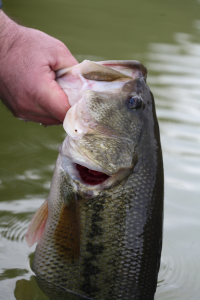
Photo: Kentucky Department Fish And Wildlife
The length of day relative to the time of year never changes. As the nights lengthen slightly with each passing day in fall, the overnight temperatures drop and pull heat from the top layers of lakes.
This development is already underway, but will peak over the next month and make excellent fishing conditions for black bass.
“The cooler, oxygenated water in the shallows draws baitfish and the bass follow to feed heavily,” said Jeff Ross, assistant director of fisheries for the Kentucky Department of Fish and Wildlife Resources. “The shorter days signal to bass that winter is coming and they must feed heavily in fall.”
The shallow movement of black bass, mainly largemouth bass, but a few spotted bass and even smallmouth on lakes that have them, presents the best bass fishing opportunities of the year for bank-bound anglers.
Water temperatures in Kentucky’s major reservoirs are in the mid-70s. When the temperatures drop into the 60s, bank anglers should hit the lower 1/3 of the main lake or major creek arm of our major reservoirs and the dam area of our smaller, state-owned lakes. You will have as good a chance at a 5-pound or better bass as someone with a bass boat that costs as much as many people’s homes.
Bank fishing, like wade fishing streams, returns anglers to a time when all they had was a small, one-tray tackle box and a Zebco 33 combo. You can concentrate on fishing, not fighting wind with a trolling motor or fiddling with a cranky sonar unit. You can bring one rod and one small tackle bag or box and have all you need.
Map study is paramount for finding productive spots to bank fish for bass in fall. Points with the old river or major creek channel running close to them are tops. Most of our major reservoirs have boat ramps and recreational areas in the lower areas of the main lake or a major creek arm that offer public bank access.
Our smaller, state-owned lakes have a 50-foot easement for the public to access the bank for fishing. Visit the Kentucky Fish and Wildlife website at www.fw.ky.gov and click on the “Find a Place To Fish” tab. Many of the state-owned lakes now have 5-foot contour maps and locations of fish attractors featured on this helpful web page.
“You can use a more active bait in fall, especially if you are fishing from the bank,” Ross said. “Crankbaits and spinnerbaits work well in fall. You don’t have to slow things down too much. When they are up shallow, they are pretty active.”
Medium-running crankbaits in shad-colors such as chrome and black work wonders as do white spinnerbaits with skirts of black, silver with touches of blue. “Keep moving and cover water,” Ross said. “You don’t have to be too fancy, just get the bait in front of the bass.”
You will catch mainly largemouth bass, but in the lower sections of lakes such as Lake Cumberland, Barren River Lake or Green River Lake that hold smallmouths, a marauding bronzeback may savage your lure, especially on overcast days. You may also pick up a football-shaped spotted bass. Spotted bass make excellent table fare. It generally benefits the black bass population in the lake if you harvest some spotted bass, one of the reasons they have no minimum size limit.
Boat ramps are another spot to catch bass, especially largemouths and spotted bass. Nearly all boat ramps have a gouge hole at the end of them from the blast of outboards scouring the bottom when trailering a boat. By mid-October, boat ramps get little action from boats, so working a crankbait over the gouge hole at the end of the ramp can produce fantastic action.
The riprap rock that armors the face of most reservoir dams also draws baitfish and bass in fall. “Dams hold those bass when they come shallow in fall and make really good fishing spots for bank anglers,” Ross said.
Crankbaits and spinnerbaits work well for fishing the dam riprap, but a large crappie minnow or small to medium shiner hooked through upper lip with a 1/0-circle hook and a couple of BB-sized split shot weights usually outfishes everything. Keep the outfit moving slowly to avoid hanging the split shot weights in the riprap. Bottom fishing live bait off channel points also works wonders in fall.
Fall is a delightful time to grab a rod, a small tackle bag and hit the bank. The weather is comfortable and the fish hungry.
 Attorney General Andy Beshear today announced his office secured $1.3 million for the state’s General Fund from a settlement against General Motors (GM) for violating Kentucky’s Consumer Protection Act.
The settlement, reached between the attorneys general of 49 states and the District of Columbia and GM, concludes a multistate investigation into the automaker concealing safety issues related to ignition switch defects in over 9 million GM vehicles in the U.S.
As part of the settlement, GM will pay fees to each state and district, as well as ensure all applicable recall repairs are complete.
“As the people’s lawyer, my office is working to protect Kentucky families and hold accountable companies that violate Kentucky’s consumer protection laws,” Beshear said. “The $1.3 million settlement announced today will provide much needed revenue to the state’s General Fund to help address any budget shortfall.”
The multistate investigation centered on GM’s 2014 seven-vehicle recall regarding defective ignition switches, which could move out of the run position to the accessory or off position.
If this occurs, the driver experiences a loss of electrical systems, including power steering and power brakes, and if a collision occurs at this time, the vehicle’s safety airbags may fail to deploy.
The states alleged, certain employees of the automaker knew as early as 2004 that the ignition switch posed a safety defect, yet GM personnel decided it was not a safety concern and delayed making recalls. GM also continued to market the reliability and safety of its motor vehicles that were equipped with the defective ignition switch.
Kentucky’s settlement with GM has been presented to Franklin Circuit Court.
Since taking office Beshear has secured penalties from three automakers, GM, Volkswagen and Hyundai-Kia, which has yielded more than $4.7 million for the General Fund.
Mayor Greg Fischer announced that, effective today , food take-out containers have been added to the list of items that Louisville residents can dispose of in their curbside recycling carts.
That includes packaging from burgers, chicken, pizza, tacos and other to-go containers as well as drink cups.
Metro Public Works is partnering with the Foodservice Packaging Institute to educate residents on the initiative. The FPI is providing the department with a grant of up to $10,000 to fund a recycling outreach campaign. The wider curbside recycling is available to over 84,000 households in the city’s Urban Service District served by Public Works.
QRS Recycling, Louisville’s recycling processor, has added the new items to the list of materials it already handles. Expanded recycling supports the goal established by Mayor Fischer to divert 90 percent of recyclable material from our landfill by the year 2042.
“This is another step in the long-term plan to create an even cleaner and more sustainable future for our city,” the Mayor said.
Residents are asked to empty all food and liquid containers before placing them in the recycling bin, though it’s not necessary to make the items perfectly clean.
“Louisville is the latest in a growing list of municipalities that are recycling food service packaging,” said Lynn Dyer, president of the Foodservice Packaging Institute, the industry’s leading trade association. “We are thankful to the city and QRS for their roles in enabling food service packaging to be recycled.”
In 2015 Louisville collected nearly 23 million pounds of recyclables that were sorted by QRS. To learn more and see a list of all acceptable curbside recyclables, log on to: www.Louisville.gov/recycling.
 The Kentucky Arts Council has awarded 19 grants to 12 Kentucky schools to fund student transportation to and from arts-related field trips for students through the popular TranspARTation Grant.
The TranspARTation Grant is awarded annually by the arts council. The program is now in its fourth year. Grants are based on the mileage from the school building to the arts organization or performance venue and the number of buses necessary.
Collins Lane Elementary School in Frankfort will use its TranspARTation grant to send all of its students to StageOne Family Theatre in Louisville for a production of “The Best Christmas Pageant Ever.”
Principal Jennifer Perkins said the staff and teachers want to make that field trip available to every student at Collins Lane, where 50 percent of the student body is on free or reduced lunch.
“We are given a limited amount of funds to pay for field trips each year, and it does not cover the amount of field trips we take over the course of the year,” Perkins said. “This grant helps fund this field trip by removing the transportation cost as a barrier to student participation.”
“We went to see ‘Click, Clack, Moo’ at StageOne last year, and to see the kids faces as they ride the buses together and sit in the audience together is amazing,” Perkins said. “A lot of our families can’t afford to do something like this on their own, and Collins Lane is a big proponent of building community in classrooms and the school. Being able to do this, and not have to worry about the cost of transportation, helps us accomplish that goal.”
Schools that received grants, listed by county, arts activity and amount awarded, are:
- Clarkson Elementary School, Grayson, “Dragons Love Tacos and Other Stories” at RiverPark Center, $544; “My Father’s Dragon” at RiverPark Center, $544; “Are You My Mother?” at RiverPark Center, $272; “The Nutcracker” at RiverPark Center, $544; “Pete the Cat” at RiverPark Center, $1,088; “Where in the World” at the Speed Art Museum, $552
- South Warren High School, Warren, Louisville Orchestra Coffee Concert, Kentucky Center for the Arts, $1,000
- Forest Heights Elementary School, Nelson, “American Tales” at StageOne Family Theatre, $516
- Bondurant Middle School, Franklin, “Where in the World” at the Speed Art Museum, $416
- Collins Lane Elementary School, Franklin, “The Best Christmas Pageant Ever” at StageOne Family Theatre, $2,448
- Southern Elementary School, Scott, Music Builds Discovery with the Canadian Brass at Singletary Center for the Arts, $112
- Kingston Elementary School, Madison, “Elephant and Piggie’s We Are In a Play” at Lexington Children’s Theatre, $328
- Toliver Elementary School, Boyle, “Where in the World” at the Speed Art Museum, $328; “Sacgawea: Discovering History” at Lexington Children’s Theatre, $188; “The Best Christmas Pageant Ever” at Lexington Children’s Theatre, $376
- Daniel Boone Elementary School, Madison, “The Legend of Sleepy Hollow” at Lexington Children’s Theatre, $240
- Russell County Middle School, Russell, “The Legend of Sleepy Hollow” at Lexington Children’s Theatre, $880
- Livingston County Middle School, Livingston, “Mr. Molecule’s Bing, Bang, Boom! Science Show” at The Carson Center, $728
- Brodhead Elementary School, Rockcastle, Arc Attach Science Arts Performance at the EKU Center for the Arts, $280
Any Kentucky public or private school that supports grades pre-K through 12 may apply for a TranspARTation Grant.
Schools receiving TranspARTation Grants must attend arts events presented by one of many preapproved TranspARTation organizations.
For more information about applying for a TranspARTation Grant, visit the TranspARTation webpage, or contact Jean St. John, arts council arts education director, at jean.stjohn@ky.gov or 502-892-3124.
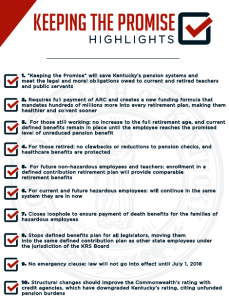 Gov. Matt Bevin, together with Senate President Robert Stivers and House Speaker Jeff Hoover, today unveiled “Keeping the Promise” — a comprehensive plan to save Kentucky’s ailing public pension systems.
“There is no such thing as an insurmountable obstacle,” said Gov. Bevin. “We, as a Commonwealth, have a moral and legal obligation to fulfill the promises that have been made to our public employees. This is not just about fixing our present underfunding problem. It is also about ensuring that we leave a better, financially stable Kentucky to our children.
“The right thing to do is rarely the easiest, but we are determined to address this crisis with the most fiscally responsible public pension reform plan in the history of the United States. I am confident that the rest of the country will pay close attention to this excellent work by our legislature and for good reason. For those retired, for those still working, and for those yet to come: we are truly fixing our broken pension systems. United we stand. Divided we fall.”
Highlights of the plan include:
- “Keeping the Promise” will save Kentucky’s pension systems and meet the legal and moral obligations owed to current and retired teachers and public servants
- Requires full payment of ARC and creates new funding formula that mandates hundreds of millions more into every retirement plan, making them healthier and solvent sooner
- For those still working: no increase to the full retirement age, and current defined benefits remain in place until the employee reaches the promised level of unreduced pension benefit
- For those retired: no clawbacks or reductions to pension checks, and healthcare benefits are protected
- For future non-hazardous employees and teachers: enrollment in a defined contribution retirement plan that will provide comparable retirement benefits
- For current and future hazardous employees: will continue in the same system they are in now
- Closes loophole to ensure payment of death benefits for the families of hazardous employees
- Stops defined benefits plan for all legislators, moving them into the same defined contribution plan as other state employees under the jurisdiction of the KRS Board
- No emergency clause: law will not go into effect until July 1, 2018
- Structural changes should improve the Commonwealth’s rating with credit agencies, which have downgraded Kentucky’s rating, citing unfunded pension burdens
Gov. Bevin will call the General Assembly into special session in the coming weeks to pass into law these much-needed reforms.
“Our state’s pension systems are among the worst-funded in the country,” said Senate President Stivers. “In order to move these systems forward along the path to solvency, bold action is required. The framework that we have in place for a pension reform bill is morally right, fiscally responsible, and legally defensible. I thank Governor Bevin, Speaker Hoover, and all my colleagues in the Legislature for their help and support throughout this process, and I look forward to hearing feedback from constituents and moving forward in the coming weeks.”
“Kentucky’s pension problem has been a long time in the making, and has only gotten worse by past leaders who failed to act, or even acknowledge, the issue,” said Speaker Jeff Hoover. “Unlike in the past, inaction is simply not an option. The New Majority is committed to address the pension problem by providing a strong foundation that results in long-term pension stability for public workers and teachers.”
The Commonwealth’s three major public pension systems — Kentucky Retirement Systems (KRS), Teachers’ Retirement System of Kentucky (TRS), and the Kentucky Judicial Form Retirement System (KJFRS) — collectively administer eight distinct retirement plans.
The state currently has an unfunded pension liability of at least $64 billion, ranking as the worst funded system in the nation. Using prior funding patterns, experts conclude that the Kentucky Employee Retirement System, Non-Hazardous (KERS-NH), will run completely out of money by the year 2022 if meaningful pension reform does not occur.
With $7 billion in negative cash flow over the past decade, Kentucky’s pension spending has been increasing nearly five times as fast as revenues. This effectively reduces funds available for other important budgetary priorities such as education, healthcare, public safety and transportation infrastructure.
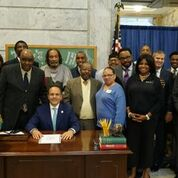 Gov. Matt Bevin, joined by legislators, education officials and community leaders, ceremonially signed House Bill 520 in the State Capitol Rotunda. Enacted during the regular session of the 2017 General Assembly, HB 520 enables the creation of public charter schools for the first time in the Commonwealth.
“We owe it to the generations yet to come to provide them with an equal opportunity for a quality education,” said Gov. Bevin. “I’m grateful to the men and women who are working to educate our young people; and the best and brightest among them are begging for some change to a bureaucratic system. We simply want to give choices to parents and to students — to give every child an opportunity. That’s what this bill is about.”
The legislation makes Kentucky the 44th state in the nation with charter schools, which are tuition-free, open enrollment public schools. While the Commonwealth’s charter schools will be granted greater flexibility and autonomy than traditional public schools, they will also experience greater performance accountability than traditional public schools.
“Charter schools in Kentucky mean more education opportunities for our youth who happen to live in low-performing districts,” said Rep. Bam Carney, the chief sponsor of the charter school bill. “Every single student deserves the best shot at a quality education that will prepare them for a lifetime, and I’m proud to have had the opportunity to support this important measure. Kentucky’s students are bright, and with an education to match, the entire Commonwealth’s future will shine.”
HB 520 outlines how charter schools — termed achievement academies — are to be authorized: by local boards of education or by the mayors of Louisville and Lexington. If a charter school application is denied, it can then go through an appeals process with the Kentucky Board of Education (KBE).
Since the bill was passed in March, regulations have been promulgated on student applications, charter applications, appeals to the authorizer accountability, the process for converting existing public schools into public charter schools, and appeals to KBE.
“Across the country, specialized forms of education are accelerating learning for children who are often the hardest to reach in a traditional school framework,” said Hal Heiner, Secretary of the Kentucky Education and Workforce Development Cabinet. “I applaud Kentucky’s legislature for passing House Bill 520, a monumental step in providing parents a different, innovative choice in public education for the specific learning needs of their child.”
According to HB 520, public charter schools are required to participate in the state assessment and accountability system, and required to meet the academic performance standards agreed upon in their charters. Charter schools that fail to meet of make significant progress toward meeting those standards would be closed by their board authorizers.