Thursday January 22, 2026
Local Connection
 Weather
 Traffic
 @LouisvilleDispatch
 @LouisvilleDisp
 Subscribe
 Attorney General Andy Beshear said a cyber-tip from Facebook led his office to arrest a 25-year-old Dry Ridge man for allegedly exchanging sexual images with a Kentucky minor over the Facebook Messenger app.
On Oct. 8, Tyler Lee Day was arrested by Beshear’s Department of Criminal Investigations, Cyber Crimes Unit. Day was charged with 12 counts of use of a minor under 16 in a sexual performance, Class B felonies; two counts of the prohibited use of a communications system to procure a minor for a sex offense, Class D felonies; and two counts of distribution of obscene matter to a minor, Class A misdemeanors.
The arrest stems from a cyber-tip reported by Facebook to the National Center for Missing and Exploited Children (NCMEC), which was received by Beshear’s office and investigated for seven weeks.
Detectives from Beshear’s office submitted multiple subpoenas and search warrants during the investigation, which led to the discovery that Day had sent sexual images of himself, requested sexual images of children and, in some cases, received images from children.
More than 15 children from multiple states were targeted by Day.
“Make no mistake, the internet is a treacherous place for our children and nearly every online platform or app can be exploited by sexual predators,” Beshear said. “We all have a moral and legal duty to report child abuse, and once my office receives a report we work with local, state and federal partners to ensure child predators are caught quickly and that our children are safe.”
An extensive search by Beshear’s detectives led to a Dry Ridge location where Day was taken into custody. He is currently being held in the Carroll County Jail, and a preliminary hearing is scheduled for Oct. 16 in Gallatin District Court.
The Williamstown Police and Grant County Sheriff’s Office assisted the Cyber Crimes Unit.
When it comes to identifying child predators, Beshear’s office has reached historic levels with more arrests than ever before.
The Cyber Crimes Unit is part of the Kentucky Internet Crimes Against Children Task Force, which works to reduce the number of child predators going after Kentucky’s most vulnerable children.
With the ever-changing cyber landscape, the unit is dedicated to educating its detectives on the most current techniques and technologies to keep pace with those seeking to harm our children.
The Office of the Attorney General also makes it a priority to educate law enforcement, prosecutors, parents, children and care givers on the dangers lurking on the internet.
To help keep children safe online, the office has collaborated with Prevent Child Abuse Kentucky to offer statewide trainings.
Beshear said the trainings offer a free Internet Safety Toolkit, which he said every Kentuckian could access online to obtain information that can protect children from cyber bullying to online predators.
To report any instance of child abuse to local law enforcement or to Kentucky’s Child Abuse hotline at 877-597-2331 or 877-KYSAFE1.
Attorney General Andy Beshear is calling on federal regulators to allow telephone service providers to block more illegal robocalls being made to Kentuckians.
Beshear and more than 30 state attorneys general detail in their letter that scammers have devised methods to evade a call blocking order issued by the Federal Communications Commission last year.
Beshear said at issue is “neighborhood spoofing,” a technique allowing scammers – no matter where they are located – to appear on Kentuckians’ caller ID as being from a phone number that has the same local area code – 270, 502, 606 or 859.
“Protecting Kentuckians from the constant barrage of unwanted scams and robocalls is an ongoing priority of my office,” Beshear said. “We must strengthen the protections to our citizens when scammers strengthen their ploys to deceive them.”
In 2017, the Federal Trade Commission received 4.5 million illegal robocall complaints – two and a half times more than in 2014.
Beshear said his Office of Consumer Protection receives more than a thousand complaints each year with respect to illegal calls, including scam calls, telemarketing complaints and robocalls.
Beshear encourages Kentuckians to use the National Do Not Call Registry provided by the FCC.
Beshear and his office are fighting to stop con artists and are asking Kentuckians to report scams and identity theft via his office’s online form.
Earlier this year, Beshear announced nearly 2,200 Kentucky small businesses would get money back from a Michigan-based company that allegedly sold scam services.
Beshear recommends all Kentuckians stay ahead of scammers by signing up for his office’s Scam Alerts. To enroll text the words KYOAG Scam to GOV-311 (468-311) or online at ag.ky.gov/scams and select text message or email alert.
 District Court judges from across the state participated in sessions on Casey’s Law, guardianship cases, cultural competency and more Sept. 16-19 at the 2018 District Judges College in Lexington. The Education Committee of the Kentucky District Judges Association and the Office of Judicial Branch Education at the Administrative Office of the Courts developed the college.
“The educational programs help judges enhance their legal knowledge and administrative skills, with the resulting public benefit of competent and fair administration of justice,” said District Court Judge John M. McCarty, president of the Kentucky District Judges Association. “The judges also got to spend some quality time with each other. Our annual colleges are a great opportunity to come together and discuss insights and shared challenges.”
Judge McCarty serves as a district judge for Butler, Edmonson, Hancock and Ohio counties, and is temporarily serving as a Family Court judge for Daviess County.
In the session on Casey’s Law, judges heard from people who said they benefited from the involuntary commitment law, which allows parents and others to petition courts for treatment on behalf of the person with a substance use disorder. The legislation is named for Casey Wethington of Northern Kentucky, who died from a heroin overdose in 2002. Guest speakers were Casey’s mother, Charlotte Wethington, who initiated the law and is a recovery advocate, and Wayne Crabtree, recently retired director of the Office of Addiction Services for the Louisville Metro Department of Public Health and Wellness. Judges led a discussion on addiction, treatment and court intervention during the session.
The session on guardianship covered House Bill 5, a law the 2018 General Assembly passed that aims to address the growing number of vulnerable elderly and disabled people who become wards of the state. Under the legislation, judges must determine exceptional circumstances before appointing the state, rather than a family member, as guardian.
Pastor Edward Palmer, a certified diversity trainer, presented on cultural competency, which involves understanding differences in culture and interacting with people of other cultures effectively. The session also focused on racial disparity in the juvenile justice and child welfare systems, where black youths are overrepresented in areas such as diversion overrides, meaning they are not allowed to participate in diversion after committing an offense and instead are sentenced in court.
The college also covered pretrial release, court designated workers and juvenile case processing, domestic violence, ethics and new case law.
Judges had a special opportunity to hear from the justices of the Supreme Court of Kentucky in a panel discussion.
The college included 17 hours of continuing judicial education credit for the district judges.
 The Kentucky Agricultural Finance Corp. (KAFC) approved $1,803,438 in agricultural loans for projects in the Commonwealth at its board meeting today.
Agricultural Infrastructure Loan Program (AILP)
- One Agricultural Infrastructure loan was approved for a recipients in Taylor ($150,000) county. KAFC participates with lenders to provide financing to producers making capital expenditures for agricultural projects through the AILP. Eligible projects include permanent farm structures with attached equipment that improves the profitability of farming operations. Producers with documented tobacco history may be eligible for up to $150,000 not to exceed 50 percent of the project.
Beginning Farmer Loan Program (BFLP)
- Eleven Beginning Farmer loans totaled $1,653,438 for recipients in Ballard ($123,750), Bourbon ($67,688), Clark ($150,000), Graves ($250,000), Green ($250,000), Henry ($117,500), Madison ($112,000), McLean ($267,500), Muhlenberg ($250,000) and Washington ($65,000) counties. BFLP is designed to assist individuals with some farming experience who desire to develop, expand or buy into a farming operation. Beginning farmers may qualify for financing to purchase livestock, equipment or agriculture facilities; to secure permanent working capital; for the purchase of farm real estate; or to invest in a partnership or LLC.
For more information on the programs offered by the KAFC, contact Sadie Middleton, Loan Programs Manager, at (502) 782-1757, sadier.middleton@ky.gov or visit the KAFC webpage at kafc.ky.gov.
 Helping transit employees identify and report human trafficking when they encounter it on the streets of the Greater Louisville area is the goal of a new training effort announced Thursday by Attorney General Andy Beshear.
At Union Station, Beshear and J. Barry Barker, the Transit Authority of River City (TARC) executive director, rolled out human trafficking awareness training and reporting protocols that focus on the specific needs of nearly 400 TARC managers, dispatchers and bus drivers.
Beshear said trafficking occurs in countless locations in every community in this state, including at bus terminals where traffickers try to recruit victims and on busses where victims are transported.
“TARC employees are among those who serve as the eyes and ears of our community, and this training will help ensure they are in a better position to spot potential human trafficking situations and safely assist victims,” Beshear said. “Our partnership with TARC presents a momentous opportunity to confront human trafficking throughout Greater Louisville.”
Beshear said TARC will be a strong partner to help fight one of the nation’s fasting growing crimes because it has more than 15 million customers on 41 routes in five counties in Kentucky and southern Indiana.
“TARC is proud to partner with the Attorney General to bring awareness to and support their efforts in leading the fight against human trafficking,” Barker said. “As an agency that interacts with the public every day, the training provided by the Attorney General’s office positions us to be of great service in recognizing and reporting signs of trafficking in our region.”
Beshear’s Office of Child Abuse and Human Trafficking Prevention and Prosecution is prepared to train TARC employees beginning Oct. 29.
The training includes guidance on the signs of human trafficking, questions to ask suspected victims and reporting protocols. Awareness signage, including window clings for over 200 buses, a wallet card for each driver and brochures will be distributed at the training thanks to Truckers Against Trafficking (TAT) Busing on the Lookout program.
Beshear said he is thankful for the support of Truckers Against Trafficking, an organization that his office worked with to train Kentucky commercial drivers and truck-stop employees on how to recognize and report human trafficking.
Beshear also recognized Maryhurst on Thursday, a nonprofit agency that helps survivors of abuse and young women who are vulnerable to human trafficking, for hosting human trafficking training for their staff and leadership.
“Even though trafficking can be difficult to see, there are clear warning signs that anyone can spot with the right training,” said Judy Lambeth, president and chief executive officer of Maryhurst. “The girls who come to us have terribly upsetting stories full of pain and trauma, most often inflicted in secret. We’re supportive of the TARC program because it will empower our system to better expose – and ultimately remedy – situations where trafficking is common.”
Other public and private agencies including all Kentucky Transportation Cabinet highway incident safety professionals, the Kentucky Baptist Convention, hotel and hospitality industry employees, firefighters, EMTs and paramedics have joined Beshear’s fight against trafficking, allowing the office to train more than 5,000 individuals statewide.
Thursday’s announcement is the latest in a string of moves Beshear has taken to turn his office into the leading state agency fighting human trafficking – a crime that often targets children for sex or labor services.
Upon taking office in 2016, Beshear teamed up with Catholic Charities of Louisville to secure a three-year, $1.5 million federal grant to help train law enforcement, increase victim services and hire the state’s first full-time human trafficking investigator.
Beshear’s office currently has 15 open human trafficking cases, and over the course of 2018 the office has been involved in 31 arrests or citations involving the crime. In February, the office secured a 20-year sentence against former Campbell County District Judge Timothy Nolan on numerous felony charges, including human trafficking of adults and minors.
Last month, Beshear joined Rep. Dennis Keene, of Wilder, to announce legislation that would grant the Office of the Attorney General the ability to investigate crimes, like human trafficking that can occur across multiple jurisdictions.
If a human trafficking victim is in immediate danger dial 911 and report suspected human trafficking of a child to 877-KYSAFE1. Victims of human trafficking may call or text the National Human Trafficking Hotline at 888-373-7888.
 Kevin Moore was named as the new General Manager of the Kentucky Exposition Center today. The Kentucky Exposition Center and the Kentucky International Convention Center are managed by Kentucky Venues, which is the organizational brand of the Kentucky State Fair Board.
Moore most recently served as the Chief Financial Officer of Kentucky Venues and has been with the organization since 2013. Prior to working at Kentucky Venues, Moore worked in various financial roles with Louisville Metro Government for 13 years. His experience includes executive management, project oversight, strategic planning, and facility operations. Moore lives in Simpsonville with his wife and two daughters.
“Moore’s management experience, integrity, and vision for the property are exactly what the Expo Center needs as we look toward the future,” said David S. Beck, President and CEO of Kentucky Venues. “Under his leadership, we have tremendous opportunities to position the facility for new growth.”
As General Manager, Moore will be responsible for day-to-day operations of the Expo Center.
In 2017, the Kentucky Exposition Center generated approximately $227 million in economic impact, hosted 225 events, and welcomed over 2 million visitors.
Visit www.kyvenues.com for more information about spaces and events at Kentucky Venues.
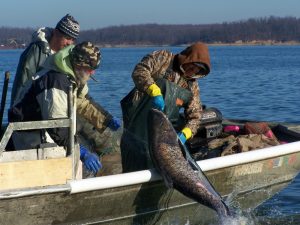 Gov. Matt Bevin today announced the award of the state’s first-ever fish house contract, in an innovative step to attack the Asian carp problem in western Kentucky and encourage job growth in the region. Bevin announced that Kentucky Fish Center, LLC of Wickliffe, Ky. has won the contract to establish the fish house, which will expand the market for Kentucky-caught Asian carp.
Angie Yu, operator of Two Rivers Fishery, a fish processing company also based in Wickliffe, will own and operate the Kentucky Fish Center. Asian carp caught in Kentucky will be sold by Kentucky Fish Center in daily auctions open to all interested buyers. The Kentucky Department of Fish and Wildlife Resources will oversee the auctions.
“The Tourism, Arts and Heritage Cabinet has worked tirelessly to develop a workable solution for mitigating Asian carp,” said Gov. Bevin. “Today’s announcement is a great example of government partnering with the private sector to create a commonsense, market-based solution. It will provide commercial anglers with new opportunities, while also removing this invasive species from Kentucky’s waterways.”
By buying carp caught in Kentucky waters at a guaranteed price of 19 cents per pound, and selling the fish to both domestic and international users in daily auctions, the fish house will play a key role in growing the market for Kentucky carp.
The Kentucky Department of Fish and Wildlife Resources is pledging up to $4 million in loans and incentives for the fish house and commercial fishermen. The department will pay commercial anglers an incentive of 5 cents per pound for their catch, supplementing the fish house’s guaranteed 14 cents per pound purchase price, to make fishing for carp in Kentucky’s waters economically attractive.
“Commercial anglers currently harvest two million pounds of Asian carp from Kentucky’s waters each year,” said Ron Brooks, Kentucky Fish and Wildlife’s fisheries director. “We believe this program can increase that catch to 20 million pounds across the state within the next five years.”
Asian carp first came to the United States to help control aquatic weeds and algae blooms in fish farms. By the 1980s, three species of Asian carp had escaped into the wild during floods. They have now spread throughout lengthy portions of the Mississippi, Ohio, Missouri and Illinois rivers. They have established significant populations in Kentucky and Barkley lakes.
Asian carp include bighead, silver, grass and black carp. They are prolific breeders. A single large Asian carp may produce up to a million eggs yearly. An Asian carp can consume 5 to 40 percent of its body weight each day. Bighead and silver carp feed voraciously on the same plankton that young sport fish such as crappie depend upon for their survival. Silver carp also jump from the water upon hearing the approach of a motor, creating hazards for boaters.
Commercial angling is the only practical method for limiting and reducing Asian carp numbers. Currently, only a handful of commercial anglers operate on Kentucky and Barkley lakes.
The incentives offered under the new distribution center contract will guarantee anglers a buyer and a nearby place to offload their catch. Brooks said the arrangement should lure more commercial anglers to Kentucky and Barkley lakes.
“We believe this will increase the amount of Asian carp coming out of those lakes to five million pounds per year,” Brooks said. “A sustained harvest of this amount will significantly reduce the impact of Asian carp on these nationally-recognized crappie lakes.”
The program includes a $734,000 secured loan for fixed assets to assist with the start-up of the fish house. Performance-based incentives of $570,000 to $700,000 a year will be awarded if the escalating yearly harvest goals of 5 to 20 million pounds of fish are met. The secured loan would be forgiven in 2024 if the 20 million pound goal is met that year. The program will be fully funded by boat registration fees.
Department officials estimate the effort would cost $3.5 million a year if it were run entirely by the state and would produce a harvest far less than the 20 million pound goal of the partnership announced today.
