Thursday January 22, 2026
Local Connection
 Weather
 Traffic
 @LouisvilleDispatch
 @LouisvilleDisp
 Subscribe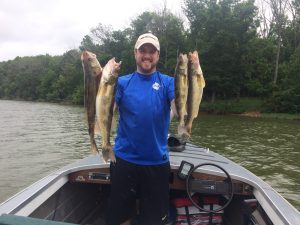
Photo: Kentucky Department Fish and Wildlife
With every passing season, anglers are building their knowledge base about how to catch saugeye stocked in a handful of central and northern Kentucky lakes.
A saugeye is a fast-growing cross between a walleye and sauger that can reach 15 to 19 inches in its second year. The hybridization is evident in the species’ physical appearance. Saugeye display the faint saddle markings of a sauger and the white fin tips of a walleye. Unlike either, it features black smudges on its dorsal fin.
Three lakes – 317-acre Guist Creek Lake in Shelby County, 148-acre Bullock Pen Lake in Owen County and 175-acre A.J. Jolly Lake in Campbell County – received experimental stockings of the species in 2013 and five have been stocked this year by the Kentucky Department of Fish and Wildlife Resources.
Guist Creek Lake received more than 15,000 fingerlings this spring. Anglers have reported good success in recent weeks fishing jigs off mud flats in 4 to 10 feet of water.
Paul Wilkes and Dane Balsman had never tried fishing for saugeye before they visited Guist Creek Lake one day in late June. They spoke with other anglers and studied bottom contour maps available on Kentucky Fish and Wildlife’s website at fw.ky.gov beforehand.
“We were able to identify some flats that we wanted to hit and then went out and graphed some baitfish near the drop-offs of those flats,” said Wilkes, fisheries program coordinator with Kentucky Fish and Wildlife. “We went out there with a mindset of if we caught one or two we were going to be pumped because this was a new species for us.”
The two reeled in 11 saugeye, including one that weighed 4.5 pounds and two others that weighed better than 3 pounds.
“We went out there and tried it and tried a few different drop-offs we mapped,” Wilkes said. “We stuck to the basics of jigging slowly in the areas we had identified. Strikes were kind of a thud, where you almost thought you were hung up until you really pulled it in. Once we found the fish, it seemed like they were in small schools. You’d catch several.”
Minnow or worm-tipped jigs or small shad-imitating crankbaits are good options for saugeye, as are small suspending jerkbaits or swimbaits in grey and white. Wilkes and Balsman, urban fisheries program coordinator with Kentucky Fish and Wildlife, found bladed jig heads with chartreuse bodies worked best for them.
Mike Hardin enjoyed similarly good fortune on Guist Creek Lake this spring fishing a little deeper in 8 to 10 feet of water.
“If you look at the fishing reports from saugeye lakes in Kentucky and Ohio, you see a lot of reports of anglers finding them in shallow water on crankbaits,” said Hardin, assistant Fisheries Division director with Kentucky Fish and Wildlife. “For a long time, I looked and looked and fished extremely shallow water jigging and picking up the occasional saugeye.
“We pulled off the bank and found wads of baitfish in 8- to 10-feet of water and it was game on. Fish close to the bottom, just like walleye fishing.”
He’s also had caught saugeye on Taylorsville Lake. Fisheries biologists believe good saugeye fishing could be in the cards this fall on Salt River above Taylorsville Lake based on population sampling from last fall.
“It seemed like there was definitely a push up there in the river. There’s going to be crappie and saugeye and bass, a little bit of everything,” said David Baker, Central Fisheries District biologist with Kentucky Fish and Wildlife. “Honestly, I think we’re going to be getting a lot of phone calls about saugeye in Taylorsville here in the next year or two.”
This year, the Kentucky Department of Fish and Wildlife Resources stocked more than 150,000 fingerlings in five lakes with Taylorsville Lake receiving more than 115,000 saugeye fingerlings.
Also receiving saugeye fingerlings were Guist Creek Lake, 92-acre Boltz Lake in Grant County and A.J. Jolly Lake in Campbell County. Lake Carnico, a 114-acre lake in Nicholas County, received its first saugeye stocking this year.
“It was a ton of fun and we were able to get on some really nice fish,” Wilkes said. “It definitely exceeded our expectations.”
For more information about saugeye fishing in Kentucky, including special regulations, consult the current Kentucky Fishing and Boating Guide. It is available online at fw.ky.gov and wherever licenses are sold.
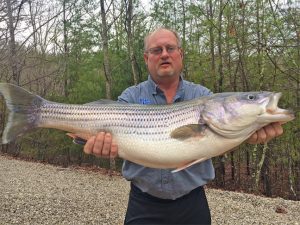
Photo: Kentucky Department Fish and Wildlife
Few things in the outdoors in Kentucky can top being on Lake Cumberland at daybreak on a summer morning, watching a planer board or large bobber disappear, followed by the sound of a slipping drag.
Striped bass pull like no other fish in Kentucky and landing a 22-inch or longer keeper brings a rush of adrenaline that gives you the shakes. Now in the fourth year of normal water levels since the drawdown to repair Wolf Creek Dam, the striped bass in Lake Cumberland are well on the way to returning to the glory days.
“The striped bass in Lake Cumberland are doing great,” said John Williams, Southeastern Fisheries District biologist for the Kentucky Department of Fish and Wildlife Resources. “There are multiple year classes in the lake with many keepers over 22 inches. We are getting more fish over 30 inches. Their body condition is fantastic.”
Although striped bass are in good numbers in Lake Cumberland, the spring fishing proved frustrating in the lake this year.
“Some guides had a hard time this spring finding fish, but now they are on fish, they found them,” Williams said. “Because we had so much rain this year and they released so much water from the lake, it spread the fish throughout the water column. This leads to spotty fishing.”
Williams said a recent temperature profile of the lake shows a gradual temperature change through the depths. “There is only a 10 degree temperature drop from 20 feet deep to 60 feet deep,” he said. “The water temperature is 70 degrees at 20 feet and 60 degrees at 60 feet deep. They have a wide range of the water column that changes only a few degrees. Usually, the temperature changes are much more abrupt as you descend in the water column in summer. They have 40 feet of depth to roam now.”
Anglers fishing live bait in the middle of this range are catching stripers. “I had my first ever triple on my boat this last weekend,” said Joe McWilliams, an avid striped bass angler who has a vacation home on the lake. “I’ve been fishing about 40 to 50 feet deep.”
McWilliams uses an old school method to judge his depth. “My rods are 7 feet long, so I do 7 pulls of line the length of the rod to get my depth right now,” he said. “In summer, I usually put two rods out at 10 to 15 feet, two more out from 28 to 35 feet and then two more out at 42 to 48 feet or so and adjust until I find fish.” McWilliams typically fishes the mid-lake region from Harmon Creek up to Fall Creek.
He employs three planer boards on each side of his boat with two large bobber rigs drifting off the back, all rigged with live threadfin shad or alewives on 3/0 circle hooks. A light drag helps keep the marauding stripers from snapping off the 20-pound leaders McWilliams uses.
A remote controlled trolling motor helps McWilliams slowly troll the bait he gathers in the pre-dawn via a casting net and a green light mounted under his boat slip. “I check my lines every 20 to 25 minutes or so,” McWilliams said. “I want fresh, lively bait on at all times.”
The river channel is key to finding the schools of baitfish stripers rip through with abandon. “The baitfish in summer seem to relate to the old Cumberland River channel,” Williams, the biologist, said. “The stripers will be close to the baitfish.”
A good sonar unit helps locate these schools. It is common in summer on Cumberland to see small scattered blobs of bait suspended over flats adjacent to the old river channel. However, once the boat cruises over the drop down into the river channel, the screen often fills with large blobs of bait. Study the depth of the blobs and start fishing.
“Modern sonar units are so good at finding schools of baitfish,” Williams said. “They really help narrow down where to fish.”
You do not have to troll to catch striped bass in summer. Once you find the baitfish, cast 1/2-ounce white and light blue doll flies down the points nearest the bait. Some anglers use downriggers to deep troll large white doll flies with a white or chartreuse curly tailed grub as a trailer.
No matter the technique employed, the early bird gets the worm for summer striped bass fishing. “You have to be out there early at this time of year,” Williams said. “You need to have your bait in the water before the sun rises. The bite is usually done by 9 a.m. or so.”
Lake Cumberland striped bass are under a 22-inch minimum size limit and a 2-fish daily creel limit. “Keep your keeper-sized fish and quit fishing when you reach your two fish daily limit,” Williams said. “Striped bass don’t release well anyway, but when you are pulling them out of deep water the pressure and temperature change really stresses them in summer.”
If you want a thrill like no other, get on Lake Cumberland this summer and hear your drag sing from a strong striped bass pulling with all its might.

Photo: Louisville Metro Parks and Recreation
Metro Parks & Recreation is offering an affordable family golfing package at its nine golf courses on Tuesday, July 4.
For only $25, a family of up to four members can play nine holes at any Metro Parks course. The $25 includes greens and cart fees, and families can take advantage of the deal after 4:30 p.m. on July 4.
Families are encouraged to call in advance to book a tee time at the golf course of their choice.
“Our courses are in great shape, and we’re hoping for a lot of play from families this summer,” said Metro Parks and Recreation Director Seve Ghose. “This special leaves plenty of room to play nine holes and enjoy a family barbecue and even fireworks at night.”
Metro Parks golf courses are open from daylight to dark seven days a week.
ABOUT METRO PARKS GOLF:
Louisville’s nine public golf courses offer a quality golfing experience at some of the most affordable prices in the nation. Each course has its own unique character, and some consistently rank among Kentucky’s best and most challenging courses. The nine municipally-owned golf courses meet the needs of everyone from beginners to scratch golfers. For more information, visit https://louisvilleky.gov/government/parks/golf-courses
Bobby Nichols Golf Course, 4301 E. Pages Lane, 502/937-9051 (9 holes)
Charlie Vettiner Golf Course, 10207 Mary Dell Lane, 502/267-9958 (18 holes)
Cherokee Golf Course, 2501 Alexander Road, 502/458-9450 (9 holes)
Crescent Hill Golf Course, 3110 Brownsboro Road, 502/896-9193 (9 holes)
Iroquois Golf Course, 1501 Rundill Road, 502/363-9520 (18 holes)
Long Run Golf Course, 1605 Flat Rock Road, 502/245-9015 (18 holes)
Seneca Golf Course, 2300 Pee Wee Reese Blvd, 502/458-9298 (18 holes)
Shawnee Golf Course, 460 Northwestern Parkway, 502/776-9389 (18 holes)
Sun Valley Golf Course, 6505 Bethany Lane, 502/937-9228 (18 holes)
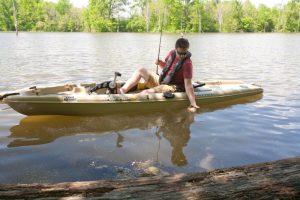
Photo: Kentucky Department Fish and Wildlife
A car, truck or sport utility vehicle with a couple of kayaks on the roof with fishing poles visible through the back window is an increasingly common sight on Kentucky highways.
Sales data shows kayak fishing and related kayak accessories increasing in popularity. Some of this popularity has to do with many baby boomers reaching retirement age and wanting a new hobby.
Price is another aspect of the rise in popularity of kayak fishing. They are a replacement for a fishing boat for many people scared off by the rising cost of power boats.
While many associate kayaks with flowing water, a huge number buy a kayak to fish small lakes, the backwaters of reservoirs, rivers and large farm ponds.
“If you want to fish mainly flatwater, the longer, the better for a kayak,” said Nathan Depenbrock, co-owner of Canoe Kentucky, an outfitter along the banks of famed Elkhorn Creek near Frankfort. “Length in a kayak gives you speed and tracking. By speed, we don’t mean miles per hour. Speed in a kayak how far you go without paddling. It is also called the glide.”
Length is relative to kayaks. Two feet of length makes a big difference in how the boat performs. “The ideal length for Kentucky is 12 to 13 feet,” Dependbrock, who’s paddled waters from Rio Grande River north to the Great Lakes, explained. “A major consideration is to buy a boat you can get to the water. Make sure it fits in the bed of your truck or on top of your vehicle. A kayak that is too heavy is no good because you won’t use it.”
As kayaks go longer than 14 feet, they also get narrower. “The long kayaks are designed for paddling long distances, not for stability,” Depenbrock said. “They can get squirrely at rest.”
This is why for fishing, the 12- to 13-foot long kayak makes the best choice. It is long enough for speed, but short enough for width and stability.
“I really would not go less than 11 feet long,” Depenbrock said. “Being in a boat of 10 or 11 feet is a really frustrating way to paddle on flatwater. They don’t perform well at all.”
He also prefers a sit-on-top or the relatively new hybrid kayaks for flatwater paddling and fishing. “Stay away from the sit in kayaks,” Depenbrock explained. “They are not meant to fish out of.”
Depenbrock also said anglers fishing lakes, rivers or reservoirs out of a kayak must keep in mind their low profile and short length makes a kayak hard to see.
“We blend in so much in kayaks, especially on our big lakes,” Depenbrock said. “Kayaks can get down in between waves and not be seen. Color is important. Make sure you have a safety flag, a bright paddle or even one of those bright safety vests so other boaters can see you. Always wear something bright.”
Practice getting back into your kayak from the water before launching. “On bigger lakes, it is really important,” Depenbrock said. “You have to be able to get back in the kayak if something happens and are far from the bank.”
Depenbrock enjoys flatwater kayaking on several spots in Kentucky. “Grayson Lake is one of my best places to paddle,” he said. “The scenery is unbelievable. A lot of the rock grottos and other really cool spots are only accessible by kayak.”
He also loves the Kentucky River. “Every pool in the Kentucky River has its own unique features,” Depenbrock said. “Everywhere on the Kentucky River is beautiful, but Pool 6 upstream to Pool 10 is some of the most spectacular scenery in Kentucky. The area in Pool 7 around Camp Nelson is unbelievable. The Kentucky River has a ton of access for paddlers to use as well.”
In fall, Depenbrock moves down river to Pool 2. “There is good wildlife in Pool 2,” he said. “We see bald eagles, coyotes, white-tailed deer, wild turkeys, waterfowl and other kinds of birds.”
Depenbrock is also exploring the forks of the Kentucky River. “The forks of the Kentucky are really looking good, especially the North Fork of the Kentucky River,” he said. “They are really improving. The cleanups are starting to show. I am going to enjoy exploring more of the forks in the coming years.”
No matter which of these scenic spots Depenbrock is paddling, he always wears his PFD (personal floatation device), commonly called a lifejacket. “No matter what time of year, I never paddle without my PFD,” he said.
Summer is a time of enjoying water sports. Keep these tips in mind if you plan to get a kayak to fish the many smaller state-owned lakes, reservoirs and rivers in Kentucky.

Photo: Churchill Downs Inc.
Churchill Downs Incorporated has announced it is investing approximately $60 million to construct a state-of-the-art historical racing machine (“HRM”) facility in Louisville. The 85,000-square-foot facility will be built at 4520 Poplar Level Road—Churchill Downs’ former Trackside (also known as the former Sports Spectrum) site, and conveniently located less than half a mile from the Poplar Level Road exit off the Henry Watterson Expressway (I-264). CDI’s request to offer exotic wagering on historical racing was conditionally approved by the Kentucky Horse Racing Commission this afternoon.
“With a state-of-the-art facility and new, innovative historical racing machines, we will deliver an exciting and compelling product for our customers in Louisville. This is a great opportunity for us to revitalize another area of our city while strengthening the Commonwealth’s equine industry through larger purses and greater incentives for Kentucky breeders and owners,” Churchill Downs Race Track president Kevin Flannery said. “Stronger horse racing means a stronger Kentucky.”
The company says the facility will create 450 new jobs for the local economy, including 250 construction jobs. An estimated 200 new full- and part-time jobs will be created to operate and manage the facility. Churchill Downs will hire both hourly and salaried employees in areas including operations, marketing, finance, food and beverage, maintenance, information technology, human resources, security and administration. Job fairs will be held at Trackside for the neighborhoods surrounding the facility and the Churchill Downs Race Track.
This announcement comes on the heels of CDI’s decision to relocate its TwinSpires.com business to Louisville from Silicon Valley, California, creating more than 70 high-tech, high-paying jobs for the city.
The planned facility will house two quick-service, walk-up food venues, as well as a bar with seating for 50 and large format televisions for guests to take in all the best sporting action year-round. The gaming area will open with 600 cutting-edge historical racing machines and a player’s club reward center offering special perks and benefits, including an exclusive parking area for loyal guests.
Construction is slated to begin later this year, and CDI hopes to open the facility by summer of 2018.
Photo: Louisville Metro Parks and Recreation
As part of a multi-year effort creating improvements at Shawnee Park, Mayor Greg Fischer and other local officials dedicated the newly upgraded and historic Dirt Bowl courts Tuesday morning. The annual Dirt Bowl tournament, in its 48th year, begins this year on Saturday, June 17 at Shawnee Park.
Many of the city’s and region’s leading hoops figures– including Darrell Griffith, Tony Kimbro, Artis Gilmore, Louie Dampier and Derek Anderson – have competed in the tournament. In addition to the high-quality of competition in the tournament, the Dirt Bowl is also been recognized as cultural and social summertime institution in west Louisville.
Just last year, a book titled “I Said Bang: A History Of The Dirt Bowl” was released by the Louisville Story Project outlining the significance of the tournament, from its beginnings in 1969 when it was created by Janis Carter and Ben Watkins.
In conjunction with an underground basin project that is ongoing in the park and is slated to continue through 2018, MSD has committed to making several improvements to the park, including new playing surfaces at Hornung Field, a new open-air pavilion and restrooms and the restoration of the lily pond and Ball House – the future home of the West Louisville Outdoor Recreation Initiative.
“These changes will transform the park and bring amenities that will be enjoyed at Shawnee Park for generations to come,” said Mayor Greg Fischer. “The short-term inconvenience due to MSD’s work in the park will result in a long-term gain.”
“I’m so glad that the MSD basin project has made the improvements to the Dirt Bowl courts possible. They are heavily used courts and will be able to extend the enjoyment and usage of the courts for years to come for patrons of all ages,” said Councilwoman Cheri Bryant Hamilton, who represents District 5, which includes Shawnee Park.
The work on the basketball courts consists of new fiberglass backboards, a scoreboard, concrete pads and bleachers as well as an enhanced electrical system for the court and nearby surroundings. The courts have also been slightly moved so that the evening sun will not be in the player’s faces, something that has been a long been a challenge at the Dirt Bowl.
“Everything about the Dirt Bowl experience, from the people in the stands listening to the call of the game and watching it on the court, to the players participating in it, will be enhanced because of this work,” said Seve Ghose, Director of Metro Parks and Recreation. “These are crowd-pleasing improvements and we’re looking forward to a great summer at Shawnee Park.”
The three basketball courts at Wyandotte Park in south Louisville have been completely rebuilt thanks to a partnership between the city of Louisville, Nike and RCA recording artist Bryson Tiller.
The new courts debuted on Wednesday, June 7 with an appearance from Tiller at Wyandotte along with Mayor Greg Fischer.
Tiller and Nike teamed up on the construction of the courts at Wyandotte Park, located just east of the Watterson Expressway off Taylor Boulevard, less than a mile from Churchill Downs.
Tiller will perform at the Mercury Ballroom tonight at 7 p.m. and then return for an engagement at the KFC Yum! Center on Saturday, September 16.
“We couldn’t be more pleased that Nike and Louisville’s own Bryson Tiller have given us this spectacular new complex of courts at Wyandotte Park kids and families can enjoy,” Fischer said. “These are some of the best outdoor courts in the country. It’s going to be great to see them in use this summer.”
“It is exciting to know that Louisville is never far from Bryson Tiller’s mind,” said Councilwoman Marianne Butler, who represents Metro Council District 15, where Wyandotte Park is located. “We are so grateful to Nike and Mr. Tiller for the offer and the beautiful courts that we produce future Cardinals – and maybe some Cats – to go on and make a difference in the world. We hope they all learn from Mr. Tiller’s action – never forget where you came from and give back. Thank you!”
“I am so proud that we have a young man like Bryson from our community,” said Councilwoman Jessica Green, District 1, and a friend of Tiller’s. “He has taken the music industry by storm, and most importantly, he has not forgotten his Louisville roots. As the icing on the cake, he is just a wonderful and humble young man. I am so honored to know him. We are so appreciative to him and to Nike for these timely park improvements.”
The project at Wyandotte includes new expanded asphalt to increase the size of the original three-court configuration. After the asphalt was cured for three weeks, a modern rubberized surface was added, along with freshly-painted lines to re-establish court boundaries. New goal posts and fiberglass backboards were then added.
In the future, work at Wyandotte will include new lighting, tennis and pickleball courts.