Thursday January 22, 2026
Local Connection
 Weather
 Traffic
 @LouisvilleDispatch
 @LouisvilleDisp
 Subscribe
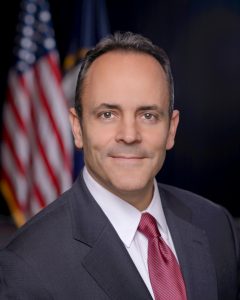 Gov. Matt Bevin testified last week before the House Judiciary Committee in support of House Bill 333, which seeks to set common sense limits on pain medication prescriptions in an effort to combat Kentucky’s opioid epidemic. The bill also has several measures to regulate, prohibit and punish the illicit possession, importation and trafficking of fentanyl, carfentanil and fentanyl derivatives.
Introduced by Rep. Kimberly Moser and a group of five bipartisan co-sponsors, this legislation seeks to prevent the creation of new addicts by reducing overexposure and oversupply of opioids in acute care settings. Recent statistics show that Kentucky ranks third among all states in opioid addiction, with a rate double the national average.
“Until we have a frank conversation—as it relates to everything from the production, prescription, dissemination, and prosecution of opioids—we’re not going to fix the problem,” said Gov. Bevin. “With the exception of intentional drug dealers, most of the people who are complicit in this didn’t start out trying to be complicit in something that has been so crippling to our nation and to the Commonwealth.”
In accordance with Center for Disease Control and Prevention (CDC) guidelines, House Bill 333 would prohibit a practitioner from issuing a prescription for more than a three-day supply of a Schedule II controlled substance intended to treat pain as an acute medical condition.
Certain exemptions would apply for cancer patients, individuals diagnosed with chronic pain, those in narcotic treatment programs, patients receiving end-of-life care, and other situations deemed medically necessary.
Studies compiled by the National Institute on Drug Abuse illustrate the importance of decreasing exposure to opioids: 86 percent of injection drug users took opioid pain relievers non-medically prior to using heroin, 75 percent of individuals abusing opioids used a prescription drug as their first opioid, and incidence of heroin initiation is 19 times higher among those using non-medical pain relievers versus those who did not.
“This addiction is everywhere, and we have to make it harder to get addicted,” said Gov. Bevin. “We don’t have the luxury of being able to pretend this doesn’t exist.”
Last week, joined by legislators and officials from local government, education and business associations, Gov. Matt Bevin ceremonially signed House Bill 3, which repeals the state law requiring payment of a set hourly base (prevailing) wage to workers on public works construction projects.
The prevailing wage is the wage set by government, which contractors and subcontractors must pay workers hired for public works projects (such as roads, buildings and sewers) that cost more than $250,000.
“This is one of those win-wins,” said Gov. Bevin. “We want to be good stewards of the limited resources we have, and this is going to be transformative in terms of just the financial impact alone on the Commonwealth of Kentucky. Studies estimate that, conservatively, it will result in somewhere between $125 and $135 million dollars a year in savings.”
A 2014 study by the Kentucky Legislative Research Commission found that the prevailing wage law inflated labor cost by 24 percent and increased the total project cost by 10 to 16 percent on average.
Experts note that prevailing wage regulations create a financial strain on local governments and school districts. In fact, the Kentucky Department of Education estimates that prevailing wage regulations have cost the Commonwealth at least $100 million since 1996.
“Without artificial, and often inflated, wage rates set by antiquated prevailing wage laws, Kentucky is now positioned to complete necessary construction projects at lower costs,” said Rep. Adam Koenig. “We are committed to spending every single tax payer dollar wisely, and Kentucky cities are already saving money due to the swift passage of the prevailing wage repeal by the House and Senate, and Governor Bevin’s prompt signing.”
“As a sponsor of similar legislation last Session, I applaud the efforts of Governor Bevin and my colleagues in the legislature who helped make this prevailing wage repeal bill become law in 2017,” said Sen. Wil Schroder. “This measure will provide more money for construction in our school districts, ultimately putting taxpayer dollars to better use.”
Kentucky’s exports broke an all-time record in 2016 with $29.24 billion in goods and services shipped abroad from the Commonwealth, a 5.8-percent increase from 2015, Gov. Matt Bevin recently announced.
Aerospace products and parts led all categories with more than $10.85 billion in goods exported internationally, an increase of more than 24 percent over 2015. Kentucky ranked second nationally for 2016 in aerospace-related exports.
“Kentucky is headed in the right direction and the business community is taking notice. This new record is unequivocal proof of our positive trajectory,” said Gov. Bevin. “As we improve our business climate, global demand for our brands and expertise continues to grow, attracting new companies while at the same time strengthening existing partnerships. Together, we are moving forward. The economic future in Kentucky is very bright, indeed!”
Overall, the state’s 2016 exports increased $1.6 billion over the 2015 total. That placed Kentucky eighth among all U.S. states by percentage increase, according to data from the U.S. Census Bureau Foreign Trade Division and WISERTrade.
Kentucky’s strong showing in exports – ranking 17th nationally by dollar amount – continued its years-long trend of punching above its weight. As a state with 4.4 million people, Kentucky ranks 26th nationally in size.
As well, Kentucky’s positive numbers stand in contrast to a 3.3 percent decline nationally in exports during 2016. Additionally, the fact Kentucky is not along a coast speaks volumes about the state’s logistics industry – which includes air cargo, rail, barge and ship, and trucking capacities – and its ever-increasing ability to quickly send products across the world.
Kentucky exported to 199 nations in 2016, with Canada, the United Kingdom, France, Mexico and Brazil as the state’s top five trade partners. The Commonwealth sold nearly $7.5 billion in products and services to Canada last year, nearly three times as much as the next destination, the U.K.
Among the state’s largest percentage increases by destination in 2016 were France (59.8 percent), Malaysia (31.8 percent), the Republic of Korea (28.2 percent), Hong Kong (26.8 percent) and Brazil (17.6 percent).
By industry category, following aerospace were motor vehicles ($3.32 billion), pharmaceuticals and medicines ($1.81 billion), motor vehicle parts ($1.76 billion), resin and synthetic rubber, artificial and synthetic fiber and filament ($1.1 billion) and basic chemicals ($741 million). Those categories are established under the North American Industry Classification System.
Aerospace saw the highest percentage increase in 2016 (24.3 percent), followed by motor vehicle parts (12 percent) and pharmaceuticals and medicines (9 percent).
The Commonwealth ranks sixth nationally in motor vehicle exports for 2016. In total, Kentucky’s automotive industry – with parts, bodies, trailers and whole vehicles combined – exported nearly $5.5 billion in products throughout 2016.
The state’s horses, live, purebred breeding industry ranked first in the nation in 2016, with $195.2 million exported, a 33.1 percent increase over the previous year. Kentucky also exported whisky to Cuba, wine to France and beer to Ireland during 2016.
For more information on Kentucky exports, visit www.kyexports.com.
The state helps businesses learn about and connect with exporting opportunities through the Kentucky Export Initiative. KEI brings together a coalition of business organizations, trade experts and government entities including the Kentucky Cabinet for Economic Development with a focus on increasing Kentucky exports to create new jobs and diversified markets for the state’s products.
Information on Kentucky’s economic development efforts and programs is available at ThinkKentucky.com. Fans of the Cabinet for Economic Development can also join the discussion on Facebook or follow on Twitter. Watch the Cabinet’s “This is My Kentucky” video on YouTube.
 Last week, Gov. Matt Bevin filed a lengthy legal brief—the second from his administration—to vigorously defend the recently enacted House Bill 2, which requires physicians to offer an ultrasound to patients prior to performing an abortion, describe the developing child that is depicted and allow the heartbeat to be heard.
Yesterday was the deadline for Kentucky Attorney General Andy Beshear to file a brief ahead of a Feb. 16 hearing before U.S. District Judge David Hale on a requested temporary restraining order, and he unsurprisingly failed to do so.
Despite claims that he has taken “the most aggressive action possible,” Beshear’s actions show otherwise. Three weeks ago, he simply filed a one-page brief asserting his office was “taking no position” on House Bill 2 and when invited by the Judge to file a supplemental brief by Feb. 9, he failed to file anything. Beshear has not lifted a finger to defend the constitutionality of HB 2.
He continues to cling to the nuance that he is defending the statute because his office has entered an appearance for himself and a state agency. However, he has made no effort to actually defend the statute. He is failing to defend Kentucky law and the unborn children and expecting mothers it was enacted to protect—the basic job of the attorney general of the Commonwealth.
 “I find it tragically ironic that while Attorney General Beshear boasts about protecting Kentucky’s families and children, he is shirking his duty when it comes to protecting the most vulnerable among us,” said Communications Director Amanda Stamper.
He recently asked to be removed as a defendant, saying nothing in the law says his office has the duty or authority to enforce it.
However, even the ACLU in a reply memorandum noted that Beshear’s argument is incorrect “because it ignores the broad power the Attorney General wields under existing Kentucky law to enforce state statutes and to initiate actions in which the Commonwealth has an interest.”
House Bill 2 was passed by the Kentucky General Assembly last month with 83 percent bipartisan support.
Note: Click here to download copy of legal briefs.
Governor Matt Bevin joined with Senate Judiciary Chairman Whitney Westerfield and a bipartisan group of officials this week to introduce Senate Bill 120, legislation aimed at ensuring people who leave prison can successfully rejoin society and turn away from crime.
These changes – ranging from improved reentry substance abuse supervision to removing government licensing restrictions that will expand job opportunities for those with records – will address Kentucky’s abysmal recidivism rate, which currently hovers above 40 percent. The legislation is the result of policy discussions from the bipartisan Criminal Justice Policy Assessment Council. The 23-member council was created by the Governor to find ways to make Kentucky’s justice system fairer, more effective and more efficient with Kentucky’s taxpayer dollars, while protecting public safety.
“America is a country founded on the principles of redemption and second chances,” said Gov. Bevin. “It is imperative that we see incarcerated people as individuals deserving of dignity and opportunity. We need to pursue policies that get bureaucracy out of the way, and allow those who have committed minor offenses to turn their lives around, find jobs and support their families. I am extremely grateful for the work the Criminal Justice Policy Assessment Council put into this legislation, and am proud of Chairman Whitney Westerfield. His passion for public safety and a justice system that is fair to everyone is admirable, and speaks to the best of what Kentucky has to offer.”
The bill would also establish a mechanism for private industry to operate inside prisons, giving inmates an opportunity to learn real-life job skills while also paying restitution, child support and for their own incarceration costs. Additionally, the legislation allows certain lower-level inmates serving felony sentences in county jails the chance at work release, which enables them to become employable post-sentence and able to pay restitution. Finally, the bill establishes opportunities for jails to operate reentry centers or day reporting centers to ease inmate transition back into society.
“We have reached a critical point in Kentucky,” said Sen. Westerfield. “While we must hold people accountable for their crimes, we also need to find better ways to prepare those coming out of prison to return to productive society. “This bill takes major steps toward better reentry opportunities, reducing recidivism and improving public safety across Kentucky.”
The bill includes provisions that:
- Modifies discretionary detention so it gives Probation and Parole more flexibility to use sanctions for supervision violations.
- Adjusts parole and probation credits for those who are compliant and need less supervision, which should ease a growing caseload with no negative impact on public safety. These compliance credits mirror a successful model from Missouri.
- Removes automatic bans for felons seeking professional/occupational licenses, giving discretion and providing a process for boards to determine whether a crime should prohibit licensure.
- Creates a way for the Department of Corrections to implement a reentry drug supervision pilot program (similar to drug court) for certain inmates and parolees with substance abuse disorders.
- Establishes a way for law enforcement agencies to offer “Angel Initiative” programs. These programs allow addicts to come to police departments seeking help finding treatment without fear of drug possession charges.
- Establishes a mechanism for private industry, which doesn’t compete with other Kentucky businesses, to operate inside prisons, giving inmates an opportunity to learn real-life job skills while also paying restitution, child support and for their own incarceration costs.
- Establishes authority to allow certain lower-level inmates serving felony sentences in county jails the chance at work release, thereby helping them become employable post-sentence and able to pay restitution.
- Establishes opportunities for jails to operate reentry centers or day reporting centers to ease inmate transition back into society.
Yesterday’s announcement builds on the momentum for justice reform in Kentucky, and comes on the heels of Gov. Bevin’s executive order last week to remove questions about criminal history from the initial application for state jobs. Last year, the governor signed legislation to allow for the expungement of certain low-level felonies after a person has completed the terms of their criminal sentence.
Yesterday, on behalf of Gov. Matt Bevin, Lt. Gov. Jenean Hampton joined Department for Local Government (DLG) Commissioner Sandy Dunahoo in a Capitol rotunda ceremony to announce over $5.7 million in Community Development Block Grants (CDBG) for 13 new projects in Kentucky. These grants impact multiple regions and counties across the Commonwealth.
“We are excited to announce 13 new Community Development Block Grant projects. Each project is designed to aid critical infrastructure needs across the Commonwealth, such as water safety, public facilities and local health resources,” said Gov. Bevin. “These block grants will not only have a significant impact on improving quality of life for Kentuckians, but will create economic opportunity and jobs as well. Great things happen when we work together.”
“It has been a true joy over the last year visiting different communities in Kentucky and hearing their stories,” said Lt. Gov. Hampton. “These grants have created wonderful opportunities for communities across the Commonwealth in terms of economic development, tourism, education, the environment, and more.”
“I’m pleased by the governor’s announcement of these projects to help address many of the community challenges and infrastructure needs facing Kentucky,” said DLG Commissioner Dunahoo. “We are always looking at ways to coordinate our efforts with local regions for community projects and economic development. This grant assistance does that in a big way.”
The 13 projects include:
- Hawesville WWTP in Hancock Co., $800,000.
- Cumberland Hope Community in Harlan Co., $220,000.
- Hickory Hill Recovery Center for Men (Recovery Kentucky) in Knott Co., $220,000.
- Madison Co. God’s Outreach Food Bank Expansion Project in Madison Co., $300,000.
- Gamiliel City Hall and Community Ctr Architectural Barrier Removal Project in Monroe Co., $85,000.
- Centertown Water Tank Project in Ohio Co., $403,000.
- Hartford Water System Capital Improvements Project in Ohio Co., $896,250.
- Apple Patch Education Adult Day Program Relocation Project in Oldham Co., $405,000.
- Mt. Olivet Wastewater Treatment Plant Renovation and Expansion in Robertson Co., $634,500.
- Morehead Inspiration Ctr (Recovery Kentucky) in Rowan Co., $220,000.
- Fritz Winter Rail Spur Development in Simpson Co., $997,000.
- Todd County Health Department Expansion Project in Todd Co., $500,000.
- Guthrie Koppers Natural Gas Line Project in Todd Co., $100,000.
The CDBG program provides assistance to communities for use in revitalizing neighborhoods, expanding affordable housing and economic opportunities, providing infrastructure and/or improving community facilities and services.
Applications for CDBG funds are also submitted to DLG. To learn more, visit https://kydlgweb.ky.gov/FederalGrants/CDBG_cities.cfm.
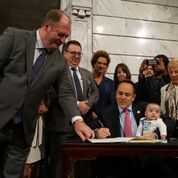 Flanked by more than a dozen state legislators and an overflow crowd filling three levels of the Capitol rotunda, Gov. Matt Bevin today ceremonially signed two historic pro-life measures during the Kentucky Right to Life Association’s “Rally for Life.”
Gov. Bevin commemorated the recently enacted Senate Bill 5 and House Bill 2, which both passed with broad bipartisan support in the first week of this year’s General Assembly.
He applauded legislators for their unwavering commitment to protect the most vulnerable members of society and noted that despite political controversy, “the sanctity of human life is worth fighting for.”
“We have a chance to lead this nation from a moral and spiritual perspective that is desperately needed,” said Gov. Bevin. “We must continue to fight this scourge that is the taking of innocent life. It’s worth it, America is worth it, and Kentucky is going to lead the way.”
Senate Bill 5 prohibits physicians from terminating pregnancies after 20 weeks of gestation—a timeframe in which experts say that a fetus can feel pain. House Bill 2 requires physicians to offer an ultrasound to patients prior to performing an abortion, allowing women to make a truly informed medical decision. (Patients may choose not to have the ultrasound by signing a form to opt out.)
“Kentucky citizens elected the members of the General Assembly to pass responsible legislation that falls in line with Kentucky values,” said Senate President Robert Stivers. “Senate Bill 5, along with House Bill 2, protects the integrity and intrinsic value of human life. It is our duty as elected leaders to protect our most vulnerable, and we have made steps towards accomplishing that goal by passing this momentous legislation.”
“Studies have shown over and over that unborn children at 20 weeks of gestation are sensitive to pain,” said Sen. Brandon Smith, primary sponsor of Senate Bill 5. “The Pain Capable Unborn Child Act offers one more protection to those who cannot protect themselves. Kentuckians value the sanctity of life, and I am proud that we in the Kentucky Senate are committed to safeguarding the lives of all our citizens.”
“This session, common sense legislation to protect life and provide women with appropriate medical information has passed the Kentucky General Assembly,” said Rep. Addia Wuchner, chair of the House Health and Family Services Committee. “Just like our passage of an informed consent bill last session, this bill demonstrates a further commitment from the House to providing women with all of the medical information available before undergoing an abortion.”
Since taking office, Gov. Bevin has signed three important pieces of pro-life legislation into law. In addition to this year’s measures, he signed Senate Bill 4 (“informed consent”) in 2016, requiring medical personnel to provide face-to-face consultation to women 24 hours before an abortion is performed.