Thursday January 22, 2026
Local Connection
 Weather
 Traffic
 @LouisvilleDispatch
 @LouisvilleDisp
 Subscribe
“In For The Cure” by Franklin County artist Fran Redmon
Work by 29 Kentucky artists will hang in Frankfort for the Governor’s Derby Exhibit, an annual initiative coordinated by the Kentucky Arts Council.
This exhibit is on display through May 8 in the Capitol Rotunda, 700 Capital Ave. in Frankfort.
“The Kentucky Derby is a time-honored tradition, and so, too, is our celebration of work by Kentucky artists,” said Kentucky First Lady Glenna Bevin. “The Governor’s Derby Exhibit is something we want all Kentuckians and visitors to our wonderful state to come to Frankfort and enjoy as we count down the days until the first Saturday in May.”
The exhibit celebrates Kentucky stories and traditions, including its tobacco heritage, which Frankfort artist Fran Redmon chose to capture in her pastel work titled “In For the Cure,” which shows a colorful rendition of a barn with drying tobacco hanging inside.
“I grew up in Woodford County as the daughter of a tobacco farmer with my five siblings,” Redmon said. “We worked on the farm every year. It was something we were all part of. When I drive down the road in the fall and see tobacco hanging, I remember those days.”
The barn in her piece is one she saw on a fall drive in Franklin County near Switzer.
“I took a picture of it and decided to do a painting,” she said. “I liked the way it was weathered, but the thing that caught my eye was the dramatic lighting of the sun coming across the front. I liked the drama of the light and shadow at that time of day.”
This is the second time Redmon’s work has been selected for the Governor’s Derby Exhibit.
Unlike most Kentucky Arts Council exhibits, which are only open to adjudicated arts council program participants, the Governor’s Derby Exhibit includes art from any Kentuckian age 18 or older.
“One of my goals as executive director is creating more opportunities for Kentucky artists across the state to show work in arts council exhibits,” said Lydia Bailey Brown, arts council executive director. “These exhibits often help us discover even more talent in the state, and gives those artists the confidence to put themselves out there.”
Below is a full list of artists included in the display, their county of residence and title of artwork:
- Bill Berryman, Clark, “The Piper”
- Bill Burton, Daviess, “Keeneland Fall Meet”
- CeCe Butcher, Pulaski, “Tribute to Bill Monroe”
- Robert Clark, Scott, “Mine That Bird’s Derby”
- Laura Eklund, Carter, “Kentucky Sky”
- Darryl Halbrooks, Madison, “Natura Morta 5”
- Jerielle Hanlon, Fayette, “Kentucky Agate and Cloud Abstract”
- Marilyn Holmes, Jefferson, “I Too Sing America”
- Frederica Diane Huff, Jefferson, “A Kentucky Girl and Her Horse”
- Robert Hunt, Madison, “Kentucky Derby Story”
- Shirley Jeter, Fayette, “Tradition”
- Betty Liles, Christian, “The Apple Barn”
- David Neace, Jessamine, “Earth 1946”
- Kevin Osbourn, Clark, “The Rock Bridge”
- Ken Page, Kenton, “The Maestro Takes a Walk”
- Linda Pierce, Christian, “Troop Train”
- Monica Pipia, Fayette, “The Turnaround”
- Fran Redmon, Franklin, “In For the Cure”
- Cassandra Russell Dossett, Jefferson, “My Old Kentucky Saddler”
- Marcheta Sparrow, Franklin, “Intensity – Expression of a Kentucky Champion”
- Wayne Stacy, Franklin, “Faith Abandoned”
- Paula Stone-Buckner, Montgomery, “The Queen’s Court”
- Jason Sturgill, Fayette, “Face Shielded from the Sun Floating Slowly Down the River”
- Billy Tackett, Boone, “Pearl Bryan”
- Susan Tolliver, Jefferson, “Surging Ahead”
- Patty Trujillo, Jefferson, “Uncle Damon”
- Connie Vice, Oldham, “Worthington’s Garage”
- Amy Welborn, Oldham, “Mimosa Sunrise”
- Angela Wells, Jefferson, “Abe’s Last Garden”
The Governor’s Derby Exhibit is open to the public during regular State Capitol building hours from 8 a.m. to 4:30 p.m. Monday through Friday; and 10 a.m. to 2 p.m. Saturday.
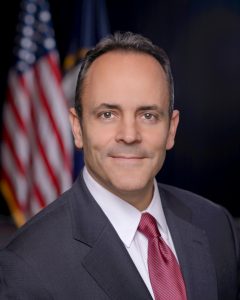 Gov. Matt Bevin, as part of his Red Tape Reduction initiative, has signed documents to eliminate more than 65 obsolete, inactive and superseded boards and commissions.
A 2012 Legislative Research Commission (LRC) study identified 571 boards, commissions and similar entities such as authorities, councils and committees in Kentucky—a figure “nearly twice the number of the typical state.”
Gov. Bevin issued an executive order on March 23 eliminating 29 boards and commissions that were originally established by gubernatorial executive order.
“This Administration desires and will implement more effective and efficient management of state government operations and resources,” wrote Gov. Bevin in the order. “The dissolution of boards and commissions that are no longer active or necessary will aid in securing this greater efficiency and effectiveness.”
House Bill 276 (signed into law on March 21) eliminates 28 boards and commissions that were originally created by legislative action, and Senate Bill 249 (signed into law on March 27) eliminates 11 additional boards, commissions and task forces.
Among the boards and commissions abolished were entities such as the Kentucky Adoption 2002 Strategic Planning Task Force, the Capitol Centennial Commission and the War of 1812 Bicentennial Commission, which completed their work in 2002, 2010 and 2015 respectively.
These actions, along with sunset provisions and board consolidations, reduce the number of active boards on the books to under 400. No board members, funds or services to taxpayers will be impacted.
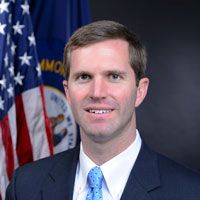 For the second time in as many months, Attorney General Andy Beshear is releasing information to the public on the work of his office after a request for information by Gov. Matt Bevin.
Beshear is releasing information on his Office of Civil and Environmental Law’s Administrative Hearings Branch after a March 10 letter by the governor.
Last month, Bevin requested information on the AG’s Office of Civil and Environmental Law’s Open Records/Open Meetings Branch and information on the office’s civil attorneys and caseload.
Beshear released that information to the public Feb. 10.
“As I have repeatedly said, each time the governor requests information it gives me the chance to honor the hard work of the employees in my office,” Beshear said. “While many Kentuckians are unfamiliar with this branch in the Attorney General’s office, it plays a vital role to ensure government is operating properly and within the guidelines of the law.”
Hearing officers serve as impartial adjudicators of administrative matters in government. Lawmakers established the branch in 1994 to conduct administrative hearings for government boards and agencies and provide training in administrative hearing procedures for hearing officers, who propose or render decisions on claims regarding government programs.
Currently, the branch provides hearing officer services to more than 60 government agencies and boards across Kentucky.
“Use of the branch is advantageous, as the hearing officers are independent, unlike those employed by the same agency or cabinet who often bring action in a matter or has made a decision that initiated the matter,” Beshear said. “Using an independent hearing officer can defeat claims of having ‘kangaroo courts’ in administrative matters involving an agency or cabinet.”
The branch recently conducted a training March 15 at the Kentucky Transportation Cabinet, providing three hours of continuing legal education and educational requirements as required by Kentucky law.
“Our team has spent more than 175 hours responding to the eight different requests from the governor for information on my office,” Beshear said. “This is valuable time that should have been spent furthering our missions of seeking justice for victims of sexual assault, protecting seniors from scams, addressing our drug problem and protecting children from sexual abuse.”
Last week, Gov. Matt Bevin ceremonially signed two pieces of recently enacted legislation that will improve the lives of children removed from their homes because of abuse or neglect.
House Bill 180 allows youth to be temporarily placed with non-relative adults who already have a significant emotional relationship with the child. House Bill 192 allows foster children to obtain their learner’s permits and driver’s licenses without the signature of their parent or guardian.
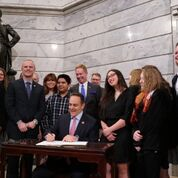 “These new laws will help to restore some much-needed normalcy to the lives of Kentucky foster youth,” said Gov. Bevin. “But today is about more than simply restoring normalcy. It’s about respect. It’s about dignity. And it’s about creating opportunity.”
Rep. Addia Wuchner, chairwoman of the House Health and Family Services Committee and primary sponsor of HB 180, noted that her bill provides adults with a family-like relationship to children the chance to play a larger role in their lives and gives the Cabinet for Health and Family Services (CHFS) and the courts another—less traumatic—option when children have to be removed from their homes.
“We all grew up with someone—a coach, a neighbor, a teacher, a friend’s parent or neighbor whose positive influence on us helped to guide us into maturity,” said Rep. Wuchner. “Sometimes those individuals are just like family and the closest thing to parents that kids have. In circumstances when a child is removed from a home, they can be a saving grace—a stabilizer that keeps a child from entering foster care and a series of tough transitions. ‘Fictive kin,’ as they are called, can be lifesavers. I am extremely proud that Gov. Bevin has such a commitment to Kentucky’s children, and I appreciate his support in signing this bill into law and his efforts to strengthen all families of the Commonwealth.”
Rep. Larry Brown, who was primary sponsor of HB 192, said that for too long, learning to drive has been one of many obstacles foster children face.
“At the point they are in out-of-home care, foster children have gone through so much trauma,” said Rep. Brown. “This new law will make life easier for them as they can apply for their driver’s licenses just like any other teenager. Foster kids have been asking for this for years. Thankfully, this legislature and this administration are listening to them.”
CHFS, the agency that administers the state’s adoption and foster care programs, says that almost 8,000 children are in state custody; and of these, more than 6,000 are in a foster care placement.
Cabinet Secretary Vickie Yates Brown Glisson noted that these new laws are part of the state’s overall commitment to transforming adoption and foster care programs.
“Gov. and First Lady Bevin are leading the charge to make life better for vulnerable children in Kentucky,” said Sec. Glisson. “We are truly all working together as a team to ensure all children in the Commonwealth are safe, cared for and loved.”
Glenda Wright, a former foster child and current president of Voices of the Commonwealth (an advocacy group of both present and former foster youth) said that she knows firsthand the struggles to fit in as a foster child.
“As a child without a permanent family, you already feel remarkably different from the other kids,” said Wright. “These new laws can give children in out-of-home care both the sense of security that comes from a loving home and the promise of independence that comes with growing up. I appreciate Gov. Bevin and the legislators who made these new laws a reality.”
Gov. Bevin has pledged to improve the state’s adoption and foster care system by mobilizing a network of nonprofits, faith-based organizations and loving families through his “Open Hearts/Open Homes” initiative.
For details about how you can become a foster or adoptive parent or to obtain general information, please visit adopt.ky.gov or contact the Commonwealth at openhearts@ky.gov or 1-800-232-KIDS (5437).
On Monday, Gov. Matt Bevin restored the right to vote and hold public office to certain offenders who have completed their respective sentences and have applied for restoration of their civil rights.
The orders exclude individuals convicted of violent or sex crimes, bribery or treason.
“We have always been a nation of second chances,” said Gov. Bevin. “The criminal justice system should not exist solely to punish offenders, but also to rehabilitate and assimilate them back into society. Through this executive action, we are empowering men and women with the opportunity to become contributing members of our communities. Restoring the voting rights of certain low-level offenders is a significant step towards achieving this goal. There will be many more such opportunities granted in the months and years ahead.”
While the orders restore the right to vote and hold public office, they do not restore any other civil right, including but not limited to the right to receive, possess or transport in commerce a firearm or serve on a jury.
The Bevin Administration has initiated groundbreaking criminal justice reform efforts aimed at removing barriers for offenders to successfully reenter society.
In 2016, Gov. Bevin signed into law historic felony expungement legislation that gives non-violent felony offenders who have paid their debt to society a second chance. House Bill 40 allows Kentuckians convicted of certain Class D felonies—who have paid their debt to society, have stayed out of trouble as required by the law, and have shown that they are indeed trying to get back on track—to erase their criminal records and obtain a second chance at jobs, housing, and other opportunities sometimes denied felons.
Also, this past February, Gov. Bevin issued an executive order that removes questions about criminal history from the initial application for state jobs in the executive branch. The Fair Chance Employment Initiative means that applicants will not be required to check the box for criminal convictions on the initial state application, a policy in line with twenty-four states and more than 150 cities and counties across the nation.
Individuals who are interested in applying for restoration of their civil rights may do so by obtaining a form at any Probation and Parole office, or by contacting the Department of Corrections at 502-782-2248 or online at corrections.ky.gov, and returning the form to the address listed.
Gov. Matt Bevin has issued a proclamation declaring the week of Feb. 24 through March 4, 2017, as Kentucky Saves Week.
Kentucky Saves Week is a local part of America Saves Week, an annual opportunity for organizations to join together and encourage individuals and families to take financial action through saving.
The Department of Financial Institutions (DFI) will host a Kentucky Saves Week celebration at the Capitol on Tuesday. The event will educate Kentuckians about the importance of personal and household savings, which Governor Bevin describes in the proclamation as “fundamental to the stability and vitality of the Commonwealth and the nation.”
At the event, students from across the state will receive awards for participating in a piggy bank contest, sponsored by Kentucky Cooperative Extension, and a poster contest, sponsored by the Kentucky Jump$tart Coalition. OJ Oleka, Chief of Staff and Assistant Treasurer in the Office of Kentucky State Treasurer Allison Ball, will present the keynote address.
Celebration Event at the Capitol
| WHAT: | A Celebration of Kentucky Saves Week, including a presentation of student awards in two savings-themed contests
|
| WHEN: | 10 a.m. on Tuesday, Feb. 28, 2017 |
| WHERE: | Rotunda, Kentucky Capitol
700 Capitol Avenue Frankfort, KY 40601
|
| WHO: |
|
| WHY: | Saving money is important for every Kentuckian! |
There are many ways to celebrate Kentucky Saves Week. Join the celebration by participating in the following programs:
Kentucky Saves Campaign
Visit www.kentuckysaves.org to take a savings pledge and find helpful articles on savings strategies, newsletters, and a sign-up area for text message reminders.
Kentucky Jump$tart Coalition Information Table
The Kentucky Jump$tart Coalition will host an information table on Tuesday, Feb. 28, in the Capitol Annex.
STABLE Kentucky
Kentucky STABLE (State Treasurer Achieving a Better Life Experience) accounts allow individuals with disabilities the opportunity to save and invest money without losing eligibility for certain public benefits programs. Earnings in STABLE Kentucky Accounts are not subject to federal income tax, so long as funds are spent on qualified disability expenses. Find out more at http://stablekentucky.com.
Financial Field Manual for Military Families
DFI offers the updated Kiplinger’s Financial Field Manual: A Personal Finance Guide for Military Families, which helps military members and their families make the most of the special financial benefits open to them. This updated version also includes information on the new 2018 retirement plan rules. Find it online at http://kfi.ky.gov/public/Pages/invest.aspx.
Conversation Starters
DFI offers conversation starters to help all Kentucky families start a discussion about their finances. Each conversation starter includes questions designed to help families kick-start an ongoing dialogue about budgeting, saving, investing and avoiding investment fraud. The series includes sets of questions for new couples, families, working adults and employers, retirees and seniors, and military families. Start the conversation by visiting http://kfi.ky.gov/public/Pages/invest.aspx.
Tips Through Social Media
Follow the Public Protection Cabinet on Facebook to receive Kentucky Saves Week tips. Search @ppckentucky or visit www.facebook.com/kypublicprotection.
Gov. Matt Bevin has joined with 25 other states in filing an amicus brief in Peruta v. San Diego County, an important Second Amendment case challenging the constitutionality of a California law restricting citizens’ rights to carry handguns outside their homes for self-defense.
“As states and individuals, we must stand united against arbitrary government overreach and this unconstitutional attack on the Second Amendment,” said Gov. Bevin. “In America, our freedom and liberty have been purchased at a great price. We must do everything in our power to preserve them for the generations yet to come.”
The case questions the legality of California’s restrictive concealed carry permit policy, which requires citizens to satisfy a number of conditions before obtaining a concealed carry license. Under the law, an applicant must show “good cause” to obtain a permit, and each county sheriff gets to create their own subjective definition of “good cause.”
Also included in the amicus brief are Alabama, Alaska, Arizona, Arkansas, Florida, Georgia, Idaho, Indiana, Kansas, Louisiana, Michigan, Missouri, Montana, Nebraska, Nevada, North Dakota, Ohio, Oklahoma, South Carolina, South Dakota, Texas, Utah, West Virginia, Wisconsin and Wyoming.
“When it comes to regulating gun rights, California thinks that the State can do things that would be unthinkable in other areas of constitutional law,” the brief noted, challenging the Court to envision the public outcry if other constitutionally protected rights were subjected to the same capricious judgement of a public official.
“Imagine if California did any of the following: no speech unless a sheriff finds ‘good cause’ for it; no public assembly unless a sheriff finds ‘good cause’ for it; no religious exercise unless a sheriff finds ‘good cause’ for it,” the 26 states assert.