Weather
 Traffic
 @LouisvilleDispatch
 @LouisvilleDisp
 Subscribe
 Ahead of its 2016 DC Fly-In, GLI is releasing a document outlining its federal priorities for the business community in 2016.
“The federal agenda is a unique and essential advocacy tool utilized by our region,” said Kent Oyler, President & CEO, “When we take top leaders on the DC Fly-In, the agenda provides the ability to address a host of issues to our officials on a limited time frame.”
Each issue on the agenda directly impacts multiple businesses in the region. Those include:
The policy priorities were selected by business leaders participating in GLI’s Public Policy Committee system. GLI also surveyed its membership to obtain feedback on federal policy issues. You can view the full agenda here.
“The agenda includes issues for businesses of all sizes and industries,” said Sarah Davasher-Wisdom, Chief Operating Officer, “Our committees take a holistic look at the region’s business ecosystem to ensure we are addressing the most timely and pertinent issues.”
Dozens of business leaders from across the Greater Louisville region will be embarking to Washington on June 22nd and 23rd for GLI’s 2016 DC Fly-In.
 Kentucky Transportation Cabinet (KYTC) Secretary Greg Thomas today testified before the Interim Joint Committee on Transportation about the condition of the Road Fund cash balance—the funding source for all Cabinet operations including construction, maintenance and general support.
In his testimony, Sec. Thomas detailed the seriousness of a low Road Fund cash balance and introduced the Cabinet’s “Pause-50” plan to restore funding back to normal operating levels.
“For the first time in recent history, the Cabinet faces a low Road Fund cash balance, which compromises our ability to authorize new state road projects over the next biennium,” said Sec. Thomas. “The “Pause-50” approach is designed to slow or delay the starts of new projects so that we can pay current expenditures, recoup lost revenue and rebuild our funding base.”
Based on the KYTC’s cash management plan, the Cabinet strives to have a balance of at least $100 million at any given time. The last time the cash balance neared zero was in 2004 when it hit $30 million.
Consequently, the Cabinet will implement the “Pause-50” plan by halting the starts of new state-funded projects in all phases, which includes design, right of way/utilities, and construction for the first year of the biennium; and in the second year, aim for a goal of $50 million to allocate on state-funded projects starts.
In essence, the Cabinet will “pause” adding new state-funded projects for the first year in the biennium. For the second year, the Cabinet anticipates the availability of $50 million for state-funded projects starts. The dollar amount could be higher or lower depending on actual expenditures of current projects and the flow of state revenue funding.
In March, Sec. Thomas gave legislators a brief overview of the situation and identified several critical factors that have contributed to the low cash balance—mainly, overspending with limited funds.
State spending has greatly exceeded revenues since Fiscal Year 2014. Road Fund revenues totaled $4.5 billion over FY 2014-2016. Over the same period, expenses totaled $5.035 billion, exceeding revenues by $498 million; meaning that the start of new state funded projects must be delayed in order to meet payment of current expenditures as well as restoring the $100 million cash balance threshold. Continue reading
 Mayor Greg Fisher will deliver his proposed 2016-2017 Capital and Operational Budget Address on Thursday, May 26th at 4:00pm during a special meeting of the Louisville Metro Council. As a result of this special meeting, the Democratic Caucus will not meet on Thursday.
The Committee of the Whole will meet prior to the Mayor’s address at 3:00pm in the First Floor Conference Room to review the Council’s agendas for the evening.
The Louisville Metro Council will hold its last regular meeting of the month of May at 6:00pm in Council Chambers. The meetings are open to the public, who may enter City Hall using the Sixth Street entrance. Anyone needing assistance may enter City Hall from the Jefferson Street entrance.
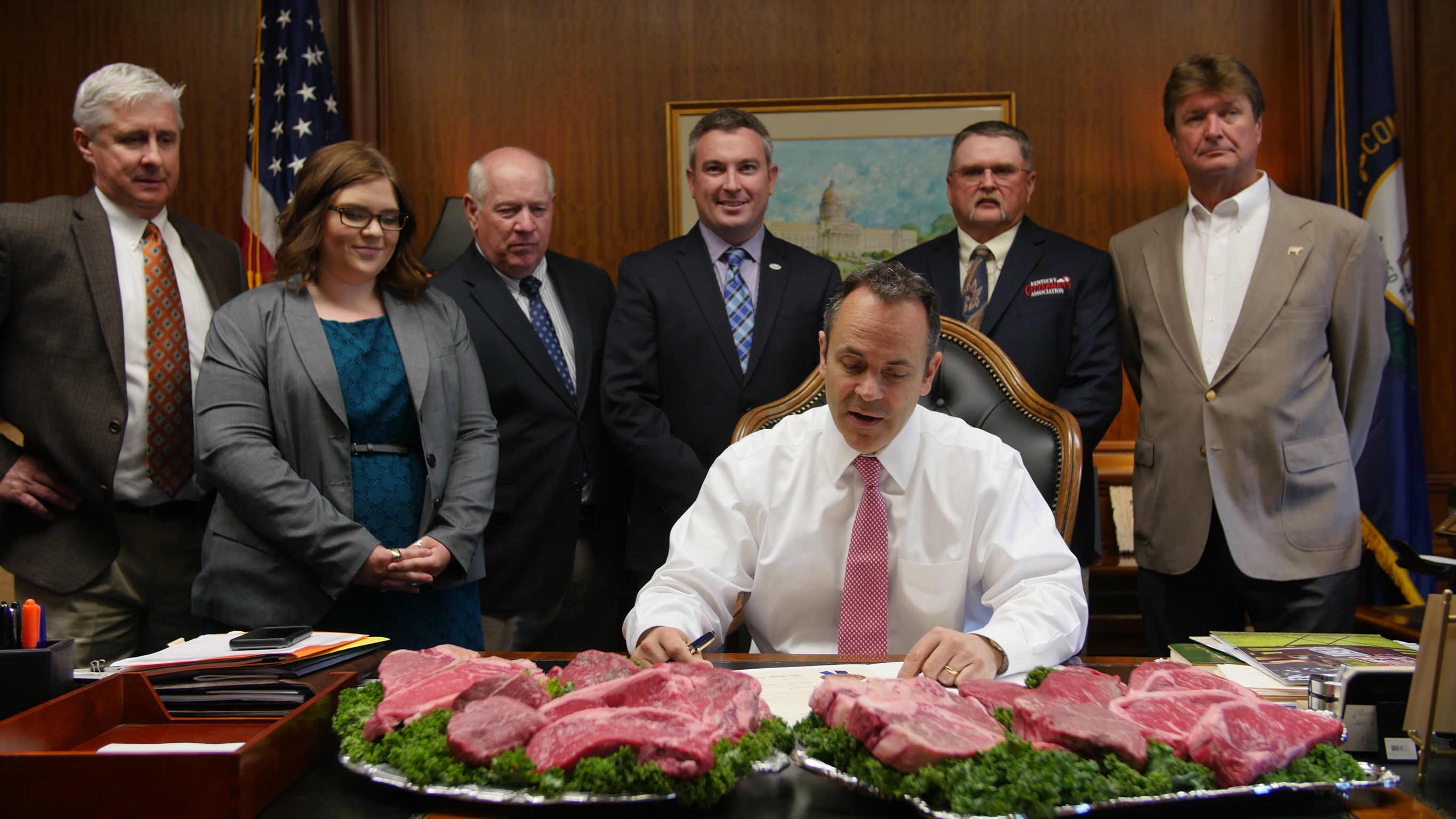
Gov. Matt Bevin, along with Kentucky Commissioner of Agriculture Ryan Quarles, today proclaimed May as Beef Month in Kentucky, citing beef’s nutritional benefits and its impact on Kentucky’s economy. They were joined by Beef Council chairman Steve Dunning, Beef Council president David Lemaster, Kentucky Cattleman’s Association executive vice president Dave Maples, Kentucky Beef Council director of Consumer Affairs Kiah Twisselman, and the Governor’s Office of Agriculture Policy executive director Warren Beeler.
“Kentucky is the leading beef cattle producing state east of the Mississippi River and ranks fifth nationally in total number of farms,” said Gov. Bevin. “We have a rich agricultural tradition and history, and beef cattle comprise a big part of that.”
“Cattle generated more than $1 billion in farm gate cash receipts in 2014,” Commissioner Quarles said. “That means income for Kentucky farm families and economic activity throughout the Commonwealth. Beef is also an important part of a balanced diet with protein, vitamins, and minerals we all need to maintain a healthy and active lifestyle.”
Kentucky ranks eighth in the United States with just over 1 million beef cows as of Jan. 1, the National Agricultural Statistics Service reported. The Kentucky Cattlemen’s Association says some 38,000 farming operations in Kentucky produce beef cattle.
“Kentucky is home to a million cows supporting thousands of farm families, rural communities and our commonwealth,” said Beeler. “Kentucky’s investment in the beef industry has only enhanced production and quality levels to new heights.”
The Kentucky Department of Agriculture helps Kentucky beef cattle producers raise and market their products. The Office of the State Veterinarian works with farmers, veterinary practitioners, the state livestock disease diagnostic laboratories, and its counterparts in other states and at the federal level to protect Kentucky livestock herds from disease and eliminate disease outbreaks when they occur. The KDA’s marketing office helps Kentucky producers find new markets for their products.
 The Kentucky Office of Highway Safety (KOHS) and the Kentucky State Police (KSP) are reminding motorists to buckle up as law enforcement agencies throughout the state join the nationwide Click It or Ticket seat belt enforcement mobilization May 23 through June 5.
“Every day, unbuckled motorists are losing their lives in motor vehicle crashes,” said KOHS Executive Director Bill Bell. “As we approach Memorial Day weekend and the summer vacation season, we want those traveling our roadways to do the one thing that could save them in a crash: buckle up.”
There were 761 total highway fatalities in Kentucky in 2015, with 588 killed in motor vehicles. Of those 588 fatalities, 358 (61 percent) were unrestrained. Six of those motor vehicle fatalities occurred over the Memorial Day holiday. None were wearing a seat belt.
“Clearly this is an indication that people are not taking the law seriously, or they’re just not aware of the huge risk being taken by not buckling up,” said Bell.
Kentucky has a primary seat belt law, meaning everyone is required to buckle up while in a moving vehicle.
“We will be out in force – day and night – ticketing anyone not wearing a seat belt,” said KSP Sgt. Michael Webb. “Drivers must remember that under Kentucky’s law, you are responsible for making sure all of your passengers are properly restrained.”
This year’s campaign, funded by a federal grant through the National Highway Traffic Safety Administration (NHTSA), has a special emphasis on pickup trucks. Continue reading
 Louisville is one of five cities selected by national funder Living Cities and the Government Alliance on Race and Equity to join an effort, Racial Equity Here, to improve racial equity and advance successful outcomes for all in America’s cities.
“Louisville is a compassionate city, dedicated to offering each and every individual the opportunity to reach their full human potential,” Mayor Greg Fischer said. “We have taken many steps to improve our city through innovation and regular analysis of our daily work and are focused on system-wide change.
“Racial Equity Here will help us develop even more tools to address disparities that seriously affect individuals across our community. We look forward to further advancing racial equity here in Louisville and taking a lead in closing the opportunity gap.”
Louisville will join Albuquerque, Austin, Grand Rapids, and Philadelphia as part of this effort.
Government leaders in each city will complete a racial equity assessment of their core government operations. This assessment will include an intentional focus on operations as they relate to adults and youth of color aged 16 to 24, who are disproportionally out of school or work.
By understanding how and where municipal operations affect young people of color, governments will not only better understand their role in perpetuating disparities but will also begin addressing them in transformative ways. Over a two-year period, the jurisdictions will develop a blueprint of government-wide strategies and begin executing the skills, tools and processes they develop through this work.
The cities participating in Racial Equity Here were selected based in part on a demonstrated commitment to improving racial equity and improving outcomes for young people of color, and to expanding efforts across the breadth of outcomes that government influences.
A cross-functional team of Louisville government leaders, led by the Office of Performance Improvement & Innovation (OPI2), submitted the application to participate in the initiative. The Center for Health Equity, Office for Safe and Healthy Neighborhoods, Office for Globalization, Departments of Community Services and Human Resources and the Human Relations Commission will all participate in the 24-month cohort, alongside OPI2. Continue reading
Mayor Greg Fischer welcomed an announcement today from 100 Resilient Cities – Pioneered by The Rockefeller Foundation (100RC), selecting Louisville to join the 100RC Network to build urban, environmental, and economic resilience.
Louisville is among the final cohort of cities invited to join the worldwide 100RC Network. As a member of 100RC, Louisville will gain access to tools, funding, technical expertise, and other resources to build resilience to the challenges of the 21st century.
Mayor Fischer said entrance into the 100RC Network will help Louisville fight the resilience challenges of environmental sustainability, as well as the economic resilience challenges that impact many low-income and disadvantaged citizens. The grant will help the city hire a Chief Resilience Officer who reports directly to the Mayor.
“Louisville’s selection to join the 100 Resilient Network is not only a significant honor but will give us the tools to support a better today, tomorrow and for future generations to come. Our application recognized Louisville’s commitment to addressing and environmental issues that disproportionately impact low-income and minority neighborhoods. It will also examine income inequality in our city,” Fischer said. “As a new member of 100 Resilient Cities, we can work with the best in the private, government, and non-profit sectors in developing and sharing tools to plan to and respond to the resilience challenges ahead.”
“We are so proud to welcome Louisville to 100 Resilient Cities,” 100RC President Michael Berkowitz said. “We selected Louisville because of its leaders’ commitment to resilience building and the innovative and proactive way they’ve been thinking about the challenges the city faces. We’re excited to get to work.”
“For us, a resilient city has good emergency response and meets its citizens’ needs,” Berkowitz continued. “It has diverse economies and takes care of both its built and natural infrastructure. It has effective leadership, empowered stakeholders, and an integrated planning system. All of those things are essential for a resilient city.”
Momentum from 100RC’s two earlier challenges made this year highly competitive, spanning over 90 countries across six continents. Louisville was chosen from more than 325 applicants on the basis of their willingness, ability, and need to become resilient in the face of future challenges. The application process showed each city’s unique vision for resilience, a long-term commitment to building resilience in a way that connects silos of government and sectors of society, and specific attention to the needs of poor and vulnerable citizens. Applicant cities also demonstrated the willingness to be leaders in urban resilience, sharing learning experiences and becoming a model for other cities across the globe.
Member cities were selected upon the recommendation of distinguished judges from around the world, including: A. Eugene Kohn, Chairman of Kohn Pedersen Fox Associates, Acha Leke, Director at McKinsey & Co Africa, Co-Founder of African Leadership Network, Ann Fudge, Vice-Chair and Senior Independent Director of Unilever, Charlotte Petri Gornitzka, Director-General of Swedish International Development Cooperation (SIDA) , Dan Doctoroff, CEO of Sidewalk Labs, Dr. Judith Rodin, President of the Rockefeller Foundation, Kai-Uwe Bergmann, Partner at the Bjarke Ingels Group, Michael Kocher, General Manager at Aga Khan Foundation, Nachiket Mor, Former Director and Current Board Member, Reserve Bank of India and Senior Advisor to the Bill & Melinda Gates Foundation, andNena Stoiljkovic, Vice President, Global Partnerships at the IFC.
Selected cities are now part of a global community of cities working together to build urban resilience. In the months ahead, as part of the 100RC Network, Louisville will be eligible to receive grant funding to hire a Chief Resilience Officer, who will lead the citywide resilience-building process and engage stakeholders from across different government agencies, public and private sectors, and various communities to incorporate diverse perspectives and knowledge. Louisville will also receive technical support to develop a Resilience Strategy that reflects the city’s distinct needs, and the support and services they need as they work towards implementing that strategy. Each new network member will gain access to a variety of 100RC Platform Partners in the private, public, academic, government, and nonprofit sectors. Partners offer tools and services valued at over $200 million USD at no direct cost to 100RC members, in areas such as innovative finance, technology, infrastructure, land use, and community and social resilience. Finally, the cities will be linked together in a global network so they can learn from each other’s challenges and successes.