Thursday January 22, 2026
Local Connection
 Weather
 Traffic
 @LouisvilleDispatch
 @LouisvilleDisp
 Subscribe
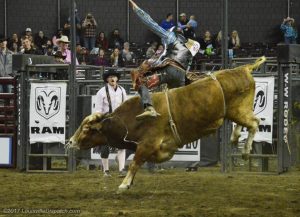 The 44th annual North American International Livestock Exposition (NAILE) saw an increase in both exhibitors and rodeo attendance during its 17-day run at the Kentucky Exposition Center. NAILE drew nearly 30,000 entries with competitors, exhibitors and attendees from 49 states and six foreign countries. The event generated an economic impact of $8.3 million to the greater Louisville region.
The Great Lakes Circuit Finals Rodeo, held in conjunction with NAILE, saw the highest attendance in five years with more than 19,000 fans enjoying the three performances in Freedom Hall.
NAILE, the world’s largest purebred livestock show, is held annually at the Kentucky Exposition Center. Included in the event are national collegiate and youth livestock judging contests, competition within ten livestock divisions and livestock sales. The event is owned and produced by Kentucky Venues.
Steve Kelly, Executive Director of Expositions for Kentucky Venues noted that renowned judges and officials from across the country evaluate the livestock and assist with the show, underscoring the event’s prestige. “NAILE serves as the livestock industry’s capstone event. Kentucky showcases its agriculture heritage by hosting the esteemed livestock show each year.”
The Sale of Champions, held the last night of NAILE, raised $64,500, with proceeds distributed to youth exhibitors of market animals (80 percent), charities (10 percent) and promotion (10 percent).
For more information, visit www.livestockexpo.org.
 The 55th Annual National Recreation Vehicle Trade Show returns to Louisville Nov. 27-30 at the Kentucky Exposition Center. This industry-only event draws approximately 8,000 industry professionals and is expected to generate $6.9 million in economic impact.
The Recreation Vehicle Industry Association (RVIA) hosts the event, which is the largest concentration of RV manufacturers, suppliers, dealers and campground managers in the world. More than 300 booths will pack 1.2 million square feet of exhibit space with motorhomes, travel trailers, campers, RV parts and accessories.
The four-day show provides attendees the opportunity to:
- Discover new products and innovations
- Attend training sessions
- Engage with key stakeholders and leaders
- Network with colleagues
This year features new awards:
- the RV Industry Awards
- the RV Industry 40 under 40.
Other new additions include a dealer sales boot camp, top tech challenge, and outdoor lifestyle pavilion.
Today, a record 9 million recreation vehicles travel U.S. roads representing a substantial increase in ownership over the past decade. The RV industry has seen seven consecutive years of growth.
RVIA is the national trade association for RV manufacturers and their component parts suppliers that together build more than 98 percent of all recreational vehicles produced in the United States.
The National RV Trade Show is closed to the public. For more information, visit www.rviashow.org.
 Small Business Saturday® has quickly become synonymous with the first Saturday after Thanksgiving as a means to encourage holiday shoppers to patronize local businesses. This national Shop Small® marketing campaign also coincides with holiday events and activities already planned in many Kentucky Main Street (KYMS) communities.
“Small Business Saturday reminds us that during one of the busiest spending times of the year, we need to invest locally with friends and neighbors, ensuring that the dollars being spent are being reinvested locally,” said Kitty Dougoud, KYMS Administrator. “When you shop with a small, independent business, which KYMS promotes throughout the year, you not only celebrate the uniqueness of your community, you also support local jobs and families.”
The Kentucky Main Street Program was created in 1979 by the Kentucky Heritage Council/State Historic Preservation Office to focus on downtown revitalization and economic development within the context of preserving and reusing historic commercial buildings. KYMS requires local commitment and financial support in exchange for technical and design assistance, on-site visits, access to national consultants, and occasional grant opportunities. Currently the state program supports 37 communities.
Activities planned in KYMS communities this Saturday, Nov. 25, include Paducah Main Street’s Dickens of a Christmas, Bellevue In Vue’s annual Christmas Walk and holiday open house (Friday and Saturday), and Pikeville Main Street’s Storybook Walk. For more holiday events sure to bring cheer to your shopping experience, like and follow Kentucky Main Street on Facebook or visit Kentucky Tourism’s Kentucky Main Street holiday guide.
Small Business Saturday was launched in 2010 by American Express. According to a consumer insights survey released by the company and the National Federation of Independent Business, total reported spending last year on this one day reached an estimated $15.4 billion at independent retailers and restaurants. Kentucky Main Street can document more than $3.9 billion of investment throughout the Commonwealth over nearly four decades.
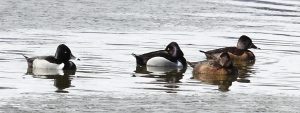
Photo: Kentucky Department Fish And Wildlife
The outlook for the upcoming waterfowl hunting seasons looks as promising as any seasons in recent memory.
“It is shaping up to be a phenomenal year,” said John Brunjes, migratory bird coordinator for the Kentucky Department of Fish and Wildlife Resources. “We are still at all-time highs for duck numbers with as many breeding ducks as we’ve ever had. It’s been that way for a couple of years now.”
Brunjes said biologists conducted duck population counts along the Mississippi River in Illinois last week. They produced four times the normal number of birds counted. “Usually for the second week of November in Illinois, they see about 200,000 birds,” he said. “They counted 800,000 birds along the Mississippi River last week and those birds are heading our way.”
Waterfowl of all stripes are migrating through Kentucky right now. “We are seeing white-fronted geese and even tundra swans in southeast Kentucky,” Brunjes said. “It is very rare. We have a ton of snow geese showing up in weird places this year. The birds are moving well this year.”
The duck, coot, and merganser seasons all open Thanksgiving Day, Nov. 23. The opening segment of the hunting season for ducks, coots and mergansers runs until Nov. 26. These seasons open again Dec. 4, 2017, and close Jan. 28, 2018.
The hunting season for Canada, white-fronted, brant and snow geese also open Thanksgiving Day, but do not close until Feb. 15, 2018.
“We want to remind hunters there is an extended opportunity for geese,” Brunjes said. “The extended season went into effect last year.” Traditionally, goose seasons closed in late January.
A summer devoid of long dry periods set the table for excellent waterfowl habitat this fall. “The moist soil areas and native vegetation look really good,” Brunjes said. “The crops on our wildlife management areas (WMAs) did well. We have the best crops at Ballard WMA that we’ve had in a number of years.”
Finding a place to waterfowl hunt is a challenge for the majority of Kentucky hunters. The first place to check is the public land hunting section of the 2017-2018 Kentucky Hunting Guide for Waterfowl. This section details the hunting options and regulations on public lands, mainly wildlife management areas.
Many, but not all, of the smaller state-owned or managed lakes are open to waterfowl hunting as are reservoirs operated by the U.S. Army Corps of Engineers or the U.S. Forest Service. The bigger waters hold more birds during the coldest stretches of the year, when many farm ponds or smaller lakes freeze over. Call the Kentucky Fish and Wildlife information center at 1-800-858-1549 to inquire if a lake is open to waterfowl hunting.
Those pursuing waterfowl on reservoirs must not hunt near access areas such as boat ramps or areas closed to hunting or public access by signs. Common sense and courtesy dictates waterfowl hunters avoid setting up near private residences or marinas.
Scouting is vitally important to waterfowl hunting success, especially in the first month of the season.
“If you aren’t seeing any birds in the areas you hoped to hunt prior to opening day, you likely won’t see birds on opening weekend either,” Brunjes said. “You have to find the areas birds are using and set up accordingly.”
Waste corn in cut silage fields provides excellent food for ducks and geese. Goose hunters may find agreeable farmers who consider geese a nuisance. Goose hunting in harvested cornfields provides excellent sport and peaks with the coldest weather.
Those farmers may also grant permission to hunt their ponds. From the air, farm ponds dot the Kentucky landscape as craters do the Moon. They can provide the hottest hunting, but not all farm ponds attract birds. Scouting is vital for successful farm pond hunting.
Waterfowl hunters must have a valid Kentucky hunting license, a Kentucky migratory game bird – waterfowl permit along with a Federal Duck Stamp. Federal Duck Stamps are available at post offices across Kentucky.
Waterfowl hunters must have their Harvest Information Program (H.I.P.) confirmation number recorded on either their Kentucky hunting license or on their Kentucky migratory game bird – waterfowl permit. To get your H.I.P. number, visit the Kentucky Fish and Wildlife website at www.fw.ky.gov and click on the “My Profile” tab. Answer a few questions about last season’s harvest of migratory birds to receive your confirmation number. The process takes less than 5 minutes.
“Folks in the neighboring states to our north such as Illinois, where waterfowl seasons are already open, are having great hunting so far,” Brunjes said. “It is early and a lot remains to be seen, but everything is setting up for a great season.”
 Joined by the 265-member Louisville Metro Snow Team, Mayor Greg Fischer declared today that the city is battle ready for winter 2017-18. The declaration came after the Snow Team spent hours working through a mock snow event that included driving all road treatment routes.
Mayor Fischer said, “Most important to the snow fighting effort are the 265 or so men and women who make up the Snow Team. They are the ones who will spring into action any hour of the day, any day of the week, to make it safe for the rest of us to get where we need to go when it snows.”
The Snow Team is led by Metro Public Works under the leadership of Director Vanessa Burns and Assistant Director for Roads and Operations Brian Funk.
Funk will direct the team, which also includes the Public Works Solid Waste Management Division, Metro Parks, the Department of Codes & Regulations, and the Division of Fleet and Facilities.
Louisville will begin the snow season this year with 33,500 tons of salt on hand. A contract is in place to order more if needed. Most of the salt will be stored underground in Louisville Mega Cavern, 1841 Taylor Ave., with about 13,500 tons distributed to four above ground locations, where it will be loaded onto salt spreading vehicles as needed.
The city will also continue to pretreat roads with brine ahead of snowfalls. Brine is a saltwater solution that reduces the adherence of snow and ice to pavement and reduces slick spots.
Snow removal progress can be followed via an interactive online map. During snow events we will post a link to the snow map on the city website www.Louisvilleky.gov and the Department of Public Works site at www.louisvilleky.gov/publicworks. The latest updates will also be posted on Twitter. Just follow the @LouPubWorks profile.
City snow routes include arterial and collector roads, bus routes and roads to major employers and emergency facilities. The Kentucky Transportation Cabinet and private contractors clear about 600 miles in the city. About 1,000 miles of neighborhood streets are only cleared when a snow emergency has been officially declared.
 The Commonwealth of Kentucky Court of Appeals ruled in favor of the Bevin Administration by granting a stay of the Franklin Circuit Court’s Oct. 30, 2017 ruling in the Medical Review Panels case.
The Circuit Court’s opinion had ruled that the new Medical Review Panel law was unconstitutional.
As a result of today’s decision, 89 current cases will proceed, and all prospective malpractice cases will be required to proceed through the Medical Review Panel process before being filed in court.
“We are encouraged by the Court of Appeals ruling and ready to resume the administration of Medical Review Panel cases just as they were being handled before Oct. 30,” said Woody Maglinger, press secretary for Gov. Matt Bevin.
Senate Bill 4, enacted by the 2017 General Assembly and signed into law by Gov. Bevin, requires peer review of medical malpractice complaints by Medical Review Panels before medical malpractice cases can go to court. A complaint can bypass the panel and go directly to court only by agreement of all parties.
This new tort reform measure is aimed at cutting down on frivolous malpractice claims against medical professionals in the Commonwealth.
The Court of Appeals stay will remain in effect until further ruling.
A copy of today’s ruling can be accessed here.
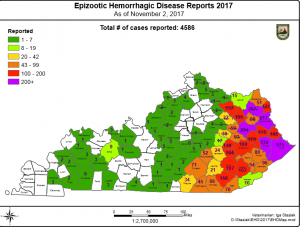 The recent cold snap experienced across Kentucky effectively ended the state’s worst outbreak of epizootic hemorrhagic disease in white-tailed deer in a decade.
Epizootic hemorrhagic disease (EHD) is a viral disease transmitted to deer by biting flies or midges. It does not affect people or pets, and outbreaks cease at the first frost, which kills the bugs.
The Kentucky Department of Fish and Wildlife Resources receives and confirms EHD deer mortalities each year but the outbreak this year was severe by comparison. The department started receiving reports of sick or dead deer in some east Kentucky counties in July. August brought confirmation that a common strain of the EHD virus was to blame.
The department encouraged the public to report suspected cases, and the public responded. Kentucky Fish and Wildlife fielded 1,822 individual reports and documented 4,586 suspected EHD cases through phone calls and an online reporting system.
“Kentucky Fish and Wildlife would like to thank the public for its assistance,” said Dr. Iga Stasiak, state wildlife veterinarian with Kentucky Fish and Wildlife. “The incredible response we received was invaluable in helping us gauge the extent and intensity of this year’s severe outbreak. The public’s feedback through those outlets helped biologists monitor the situation in real-time and generate incredibly helpful maps.”
This year’s outbreak affected multiple states across the Appalachian Plateau. In Kentucky, it was primarily confined to counties along and south of Interstate 64 and east of Interstate 75. The epicenter of the outbreak in Kentucky appeared to be in Floyd and Pike counties.
The severity of this year’s outbreak in east Kentucky is comparable to that seen in other parts of the state in 2007. While EHD can cause significant regional population die-offs, populations recover with time, Stasiak said.
“The herd is resilient,” said Gabe Jenkins, deer program coordinator with Kentucky Fish and Wildlife. “We had probably the highest densities of deer that we’ve ever seen in that part of the state. Yes, it knocked them back pretty hard but the population will rebound.”
Herd estimates after the 2016-17 hunting season pegged the statewide deer population at about 850,000 animals.
Kentucky’s deer seasons are continuing as scheduled this year.
“Department biologists will be looking closely at harvest data and monitoring the deer herd ahead of next year’s hunting season,” Stasiak said. “We will also be monitoring deer at several check stations throughout the hunting season to identify deer that may have been exposed to the disease and assess the degree of immunity in the herd.”
Although EHD is not transmissible to people, the department reminds hunters to avoid eating animals that appear to be sick and asks that sick deer be reported to the department either by calling 1-800-858-1549 between 8 a.m.-4:30 p.m. (Eastern) weekdays or contacting their local private lands or public lands biologist, depending on where the animal was observed.