Saturday December 6, 2025
Local Connection
 Weather
 Traffic
 @LouisvilleDispatch
 @LouisvilleDisp
 Subscribe
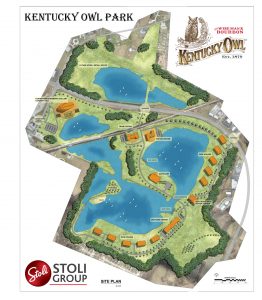 In one of bourbon country’s largest single projects, Gov. Matt Bevin and leaders of Stoli Group broke ground recently for Kentucky Owl Park, a nearly $150 million lakeside complex to include a distillery, visitors center, cooperage, rickhouses, bottling center, restaurant and other facilities at Bardstown’s 420-acre Haydon Materials Quarry.
“Global demand for bourbon continues to bring significant economic impact to Kentucky through jobs, investment and tourism,” said Gov. Bevin. “This new project by Stoli Group in the heart of bourbon country will serve to accelerate this trend. Stoli Group will offer numerous employment opportunities and support many families in and around Nelson County. I congratulate the company and look forward seeing this concept come to life over the coming years.”
Site prep and construction for the project’s first phase — which includes the distillery — could begin early next year with an opening targeted for 2020. It would create approximately 57 of the park’s anticipated 77 total full-time jobs. The park will be home to Stoli Group’s newly created American Whiskey Division, including its storied 140-year-old Kentucky Owl brand.
“Stoli Group will put great resources into these endeavors — both the distillery experience and the growth of this very important category for our company. As master blender, Dixon Dedman will continue to manage the production of Kentucky Owl — the crown jewel of the new division, which will remain a small batch offering,” said Dmitry Efimov, head of Stoli Group’s American Whiskey Division. “This site will be home to additional brands that we will create or acquire. With the continued strength and growth of American whiskies and bourbons, we are beginning to evaluate those opportunities.”
Stoli Group purchased the Haydon Materials Quarry, formerly Cedar Creek quarry, along John Rowan Boulevard in Bardstown, to provide a unique topographical setting. In the long-term, company leaders plan to establish the park as a premier destination on the Bourbon Trail. Their plans include a freshwater lake for fishing and recreation, a gourmet restaurant, a convention center and hotel, a vintage passenger train and a refurbished train station.
Established in 2013, Stoli Group is responsible for the management, distribution and marketing operations of SPI Group’s global spirits portfolio. One of the world’s leading wine and spirits organizations, SPI Group is an independent company headquartered in Luxembourg committed to a mission of building a respected portfolio of select premium brands. Additionally, SPI Group develops large-scale real estate projects, including the Finos Tequila distillery in Jalisco, Mexico and the award-winning Bayou Rum distillery and visitors center in Lacassine, Louisiana, and farms 14,000 acres of agricultural land, including for its Stoli and elit Vodkas in Tambov, Russia.
Sen. Jimmy Higdon, of Lebanon, said Stoli Group promises to grow the state’s strong reputation in the bourbon industry.
“I am so pleased to hear Stoli Group has chosen this Bardstown location to be Kentucky’s newest bourbon-based economic development project,” Sen. Higdon said. “Kentucky’s signature bourbon industry has showed no sign of slowing, and with this huge investment in the region and the creation of new Kentucky jobs, I have no doubt that Stoli Group will join the ranks of great distillers.”
Rep. Chad McCoy, of Bardstown, said the project will have a substantial impact on the already thriving local bourbon industry.
“Stoli Group understands the rich tradition of bourbon in the commonwealth, and we are thrilled the company is expanding a recently acquired family business to Bardstown,” said Rep. Chad McCoy, who serves as vice-chair of the Licensing, Occupations and Administrative Regulations Committee. “The distillery is a boon for our community and will cement Bardstown’s transformation into the premiere bourbon destination for Kentuckians and people from all over the world.”
Bardstown Mayor Dick Heaton said the company has found the perfect home in Nelson County.
“We are extremely happy to have Stoli Group’s American Whiskey Distillery join our growing family of distilleries in Bardstown and Nelson County,” Mayor Heaton said. “Bardstown is known as the Bourbon Capital of the World. This new investment is a testament that there is no better place to make bourbon, educate and entertain visitors than Bardstown, Kentucky. The announcement comes as a result of much hard work by many people in the public and private sector here. The City of Bardstown is proud to be a part of this exciting project.”
Nelson County Judge-Executive Dean Watts said the project will have a positive impact on the community.
“The announcement of Stoli Group’s American Whiskey Distillery coming to Nelson County is excellent economic news,” Judge-Executive Watts said. “We appreciate their investment in our community and look forward to helping with their success.”
To encourage the investment and job growth in the community, the Kentucky Economic Development Finance Authority (KEDFA) in September preliminarily approved the company for tax incentives up to $2 million through the Kentucky Business Investment program. The performance-based incentive allows a company to keep a portion of its investment over the agreement term through corporate income tax credits and wage assessments by meeting job and investment targets.
In October, KEDFA approved SPI Group for up to $1.2 million in tax incentives through the Kentucky Enterprise Initiative Act (KEIA). KEIA allows approved companies to recoup Kentucky sales and use tax on construction costs, building fixtures, equipment used in research and development and electronic processing.
In addition, SPI Group can receive resources from the Kentucky Skills Network. Through the Kentucky Skills Network, companies can receive no-cost recruitment and job placement services, reduced-cost customized training and job training incentives. In fiscal year 2017, the Kentucky Skills Network provided training for more than 120,000 Kentuckians and 5,700 companies from a variety of industry sectors.
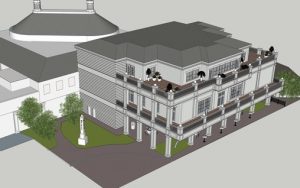 The Kentucky Derby Museum announces a $6.5 million renovation and expansion project, adding over 11,000 square feet of brand new space and renovation of an existing 5,000 square feet. It will be the largest expansion of the Museum’s footprint since the building was constructed in 1985 and one of the largest renovations since a major refurbishing project following damaging flooding in 2009.
The expansion will provide a greater visitor experience for guests with an emphasis on new exhibit space. The recently acquired D. Wayne Lukas collection will be featured in its own permanent gallery. It also creates space to display key pieces of the Bill Shoemaker collection, which has been housed in the Museum’s archives for many years. The expanded second floor will feature other exhibits, plus additional meeting and rental space.
The Museum will build an entirely new third floor within the expansion footprint to house administrative offices, a large conference room and storage areas.
On the ground level, a new stable will house the Museum’s resident Thoroughbred and miniature horse. The area will include seating for educational programming. It also features more than 7,400 square feet of covered space that can be set for various events, including outdoor weddings, dinners, parties and more. With the addition of the new rental space, the Museum will be able to host events with as many as 1,300 people.
The Museum closed out fiscal year 2017 with a record-setting attendance number, welcoming more than 230,000 visitors through its doors, an increase of 5.6 percent over the previous fiscal year. The energy of that success compelled the Museum’s Board of Directors and leadership team to pursue an expansion project and enhance the overall visitor experience.
“We wanted to build upon the momentum of our recent growth and take the Museum to the next level. With this expansion, we’ll create a new, dynamic way to present our mission to engage, educate and excite everyone about the extraordinary event that is the Kentucky Derby to guests from around the world,” Kentucky Derby Museum President and CEO Patrick Armstrong said.
“The Kentucky Derby Museum is one of the city’s iconic attractions drawing both leisure and convention travelers looking for an authentic Louisville experience,” Karen Williams, President & CEO of the Louisville Convention & Visitors Bureau said. “The expansion and renovation will offer our visitors even more one-of-a-kind opportunities to enjoy the thrills and traditions of the legendary Kentucky Derby.”
Construction is set to begin after Kentucky Derby 2018 and is expected to be complete by November, in time for the 2018 Breeders’ Cup at Churchill Downs Racetrack.
 Mayor Greg Fischer announced that Louisville has again been ranked a top digital city nationally, placing in the Top 5 in the Center for Digital Government’s Digital Cities Survey.
The annual survey, now in its 17th year, “recognizes cities using technology to improve citizen services, enhance transparency and encourage citizen engagement,” according to the center.
“In this changing world, we have to keep innovating to serve our citizens. Louisville has been a national leader in using technology and data to improve city services and create opportunity, and this recognition is another confirmation of our team’s hard work and innovative spirit,” Mayor Fischer said.
Earlier this year, Louisville ranked second in the Government Experience Awards from the Center for Digital Government for efforts to improve online services and access on the city’s web portal www.louisvilleky.gov.
The city’s Office of Civic Innovation is working to integrate city services with Amazon Echo, working to improve broadband services with companies such as Google Fiber (https://fiber.google.com/cities/louisville/), helping to remove barriers to digital access with the Digital Inclusion Plan (http://digitalinclusion.louisvilleky.gov/) and have deployed services on the IFTTT platform with the Smart Louisville initiative (https://louisvilleky.gov/government/smart-louisville).
“This year’s leading digital cities are leveraging technology to connect disadvantaged citizens with critical information and services, promote citizen inclusion in important government processes and share government data with the public,” said Teri Takai, executive director of the Center for Digital Government. “Thanks to the efforts of these innovative cities, citizens can now meaningfully interact with city government more easily than in any other time in history. Congratulations to the winners!”
This year the survey honors cities in five population classifications. Louisville placed fifth in the 500,000 or more classification:
500,000 or more population category:
1st City of Los Angeles, CA
2nd City of Albuquerque, NM
3rd City of San Diego, CA
4th City of Charlotte, NC / Philadelphia, PA
5th City of Louisville, KY
6th City of Denver, CO /City of Seattle, WA
7th City of Boston, MA / Phoenix, AZ
8th City of Austin, TX / San Jose, CA
9th City of Tucson, AZ
10th City of El Paso, TX
Learn more about the awards (http://www.govtech.com/dc/Digital-Cities-Survey-2017.html), part of e.Republic and get highlights from the winning cities.
 Belle of Louisville named best of the best award winner from American Bus Association for the hard work and dedication of the group sales and marketing team giving careful attention to the motor-coaches when they arrive for their cruises.
More information can be found at the American Bus Association website.
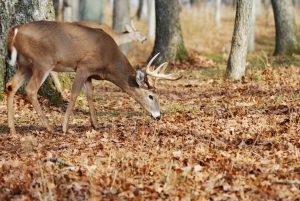
Photo: Kevin Kelly/Kentucky Department Fish and Wildlife
A burst of fall colors, frosty mornings and an uptick in deer activity recently are encouraging and telling signs for hunters.
The season that contributes the greatest percentage of Kentucky’s annual deer harvest and fills many freezers with protein-rich venison is almost here.
Modern gun deer season opens statewide Nov. 11, 2017.
“Opening day should be spot on,” said Gabe Jenkins, deer program coordinator for the Kentucky Department of Fish and Wildlife Resources. “Our gun hunters should have some fantastic deer activity. The start of the season falls early this year. It touches on the end of the chase period and continues into the peak of the rut. We should see some good movement early and late in the season.”
Kentucky’s modern gun deer season is designed to coincide with the peak of fall breeding, known as the rut. It runs for 16 consecutive days in Zones 1 and 2 and for 10 consecutive days in Zones 3 and 4.
County zone assignments are published in the annual Kentucky Hunting and Trapping Guide, available on the department’s website at fw.ky.gov and where licenses and permits are sold. The guide also provides information about license and permit requirements, hunter education and hunter orange requirements, bag limits and legal equipment for deer hunting. Also available on the department’s website is a detailed list of frequently asked questions about deer hunting in Kentucky. Type “Deer Season FAQs” into the search box on the homepage to access it.
Hunters in Kentucky have taken more than 130,000 deer annually over the past five seasons. The 2016-17 tally was the third highest on record with the modern gun season harvest accounting for more than 70 percent of that figure.
This year, the modern gun season harvest will provide biologists additional data to further assess the scope and impact of the outbreak of epizootic hemorrhagic disease (EHD) in eastern Kentucky.
As of Nov. 2, Kentucky Fish and Wildlife had received reports of more than 4,500 sick or dead deer across the state since mid-July. The outbreak was confined primarily to counties east of Interstate 75 and along and south of Interstate 64.
EHD is a virus spread by small biting flies or midges. A recent cold snap effectively ended the outbreak since frost kills the insects that carry the disease.
The virus is not transmissible to people and the meat is safe to eat. In any year, hunters are advised to avoid eating the meat from animals that appear to be overtly sick.
Hunters concerned about hunting elsewhere in the state should have no reservations whatsoever, Jenkins said. The herd remains robust.
“We’ve got a lot of deer,” he said. “I look for it to be just as strong in the rest of the state as it has been in recent years. We had a good fawn year last year, good acorns last year, a mild winter and nice summer. All factors for good survival, good antler production. Lots of goods in there.”
The statewide deer harvest from September’s record opening weekend of archery season through October was up compared to 2016. Harvest reports from the youth-only gun and early muzzleloader seasons in October were down.
A middling mast crop could play to the hunter’s favor. This year’s statewide mast survey found about a third of white oaks with acorns. Red oak acorn production was better at 63 percent. White oak acorns are the first choice for deer because they are sweeter and more palatable to deer than red oak acorns, which have higher tannic acid.
“If you find a white oak with acorns, be on it,” Jenkins said. “During the early muzzleloader season, two does came right underneath me. There was a red oak tree and a white oak tree and one of the does was just sniffing around trying to find those white oak acorns and passing up those red oak acorns. She’d find one and crunch, crunch, crunch.”
In addition to the hunter orange and hunter education requirements, as well as following the guidelines for safe handling of firearms, hunter safety during the modern gun season also extends to the use of tree stands.
Serious accidents can be prevented by following the manufacturer’s instructions for installation, use and maintenance of tree stands.
Hunter education classes offered by Kentucky Fish and Wildlife cover the basics of tree stand safety. Olivia Dangler, a conservation educator with the department, said hunters must not let their guard down.
“Do not let your excitement cause you to forget about safety,” she said. “It does not matter how good of a climber you are, or if you think it will never happen to you, always wear a harness and stay clipped into the tree because it can save your life.
“Inspect your equipment prior to use and wear a full body harness whether you are hanging, practicing or hunting from a tree stand. Once you leave the ground, your harness should be connected to the tree. According to the International Hunter Education Association, 99 percent of fall victims injured were not attached to the tree.”
Tree stands and harnesses are rated to support up to their stated weight capacities.
Keep your hands free and never carry equipment while climbing up to or down from a tree stand. Use a haul line to raise or lower equipment instead.
“Firearms should be unloaded with the safety on,” Dangler said. “Attach the haul line to the sling or stock so the muzzle is pointed down when pulling it up to you or lowering it to the ground. If using a bow while hunting, make sure it is unloaded before attaching the haul line and have arrows secured in covered quiver.”
An online tree stand safety course can provide a good introduction or refresher. A free, interactive course is available through the Treestand Manufacturer’s Association website at tmastands.com.
Hunters should choose trees that are straight and large enough to adequately support their tree stands. Avoid ash trees. The emerald ash borer has decimated the ash tree population in recent years. Any ash trees still standing should be considered unsuitable. Knowing where ash trees are in proximity to your location is another important consideration. Dead limbs can break under their own weight without warning.
Hunters who are still looking for a place to hunt can find information about public lands on the department’s website. On any wildlife management area that allows gun deer hunting, anyone hunting from inside a ground blind must now attach a hat or vest made of solid, unbroken hunter orange material to the outside so it is visible from all sides. Hunter orange clothing requirements still apply for anyone inside the blind.
Once you know where you will be hunting, it’s always a good idea to let a family member or friend know where you will be that day and when you expect to return.
“Get out there and go,” Jenkins said. “The full-swing rut is definitely here.”
Registration deadline is Oct. 22
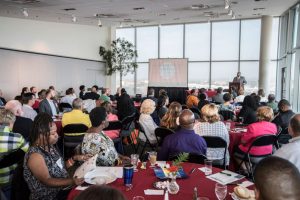 A Nov. 2 economic development forum focused on west Louisville will examine strategies and available resources to help rebuild and sustain communities.
The University of Louisville’s College of Arts and Sciences is offering the public event, “The Future of Our Community: West Louisville Economic and Community Development Forum,” at the Kentucky Center for African American Heritage, 1701 W. Muhammad Ali Blvd. The program runs from 8:30 a.m. to 5 p.m.
Advance registration is required by Oct. 22 for the forum, which includes lunch. Participants should visit http://uofl.me/wledf-2017 and pay online or by check; fees are $60 for corporate representatives, $50 for individuals and $40 for students.
Forum breakout sessions will focus on creative financing for individual and large construction projects, economic opportunities for minority-owned firms, successful neighborhood planning and access to lending opportunities. Panelists will include residents, developers, financiers, entrepreneurs and government and community group representatives.
WAVE 3 News anchor Dawne Gee will serve as mistress of ceremonies for the event.
The program includes a 12:45-2:15 p.m. luncheon panel with former National Basketball Association players Derek Anderson and Darrell Griffith discussing “Giving Back: The Power of Investing in the Community” and a tribute to philanthropist and civic leader Charlie Johnson.
The A&S international, diversity and engagement programs office organized the forum. Other partners are Brown-Forman Corp., OneWest, PNC Bank, Federal Reserve Bank of St. Louis-Louisville Branch, Louisville Metro Council, Louisville Housing Authority, Louisville Forward, U.S. Rep. John Yarmuth and UofL’s urban and public affairs department.
For a full schedule of sessions and speakers, see the forum’s website. For more information, contact Clest Lanier at 502-852-3042 or cvlani01@louisville.edu.
EnterpriseCorp, the entrepreneurial support arm of GLI, welcomed nearly 300 people to the Kentucky Derby Museum for the annual Evening of Entrepreneurship, presented by Wyatt Tarrant & Combs, Wednesday evening. The event featured a keynote presentation by Frederique Dame, a well-known angel investor and former product engineer for Uber, and gave the region’s startup community a chance to celebrate their accomplishments and look ahead to the work that needs to be done to accelerate the region’s startup community.
“We’ve taken huge steps forward in just a year’s time and as other communities have taught us, once the ball is rolling it’s hard to stop it. We have every reason to be optimistic about the state of entrepreneurship in our region. Yes, there are challenges that we need to take head on to keep up the pace of this progress, but there is so much to be proud of and so many opportunities to connect, engage and grow our region’s startups,” Lisa Bajorinas, Vice President of Entrepreneurship and Talent for GLI, told the crowd during her State of Entrepreneurship address.
The theme of this year’s program was customer development, specifically the clients that have made the biggest impact on local startups and entrepreneurs. Dame’s speech centered on her time at Uber and how the company scaled from early stage to global success by listening to their drivers and customers pain points and working from that point.
“Building a product with the customer is not only essential. It’s also really fun,” Dame said. “If you’re not building for the customer, then what is your business actually doing?”
Dame also took the chance to comment on the landscape of tech startups and how established companies and entrepreneurs can work together.
“Being beta testers, as a large customer, would be incredible help to small startups and the large companies can benefit from the collaboration with startups to increase their agility within their markets,” Dame said.
In addition to Dame’s address, Mary Tapolsky took home 2017’s EnterpriseCorp Award, which recognizes an individual that has made a significant contribution to Louisville’s entrepreneurial community.
Tapolsky is the Director for Technology Commercialization and Program Administration for UofL’s Nucleus. She focuses on developing and administering programs and services to help facilitate the creation and success of startup and early stage companies. These programs include LaunchIt, an entrepreneur training program that has graduated over 380 entrepreneurs, RevIt – Accelerating Customer Growth, VetStart, Open Office Hours, e + i Entrepreneurs Meet Innovators, Nucleus MeetUps, and Startup Seminar Series – Educating Entrepreneurs. In addition, she administers the Nucleus Startup Grants program and has been instrumental in recruiting more than twenty technology-based companies to One Innovation Center.