Monday December 15, 2025
Local Connection
 Weather
 Traffic
 @LouisvilleDispatch
 @LouisvilleDisp
 Subscribe
With the impending arrival of street sweeping season, Mayor Greg Fischer today reminded Louisville residents to sign up to receive an automatic notice, via text or email, when their street is scheduled to be swept by Metro Public Works.
The alerts system was introduced last year as a way to notify residents in advance that they must find alternate parking on street sweeping day. No parking is allowed on affected streets during street sweeping, and violators are subject to citation and/or towing.
About 6,000 people signed up for the alerts last year. As a result, the number of parking tickets issued for street sweeping violations dropped from 12,938 in 2015, to 7,493 in 2016. “This year, we want to build on that success and get even more people to sign up for electronic street sweeping alerts,” the Mayor said.
“The people of Louisville deserve clean streets. And we want to work with citizens to make sure they know when sweeping is happening so our streets get cleaned, and nobody has to get towed or ticketed.”
Residents can subscribe to the alerts by going to 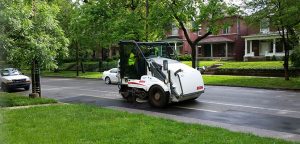 https://louisvilleky.gov/city-services/mylouisville and entering their address in the MyLouisville box and following the brief instructions for choosing email and/or text alerts (Note: You must at least enter an email address). They are also able to subscribe to reminders for Project Pickup junk collection dates.
Subscribers are alerted one week in advance that street sweeping is scheduled for their general area. A second alert goes out the day before street sweeping to tell residents that their particular block is to be swept. The alerts are in addition to signs that are posted on affected streets on the business day preceding street sweeping.
Street cleaning is scheduled from March through November. During that time, curbed neighborhood streets are generally cleaned three times.
- Street cleaning signs are posted prior to 5 p.m. on the business day before sweeping occurs. They alert residents that there is No Parking between the hours of 7 a.m. and 5 p.m. on sweeping day.
- Sweeping is conducted each day on east/west streets only, or north/south streets only, to make it easier for residents to find alternate parking.
- Vehicles parked in No Parking areas are subject to citation and/or towing.
- Residents should not park in affected areas until after 5 p.m., even if it appears an area has been swept, as sweepers may return before that time.
- The No Parking zone covers both sides of the street, though signs may only be posted on one side.
The MyLouisville online tool also provides information on garbage and recycling collection dates, emergency services and political representation, in addition to the alerts.
Kentucky needs more funding to combat the spread of invasive Asian carp in the state’s waterways.
To help fund this need, members of the Kentucky Fish and Wildlife Commission’s Administration, Education and Policy Committee have recommended that the full commission consider increasing Kentucky boat registration fees at its March 17 meeting. The recommendation does not include fees on paddlecraft such as canoes or kayaks.
Committee members say the increase is necessary to blunt Kentucky’s population explosion of Asian carp. These invasive carp, which threaten native sport fish species and present a safety hazard to recreational boaters, endanger the $1.2 billion fishing and recreational boating industry in western Kentucky.
Kentucky is now home to three types of Asian carp: silver carp, big head carp and now black carp. Silver and big head carp numbers have exploded along most of the Ohio River and its tributaries. They are prevalent in Kentucky and Barkley lakes.
A typical silver carp weighs from five to 30 pounds. Big heads can weigh more than 100 pounds, but 50-80 pounds is more common.
Asian carp school by the thousands and can fill the air with jumping fish when a boat motor startles them. “The surface of the water around and in front of a moving boat can suddenly erupt with thousands of jumping fish,” said Fisheries Division Director Ron Brooks, a nationally recognized authority on this invasive species. “The damage to boats and injuries to boaters caused by high speed collisions with these fish are increasing each year.”
Safety problems caused by Asian carp are growing. The department already receives reports of water skiers and tubers being struck by jumping fish while skimming behind a boat going 30 mph. On some Kentucky waterways, it is becoming a likely and dangerous occurrence.
Controlling Asian carp is a challenge for states drained by the Mississippi River and its various tributaries.
“Asian carp are extremely prolific breeders and have been competing with our native fisheries for quite some time,” said Kentucky Fish and Wildlife Commissioner Gregory Johnson. “Each female fish can produce up to a million eggs and spawn multiple times each year. Their numbers have reached the point now where they even threaten the safety of our boaters.”
Recreational boaters threatened by the presence of Asian carp may be asked to help fund the effort to take on this menace.
Kentucky annually registers more than 170,000 motorized vessels. Boater registration fees pay for new boat ramps, maintenance of 165 aging ramps and provides for boating safety and enforcement.
Kentucky has not raised its boat registration fees in 15 years. In evaluating the state’s pricing structure, committee members noted that registering a boat in Kentucky costs far less on average than the surrounding states. Proposed new rates would continue to keep Kentucky’s registration fees lower than neighboring states.
Controlling the fishes’ numbers and territorial expansions are forcing the department to seek additional resources. Department officials identified a shortfall of about $1.8 million needed for Asian carp control, engineering programs that build and maintain boat launch ramps for boater access, boater safety and enforcement.
The recommendations include increasing registration pricing for boats under 16 feet in length from $19 to $24 (neighboring state average is $22.50); boats 16-26 feet from $23 to $38 (Neighbor average is $40); boats 26-40 feet from $29 to $50 (neighbor average is $72); and boats longer than 40 feet from $33 to $60 (neighbor average is $96). Inboards would increase from $34 to $47 and boats powered only by trolling motors from $9 to $14.
Secretary of State Alison Lundergan Grimes on Tuesday urged lawmakers to renew a Kentucky law that provides tax incentives to Kentucky farmers who donate to food banks. Grimes was a prominent backer of legislation creating the incentives.
“Kentucky farmers grow some of the best agricultural products in the country and the world,” said Grimes. “And knowing that as many as one in six Kentuckians is impacted by lack of food, the Farms to Food Banks tax credits for farmers who donate to Kentucky food banks are more important than ever. We should not only renew the credits, but increase their value.”
Grimes is joining Agriculture Commissioner Ryan Quarles in lobbying the legislature for the renewal of the tax credits that House Bill 141 created in 2013. The Kentucky Nonprofit Network recognized Grimes for her work on the legislation last year.
Joining other Kentucky constitutional officers and legislators, Grimes also announced at the rally that her office will launch a Commonwealth of Kentucky Bowl food drive this fall. The drive will be held amongst Kentucky businesses and community organizations to help food banks at an important time of need – just before the holidays.
“One in four Kentucky children don’t always know where their next meal will come from,” said Grimes. “We have to do better. That’s why I will be calling on the more than 200,000 businesses that make up the Commonwealth’s business community to help us feed the children and their families this holiday season.”
Grimes is partnering with the Kentucky Association of Food Banks, which hosted Tuesday’s rally, for the bowl. She is challenging local chambers of commerce to participate by coordinating donations with their members.
Grimes has been a champion for solving Kentucky’s hunger issues since she took office in 2012 and before she was elected to public office. She is a longtime volunteer at the Salvation Army, serving the Thanksgiving meal at her local service center every year. She also has served on the board of God’s Pantry Food Bank in Lexington.
At the rally, Grimes thanked the farmers who participate in the tax credit program and Kentucky’s food banks for their tireless work to help eradicate hunger and food insecurity in the Commonwealth.
“Scripture calls us to help feed those who are hungry. Every Kentuckian that doesn’t worry about when they will eat their next meal or how they will feed their family has a role to play in ensuring no other citizen of this Commonwealth has those worries,” said Grimes.
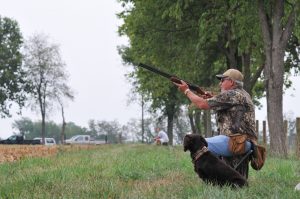 Kentucky farmers can earn some much-needed extra cash by enrolling in the Cooperative Dove Field Program. Enrollment is underway and continues through March 1.
The Cooperative Dove Field Program pays landowners to lease fields on their property for public dove hunting.
“Landowners may earn up to $10,000 in the Cooperative Dove Field Program,” said Wes Little, migratory bird biologist for the Kentucky Department of Fish and Wildlife Resources. “They earn $300 per acre planted.”
Little said the department has accepted fields ranging from six to 40 acres with additional lease payments offered for buffers around planted fields. “Fields generally run from 20 to 30 acres in size,” he explained. “But, we encourage anyone interested to apply.”
Farmers may plant sunflowers, millet or another acceptable crop for a public dove field by working with a Kentucky Fish and Wildlife private lands biologist and following some simple guidelines.
Payment amounts depend on the number of acres enrolled, crop type and fulfillment of the plot management agreement with Kentucky Fish and Wildlife.
The department is especially interested in reaching agreements with property owners who have acreage in underserved areas with significant numbers of dove hunters. In the west, this includes Caldwell, Calloway, Christian, Daviess, Fulton, Grayson, Hardin, Hart, Hickman, LaRue, Logan, Lyon, Simpson, Todd and Trigg counties. In southcentral Kentucky, this includes Boyle, Cumberland, Laurel, Lincoln, Pulaski and Wayne counties.
To get the process started, landowners must contact their Kentucky Fish and Wildlife private lands biologist or Natural Resources Conservation Service liaison. For a listing of biologists, visit the Kentucky Fish and Wildlife homepage at www.fw.ky.gov and search under the keywords, “private lands biologist.” Property owners may also call the department at 1-800-858-1549 for more information.
Five new lakes enrolled in the Fishing in Neighborhoods Program (FINs) will receive stockings of trout in February, a boon to anglers tired of being house bound.
Flemingsburg Old Reservoir, an 11-acre lake in Fleming County, gets 900 trout while Leary Lake, a 5-acre lake on Lloyd Wildlife Management Area in Grant County, gets the same amount of trout. The 9-acre Logan-Hubble Park Lake just south of Lancaster in Garrard County will receive 900 trout as well.
The 2-acre Kess Creek Park Lake in Mayfield in Graves County will get 500 trout as will the Clinton Rotary Park Lake in Clinton in Hickman County. Both of these lakes are in the Purchase Region.
“We are stocking a larger-sized trout in all of our FINs lakes for 2017,” said Dane Balsman, coordinator of the FINs program for the Kentucky Department of Fish and Wildlife Resources. “The larger trout now average about 10 to 11 inches long and one-half pound in weight.”
Kentucky Fish and Wildlife formerly stocked its traditional “stocker” trout of 9 to 10 inches in the FINs lakes. “We wanted to improve angler satisfaction and utilization as well as reducing hooking and handling mortality. These fish won’t be caught as many times and anglers are more likely to harvest a larger trout.”
Balsman cautions anglers fishing on a FINs lake to practice beneficial catch and release tactics when they catch a trout, especially as the water warms. Anglers can purchase inexpensive fish grabbers to prevent touching or squeezing a trout when removing the hook. These devices prove valuable when handling fish that may cause injury, such as a catfish or fish with teeth, such as a muskellunge.
Forty-three lakes across Kentucky are in the FINs program. They offer fantastic fishing for trout, but also excellent fishing for catfish and largemouth bass.
“We will start in March with the catfish stockings in FINs lakes,” Balsman said. “Due to hatchery expansion, we now have the capabilities to raise all of the FINs catfish in house. We will stock about 125,000 catfish in our FINs lakes.”
Largemouth bass anglers usually turn to waters such as Kentucky Lake, Barren River Lake or state-owned lakes, such as Lake Malone or Lake Kincaid, for a chance at a trophy fish.
“We see exceptional largemouth bass in the FINs lakes, many of them big bass,” Balsman said. “We saw a 9.7-pound largemouth bass from Mike Miller Park Lake this past year, my personal best I’ve seen in a FINs lake. We routinely see 6- to 8-pound bass in the spring.” Four-acre Mike Miller Park Lake lies near Draffenville in Marshall County.
Balsman recommends early spring as the time to catch these bruisers. “We stock these lakes with trout and the bass eat them and grow big,” he said. A white spinnerbait with a silver Colorado blade works well for trophy pre-spawn largemouth bass in small lakes, especially when rains colored the water a touch. A large soft-plastic swimbait in trout colors may also work well in these lakes.
Many anglers flock to Kentucky Lake or Lake Barkley each May for the redear sunfish spawn. Anglers do not need to go that far.
“Some of these lakes have really good redear sunfish in them,” Balsman said. “Three Springs Park Lake near Bowling Green and Madisonville City Park Lake South have great populations of redear sunfish. Both lakes offer trophy potential of 10-inch and longer redear sunfish.”
Lake Mingo in Nicholasville, just south of Lexington has moderate numbers of redear sunfish, commonly called shellcrackers. However, Balsman said some of them are true trophies, running 12 inches or more.
“The trout and catfish are for put and take fishing,” Balsman said. “There is trophy potential for redear sunfish and some of these lakes are great bluegill lakes as well.”
The main point of the FINs program is providing a place close to home for folks to go and have a reasonable expectation of catching fish.
“We want people to be able to go fish the FINs lakes after work in spring and summer or take the kids and fish for an hour or two on the weekends and catch fish,” Balsman said. “The convenience factor is whole point of the FINs program.”
Remember, current fishing licenses expire Feb. 28. It is a good idea to buy your fishing license soon.
The West Louisville Community Council (WLCC), One West, and Louisville Forward
are offering west Louisville the opportunity to share the historic legacy of the Shawnee, Russell, and Portland
neighborhoods through art. This partnership of local residents, non-profit organizations and city government is asking artists to submit artwork that can be considered for display on a billboard at 30th Street and Muhammad Ali Boulevard on the Heritage West site.
Designs will be accepted from middle school students through adults who live, work, worship, or learn in the 40203,40210, 40211, or 40212 zip codes. Designs must help tell the story of a vibrant west Louisville community with active families, rich history, and numerous possibilities. This is an opportunity for west Louisville residents to tell their story through art.
A panel of local west Louisville artists will select the best work from each of three categories: Middle/High School (grades 6-12), Young Adult (ages 18-35), and adult (age 36+). The community will then be invited to vote for their favorite design at the March 13, 2017 WLCC Meeting. Cash awards will be presented to the 1st ($500), 2nd ($300), & 3rd ($100) place designs.
The Heritage West Art Competition will officially launch on February 6, 2017 at the WLCC Meeting held at Southern Star Community Center ( 2308 Algonquin Pkwy, Louisville, KY 40210) from 6:00-7:30pm. During the meeting entry forms and complete guidelines will be made available. Entry forms can also be downloaded at www.wearewestlouisville.weebly.com after the February 6th meeting.
The deadline for entry is Monday, February 27, 2017.
Everyone is invited to the WLCC Meeting on February 6th. In addition to launching the Heritage West Art Competition, we will present the WLCC Development Priorities & Visioning Report and initial strategies for community input regarding development of Heritage West. The Development Priorities & Visioning Report is a presentation of ideas gathered from a community visioning session held at the Louisville Urban League in September 2016.
Contact: Ramona Lindsey, wlccouncil@gmail.com , WLCC P. O. Box 11293, Louisville, KY 40291
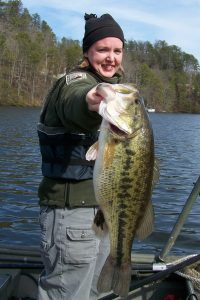
Photo From KDFW
It seems to Kentuckians that someone accidentally dropped the sun down a storm drain about three weeks ago and it hasn’t been found yet.
Day after day desolate gray skies discharged rain every few hours. Although it has been warmer than usual, this January has been a long slog.
February is the month tinges of hope arrive back in many anglers’ souls.
“Before any change of season, there are hints of the season to come,” said Mike Hardin, assistant director of Fisheries for the Kentucky Department of Fish and Wildlife Resources. “The change from late winter to spring is not abrupt. By the third week of February, you can hear spring peepers calling.”
This translates into a time when someone suffering from terminal cabin fever can catch a fish for the ages.
Warm February rains muddy the water and provide a temperature spike. “You get that good muddy water in mid- to late-February and you can pull some sows out of it,” Hardin said. “Females are gearing up for spawning. They need healthy fat reserves to get them through rigors of spawning. Instinct tells them they must eat.”
This situation is a fantastic time to catch a fat, pre-spawn female largemouth bass. Back in the day before graphite rods, bass boats or sonar units, gritty anglers would brave the weather during the first warm rains of February and employ the “jigging” technique to pull huge largemouth bass from shallow water.
They would use stout cane poles and a large hook tied to heavy black dacron line. These anglers would impale as many nightcrawlers as possible on the hook and using a skulling paddle for stealth, drop this combination beside any stump, log or other shoreline cover they could find.
Modern anglers can do the same thing with a ½-ounce black and blue jig and a flipping stick.
“That muddy water in late February is good flipping water,” Hardin said. “My uncle loved it when rains warmed the water to 51 degrees along the shoreline. He would flip a jig to the shoreline cover along those outside bends of Cave Run. That is when he caught his biggest largemouth bass. He had better weights in 51 degree water than in 70 degree water.”
Hardin said rains from the south in February also bring large muskellunge to the shoreline.
“That is when I first get my muskies,” said Hardin, who caught a 50-inch muskellunge from Cave Run Lake this past fall. “When you have a 42- to 48-degree main lake with warmer water coming in that is in the mid-50s, this is when you find fish along the shoreline.”
Some fish live suckers along the shoreline for big February muskellunge. Those anglers are strongly encouraged to employ a quick strike rig to prevent catch and release mortality. Large rattle baits, such as a muskellunge-sized Rat-L-Trap, also work well for shoreline muskellunge during this time of year.
“I also like a soft plastic bait called the Bulldawg in February,” Hardin said. “I like two-tone colors such as brown and orange. I also like the firetiger with a chartreuse tail version. I also throw jerkbaits like a Suick Thriller when they have their nose on the bank. They see that jerkbait work over their head and they hit it.”
A pronounced warm front in mid-to-late February draws big female smallmouth bass from their winter lairs into shallower water to feed heavily in lakes such as Lake Cumberland, Laurel River Lake, Dale Hollow Lake or the lower section of Green River Lake.
If warm rains accompanied the warm front, work white spinnerbaits with chrome Colorado blades right beside any submerged woody cover. This is an excellent presentation to catch huge smallmouths, especially if the water has some color to it.
If the warm front simply warms the top layer of water a degree or two without rain, big smallmouth will move up onto a flat to feed. The best flats lie adjacent to the channel on the main lake or major creek arm.
A medium-sized live shiner bottom fished in these areas is one of the best ways to catch the heaviest smallmouth bass of your life. Some anglers crawl the shiner slowly across the flat with just enough split shot weights to keep the shiner down. Others prefer still fishing shiners on the flat using a 1/4- to 3/8-ounce slip-sinker rig with a small black barrel swivel tied on the main line. An 18-inch leader of 8-pound test fluorocarbon line is tied on the other loop of the barrel swivel while the hook goes on the other end of the leader.
A size 1 Octopus-style hook works well for both presentations. You can also fish these rigs right in the middle of small cuts and tiny coves along the main lake or major creek arm for large February smallmouths.
“If you like catching big fish, February is a great month,” Hardin said. “A big fish warms you up better than a big coat.”
Remember to buy your fishing license soon. Feb. 28 is the last day of the current license year in Kentucky.