Saturday January 31, 2026
Local Connection
 Weather
 Traffic
 @LouisvilleDispatch
 @LouisvilleDisp
 Subscribe
Photo: KY Department of Corrections
Department of Corrections Deputy Commissioner Kimberly Potter-Blair today announced that Jessica Johnson has been selected as a program administrator in the Curriculum Branch of the Division of Corrections Training. Her new position was effective June 1.
“Jessica Johnson has a long history in training, both in the department and during her military service,” said Potter-Blair. “I know the experience and expertise she brings to this position will be invaluable.”
Johnson began her career with the Department of Corrections in 2012 as a correctional officer at the Kentucky Correctional Institution for Women (KCIW). She was then promoted to sergeant in June 2013. From 2014 to 2015 Johnson provided research, curriculum development and coordinated training when she was promoted to institutional training coordinator. She was promoted to a unit administrator in October 2015, where she also served as the KCIW Corrections Emergency Response Team (CERT) commander. In March 2016 she assumed the role of training coordinator/instructor at the Harold E. Black Training Center in LaGrange.
Johnson is a veteran of the United States Army National Guard. She received numerous medals during her military service, including an Army achievement medal and the National Defense Service Medal. She has served as an instructor for the use of firearms, Tasers, and controlled force during her corrections career. She is a member of the Kentucky Council on Crime and Delinquency (KCCD). Other noteworthy accomplishments include graduating from the I-LEAD program, participation in CERT from 2013 to present, and being a recipient of the 2013 Achievement Award for KCIW. Johnson obtained her bachelor’s degree in business administration at Strayer University in 2014.
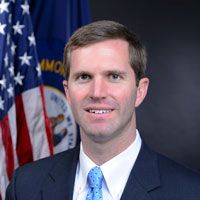 In his ongoing efforts to help improve responses to victims, Attorney General Andy Beshear and his Office of Victims Advocacy have created a statewide map of victim advocates that includes local and regional prosecutors and law enforcement agencies.
A core mission of Beshear’s is to seek justice for victims, and the map is necessary to strengthen and publicize the network of victim advocacy across the Commonwealth, Beshear said.
“We are focused on empowering victims of crime, including advancing victim-centered services, trainings and policy, and raising awareness,” Beshear said. “This map will guide survivors and their families to the appropriate agency in their county or region who can counsel them and advise them of their rights as victims.”
The map provides information on the state’s victim advocates – county attorneys, commonwealth’s attorneys, sheriffs’ offices, police departments and the AG’s office.
Beshear said Kentuckians become victims every day from surviving the violent death of a family member, sexual assault, child sexual abuse, domestic violence, gun violence and other violent crimes. Having information about their rights and access to advocacy may help victims in their healing and pursuit of justice, he said.
Beshear’s Office of Victims Advocacy will host the Victims Assistance Conference June 13 and 14 in Frankfort at the Administrative Office of the Courts to train victim advocates, survivor leaders, prosecutors, law enforcement and other allied professionals.
At the conference, Beshear’s office will present the inaugural Attorney General Distinguished Service Award to Marlene Zimmerman. Zimmerman is a victim advocate with the Jefferson County Attorney’s Office of Domestic Violence, Sex Crimes and Child Abuse Unit. Zimmerman is being recognized for “her tireless commitment, distinguished service and significant contribution to protecting victims’ rights to justice, and to improving the treatment of crime victims over the past 23 years,” Beshear said.
The conference will feature national speaker Julie Brand. Participants may choose from multiple workshops and plenary sessions for new, intermediate and advanced victim advocates. Educational topics include promoting resiliency for victims/self; ethics in victim services; examining hate crimes; navigating human trafficking cases; stalking; and sexual assault forensic exam (SAFE) kit research.
Beshear provided $4.5 million in settlement money to lawmakers in 2016 to fund requested Kentucky State Police crime lab upgrades and an additional $1 million from the settlement to aid law enforcement and prosecutors in conducting victim-centered investigations and prosecuting sexual assault offenders.
Along with funding, Beshear has created a survivors council; held multiple state trainings on the SAFE kit backlog; launched a collaborative research project with the University of Louisville to provide accountability to address the backlog; and collaborated with the Kentucky Association of Sexual Assault Programs to hold the #VoiceOfJustice video contest to raise awareness of sexual assault on campus.
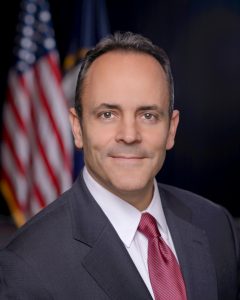 Gov. Matt Bevin today recognized the sacrifice of three Fort Campbell soldiers—Sgt. Eric M. Houck, 25, of Baltimore, Maryland; Sgt. William M. Bays, 29 of Barstow, California; and Corporal Dillon C. Baldridge, 22 of Youngsville, North Carolina—who died while supporting Operation Freedom’s Sentinel.
According to the Department of Defense, the Fort Campbell soldiers died on June 10 in Peka Valley, Nangarhar Province, Afghanistan, of gunshot wounds sustained there. The incident is under investigation.
The soldiers were assigned to Headquarters and Headquarters Battery, 3rd Battalion, 320th Field Artillery Regiment, 101st Airborne Division (Air Assault) and Company D, 1st Battalion, 187th Infantry Regiment, 3rd Brigade Combat Team, 101st Airborne Division (Air Assault), Fort Campbell, Kentucky.
Service arrangements for the soldiers are not yet complete. Gov. Bevin will order flags lowered to half-staff in honor of Sgt. Houck, Sgt. Bays and Corporal Baldridge on the date of interment, and encourages individuals, businesses, organizations and government agencies to join in this tribute.
For more information, media may contact the Fort Campbell Public Affairs office at 270-798-9963.
Flag status information is available at http://governor.ky.gov/flag-status.
 Attorney General Andy Beshear today announced that his office is working with Tennessee law enforcement to focus on the effective prosecution of vehicular homicide cases.
The annual training event, being held in Pigeon Forge June 13-15, brings together Kentucky commonwealth’s attorneys with prosecutors from the Tennessee District Attorney’s Office and crash reconstruction officers from both states.
“Unfortunately, the Commonwealth has experienced a 10 percent increase in annual highway fatalities from 2015 through 2016,” Beshear said. “My administration is focused on addressing the persistent challenges our families face, and one of those is better addressing Kentucky’s drug epidemic. Every time our families, our friends or our children get in a vehicle, they are at risk of being harmed by a driver under the influence of drugs and/or alcohol.”
In 2016, 834 people were killed on Kentucky’s roadways.
A statistic that remains constant, Beshear said, is that one in five highway fatalities are in crashes that involved alcohol.
In Kentucky last year, there were more than 6,228 collisions involving alcohol and drugs, resulting in more than 2,900 injuries and 167 fatalities.
Advanced training in this area by prosecutors and crash reconstructionists will improve the ability of prosecutors to both recognize these events as well as to successfully prosecute them when warranted, Beshear said.
Attorney General’s Traffic Safety Resource Prosecutor Robert Stokes will work in coordination with his Tennessee counterpart to present the training, which is open to the media. The training is at the Courtyard Marriott at 120 Community Drive in Pigeon Forge.
The goal of the training is to create a team building approach between crash reconstruction officers and state prosecutors, Stokes said.
The training is presented under the direction of the American Prosecutors Research Institute’s (APRI) National Traffic Law Center. Last year’s training was held at Lake Barkley State Park in Cadiz.
 The Louisville Metro Syringe Exchange Program will mark its two-year anniversary tomorrow.
Kentucky’s first syringe exchange program began in a mobile unit outside of Public Health and Wellness headquarters at 400 E. Gray St. on June 10, 2015. Since then, the program has been moved into renovated space inside and expanded to include three neighborhood sites. The exchange is open six days a week on Gray Street, and each of the neighborhood sites is open one day per week.
The demand for the Louisville Metro Syringe Exchange Program has far exceeded expectations. Originally budgeted for about 500 participants per year, the program had served 10,639 participants by the end of May 2017 and referred more than 347 to drug treatment. The ratio of syringes distributed versus exchanged remains at less than 2:1.
Additionally, since it began, the Louisville Metro Syringe Exchange Program has:
- Conducted 800 HIV tests and referred 18 individuals for medical treatment and support services;
- Conducted 691 Hepatitis C tests and referred 368 individuals for medical treatment;
- Provided overdose prevention training and naloxone kits to 995 participants and their family members or friends.
“From a public health perspective, the greatest benefit of any syringe exchange program is reducing the transmission of HIV, Hepatitis C and other infectious diseases, as well as increasing access to substance abuse treatment,” said Dr. Sarah Moyer, medical director of the Department of Public Health and Wellness. “We are very grateful to our state legislative delegation, to Mayor Greg Fischer and the Metro Council, the Board of Health and to the entire Louisville community for the support they have shown over the past two years.”
The Louisville Metro Syringe Exchange Program was begun primarily to protect the community against a potential outbreak of such blood-borne diseases as HIV and Hepatitis C spread by needle sharing among injection drug users. The neighboring community of Austin, Ind., with a population of about 4,200 and just 35 miles north of Louisville, had seen 181 new HIV cases the prior year and approximately 155 new Hepatitis C cases as a result of needle sharing. In a city the size of Louisville, that would have translated to more than 31,600 new HIV cases and approximately 27,100 new Hepatitis C cases.
According to the Centers for Disease Control, “lifetime treatment cost of a single case of HIV infection is $379, 668; the costs of treating the patients who contracted HIV and Hepatitis C in Scott County (Austin), Indiana over the next decades are expected to approach $90 million.”
In 2015 Kentucky enacted legislation allowing local health departments to operate substance abuse outreach programs, which include syringe exchange programs. The Louisville Metro Council then adopted an ordinance to approve operating a syringe exchange program for the city, and the Louisville Metro Board of Health approved the exchange.
“Addressing the heroin epidemic effectively requires a multidisciplinary approach. Harm reduction interventions like the Louisville Syringe Exchange Program are an important part of that approach,” said Moyer.
Photo: Kentucky Transportation Cabinet
Governor Matt Bevin has approved $24.9 million in Congestion Mitigation and Air Quality (CMAQ) and Transportation Alternatives Program (TAP) funds for communities across the Commonwealth. TAP and CMAQ programs are federally funded reimbursement programs administered through the Kentucky Transportation Cabinet’s (KYTC) Office of Local Programs.
“By updating this year’s priority ranking criteria, we ensured federal dollars will be spent on the greatest community needs,” said Gov. Bevin. “These funds allow investments to be made in local infrastructure that increases connectivity and serves diverse populations, such as the non-driving and disabled communities.”
This year, TAP funding for 34 projects was awarded to 28 counties while 10 CMAQ projects in various municipalities were selected. Furthermore, four ongoing TAP projects received additional funding. Projects in this year’s cycle range from new sidewalks and walk/bike paths to the purchase of new hybrid electric diesel buses that will replace traditional diesel buses.
“These funds support many Cabinet priorities such as improved safety, increased access and more efficient modes of transportation,” said Sec. Greg Thomas. “We’re pleased so many counties across the state will be able to make needed improvements to enhance the quality of life for Kentuckians.”
TAP assists communities in funding transportation improvements, such as safe bicycle and pedestrian pathways and/or facilities, safe routes to schools, scenic turnouts and overlooks and other investments. Projects may be a mix of elements and accessible to the general public or targeted to a broad segment of the general public.
Funding for TAP is authorized as a set-aside of the Surface Transportation Block Grant (STBG) funding program under the Fixing America’s Surface Transportation (FAST) Act, which authorizes federal transportation funding from Fiscal Year 2016-2020.
Both TAP and CMAQ enable local governments to recoup as much as 80 percent of the cost of a project.
CMAQ is a transportation improvement program focused on funding innovative transportation projects or programs that will reduce congestion and improve air quality. Kentucky receives CMAQ funds each year which can only be spent in areas designated as non-attainment or maintenance for the National Ambient Air Quality Standards.
CMAQ funds are available to state and local government agencies as well as private entities through public-private partnerships. Nonprofit organizations may also apply in partnership with a state or local government agency.
KYTC solicits applications and makes awards annually for these CMAQ/TAP funds. The 2016 application cycle ended on Sept. 30, 2016.
For a list of CMAQ and TAP awards by county, click here.
For more information, please visit http://transportation.ky.gov/Local-Programs.
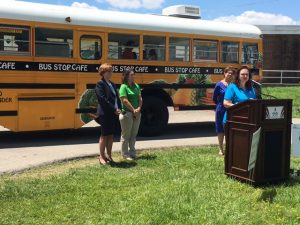
Photo: JCPS
Jefferson County Public Schools (JCPS) has kicked off its Summer Food Service Program, offering free nutritionally balanced meals to children and teens to help prevent the nutritional ‘summer slide.’ The free breakfasts and lunches are available Monday through Friday at 127 sites throughout the summer.
“We know that making sure young people maintain a healthy diet is a key factor in how much they retain of what they’ve learned,” JCPS Superintendent Dr. Donna Hargens said. “The summer food program helps ensure that a nutritious meal is readily available throughout the county, and at locations that make it easy for young people to access.”
The program operates at open sites—which serve meals to any child on a first-come, first-served basis—and at certain camps and summer programs. Participants can also get a meal at the JCPS Bus Stop Café, a converted school bus that travels to sites where young people typically gather, such as parks and pools. The program is open to anyone age 18 or under, regardless of whether they attend a JCPS school.
“JCPS is proud to sponsor the USDA Summer Food Service Program,” JCPS Nutrition Services Director Julia Bauscher said. “This program helps all children in Jefferson County have a healthy, fun summer. We hope that children will join us for summer meals at one of our 120-plus sites!”
Families can find a site near them by texting “FOOD” to 877877, checking the school menu section of the JCPS mobile app or by visiting JCPS.Nutrislice.com.
Last year, JCPS served 104,689 breakfasts and 178,121 lunches throughout the summer as part of its free Summer Food Service Program. The program is funded by the U.S. Department of Agriculture.