Sunday January 25, 2026
Local Connection
 Weather
 Traffic
 @LouisvilleDispatch
 @LouisvilleDisp
 Subscribe
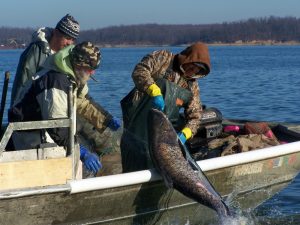 Gov. Matt Bevin today announced the award of the state’s first-ever fish house contract, in an innovative step to attack the Asian carp problem in western Kentucky and encourage job growth in the region. Bevin announced that Kentucky Fish Center, LLC of Wickliffe, Ky. has won the contract to establish the fish house, which will expand the market for Kentucky-caught Asian carp.
Angie Yu, operator of Two Rivers Fishery, a fish processing company also based in Wickliffe, will own and operate the Kentucky Fish Center. Asian carp caught in Kentucky will be sold by Kentucky Fish Center in daily auctions open to all interested buyers. The Kentucky Department of Fish and Wildlife Resources will oversee the auctions.
“The Tourism, Arts and Heritage Cabinet has worked tirelessly to develop a workable solution for mitigating Asian carp,” said Gov. Bevin. “Today’s announcement is a great example of government partnering with the private sector to create a commonsense, market-based solution. It will provide commercial anglers with new opportunities, while also removing this invasive species from Kentucky’s waterways.”
By buying carp caught in Kentucky waters at a guaranteed price of 19 cents per pound, and selling the fish to both domestic and international users in daily auctions, the fish house will play a key role in growing the market for Kentucky carp.
The Kentucky Department of Fish and Wildlife Resources is pledging up to $4 million in loans and incentives for the fish house and commercial fishermen. The department will pay commercial anglers an incentive of 5 cents per pound for their catch, supplementing the fish house’s guaranteed 14 cents per pound purchase price, to make fishing for carp in Kentucky’s waters economically attractive.
“Commercial anglers currently harvest two million pounds of Asian carp from Kentucky’s waters each year,” said Ron Brooks, Kentucky Fish and Wildlife’s fisheries director. “We believe this program can increase that catch to 20 million pounds across the state within the next five years.”
Asian carp first came to the United States to help control aquatic weeds and algae blooms in fish farms. By the 1980s, three species of Asian carp had escaped into the wild during floods. They have now spread throughout lengthy portions of the Mississippi, Ohio, Missouri and Illinois rivers. They have established significant populations in Kentucky and Barkley lakes.
Asian carp include bighead, silver, grass and black carp. They are prolific breeders. A single large Asian carp may produce up to a million eggs yearly. An Asian carp can consume 5 to 40 percent of its body weight each day. Bighead and silver carp feed voraciously on the same plankton that young sport fish such as crappie depend upon for their survival. Silver carp also jump from the water upon hearing the approach of a motor, creating hazards for boaters.
Commercial angling is the only practical method for limiting and reducing Asian carp numbers. Currently, only a handful of commercial anglers operate on Kentucky and Barkley lakes.
The incentives offered under the new distribution center contract will guarantee anglers a buyer and a nearby place to offload their catch. Brooks said the arrangement should lure more commercial anglers to Kentucky and Barkley lakes.
“We believe this will increase the amount of Asian carp coming out of those lakes to five million pounds per year,” Brooks said. “A sustained harvest of this amount will significantly reduce the impact of Asian carp on these nationally-recognized crappie lakes.”
The program includes a $734,000 secured loan for fixed assets to assist with the start-up of the fish house. Performance-based incentives of $570,000 to $700,000 a year will be awarded if the escalating yearly harvest goals of 5 to 20 million pounds of fish are met. The secured loan would be forgiven in 2024 if the 20 million pound goal is met that year. The program will be fully funded by boat registration fees.
Department officials estimate the effort would cost $3.5 million a year if it were run entirely by the state and would produce a harvest far less than the 20 million pound goal of the partnership announced today.
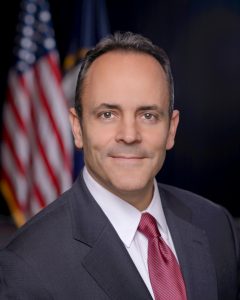 Gov. Matt Bevin has joined 15 states in a U.S. Supreme Court amicus brief supporting Second Amendment rights, in response to New York City’s restrictions on handguns kept for self-defense.
The brief was filed in response to the costly and restrictive “premises permit” required by the city to own a personal handgun for self-defense. The permit prohibits taking a weapon outside the home for any purpose other than to practice at a New York City shooting range and entirely prohibits leaving the state with the weapon. The costly “carry” permit is required to remove the weapon from the home for other purposes and is difficult to obtain.
“Citizens have the Constitutional right to ‘keep and bear Arms,’ and New York’s restrictive regulations set a dangerous precedent that heavily restricts this right and prevents responsible gun owners from protecting themselves outside of their home,” said Bevin General Counsel Steve Pitt. “Kentucky has a fundamental interest in ensuring that the Second Amendment is preserved for our citizens and that the Commonwealth is not harmed by the liberal policies of other states.”
The 16-state coalition urged the Supreme Court to review the case and provide clear guidance on the scope of the Second Amendment. The brief also calls upon the court to decide that self-defense is not limited to the home.
Kentucky joined the other states in arguing that while city and state governments have an interest in public safety and crime prevention, New York City offered no evidence that demonstrated its regulations actually enhance public safety and crime prevention. In fact, the brief argues that the restrictive regulatory scheme has the opposite effect by arbitrarily limiting a gun owner’s ability to become proficient with his or her own weapon.
The brief also points out the effect of the regulations on hunting and shooting sports, which could harm the tourism industry in states like Kentucky. “New York’s regulatory scheme discriminates against interstate commerce because it ‘deprives out-of-state businesses of access to a local market’ by forbidding its citizens from hunting and patronizing ranges outside the State with their own guns,” the states wrote.
Gov. Bevin was joined by the Governor of Mississippi in signing the brief. Fourteen states joined the brief through their Attorneys General, including Alabama, Arizona, Arkansas, Georgia, Idaho, Kansas, Louisiana, Michigan, Oklahoma, South Carolina, Texas, Utah, West Virginia, and Wisconsin.
A copy of the brief is available here.
 Louisville Metro Public Works has established a policy for regulating dockless vehicles in the city that focuses on safety and equitable access.
A dockless vehicle is defined as a bicycle, electric bicycle, or electric motor-assisted scooter, defined by Chapter 74 of the Louisville Metro Code of Ordinances, which can be located and checked out without human assistance. The electric-motor assisted bikes and scooters can travel at no more than 15 miles per hour.
As part of the policy, a total of four dockless vehicle operators are permitted to operate in Louisville. Each operator will begin with a six-month probationary period, which can lead to a full-operating permit, renewed annually. During the probationary period, operators may begin with 150 vehicles and, if ridership exceeds four rides per vehicle per day, increase their fleet by 100 vehicles per month, up to 650. Ultimately, operators will be permitted 1,050 vehicles if they successfully complete the probationary period and meet performance standards, such as responsiveness to complaints and ridership.
Dockless vehicles are permitted to operate in an operational zone, defined as within the Watterson Expressway, with extensions in the south to Palatka Road (to include Iroquois Park) and west to Shawnee Park. Dockless vehicles may not be operated at Waterfront Park, which currently offers its own bike rental service. Within the operational zone, the city has established nine distribution zones to ensure an equitable distribution of the service.
Other elements of the policy:
- Each operator will provide the city with a map and list of all parking locations for their vehicles.
- Dockless vehicles shall be relocated or removed by an operator within two hours’ notice that the vehicle is parked in an incorrect manner. Monthly data reports are required to ensure all rules are being observed.
- Dockless vehicles are to be operated on streets and, where available, in bike lanes and bike paths. Vehicles should only be operated on sidewalks when leaving or accessing a parking location.
In addition to a license application fee, annual fee, bond and fee for a designation group parking area, operators will pay $1/day per vehicle. These funds will go directly to fund improvements to our city’s shared mobility infrastructure. Other fines and administrative penalties are included to ensure compliance.
To view the entire Public Works policy on dockless vehicles, which includes a map of the operational zone, please click here.
 For the fourth year in a row, Louisville has earned a perfect 100 on the Human Rights Campaign (HRC) scorecard.
The ranking — called the Municipal Equality Index (MEI) — reflects the city’s support of the LGBTQ community, and the commitment of all Louisville Metro Government agencies to ensure the city is welcoming and inclusive.
“In Louisville, we believe that everyone has the right to be treated with respect, and that being a compassionate community means working to ensure everyone has the ability to reach their full human potential,” said Mayor Greg Fischer. “This ranking underscores our hard work and commitment to those beliefs.”
The Human Rights Campaign began in 1980 and is now the largest civil rights organization working to achieve equality for lesbian, gay, bisexual, transgender and queer Americans. It represents more than 1.5 million members and supporters.
In a press release, HRC says its index, “the only nationwide rating system of LGBTQ inclusion in municipal law and policy, shows that cities across the country, including in Kentucky, continue to take the lead in supporting LGBTQ people and workers — even in the face of renewed attacks this year on the LGBTQ community by federal and state officials.”
Mayor Fischer said Louisville’s HRC ranking is a boost to the city’s economic development efforts, given that inclusive cities are increasingly winning in the competition for residents, businesses and employees.
That message was emphasized in the HRC report, in which Richard Florida, Director of the Martin Prosperity Institute at the University of Toronto’s Rotman School of Management, noted: “Cities that do not guarantee equal rights to LGBTQ people send a strong unwelcoming message to potential visitors, residents, and investors, stymying their potential for economic advancement. In short, many businesses and top talent consider LGBTQ discrimination a deal-breaker. Fully-inclusive laws draw in diverse residents, visitors, and enterprises, the ingredients of sustained economic growth. It pays to prioritize inclusion.”
HRC president Chad Griffin said this year’s MEI “again proves that there are no barriers to municipal LGBTQ equality for a city with dedicated, pro-equality city officials. … As we approach one of the most critical elections of our lifetimes, it is incumbent on all of us to make sure that we help elect more leaders across the nation who share this uncompromising commitment to equality for all.”
Mayor Fischer applauded all city workers and staff for their work in human rights, including Louisville Metro Police and the Metro Louisville Human Relations Commission, whose mission is to promote unity, understanding and equal opportunity among all people of Louisville Metro, and to eliminate all forms of bigotry, bias, and hatred from the community.
Chris Hartman, Fairness Campaign Executive Director, said the HRC ranking highlights Louisville’s exemplary leadership on LGBTQ inclusion, which “should serve as a model for other cities in our Commonwealth and across the nation.
“As we near the 20th anniversary of Louisville’s original Fairness Ordinance in January, we’re reminded that time and time again, our city has helped pave the way for LGBTQ rights–and we’re not stopping here,” Hartman said. “We’re grateful for the dedicated work of Mayor Greg Fischer and his staff, the Louisville Metro Council and Louisville Tourism to embrace, promote and protect our diverse LGBTQ community.”
Read the full MEI report at www.hrc.org/mei.
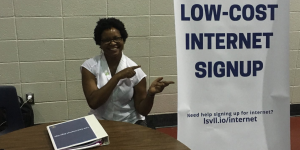 In honor of Digital Inclusion Week, a nationwide event to share efforts in local communities to promote digital inclusion and equity, Louisville Metro Government is highlighting efforts to expand access to the internet, technology devices and digital literacy training.
Digital Inclusion Week is celebrated nationwide to share efforts in local communities that promote digital inclusion and equity. Metro agencies will join with community partners in hosting events throughout the city, including two low-cost internet signup opportunities, the Verizon Innovative Initiative launch, free computer trainings, a digital inclusion workshop, a door-to-door outreach, and a computer donation drive.
“Internet access and literacy are essential for citizens to reach their full potential — to apply for jobs, to do their work and school assignments, complete entire college degree programs and more,” Mayor Greg Fischer said.
“The commitment of our city to expand digital inclusion shows in the efforts of our Office for Civic Innovation, our work to bring Google Fiber and to launch it in Portland and Newburg, and our collaborations with civic hackers to use technology to help citizens.”
Grace Simrall, the city’s Chief of Civic Innovation and Technology, added: “Our goal during Digital Inclusion Week is to highlight our city’s Digital Inclusion Strategy and the resources, knowledge and expertise that address the challenges we face.”
About 29 percent of Louisville households do not have a wired internet connection at home, and about 19 percent do not have a laptop or desktop at home, according to a 2016 American Community Survey data.
Learn more about Louisville Metro’s Digital Inclusion Plan
Louisville Digital Inclusion Week events
- Monday, Oct 8 – Launch of Digital Inclusion Week on social media. Join the conversation on social media by using #DIW2018 or “#Digital4AllLou” to call attention to the importance of digital inclusion.
- Tuesday, Oct. 9 – Verizon Innovative Learning Initiative launch. Mayor Fischer joins with JCPS to announce Verizon’s $5.1 million investment in technology, which will provide free tablets and data plans to students and teachers at five JCPS middle schools. Located at Newburg Middle School, 4901 Exeter Ave., 10:30 a.m.
- Wednesday, Oct. 10 –
- Free Internet Basics training at Jeffersontown and Iroquois libraries, Microsoft Word 2 at the Main Library, andExcel (2016) Formulas & Functions 2 at the South Central Regional Library. All Louisville Free Public Library locations provide free computer and internet access, along with computer training classes, open to the public throughout the year. See full schedule.
- Low-cost internet outreach and sign-up event at the Main Library, 301 York St., 11 a.m.- 6 p.m. Learn about and receive help signing up for low-cost internet plans in our community for qualifying households. Read more for eligibility.
- Thursday, Oct. 11 –
- Digital Inclusion Workshop at Neighborhood Place Annual Day, a day of training and team-building for more than 300 social services staff attendees. Held at the Crowne Plaza, 830 Phillips Lane, 11:15 a.m. – 12:15 p.m.
- Grow with Google train the trainer event for existing partners to build capacity to offer digital trainings to clients they serve.
- Friday, Oct. 12 – Door-to-door outreach in the Russell neighborhood as part of the city’s Building Our Blocks to inform residents about low-cost broadband options.
- Saturday, Oct. 13 –
- Laptop Donation Drive at Bon Air Library, 2816 Del Rio Place, 10 a.m.- 2 p.m. to collect donations of used laptops (with power cords) which can be refurbished and distributed to residents in need.
- Low cost internet outreach and sign-up event for qualifying households at the Bon Air Library, 10 a.m.-2 p.m. Read morefor eligibility.
To learn more about Digital Inclusion Week and Louisville Metro’s Digital Inclusion Strategy, visit http://digitalinclusion.louisvilleky.gov/
 Due to high water on the Ohio River, the annual Mary M. Miller cruises from Riverview Park have been cancelled for Sunday October 7th. The vessel’s crew has advised that they will not be able to safely access the boarding site at the park given the expected water levels this weekend.
The cruises, sponsored by District 12 and District 14, have been rescheduled for Sunday, April 14th, 2019.
Those who made advanced reservations through the Southwest Community Ministries will be contacted about the cancellation. All advanced reservations will be honored for the rescheduled date. New reservations can be made by visiting Southwest Community Ministries during their regular business hours of 9 am to 3 pm on weekdays. Seats will also be available on a first-come, first-served basis on the day of the cruise.
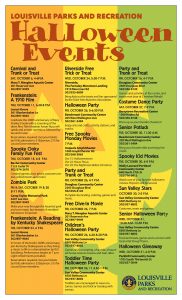 Halloween fun for kids of all ages is available during the month of October through Louisville Parks and Recreation and its associated facilities, including community centers, its two historic homes, the Iroquois Amphitheater and the Mary T. Meagher Aquatic Center.
“Whether you’re eight years old – or eighty – there are parties, movies and family fun throughout the month of October through Louisville Parks and Recreation,” Director Seve Ghose said. “Most of these events are free or very affordable for the family, and we’re looking forward to a great Halloween season.”
The unofficial start to this listing of events is this Saturday, October 6, when Louisville Parks and Recreation hosts its annual Trunk or Treat at the Mary T. Meagher Aquatic Center, 201 Reservoir Avenue, from 4-6 p.m.
It kicks off a month-long series of activities that includes movies at the Amphitheater, a Zombie Park at Camp Taylor Park, senior activities at the Sun Valley and Beechmont community centers and more. For the full schedule of Halloween-related events offered through Louisville Parks and Recreation, please reference the attached flier or click here.
