 Weather
 Traffic
 @LouisvilleDispatch
 @LouisvilleDisp
 Subscribe
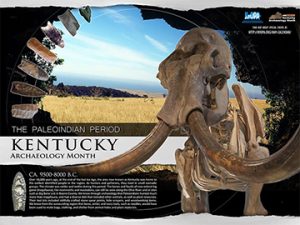 September is Kentucky Archaeology Month, a time dedicated to educating the public about what professional archaeologists do, the methods and techniques of archaeology, and what archaeology can tell us about the history of our state and the people who lived here before us.
For the fourth year, the Kentucky Heritage Council/State Historic Preservation Office (KHC) is hosting a blog, “30 Days of Kentucky Archaeology,” with brief essays by archaeologists, students, and public historians on topics ranging from earthworks to 3D scanning to native plants. Follow at www.30daysofkentuckyarchaeology.wordpress.com.
“The blog is a great way for archaeologists to highlight their research taking place in Kentucky. These blogs let us see how archaeology connects us to those who have come before us through common material culture, food, experiences, and more,” said KHC archaeologist Karen Stevens, organizer.
The 2019 Kentucky Archaeology Month poster features the Paleoindian Period in Kentucky, the first time a single archaeological era has been the focus. The Kentucky Organization of Professional Archaeologists (KyOPA) will offer free copies of the poster at events throughout the state and has also posted an online calendar at their website, www.kyopa.org.
Both presentations are free but online registration is requested for the Frankfort event. Registration for the Scott County presentation is optional.
Archaeology Month activities celebrate the professional practice of archaeology and its value to the Commonwealth as well as the importance of protecting and preserving historic and prehistoric archaeological resources. Thousands of archaeological sites have been documented across the state and some are listed in the National Register of Historic Places.
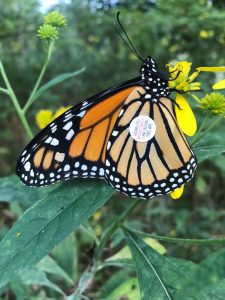 Special programs at the Salato Wildlife Education Center in Frankfort will celebrate the beginning of the monarch butterfly’s annual migration south. Participants can learn more about these valuable pollinators and receive expertise and advice on gardening for Kentucky’s native pollinators on Saturday, Sept. 7 at the Salato Center.
The event will feature activities suitable for individuals of all ages, including butterfly crafts, face painting, a monarch tagging demonstration and waystation tours, and a nectar plant and milkweed sale (while quantities last). Butterfly costumes are welcome.
Salato Center staff also will unveil a new Monarch Waystation at the event. This waystation will be dedicated to the late Mary Carol Cooper, who served as director of Salato’s Native Plant Program from 1992 to 2012.
Activities and demonstrations will run from 10:30 a.m. to 3 p.m. (Eastern Time) and are free with paid admission into the center. The center features native wildlife in naturalized enclosures, conservation exhibits and paved walking trails through a variety of habitats.
For a detailed list of activities and times, contact the Salato Center at (502) 892-4460.
The center is located off U.S. 60, approximately 1½ miles west of the U.S. 127 intersection. Look for the bronze deer statue at the entrance of the main Kentucky Fish and Wildlife campus.
Except for select events, hours are 9 a.m. to 5 p.m. Tuesday through Friday, and 10 a.m. to 5 p.m. Saturday. Salato is closed on Sunday, Monday and state holidays.
Except for select events, admission is $5 for adults and $3 for youth 5 to 18. Children four and under are admitted free. The center also offers annual memberships for individuals and families.
The Kentucky Department for Public Health (DPH), within the Cabinet for Health and Family Services (CHFS), is reminding the public that households, businesses and communities can increase their preparedness by following this year’s theme of Prepared, Not Scared. Be Ready for Disasters during September – National Preparedness Month (NPM).
This nationwide effort is organized each year by the U.S. Department of Homeland Security to encourage citizens to prepare and plan for emergencies in their homes, business and schools. This yearly observance was founded after 9/11 to increase preparedness awareness in the U.S., a fitting time to join the effort to help communities prepare for emergencies, such as natural disasters and potential terrorist threats, and to encourage individuals to take action.
“Emergencies and disasters can happen anytime and anywhere, often without notice and can leave us scared and confused,” said Jim House, Preparedness Branch Manager at DPH. “By taking the time to follow the ten steps outlined below, we all can better prepare ourselves and our communities should emergencies or disasters strike. Remember that preparedness is a shared responsibility – it takes a whole community to prepare and respond to emergencies.”
The following ten steps of Prepared, Not Scared. Be Ready for Disasters can encourage households, businesses and organizations to prepare for emergencies during National Preparedness Month by taking the following actions:
For more information about preparing for and responding to emergencies, visit http://www.ready.gov.
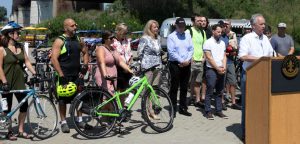 Mayor Greg Fischer joined Metro Council members, the Commission on Public Art, artist Todd C. Smith, and community partners at the base of the Big Four Bridge to unveil Bike Sense Louisville, a public art project that will promote healthy lifestyle habits and provide new data on the city’s air quality and temperature.
Using sensor units that fit into cyclists’ water bottle holders, data is collected about the cyclists’ speed and location, as well as the temperature and air quality outside. The data is then translated into sound that is streamed in both real-time on the Bike Sense website and broadcast over the Big Four Bridge speakers.
“Bike Sense encompasses our city’s core values of lifelong learning and health by incorporating science and exercise into public art,” said the Mayor. “This project will get people moving, either as volunteer cyclists collecting environmental data or as pedestrians crossing the Big Four Bridge to listen to the sounds created.”
The data will be publicly available and support the work of University of Louisville’s Christina Lee Brown Envirome Institute.
“The Center for Healthy Air Water and Soil and the Superfund Research Center in the UofL Christina Lee Brown Envirome Institute are partnering with the innovative Bike Sense project to raise awareness of the health risks posed by many volatile organic compounds,” said Dr. Ted Smith, Deputy Director of the Envirome Institute. “We look forward to providing technical assistance and health risk information to the project and its many cycling participants.”
The project was selected by the Commission on Public Art through a call for artists and is funded through a mix of private donations, public dollars, and an ArtsMatch grant from Fund for the Arts.
“By collecting volunteer cycling data that considers location as well as environmental factors, like temperature and air quality, we could learn a lot about where people are biking and how healthy it is to bike here. The sound part of the project was my creative way of sharing this data with the public,” said artist Todd C. Smith. “The bridge is a public space that sees thousands of pedestrians and cyclists and is the symbol of connection for the Kentuckiana region. I look forward to seeing how this year-long project progresses.”
For more information, visit BikeSense.net.
The Department of Public Health and Wellness will host a Birth Equity Town Hall Meeting on Thursday September 5 at 6 p.m. at 400 E. Gray St.
The meeting will consider policy initiatives to close the gap in infant and maternal mortality between the general population and minority communities. The meeting will seek input from community residents and will hear from local and national experts on best-practice policy solutions.
“Louisville has made progress in lowering overall infant mortality rates over the past twenty years,” said Public Health director and the city’s chief health strategist, Dr. Sarah Moyer. “However, there is still a significant gap between the rate at which white and black babies die before their first birthday. African American women are also still far more likely to die in childbirth. The Town Hall Meeting will seek solutions to bring about the day when every child and every community in or city thrives. I encourage people to attend.”
A panel at the Town Hall Meeting will be led by Dr. Edward Ehlinger, Acting Chair of the U.S. Health and Human Service’s Secretary’s Advisory Committee on Infant Mortality. Panelists will include Dr. Carol Brees of the University of Louisville; Dr. Brittany Watkins of Centerstone; Dr. Olugbemisola Obi of U of L Physicians; Dr. Kelly Pryor, a mother; Arthur Lemons, a Healthy Start father; Asia Ware, a Healthy Start mother and Emily Whitsett-Pickett of Mama to Mama. Dr. Moyer will also offer remarks.
While the overall infant mortality rate, the rate at which infants die before their first birthday, has fallen in Louisville from 7.6 to 6.1 per 1000 live births (five year averages of 1995 – 1999 and 2013 – 2017), African American babies still average 5.8 more deaths per 1000 live births than white babies. Also, according to the American Medical Association, African American women in the United States are two to six times more likely to die of complications from pregnancy than white women.
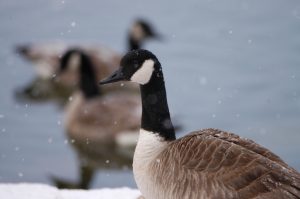
Canada geese in snow. Photos taken Feb. 9, 2006, at Kentucky Fish and Wildlife headquarters lake.
Applications will be accepted beginning Sept. 1 for two specially constructed waterfowl blinds for mobility-impaired hunters at Doug Travis Wildlife Management Area (WMA) in Hickman and Carlisle counties. Applications for these quota hunts must be postmarked by Sept. 30.
“One blind, Blind 19, is a boat-in site with a handicap-accessible boat ramp. Hunters must hunt within 10 yards of the location marker while using this blind. There will not be a constructed blind to hide the boat this year,” said Wes Little, migratory bird biologist for the Kentucky Department of Fish and Wildlife Resources. “The other blind, Blind 13, is an above ground blind that is wheelchair accessible. The mobility-impaired hunt party will be able to drive to this blind.”
The hunt dates for the mobility-impaired quota hunts during 2019-2020 are:
To register to be drawn for this blind during one or more of the mobility-impaired hunts, mail a 3 x 5 white index card in an envelope addressed to:
Kentucky Department of Fish and Wildlife Resources
Attn: Wes Little – Doug Travis WMA Mobility-Impaired Waterfowl Hunt Application
1 Sportsman’s Lane
Frankfort, KY 40601
The envelope must be postmarked between Sept. 1 and Sept. 30.
“Hunters must specify on the index card the dates for which they are applying and list them in order of preference,” Little said. “While they may apply for up to three hunting dates, they can only be drawn for one hunt. The index card must include the hunter’s name, complete mailing address and phone number as well.”
Successful applicants may invite up to three guests. After Sept. 30, those selected for hunts will be mailed a quota hunt permit for the dates they are drawn, a map showing the blind location and other instructions concerning the hunt. Unsuccessful applicants will not be notified. Duplicate applications for the same hunt will result in disqualification.
“The hunting party will be responsible for bringing and placing decoys as well as retrieving birds,” Little said. “These blinds are open to standby hunters on a first-come, first-served basis if the blind is not occupied by the drawn party by one hour before sunrise, but priority for its use will go to mobility impaired hunters.”
If not completed already, waterfowl hunters must go online at the Kentucky Fish and Wildlife website at fw.ky.gov and click the “My Profile” tab to fill out the Harvest Information Program (HIP) survey before hunting.
 Afternoon Lecture Series
Kate Hesseldenz: Margaretta’s Guest: Lafayette’s Visit to Liberty Hall
Wednesday, September 4, 1:15 pm
Lafayette, the last surviving Major General of the Revolutionary War, embarked on a great tour of the United States in 1824-1825 as the “Nation’s Guest.” Why did he visit Liberty Hall in May of 1825? Why did Margaretta Brown feel triumphant after his visit? Did John Brown serve as an aid to Lafayette during the war? In this talk, Curator Kate Hesseldenz will answer these questions as you learn about Lafayette’s connections to the Browns of Liberty Hall.
The Locust Grove Afternoon Lecture Series is held the first Wednesday of each month. Dessert and coffee are served at 1:00 pm with the lecture immediately following at 1:15 pm. Admission is $6, $4 for Friends of Historic Locust Grove. Reservations are not required.
Part of The Age of Hamilton series at Locust Grove.
Fall on the Farm
Saturday, September 7, 10:00 am – 4:30 pm
Enjoy a day filled with the hustle and bustle of harvesting, cooking, distilling and other activities that would welcome in the fall season on a 19th-century farm. Learn about the seasonal life on a farm through historic demonstrations in the hearth kitchen, farm distillery, and outbuildings. $9/adults; $8/seniors; $4 children 6-12; free for children under 6.
Beginner’s Book Binding for Kids
Saturday, September 14, 10:00 am – 11:30 am
Curious kids ages 7 to 12 will learn the basics of book binding during this fun, one-day workshop celebrating the art and craft of making books. Participants will bind a simple book with a marbled paper cover using a needle and thread, and learn about the process of making books in the 18th and 19th centuries before leaving with their very own blank book. This workshop is led by Locust Grove artist-in-residence Brandon Vigliarolo, the bookbinder behind Strano Books. $30/$25 for members; all materials included. A parent or guardian must stay on site for the duration of the workshop. Adults are welcome to assist their child with all activities. Space is limited; call 502-897-9845 to register by September 6.
Basic Book Binding for Adults
Saturday, September 21, 10:00 am – 12:00 pm
Learn more about the art and craft of book binding by making a simple blank book with a marbled paper cover. Brandon Vigliarolo, the bookbinder behind Strano Books and Locust Grove’s Summer Artist-in-Residence, will speak on the history and process of bookbinding before leading participants through the steps in making their own blank book with marbled cover.
$40/$35 for members; all materials included, and participants will be able to take their tools home. Space is limited; call 502-897-9845 to register by September 16.
Books, Prints, Paper and Art Sale
Saturday, September 28 and Sunday, September 29, 10:00 am – 4:30 pm
This special show and sale includes dealers in used, new, and collectible books, as well as maps, prints, paper, and art, at all prices and in all categories. You’ll find books about collecting, art, decorative arts, architecture and design, as well as artwork and prints. Saturday, September 28, 10 AM – 4:30 PM (Free admission) Sunday, September 39, 10 AM – 4:30 pm (With Antiques Market; $8 admission charged)
Fall Antiques Market
Sunday, September 29, 10:00am – 4:30pm
From whimsical china dogs to funky mid-century modern chairs, from stately silver to charming children’s toys, the Fall Antiques Market has something for everyone and every budget. Dozens of individual dealers from around the region will offer antique and vintage furniture, textiles, jewelry, silver, tchotchkes, ephemera, fine Kentucky crafted pieces of furniture and decorative arts, and much more. Food and drink will be available for purchase. Admission: $8 adults; free for ages 12 and under. Proceeds support the continued preservation and operation of Locust Grove.
Locust Grove is located at 561 Blankenbaker Lane (between Brownsboro Road and River Road), Louisville, KY 40207.
