Thursday January 22, 2026
Local Connection
 Weather
 Traffic
 @LouisvilleDispatch
 @LouisvilleDisp
 Subscribe
 Louisville Metro Government, Cities United and The William R. Kenan, Jr. Charitable Trust today announced the award of a $5 million grant to launch Russell: A Place of Promise, an initiative co-created with and accountable to Russell residents and stakeholders, and designed to be a national model for equitable community development in African-American communities.
The initiative will connect Russell residents and businesses that have been the backbone of the neighborhood with opportunities to build long-term individual and community wealth so that planned and underway new investment creating a renaissance in Russell does not result in their displacement. This initiative aims to create affordable housing, new jobs, business opportunities, new community gathering spots, opportunities for mobility, wealth creation, and whole-community health.
Project organizers have identified several initial efforts that could be used to create wealth for Russell residents, including the creation of new homeownership and business ownership opportunities. The details of these and other project activities will be informed by extensive discussion, input and decision-making from neighborhood residents and groups. Project leaders have had preliminary discussions with some of those stakeholders, and have met with local foundations and community-based organizations to understand the work they already have going on in Russell. The Place of Promise effort complements and augments that work, as well as efforts being made by local nonprofits and community groups, including the Louisville Urban League, One West, Concerned Pastors of Russell, Habitat for Humanity, Louisville Central Community Center, Inc., and Community Ventures.
“Thanks to local advocates, residents and non-profits and an injection of public funds, Russell is at the cusp of a really significant redevelopment, and we will be intentional about ensuring that this investment benefits existing residents while bringing much-needed new capital to Russell,” said Mayor Greg Fischer. “We are grateful to our partner, the William R. Kenan Jr. Charitable Trust, for its ongoing commitment to Louisville and its early infusion of capital to jumpstart this initiative, and we welcome the continued support of local and national partners, such as Cities United, as we move this work forward.”
Russell is a historically African-American neighborhood long referred to as the “Harlem of the South.” Despite a rich cultural history, decades of disinvestment and neglect due to then-legal racial discrimination in housing and business policy, including the practice of redlining, have left a lasting impact on Russell. As a result of these broken systems, neighborhood residents face higher hurdles related to employment, educational attainment, and access to neighborhood goods, services and health care.
“A key project value,” said Anthony Smith of Cities United, “is to ensure that the benefits of the new investment in Russell flow to the people who currently live, worship and work there, avoiding gentrification in this historic, majority-black neighborhood, which was decimated by racist practices such as redlining and urban renewal. We will do this by keeping residents’ voices front and center as we build out the initiative.”
“Louisville is a place of promise that can be a beacon that the rest of country looks to for how to build black wealth and mobility while allowing the community to define its own outcomes,” said Dorian Burton, Assistant Executive Director for the Kenan Charitable Trust, which has previously committed support to help improve the life outcomes of young black men and boys in Louisville. “This project is about not just engaging Russell residents, but also about building resources around them so they can be the heroes and heroines of their own story. We are hopeful that we can co-invest with local foundations that have already laid a solid foundation for this project in programs and projects that highlight the brilliance of the amazing people who live on the other side of 9th Street.”
Louisville Metro Government, in partnership with Cities United, will incubate Russell: A Place of Promise for up to five years before the initiative launches into a stand-alone, community based organization. Russell: A Place of Promise is fiscally sponsored by the Community Foundation of Louisville, Inc., a 501(c)(3) public charity, which allows the initiative to receive grants and tax-deductible donations. This work will align with the recently-announced civic engagement fellowship program being funded by an additional $5 million grant from the William R. Kenan Jr. Charitable Trust. The fellowship aims to create pathways for young Black men ages 22 – 26 to be prepared to serve in civic leadership roles, and offers opportunities for education, jobs and careers combined with leadership development and mentoring support.
Russell: A Place of Promise will be co-led by Theresa Zawacki, who will be leaving her position as Senior Policy Advisor to Louisville Forward to serve as an Executive on Loan to the Place of Promise initiative during its incubation stages, and Anthony Smith, Executive Director at Cities United.
“As we see increased investment in Russell, it is critical that we identify opportunities to strengthen existing residents and businesses so that they receive tangible, long-lasting, personal benefits from these investments and have opportunities to take part in shaping the outcomes in their neighborhood” said Theresa Zawacki. “Russell: A Place of Promise provides a framework for these kinds of conversations to take place in community, and we are very excited to be moving forward with neighborhood residents as our partners to co-create strategies that will lead to a brighter future for the Russell Community, the West End and all of Louisville.”
An initial advisory board has been created, with the goal of expansion to include additional residential and business stakeholders, to provide oversight to Russell: A Place of Promise. The initial board currently includes Dana Jackson, Better Together Strategies; Alice Houston, HJI Supply Chain Solutions; Jackie Floyd, Center for Neighborhoods; David Snardon, Joshua Tabernacle Missionary Baptist Church and Concerned Pastors of Russell; Kevin Dunlap, Rebound; Gill Holland, impact entrepreneur, small scale developer and community builder; Dorian Burton, Assistant Executive Director of the William R. Kenan Jr. Charitable Trust; and Trisha Finnegan, Vice President of Mission & Impact at the Community Foundation of Louisville.
Russell: A Place of Promise complements other work happening in Russell. The Louisville Urban League, for example, will invest $30 million in the Track on Ali, a multi-sports complex anchored by an indoor track and field facility to be built and operated at a 24-acre, city-owned property known as “Heritage West.” A new $130 million headquarters for Louisville-based nonprofit health insurance provider, Passport Health Plan, and a new $35 million branch of the YMCA of Greater Louisville are also under construction. One West is investing in the transformation of 18th Street and West Broadway with the launch of a “special improvements district” to focus on making the corridor clean and safe, and with plans to reinvest in area commercial spaces. A $29.5 million Choice Neighborhoods Grant awarded to the Louisville Metro Housing Authority and Louisville Metro Government is leveraging over $200 million in new investment. These activities are further complemented by longstanding partner investments in projects such as an arts and cultural district along Muhammad Ali Boulevard, the reinvigoration of existing commercial space, market rate housing development, and workforce training programs.
The community is invited to learn more about Russell: A Place of Promise at upcoming meetings to be held on:
- Tuesday, August 28th 5:00 – 7:30 pm, Joshua Tabernacle Missionary Baptist Church
- Thursday, August 30th, 5:00 – 7:30 pm, Baxter Community Center
- Saturday, September 8th, 11:30 am – 1:00 pm, location to be announced
 In December 2015, Metro Council passed an ordinance to regulate the use of short term rentals; customers often book short term rentals through online platforms such as AirBnB, VRBO, and others. City leaders have been monitoring implementation of this ordinance and the evolution of the new shared economy. Louisville Metro Department of Develop Louisville, Metro Council District 8 and Louisville Tourism have partnered to propose changes to the short term rental ordinance (Chapter 115.515-521 of the Louisville Metro Code of Ordinances and Chapter 4 of the Land Development Code) in response to the growing popularity of this tourist experience and how to best integrate it into our neighborhood fabric.
“Tourism is flourishing in our city and in addition to the number of hotels opening, we are also seeing a growth in the use of short term rentals, which allow visitors a unique way to experience our beautiful neighborhoods and vibrant commercial corridors,” said Jeff O’Brien, Director of Develop Louisville. “When welcoming this new form of the shared economy, we must also make sure that short term rentals and their occupants harmonize with neighbors and these proposed changes to our ordinance will help us better achieve that.”
“Short term rentals are good for our city but these changes are needed to upstream and toughen enforcement against illegal operators,” District 8 Metro Councilman Brandon Coan said. “Neighbors deserve these additional protections and they will serve all legal operators well.”
“As destinations around the country work to keep up with growing shared economy options for travelers, Louisville Tourism is proud to be among those that are embracing their short term rental community,” Louisville Tourism President & CEO Karen Williams said. “Now, like with traditional lodging, the transient room tax collected can be invested in marketing Louisville and we are working with our local partners, in Airbnb for example, on efforts to attract even more visitors using their properties as assets.”
Proposed changes include:
- Limiting the number of individuals eligible to reside in a short term rental to ten (10). The proposed changes would permit the number of individuals who can reside in a short term rental to two (2) times the number of bedrooms plus four (4) with a limit of ten (10) individuals.
- Allowing short term rental in properties zoned EZ-1. A map of EZ-1 zoned properties that would be eligible can be found here: https://louisvilleky.gov/government/planning-design/short-term-rental-in….
- Requiring that an emergency contact for each short term rental reside in Jefferson County.
- Eliminating an initial registration fee, which was $25. Under the proposed changes a $25 fee will be required upon renewal.
- Prohibiting the advertising of a short term rental if it is not registered with the city of Louisville. Enforcement for advertising a short term rental without registering it results in a notice of violation for a first offense and a $50 fine for every additional day that the short term rental remains advertised.
- Introducing a new enforcement process: a first offense results in a $50 fine, a second offense results in a $250 fine, a third offense results in a $500 fine, and any additional offense results in a $750 fine.
To view the proposed changes in their entirety and to provide feedback, please visit https://louisvilleky.gov/government/planning-design/short-term-rental-in….
Develop Louisville staff will be presenting these proposed changes to the Planning Commission after all public feedback has been reviewed. Once approved by the Planning Commission, then the changes will go before Metro Council. Not all municipalities with zoning authority in Jefferson County have approved a short term rental ordinance.
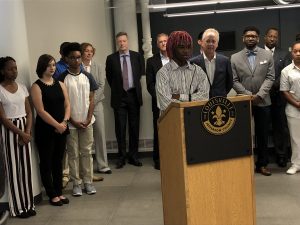 From computer coding to manufacturing and life-guarding to public finance, a record number of young people — 6,200 — gained new skills and confidence working at businesses and job sites throughout Louisville this summer as part of the SummerWorks program.
Mayor Fischer today congratulated youth and thanked the many private sector and non-profit employers who hired youth ages 16-21. That number includes 1,004 youth employed by companies and organizations that directly teamed with KentuckianaWorks and YouthBuild to provide more extensive career guidance and support.
Since its start in 2011, SummerWorks and its partner-employers have put more than 23,000 young people into summer jobs.
“SummerWorks is helping build critical skills with our young people, including many who might not otherwise have this opportunity to learn and grow in the right direction,” the Mayor said. “This effort not only helps ensure that Louisville is a city of opportunity for all our young people – it’s also helping build a pipeline of new talent which is crucial.”
At a season-closing event at the Humana Digital Experience Center, several young people shared their summer job experiences:
- Elanna Carr, 20, said her work in Public Finance at Hilliard Lyons was a “perfect real-life work fit and very beneficial,” even convincing her to major in Economics at the University of Louisville;
- Teandre Blincoe, 17, who worked in technology on the IT Service Desk at Humana, said the experience “meant a lot to me in building my customer skills and showing me possible career opportunities in the tech field.”
- Grace Hotkewicz, 17, who taught art to pre-school children at the Speed Art Museum. “I learned so much and it was a perfect fit for my career goal of creating digital animation for kids.”
Other SummerWorks’ youth worked in hospitals, restaurants, museums, banks and hotels. Working closely with supervisors and mentors, young people worked on manufacturing assembly lines and grocery check-out lanes, assisted companies with IT and human resources needs, worked in tourism and helped ship packages around the world.
Key employer-partner companies, including GE Appliances, Humana, Kentucky Kingdom, Kindred Healthcare and UPS, increased their direct hiring of SummerWorks youth from 2017. New employers included Dine Company, Hilliard Lyons, HJI Supply Chain Solutions, Kentuckiana Comfort Center, iQor, Louisville Bats, Spectrum and StoryWood Bowties.
More than 40 private-sector businesses participated this summer, and Mayor Fischer said a top goal for 2019 is to greatly increase the number of companies hiring youth.
Private donations sponsored 237 youth in jobs at dozens of non-profit organizations and public agencies, including Americana Community Center, Boys and Girls Clubs, Family Health Centers, the Food Literacy Project and Workwell Industries. TARC bus passes were provided to many youth to help get them to and from their jobs.
SummerWorks is playing a stronger role in shaping young talent through its partnership with the new Academies of Louisville initiative, which was rolled out at 14 JCPS high schools this year. The goal is for every student to have had a summer job experience by the time they graduate their Academy high school.
SummerWorks also helped build entrepreneurial skills by providing small grants to five organizations that engaged youth in summer projects ranging from bringing fresh produce to West Louisville, to providing digital skills to young women, to building a new bicycle pump track at Shawnee Park.
“We are thrilled to see this initiative grow and evolve in both the quantity of and quality of the job opportunities young people are able to experience,” said Michael Gritton, executive director of KentuckianaWorks, which operates SummerWorks in partnership with YouthBuild Louisville.
The Mayor launched SummerWorks right after taking office in 2011, in response to the elimination of federal funding for summer jobs. That first year, 200 young people were placed in jobs. The program was recognized by the U.S. Conference of Mayors in 2014 as one of the nation’s best summer jobs programs for young people.
The program’s core operating funds are approved by the Louisville Metro Council. Private donations sponsor jobs for youth in greatest need of the opportunity. Those contributors include the James Graham Brown Foundation, JPMorgan Chase Foundation, Diaz Family Foundation, Gheens Foundation, Mary Gwen Wheeler and David Jones, Jr. and other organizations and individuals.
The Mayor urged employers to make plans now to hire or support summer jobs for 2019. More information is at www.summerworks.org .
Photo: Louisville Metro Council
Neighborhood residents in two Metro Council districts will decide how a portion of the city budget is spent in their districts.
Our Money, Our Voice is an initiative of the Metro Department of Public Health and Wellness’s Center for Health Equity and Metro Councilmen David James (District 6) and Brandon Coan (District 8). Residents of those council districts will decide how $150,000 ($75,000 in each district) will be spent.
Our Money, Our Voice is the name of Louisville’s participatory budgeting initiative. Originating in Porto Alegre, Brazil in 1989, participatory budgeting is a way for members of a community to work together to better meet their needs while having a direct say in government decisions. In the process, people often find new ways of interacting with government and with each other to create solutions for all. Participatory budgeting has been practiced in the United States since 2009 in such cities as Hartford, CT; Greensboro, NC; New York and Chicago.

Photo: Louisville Metro Council
Initial funding for the initiative is coming from $100,000 in capital infrastructure funds ($50,000 from each district) and $50,000 from the Mayor’s Healthy Hometown Movement. Additional funding is being sought from foundations and private sources. Community residents will decide how to spend the money for physical improvement projects in each of the districts.
“Our Money, Our Voice is a pilot project — a new way for citizens to engage with government and decide how tax dollars are spent,” said District 8 Metro Councilman Brandon Coan. “It’s giving people real power over real money to make the decisions that affect their lives.”
“Who knows best about the needs of the community than the people who live there?” said District 6 Councilman David James. “Nobody can make better decisions about what a neighborhood needs than the residents of that neighborhood.”
The participatory budgeting process begins with the establishment of a steering committee consisting of representatives from the participating council districts. The steering committee then connects with neighborhood residents to develop ideas and create proposals for projects to benefit the neighborhoods. Finally, the residents in the metro council districts vote on how the money will be distributed among projects.
“Projects like Our Money, Our Voice are intrinsic to the work of public health,” said Dr. Sarah Moyer, director of the Department of Public Health and Wellness and the city’s chief health strategist. “Our vision is a healthy Louisville where everyone and every community thrives. Our mission is to achieve health equity and to improve the health of the people of our city. The best way to build a thriving community is to include everyone in the decision-making process from the start and participatory budgeting is a means to make that happen.”
District 6 neighborhoods participating in Our Money, Our Voice include Algonquin, California, Limerick, Old Louisville, Park Hill, Russell (the section north of Broadway Ave., south of Plymouth St., west of 22nd St. and east of 26th St.), Taylor-Berry, University and Victory Park.
Participating District 8 neighborhoods include Belknap, Bonnycastle, Alta Vista, Cherokee Triangle, Deer Park, Gardiner Lane – Upper Highlands, Hawthorne, Hayfield Dundee – Upper Highlands, Highlands Douglass, Original Highlands, Seneca Vista and Tyler Park.
Participatory budgeting was identified as a project that the community wanted to pursue during the My Dream for Lou Policy Summit hosted by the Center for Health Equity in October 2016. To learn more about the participatory budgeting process, the Department of Public Health and Wellness invites you to the kick-off event at the Heuser Hearing Institute Hearing and Language Academy at 111 E. Kentucky St. on Wednesday August 29 at 6 p.m.
 In April 2018, the U.S. Department of the Treasury certified 144 Opportunity Zones in 84 Kentucky counties as recommended by Governor Matt Bevin under a new community development program, the Investing in Opportunity Act, part of the Tax Cuts and Jobs Act of 2017. In Louisville, 19 census tracts are designated as Opportunity Zones.
The Opportunity Zones program is designed to spur economic development and create jobs by encouraging long-term investment in economically-distressed urban and rural areas. The program provides a tax incentive for investors to re-invest their unrealized capital gains into Opportunity Funds that are dedicated to investing in Opportunity Zones.
“The Opportunity Zones program establishes the framework for investors to inject investment into projects in our city that will have a significant social impact. Projects like the redevelopment of the Louisville Gardens, the Track on Ali at Heritage West, and projects from Butchertown to downtown to west Louisville are great examples of developments that could benefit from this program,” said Mayor Greg Fischer. “We look forward to continuing our work with our partners at the state and with local investors to strategically grow our city.”
To assist business owners and investors with identifying Opportunity Zones, the city created an interactive map to show exact addresses and boundaries of Louisville’s designated Opportunity Zones.
To search Louisville-specific addresses, visit https://louisvilleky.gov/government/louisville-forward/opportunity-zones-louisville
To learn more about Kentucky Opportunity Zones, visit www.KYOZ.com
To read more about Opportunity Zones in general, visit https://eig.org/opportunityzones
 Amid recent talks about tariffs and trade wars, eight of the world’s biggest players in the whiskey industry are meeting for what has been dubbed the “W8 Summit” to be hosted right here in Louisville.
The world’s eight leading whiskey associations will gather in Kentucky, the Birthplace of Bourbon, next week in a historic summit to discuss trade issues that threaten the growth of this iconic, international industry.
The “W8 – Spirit of Collaboration Summit” is being hosted and coordinated by the Kentucky Distillers’ Association, a non-profit trade group founded in 1880 as the Commonwealth’s voice for Bourbon and distilled spirits issues.
KDA President Eric Gregory said this first-ever gathering of the world’s whiskey associations will serve as an open exchange of ideas, strategy and a shared commitment to preserving free and fair trade. “Now more than ever, our groups need to be communicating directly and, hopefully, speaking with a unified voice.”
“The global whiskey industry has been enjoying an unprecedented level of success to the benefit of our legendary producers, consumers, countries and local communities,” he said. “It’s critical that we maintain this momentum and ensure that world leaders understand the deep economic impact of whiskey and how it will be affected if this unfortunate trade war escalates or continues to extend. The potential for long-term damage is real.”
Participating trade associations from around the glob include:
- Distilled Spirits Council
- Irish Whiskey & Spirits Associations
- Japan Spirits & Liqueurs Producers Makers Association
- Kentucky Distillers’ Association
- Scotch Whisky Association
- Spirits Canada
- spiritsEUROPE
- The President’s Forum
The group will meet July 25 and 26 in Louisville, ending with a press conference and ceremonial planting of a white oak tree outside the Frazier History Museum on Whiskey Row, the site of the upcoming Kentucky Bourbon Trail Welcome Center.
Kentucky Bourbon is one of the Commonwealth’s most historic and treasured industries, a booming $8.5 billion economic engine that generates as many as 17,500 jobs with an annual payroll topping $800 million and pours $825 million into tax coffers each year.
In addition, the industry is in the middle of a $1.2 billion building boom, from innovative new tourism centers to expanded production facilities, all to meet the growing global thirst for Kentucky Bourbon.
There are now 39 companies operating 52 distilleries in the Commonwealth making 6.8 million barrels of aging Bourbon – all modern records. Distillers also paid a record $19.2 million last year in barrel taxes that fund critical local programs such as education, public safety and health.
Visit www.kybourbon.com and www.kybourbontrail.com to learn more.
 The two leaders who most recently guided the Kentucky State Fair Board agree its future is in good hands with new President and CEO David Beck.
Beck officially began his new role at Kentucky Venues on July 1.
Secretary of the Kentucky Tourism, Arts and Heritage Cabinet, Don Parkinson, and Chairman of the Kentucky State Fair Board, Dr. Mark Lynn, who recently served separate terms as interim CEO at Kentucky Venues, predict David Beck will be the most consequential leader in the organization’s history.
“David successfully led a large organization, involved in major state and national legislative regulatory issues, affecting agriculture and rural Kentucky,” said Secretary Parkinson. “He brings a wealth of business expertise to the sixth largest convention operation in the nation.”
Kentucky Venues operates the Kentucky Exposition Center (KEC), the Kentucky International Convention Center (KICC) and produces the Kentucky State Fair, National Farm Machinery Show and North American International Livestock Exposition.
“The blend of leadership capability, knowledge of Kentucky and ability to unite diverse industries set David apart in his role as CEO,” said Dr. Lynn.
Beck sees tremendous opportunities at Kentucky Venues. Beck will preside over grand reopening of KICC on August 6. The downtown Louisville convention center has been closed for 24 months to allow $207 million worth of building renovations to be completed.
Beck says the 540 acre complex at the Kentucky Exposition Center is an ideal location for additional private development such as hotels and entertainment venues.
“KEC sits at the corner of Interstates 65 and 264. That is some of the most valuable property in Kentucky. We are asking private companies to give us ideas on how we can collaborate with them to enhance that area for our citizens and guests to our state. I’m excited about developing something special there.”
Beck said other priorities in his new job include bringing together the urban and rural communities and forming strategic partnerships across the state.
“I want Kentucky Venues to serve as an example of how government entities can operate effectively and efficiently,” said Beck.
Additionally, Beck is reimagining facility use at both properties. Beck plans to increase revenue through new business events and agriculture shows.
“I not only want to preserve the rich tradition of our properties but also enhance it for future Kentuckians and guests,” said Beck.
After 41 years with Kentucky Farm Bureau (KFB), Beck brings to Kentucky Venues experience in agribusiness, government affairs, and executive management. Prior to his retirement at KFB, he served as the company’s Executive Vice President. A five-member search committee was appointed in January by Kentucky State Fair Board Chairman Dr. Mark Lynn to review applications for the president/CEO position that had been vacant since September 2017.
Visit www.kyvenues.com for more information about spaces and events at Kentucky Venues.