Wednesday January 21, 2026
Local Connection
 Weather
 Traffic
 @LouisvilleDispatch
 @LouisvilleDisp
 Subscribe
The Kentucky Department for Public Health (DPH), within the Cabinet for Health and Family Services (CHFS), is reminding the public that households, businesses and communities can increase their preparedness by following this year’s theme of Prepared, Not Scared. Be Ready for Disasters during September – National Preparedness Month (NPM).
This nationwide effort is organized each year by the U.S. Department of Homeland Security to encourage citizens to prepare and plan for emergencies in their homes, business and schools. This yearly observance was founded after 9/11 to increase preparedness awareness in the U.S., a fitting time to join the effort to help communities prepare for emergencies, such as natural disasters and potential terrorist threats, and to encourage individuals to take action.
“Emergencies and disasters can happen anytime and anywhere, often without notice and can leave us scared and confused,” said Jim House, Preparedness Branch Manager at DPH. “By taking the time to follow the ten steps outlined below, we all can better prepare ourselves and our communities should emergencies or disasters strike. Remember that preparedness is a shared responsibility – it takes a whole community to prepare and respond to emergencies.”
The following ten steps of Prepared, Not Scared. Be Ready for Disasters can encourage households, businesses and organizations to prepare for emergencies during National Preparedness Month by taking the following actions:
- Assemble a Go Bag with supplies in case of an emergency.
- Prepare digital forms of important documents for an emergency.
- Have extra supplies in case of an emergency.
- Download the FEMA app (https://www.fema.gov/mobile-app) to provide emergency information at your fingertips.
- Have an alternative power source for devices during emergencies.
- Set up an In Case of Emergency (ICE) emergency contact in your cell phone.
- Choose an emergency contact when out-of-town.
- Find a local, pet-friendly evacuation center.
- Update your social media to tell loved ones you are safe during an emergency.
- Remember that in an emergency – text and don’t call. Phone lines will be backed up with calls reporting important information. To let your loved ones know you are safe, send them a text message instead.
For more information about preparing for and responding to emergencies, visit http://www.ready.gov.
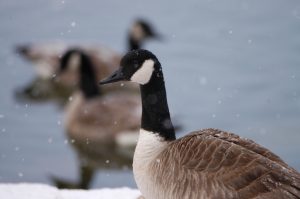
Canada geese in snow. Photos taken Feb. 9, 2006, at Kentucky Fish and Wildlife headquarters lake.
Applications will be accepted beginning Sept. 1 for two specially constructed waterfowl blinds for mobility-impaired hunters at Doug Travis Wildlife Management Area (WMA) in Hickman and Carlisle counties. Applications for these quota hunts must be postmarked by Sept. 30.
“One blind, Blind 19, is a boat-in site with a handicap-accessible boat ramp. Hunters must hunt within 10 yards of the location marker while using this blind. There will not be a constructed blind to hide the boat this year,” said Wes Little, migratory bird biologist for the Kentucky Department of Fish and Wildlife Resources. “The other blind, Blind 13, is an above ground blind that is wheelchair accessible. The mobility-impaired hunt party will be able to drive to this blind.”
The hunt dates for the mobility-impaired quota hunts during 2019-2020 are:
- Nov. 28–Dec 1, 2019
- Dec. 7-8, 2019
- Dec. 9–12, 2019
- Dec. 13–15, 2019
- Dec. 16–19, 2019
- Dec. 20–22, 2019
- Dec. 23–26, 2019
- Dec. 27–29, 2019
- Dec. 30, 2019 – Jan. 2, 2020
- Jan. 3–5, 2020
- Jan. 6–9, 2020
- Jan. 10–12, 2020
- Jan. 13–16, 2020
- Jan 17–19, 2020
- Jan. 20–23, 2020
- Jan. 24–26, 2020
- Jan. 31, 2020
To register to be drawn for this blind during one or more of the mobility-impaired hunts, mail a 3 x 5 white index card in an envelope addressed to:
Kentucky Department of Fish and Wildlife Resources
Attn: Wes Little – Doug Travis WMA Mobility-Impaired Waterfowl Hunt Application
1 Sportsman’s Lane
Frankfort, KY 40601
The envelope must be postmarked between Sept. 1 and Sept. 30.
“Hunters must specify on the index card the dates for which they are applying and list them in order of preference,” Little said. “While they may apply for up to three hunting dates, they can only be drawn for one hunt. The index card must include the hunter’s name, complete mailing address and phone number as well.”
Successful applicants may invite up to three guests. After Sept. 30, those selected for hunts will be mailed a quota hunt permit for the dates they are drawn, a map showing the blind location and other instructions concerning the hunt. Unsuccessful applicants will not be notified. Duplicate applications for the same hunt will result in disqualification.
“The hunting party will be responsible for bringing and placing decoys as well as retrieving birds,” Little said. “These blinds are open to standby hunters on a first-come, first-served basis if the blind is not occupied by the drawn party by one hour before sunrise, but priority for its use will go to mobility impaired hunters.”
If not completed already, waterfowl hunters must go online at the Kentucky Fish and Wildlife website at fw.ky.gov and click the “My Profile” tab to fill out the Harvest Information Program (HIP) survey before hunting.
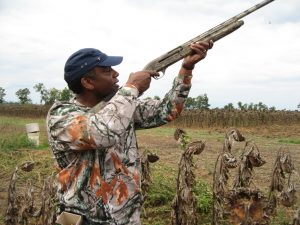
Photo: Kentucky Department Fish And Wildlife
Dove season opens on its traditional day of Sept. 1, and dove hunters need to know about some new rules regarding the use of public dove fields before hunting this year.
“New for this year, there is no access to public dove fields from Aug. 15 to Sept.1,” said Wes Little, migratory bird biologist for the Kentucky Department of Fish and Wildlife Resources. “People can scout from the parking lot or road, but you cannot physically walk into the field.”
Little explained hunters repeatedly scouting fields before the season disturbs the doves and makes them more prone to stop using the field.
“The week prior to the season, we see many groups of hunters scouting the fields, and they unintentionally flush birds,” he said. “The more times you flush a dove, the less likely it is to come back to that field. We want to lessen some of that pressure before the season to ensure a quality hunt.”
There are two new public dove fields this year in Ballard and Butler counties. Hunters using the public dove fields at Curtis Gates Lloyd Wildlife Management Area (WMA) in Grant County must know the shooting hours on opening day (Sept. 1) begin at 2 p.m.
Hunters using the cooperator dove field in Madison County off KY 627 must use U.S. Fish and Wildlife Service approved non-toxic shot.
Little noted that a few of the fields slated for public access failed due to the amount of rain this past spring.
A list of current dove fields is available by consulting the 2019-2020 Kentucky Hunting Guide for Dove, Early Waterfowl, Woodcock, Snipe and Crow. The guide, which is available online only, is accessible on Kentucky Fish and Wildlife’s website. Go to fw.ky.gov and search under the keyword, “dove,” for rules, regulations and additional information.
Hunters can also use the interactive dove field map to find public dove fields on the Kentucky Fish and Wildlife website by searching under the keywords, “Public Dove Fields.”
Hunters using public fields should remember that they cannot clean their birds at the site. Hunters also must pick up all spent shotshell hulls or other trash and obey all signs.
The first segment of the 2019-2020 dove season opens Sept. 1 and closes Oct. 26. The second segment opens Nov. 28 and closes Dec. 8, while the third segment of dove season opens Dec. 21, 2019 and closes Jan. 12, 2020.
In addition to a valid Kentucky hunting license, dove hunters must possess a Kentucky Migratory Game Bird/Waterfowl Hunting Permit. Shotguns must be plugged to only hold three shells total, one in the chamber and two in the magazine.
If not completed already, dove hunters must go online at the Kentucky Fish and Wildlife website at fw.ky.gov and click the “My Profile” tab to fill out the Harvest Information Program (HIP) survey before hunting.
 Kids can get their hands on 18th century history at Fort Boonesborough State Park’s first Hands on History for Kids event Sept. 7-8.
This event allows children to learn about life in the 18th century. Hands on skills will include churning butter, grinding corn, baking ash cakes, carving on powder horns, carding and spinning and many other pioneer skills.
The displays will be available 9 a.m. to 5 p.m. both days and are free with paid fort admission. Admission is $8 for adults, $5 for children ages 6-12 and children under 6 are free.
There will also be a puppet show featuring Punch and Judy and a demonstration on falconry. The Fort Boonesborough Foundation will have concessions available throughout each day.
Fort Boonesborough State Park marks the site of a fort built by Daniel Boone and other settlers in 1775 along the Kentucky River. The state park near Richmond has a reconstructed fort, a campground, hiking trails, mini-golf, picnic shelters and a gift shop.
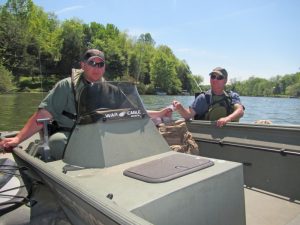
Photo: Kentucky Department Fish and Wildlife
The sun sets earlier each day and the kids are back in school. Summer is all but over. This inevitability prompts many to visit lakes, rivers and streams to get in that last weekend of the summer boating season during the Labor Day holiday weekend.
“Our busiest weekend of the year,” said Maj. Shane Carrier, assistant director of law enforcement for the Kentucky Department of Fish and Wildlife Resources. “Traditionally, Labor Day marks the end of the boating season.”
The crowded conditions common on this holiday weekend make observance of simple boating safety procedures vital to a safe weekend for everyone.
The law requires each passenger in a vessel to have a personal floatation device, commonly called a lifejacket, readily accessible for use. “I cannot stress enough the importance of wearing a lifejacket,” Carrier said. He explained that a lifejacket stored in a compartment or stuffed under a seat is not readily accessible.
“You must be able to get to the lifejacket quickly when you need it,” Carrier said.
Sales of paddlecraft such as kayaks, canoes and stand up paddleboards are booming, but wearing a lifejacket while paddling is of paramount importance for safety.
“Paddlecraft use is growing by leaps and bounds across Kentucky,” Carrier said. “Many paddlecraft users overlook the safety aspect. Paddlecraft are slow and do not have a motor. This lulls people into a false sense of security. I strongly suggest wearing a lifejacket at all times when operating a paddlecraft.”
Carrier said he sees many stand up paddleboard operators with their lifejacket strapped to the front of the paddleboard. “That doesn’t work well if you fall over and hit your head,” he said.
Paddlecraft now line the front of sporting goods, department and hardware stores awaiting a buyer.
“People buy paddlecraft with no training or experience and get in over their head, especially in moving water,” Carrier said. “Leave a float plan with a loved one and get a dry bag to store a charged cell phone on your boat in case you get in trouble.”
Carrier said the law enforcement division spent many hours this year on search and rescue efforts to look for paddlers. “We’ve had quite a few misjudge their take out or how long it takes to paddle there,” he said. “They must know how long it takes to get the float completed. If there is low water and you have to drag a boat over riffles and shoals, it takes time.”
Avoiding alcoholic drinks is one of the smartest safety decisions boaters can make. “Drinking in public is against the law in Kentucky and our waterways are public places,” Carrier said.
The combination of hours in the sun, heat and movement of the boat can induce a mild stupor called boater’s fatigue. “Alcohol intensifies boater’s fatigue,” Carrier said. “This condition can lead to poor decisions on the water.”
Carrier stressed the importance of checking safety equipment to ensure it is in good working order.
A boat with a motor must have a working fire extinguisher on board at all times. “Store the fire extinguisher away from the engine,” Carrier said. “On some boats with inboard-outboard motors, the fire extinguisher is mounted in the engine compartment. If you have a fire, you will burn yourself trying to get to it.”
All vessels over 16 feet in length must have a hand, mouth or power-operated signaling device such as a loud whistle or boat horn. They must also have working red and green navigation lights in the bow of the vessel and a steady white light visible from 360 degrees in the stern.
Boat operators must display these lights from sunset to sunrise in areas where other boats navigate, whether the boat is under power or anchored.
Some boaters mistakenly believe you do not need working navigation lights if you only operate the boat during daylight hours. Mechanical failures, dead batteries or getting lost can prevent a boat from getting back to the dock or ramp before nightfall when you must display these lights. Therefore, lights must be in working condition no matter when you operate the boat.
“You need a light at night so you don’t get run over by another boat,” Carrier said.
Each vessel must have a Type IV throwable personal floatation device such as a float cushion or ring readily accessible for use.
“Although this isn’t boating related, we’ve had multiple people this year drown from swimming,” Carrier said. “People, especially teenagers, try to swim beyond their ability and misjudge the distance. Peer pressure can induce them to try to swim across a large cove and then it is too late.”
Obey these simple safeguards and make the Labor Day weekend memorable for the right reasons.
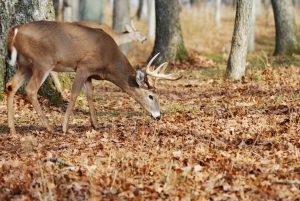
Photo: Kevin Kelly/Kentucky Department Fish and Wildlife
A white-tailed deer from western Kentucky is the state’s first confirmed case of hemorrhagic disease this year.
Murray State University’s Breathitt Veterinary Center recently confirmed to the Kentucky Department of Fish and Wildlife Resources that a deceased female deer recovered from Graves County tested positive for hemorrhagic disease, sometimes referred to as “blue tongue” or EHD. Kentucky Fish and Wildlife is investigating other possible cases involving 22 deer in 11 counties and expects the number could grow in the coming weeks.
“Hemorrhagic disease cannot be transmitted to people or pets,” said Dr. Christine Casey, state wildlife veterinarian for Kentucky Fish and Wildlife. “It is caused by two different viruses: epizootic hemorrhagic disease virus (EHD) and bluetongue virus. These viruses are transmitted to deer by small biting flies, also called no-see-ums.”
Kentucky experiences localized hemorrhagic disease outbreaks each year. More regionally widespread and statewide outbreaks can occur in cycles of five years or longer. A significant regional outbreak of hemorrhagic disease affected many east Kentucky counties two years ago. Far western Kentucky endured an outbreak in 2012, and the last statewide outbreak occurred in 2007.
Outbreaks of hemorrhagic disease generally last from late summer until the first hard frost of the year kills the virus-carrying flies.
Hemorrhagic disease has been present in the United States for more than 60 years. It is not the same as chronic wasting disease (CWD), an always fatal neurological disease that affects white-tailed deer, elk and other members of the deer family. Chronic wasting disease has never been detected in Kentucky.
One main difference between the diseases is that some deer do survive hemorrhagic disease outbreaks and produce protective antibodies, which can be passed to their young. Protective antibodies are major contributors to herd immunity and one reason why Kentucky sees cyclic outbreaks of hemorrhagic disease, rather than a higher prevalence every year.
In Kentucky and across the Midwest, deer that die from hemorrhagic disease typically die within 24 to 36 hours after being bitten by an infected insect. People often find carcasses of deer that have died from the disease around water, and because they died rapidly these animals can appear well fed or otherwise normal. Sometimes there are several carcasses in one area.
While elk in Appalachian Kentucky also contract hemorrhagic disease from insect bites, they usually show no outward signs of illness and death does not occur.
“Kentucky’s archery deer hunting season opens early next month,” said Gabe Jenkins, deer and elk program coordinator with Kentucky Fish and Wildlife. “The department is asking hunters and others to be on the lookout for sick looking deer.
“Deer with hemorrhagic disease can be more susceptible to other diseases. For that reason, the department always cautions against eating the meat from a deer that doesn’t appear to be healthy.”
Through Aug. 21, Kentucky Fish and Wildlife had received reports of suspected hemorrhagic disease in 22 deer. The reports originated from Anderson, Carroll, Christian, Graves, Greenup, Harrison, Meade, Oldham, Trimble, Scott and Shelby counties. The only confirmed case was the Graves County deer. Kentucky Fish and Wildlife is awaiting test results on others.
People can go online now to report to Kentucky Fish and Wildlife suspected cases of hemorrhagic disease in dead or dying deer. The digital form is available at fw.ky.gov under the “Important Info” tab. It takes only a few minutes to complete but provides important data for estimating the scale of the outbreak and for communicating with the public.
Reports also can be submitted by phone. Kentucky Fish and Wildlife staffs a toll-free number weekdays from 8 a.m. to 4:30 p.m. (Eastern). The number is 1-800-858-1549. In addition to their name and contact information, callers will be asked to provide the following about their observation: county and date, number of deer found, and whether the deer were sick or recently deceased.
Information reported to Kentucky Fish and Wildlife through these channels will help the department create maps so the public can see the extent of the disease’s spread.
For more information about hemorrhagic disease, visit the Kentucky Fish and Wildlife website at fw.ky.gov and search for the phrase, “Hemorrhagic Disease.”
Seven Kentucky State Parks were recognized in Kentucky Living magazine’s “Best in Kentucky” Awards announced Thursday at the 2019 Kentucky State Fair: My Old Kentucky Home, Cumberland Falls, John James Audubon, Green River Lake, Dale Hollow Lake, Natural Bridge and Barren River Lake.
“We’re proud of all of our Kentucky State Parks and the people who work there,” Parks Commissioner Donnie Holland said. “We appreciate being recognized by our guests.”
My Old Kentucky Home State Park in Bardstown received first place in the historic site category. The centerpiece of the park is Federal Hill, a mansion completed in 1818 by the Rowan family. Tours of the home and special events are offered throughout the year. The park also has a golf course and campground.
Cumberland Falls State Resort Park near Corbin received two 2nd place awards for long weekend getaway and day trip. Cumberland Falls is the home of a beautiful waterfall, 125-feet wide and 65-feet high, that also produces a “moonbow” during a full moon. The park has a lodge, cottages, restaurant, campground, hiking trails and many other recreational activities.
Other Kentucky State Parks recognized were:
- John James Audubon State Park in Henderson received 2nd place for museum.
- Green River Lake State Park near Campbellsville received 2nd place for camping spot.
- Dale Hollow Lake State Resort Park near Burkesville received 3rd place for golf course and for houseboating lake.
- Natural Bridge State Resort Park at Slade got 3rd place for place for adventure.
- Barren River Lake State Resort Park at Lucas received a 3rd place award for public hunting/fishing area.
For more information about these and other Kentucky State Parks, visit www.parks.ky.gov