Sunday February 1, 2026
Local Connection
 Weather
 Traffic
 @LouisvilleDispatch
 @LouisvilleDisp
 Subscribe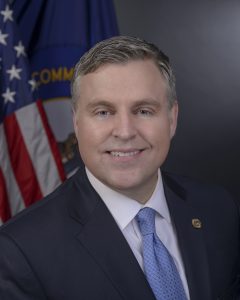
Photo: KY Justice and Public Safety Cabinet
Kentucky Justice Secretary John Tilley announced today that applications are now available for obtaining grants under the federal Victims of Crime Act (VOCA).
Programs that offer direct services to victims of violent crime may apply for the funds. The application deadline has been extended to June 2, 2017, and awards are scheduled to be announced in September.
The VOCA program provides a range of services to crime victims, including crisis intervention and follow-up, therapy, group counseling, information and referral, court advocacy, and assistance with victim compensation claims.
Eligible applicants include public agencies and nonprofit programs such as domestic violence shelters, child advocacy centers, rape crisis centers, prosecutorial and crisis intervention programs, and other advocacy programs that provide direct services to crime victims. The application offers additional information on which services qualify.
All applications must be submitted online via the Kentucky Justice Electronic Grants Management System (eGMS). New applicants are encouraged to establish an account and become familiar with the system well in advance of the due date.
Applicants should also note that validating a new user accounts requires 48-72 hours. Training videos and other aids are available by following the links on the Grants Management Branch webpage, http://justice.ky.gov/Pages/Grants-Management-Branch.aspx.
Assistance with the application process may be obtained by contacting the Grants Management Branch at askgmb@ky.gov.
 The Kentucky Historical Society will crisscross the Commonwealth to dedicate five historical markers in May.
Here is the schedule:
May 4, Walton CCC Camp Bean Ridge, 1 p.m., 30 School Road, Walton
Civilian Conservation Corps company 3541 opened in 1935 in Walton. The 200 men stationed there specialized in soil conservation. They trained local farmers in contour farming, crop rotation and strip cropping; planted trees; built fences; and developed farm management plans. They also provided relief during the 1937 Ohio River flood.
May 8, Webster County Courthouse, 10:30 a.m., CDT, Webster County Courthouse, Dixon
The courthouse dates to 1941 and was a Works Progress Administration project during the Great Depression. Architect H. Lawrence Casner, from Webster County, designed the building, as well as the Caldwell County courthouse and the main vault at Fort Knox. His wife, Arminta Bowmer Casner, made the sculptured faces on the building’s exterior walls.
May 10, First Louisville Slugger Bat, 10 a.m., 118 S. First St., Louisville
This address is the site of the original J.F. Hillerich carpentry shop. The Louisville Slugger baseball bat has its roots with Louisville Eclipse player Pete Browning’s broken baseball bat. J.F. Hillerich’s son was at the game in 1884 when it broke and offered to make a new bat for Browning. Browning got three hits with the new bat, creating a demand from his teammates for their own bats. The company trademarked “Louisville Slugger” in 1884.
May 20, Ted Poston “Dean of Black Journalists,” 3:30 p.m. CDT, 9th and Main Streets, Hopkinsville
Hopkinsville native Theodore Roosevelt Poston began his journalism career in 1936 as a freelancer for the New York Post. He went on to spend most of his career there, covering major civil rights stories of his era. Among his many awards was a Pulitzer Prize (1949).
May 28, Bon Jellico, 2 p.m., Highway 92W and Bon Hollow Road, Whitley County
The Bon Jellico coal mine operated from 1912 to 1937 and employed 350 workers. It annually produced nearly 100,000 tons of Blue Gem coal. The town included 75 houses, a three-room school/church and a company store. Around 1,500 people lived in Bon Jellico over the 25-year period the mine operated. It closed primarily because the coal supply was depleted.
More than 2,400 historical markers statewide tell Kentucky’s history. More information about the marker application process and a database of markers and their text is available at history.ky.gov/markers. Also available on the site is the Explore Kentucky History app, a source of supplemental information about marker topics and virtual tours of markers by theme. KHS administers the Kentucky Historical Marker Program in cooperation with the Kentucky Transportation Cabinet.
Anglers with a bit of salt in their hair remember fondly the venerable Sassy Shad, the paddle-tailed, shad-shaped soft plastic wonder that caught practically anything that swims.
In the fishing lure world, what is old oftentimes becomes new again. Over the last decade or so, the soft-plastic swimbait stormed the fishing world, looking remarkably like a Sassy Shad with refinements.
With softer, lifelike soft plastic formulations and more realistic color schemes that closely resemble shad or other baitfish along with salt and scent fused into the lure, the modern swimbait is one of the most versatile lures you can throw.
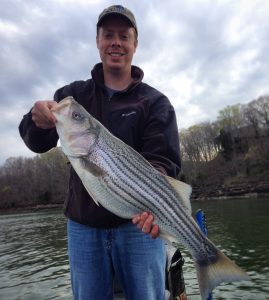
Photo: Kentucky Department Fish and Wildlife
“Anything looking to eat a baitfish will hit a swimbait,” said Chad Miles, host of the “Kentucky Afield” television show and swimbait expert. “I’ve caught everything from crappie to striped bass and all three species of black bass, smallmouths, largemouths and spotted bass on a swimbait.”
Spring through early summer is one of Miles’ favorite times to fish a swimbait for black bass. He had a great trip on Lake Cumberland last spring while filming an episode of “Kentucky Afield.” They caught several quality smallmouth bass, largemouth bass in the 5-pound range and Executive Producer Nathan Brooks caught a 37-inch striped bass.
A 4-inch white and silver swimbait rigged on a 3/8-ounce leadhead fooled them all. They caught most of their fish on secondary points in Difficulty and Harmon creeks.
“The fish are up shallow at this time of year,” he explained. “I downsize the weight of the leadhead to a 1/4-ounce and use no heavier than 3/8-ounce. You do not make a big splash on the cast with a lighter leadhead. It also allows you to keep the lure from getting hung on the bottom.”
Employ a steady retrieve and work a swimbait down sloping banks that fall off into deep water or across points in spring through early summer. These areas draw shad and other baitfish, what the swimbait emulates.
“The good thing about a swimbait is you can adjust your depth and speed, which you really can’t do with a crankbait,” Miles explained. “It is all about getting the right speed on the retrieve and adjusting it according to the aggressiveness of the fish.”
On deeper lakes, such as Dale Hollow, Lake Cumberland and Laurel River Lake, Miles used a nose-weighted swimbait hook and a solid body swimbait for bass. He rigs these swimbaits hook exposed, the way most anglers used to rig a Sassy Shad.
“I use the belly-weighted wide gap swimbait hook and a hollow body swimbait for shallow lakes with more cover such as Kentucky Lake or Lake Barkley,” Miles said. “This setup is weedless and works great over weedbeds or through cover for bass.”
In clear water, the natural shad color is hard to beat for swimbaits. White with silver flakes is also a good color. “In stained water, I like swimbaits with some chartreuse or orange in them,” Miles said. “In murky to muddy water, I don’t throw a swimbait. They are other lures much more effective than a swimbait in those conditions.”
Miles said resisting the temptation to set the hook when you first feel a bite is the most important aspect of fishing a swimbait. “Keep reeling through the strike and let the rod load up a bit before setting the hook,” he said. “If you set the hook immediately, you are pulling the swimbait away from the fish.”
A medium to medium-heavy power fast action baitcasting outfit spooled with 10- to 12-pound fluorocarbon line works well for handling swimbaits.
“You are throwing a good amount of weight with a swimbait,” Miles said. “You need a rod that can handle it.”
As the days lengthen and the water warms, Miles works 5- to 6-inch swimbaits over channel breaks, ledges and submerged humps just above the thermocline for big largemouth bass on Kentucky Lake and Nolin River Lake.
“The swimbait works well in summer for suspended bass that are hard to catch on anything else,” Miles said. He counts the swimbait down in the water column over likely fish holding structures such as ledges, humps or points that extend out into the lake. He retrieves his swimbait deeper on each cast until he finds fish.
In summer, anglers on lakes with flooded timber such as Lincoln County’s Cedar Creek Lake do well working swimbaits slow and deep for largemouth bass suspended in the flooded timber.
After the weather turns cold in fall, Miles falls back to fishing 3-inch swimbaits in the natural shad color for smallmouth and spotted bass.
You can watch Miles employ his excellent swimbait techniques on a productive spring day on Lake Cumberland from a segment filmed last April by clicking on the KY Afield tab at the top of the Kentucky Fish and Wildlife homepage at www.fw.ky.gov. Once on the “KY Afield” page, click on the link “Visit our Youtube channel,” then type “Fishing with Swimbaits on Lake Cumberland” in the search bar.

Photo: KY Department of Corrections
With prisons and county jails operating at or above capacity, the Kentucky Department of Corrections is implementing an emergency regulation this week to expedite release of certain offenders who have already been approved for parole.
The move will impact about 570 inmates whose cases have been reviewed by Kentucky’s independent Parole Board as part of the normal discharge process. Prior to the change in regulation, these inmates were already deemed safe for parole and were scheduled for release within 60 days.
The regulation is designed to free up prison and jail beds so that offenders can be transferred out of the most crowded jails, where high populations have raised concerns over safety and operations.
Since January 2016, the state inmate population has grown 6.9 percent, slowing the transfer of inmates from county jails to state prisons after an offender has been convicted in court. The growth in population has also increased the number of Class D inmates who, by statute, remain housed in jails.
Officials believe this effort is a first solid step in addressing the issue of crowding in prisons and jails. Several counties are already undertaking jail expansion projects, which are expected to increase capacity by approximately 1,706 beds in the next 24 to 36 months. In addition, the Department of Corrections is continuing to review options for reopening private prisons, though a final decision has not been made.
 Attorney General Andy Beshear is urging Kentuckians who purchased Provigil to file their claims as part of the more than $1 million settlement his office secured with pharmaceutical company Cephalon last year over its anticompetitive conduct to protect profits from its sleep disorder drug.
As part of the settlement, Kentuckians who used the drug will receive a portion of roughly $760,000. Kentucky’s Medicaid program will receive nearly $500,000 as part of the settlement.
Kentuckians eligible to file claims are those who paid for the brand-name drug Provigil or its generic Modafinil from June 24, 2006, to March 31, 2012. Beshear and a group of attorneys general were recently granted a request to the courts to extend the time to file claims on the settlement to June 25, 2017. The deadline to file claims was originally the middle of April.
“My office asked the court for additional time so that more Kentuckians could receive restitution,” Beshear said. “As attorney general, I am committed to pursuing anyone who defrauds consumers and our government, and my office will continue to monitor the settlement and work with Kentuckians who may need assistance in filing their claims.”
Kentuckians may obtain a claim form by visiting www.StateAGProvigilSettlement.com or by calling 877-236-1413.
The settlement ends a multistate investigation into Cephalon, headquartered in Pennsylvania. Cephalon is a wholly owned subsidiary of Teva Pharmaceuticals.
According to the settlement, the company’s anticompetitive actions delayed generic versions of Provigil, which is used to treat excessive sleepiness caused by sleep apnea, narcolepsy or shift work sleep disorder from entering the market for several years. As patent and regulatory barriers that prevented generic competition to Provigil neared expiration, the company intentionally defrauded the federal government to secure an additional patent.

Photo: Louisville Metro Parks and Recreation
A new mobile application that allows users to locate the nearest park or community center and make a tee time at any Metro Parks and Recreation golf course is now available for Apple and Android devices free of charge in the app store.
In addition to the GPS-enabled mapping and tee time technology, the app provides a comprehensive calendar of programs and events, information on athletic leagues and schedules, information about shelter and pavilion rentals, links to social media and more.
Users can find it in the app store by searching “Louisville Metro Parks and Rec.”
“We all know that a great parks system enhances the quality of life for all citizens. And this app will help enhance the park-use experience. So go to the app store, get the Louisville Metro Parks and Recreation app, and get yourself to a park,” Mayor Greg Fischer said.
“We’re pleased to present this new app to the community,” Parks and Recreation Director Seve Ghose said. “It’s a great way to keep up with all the fun activities and events going on this summer throughout our nationally-accredited parks and recreation department.”
Last week,  Gov. Matt Bevin announced Kobe Aluminum Automotive Products LLC (KAAP) will expand for a seventh time in Bowling Green, investing more than $51 million and creating 129 full-time jobs.
“This expansion by Kobe Aluminum Automotive Products is a shining example of growth among advanced manufacturers in Kentucky,” Gov. Bevin said. “Since establishing its Bowling Green plant in 2004, KAAP has proven itself an excellent corporate partner in the Commonwealth’s automotive industry. We are grateful for the company’s dedication to the state and are excited to see this remarkable success continue.”
KAAP will add more than 108,000 square feet to accommodate new production lines and equipment, including a melting furnace, forging presses and heat-treatment, casting and machining lines. The additional capacity will allow the company to meet increased sales goals. Company leaders expect the project to take approximately one year, with the start of production targeted for fall 2018.
“This is our 12th year producing aluminum automobile suspension parts in Kentucky. Two years ago we decided to make our sixth investment, and due to the increasing necessity of lighter vehicles, we have decided to make another investment,” said Toshihiro Katsura, KAAP president and CEO. “This will be our seventh additional investment, and we are truly grateful to the Commonwealth of Kentucky for all of the support and incentives we have received.”
The plant’s previous expansions total $293 million and it currently employs 500 Kentucky residents full-time. KAAP manufactures lightweight aluminum parts, including upper and lower control arms and steering knuckles. Lighter parts help reduce overall vehicle weight, which contributes to greater fuel economy and lower emission levels.
KAAP, based in Kobe, Japan, has served is home country’s aircraft and automotive industries since 1937, primarily manufacturing forged aluminum suspension products. The company is part of the Kobe Steel Group, known internationally as KOBELCO.
Kentucky’s automotive industry includes more than 500 facilities employing 100,000-plus residents full-time. The state ranks first nationally in light-vehicle production per-capita and is one of the top automotive production states overall.
The KAAP announcement brings the state’s 2017 automotive-sector total investment to more than $1.43 billion with nearly 280 new full-time jobs.
Sen. Mike Wilson, of Bowling Green, said the company has had an ongoing impact on the community.
“The expansion of Kobe Aluminum here in Bowling Green marks a great day for both our city and our Commonwealth,” Sen. Wilson said. “KAAP has successfully expanded in previous years, and this newest expansion will create more than a hundred new Kentucky jobs. I thank KAAP for its dedication to Kentucky’s workforce and look forward to the company’s continuous growth in our region.”
Rep. Jim DeCesare, of Bowling Green, noted KAAP’s importance to the local economic and workforce.
“Kobe Aluminum continues to invest in our region to the tune of nearly $52 million and 129 new jobs,” Rep. DeCesare said. “Since 2005, they have expanded six times for a total of $293 million pumped into our region. I commend them for this recent investment, and am proud to continue to support pro-business initiatives to encourage this exact type of growth.”
Warren County Judge-Executive Mike Buchanon welcomed the expansion and its economic impact.
“We are proud that KAAP continues to call Warren County home,” Judge-Executive Buchanon said. “Seven expansions in 12 years is a great testament to their success as a leader in an industry primed for growth. I extend our sincerest gratitude to KAAP for being such an important part of our local economy.”
Bowling Green Mayor Bruce Wilkerson said the new jobs and investment build on the company’s long partnership with the city.
“KAAP continues to have a tremendous impact on the city and our local economy,” said Mayor Wilkerson. “Their growth and success since locating to Bowling Green in 2005 is astonishing and we are grateful for all KAAP does for our community.”
To encourage the investment and job growth in the community, the Kentucky Economic Development Finance Authority (KEDFA) in April preliminarily approved the company for tax incentives up to $2 million through the Kentucky Business Investment program. The performance-based incentive allows a company to keep a portion of its investment over the agreement term through corporate income tax credits and wage assessments by meeting job and investment targets.
Additionally, KEDFA approved KAAP for up to $200,000 in tax incentives through the Kentucky Enterprise Initiative Act (KEIA). KEIA allows approved companies to recoup Kentucky sales and use tax on construction costs, building fixtures, equipment used in research and development and electronic processing.
In addition, KAAP can receive resources from the Kentucky Skills Network. Through the Kentucky Skills Network, companies can receive no-cost recruitment and job placement services, reduced-cost customized training and job training incentives. In fiscal year 2016, the Kentucky Skills Network provided training for nearly 95,000 Kentuckians and 5,000 companies from a variety of industry sectors.
For more information on KAAP, visit www.kobeal.com.