Monday January 26, 2026
Local Connection
 Weather
 Traffic
 @LouisvilleDispatch
 @LouisvilleDisp
 Subscribe
 The Solid Waste Management Services Enforcement Department has impounded its 4th vehicle of 2018 for illegal dumping.
With the help of employees from Bulk Waste, last week a Uhaul truck in the 2500 block of W Jefferson was seen illegally dumping. The employee took pictures of the vehicle and waited until SWMS Enforcement was able to investigate.
“Once again, I commended the officers and Bulk Waste for helping us crack down on this crime,” says Councilwoman Cheri Bryant Hamilton (D-5). “Our streets and alleys are not a landfill, if you are going to remove trash and debris do it the right way or it will cost you.”
SWMS officers say once confronted, it was learned one of the individuals lived in the area and knew Bulk Waste would be in the area soon for bulky item collection. They were working at another property and hauled debris from that location and placed at a vacant property in the 2500 block of W Jefferson.
The responsible party will receive a $500 fine plus the cost of cleanup and pay approximately $500 in impound and storage fees.
Over the last several years, SWMS officers have been impounding vehicles involved in illegal dumping after the Metro Council approved a change in the Metro Code of Ordinances. The change also allows anyone who sees illegal dumping and can identify the vehicle or shoot pictures of it. Those pictures have lead officers to impound the vehicle. Eighteen vehicles were impounded in 2017.
 Cuddle Clones, an award-winning Louisville company that specializes in creating the highest quality custom products made to look like people’s pets, announced its inclusion in the prestigious 2018 Inc. 5000, Inc. Magazine’s annual ranking of the nation’s fastest-growing private companies. Cuddle Clones’ three-year growth of 583% ranked 1st in the state of Kentucky and 66th in their category of Consumer Products, which placed them alongside previous brands as Timberland and Zappos, and 862nd overall in the United States.
“Cuddle Clones perfectly encapsulates the success we strive help Kentucky startups achieve,” said Vivek Sarin, co-leader of the Kentucky Cabinet for Economic Development. “This company began as a small operation in Louisville just eight years ago, so its announcement in February of a substantial $1.3 million expansion that will create 50 jobs is truly remarkable. Cuddle Clones is a prime example of what Kentucky-grown businesses are capable of, and I strongly suspect we have not yet seen the company’s full potential.”
Cuddle Clones growth is primarily a result of investing in new technology for their ecommerce platform, digital properties, and innovating new products. “We couldn’t have achieved this growth without the contributions from our team that include superb customer service and manufacturing the highest quality products for our customers” said Cuddle Clones CEO Brennen Lawrence.
Cuddle Clones expects to be on the list again next year as the first half of 2018 has exceeded expectations. Lawrence continued “We’ve performed very well in the first half of 2018 and will release several new, exciting custom pet products prior to Q’4 that we expect to further enhance our growth.”
This newest accolade comes on the heels of being named Louisville’s fastest growing company in 2017 by Business First. “It’s always exciting when a local company receives national attention for its fast-growth expansion in a global market,” said Louisville Mayor Greg Fischer. “Cuddle Clones’ success exemplifies Louisville’s robust business climate that encourages new start-ups and facilitates quick scale-up of business operations. We are proud to be the home of Cuddle Clones and we look forward to its continued success.”
Photo: Louisville Forward
Mayor Greg Fischer announced that Louisville Forward’s Small Business Development team is accepting applications for the second cohort of the city’s Entrée-preneurship Series, a free program designed to foster the development of new restaurateurs and food entrepreneurs.
The interactive 10-class series, originally called the Food Entrepreneurship Series, will run from Sept. 8 to Dec. 1, and will be taught by local industry-leading professionals. All classes will meet at Chef Space, 1812 W. Muhammad Ali Blvd., on Saturdays from 8:30 – 11 a.m.
“Our first group of graduates showed passion and knowledge about the food industry. Whether they were starting a new business, operating an existing business or just sharpening their skills, this free program gave them the boost they needed to take the next steps in defining their own success,” said Mayor Fischer. “With the outpouring of interest, I’m pleased that we are able to continue this program and support our food entrepreneurs who are setting the stage for our city’s continued momentum in the food and beverage sector.”
The inaugural Food Entrepreneurship Series launched earlier this year and graduated nine entrepreneurs with skills needed to start or grow their businesses in Louisville’s food industry.
“This Series not only helped me further develop my business plan, it gave me the tools, resources and connections to help me fulfill my purpose as a recipe creator and healthy living educator,” said Jessica Taylor, a graduate of the inaugural series and founder of Jessica Taylor New Living (@VeganNewLiving on Instagram).
Registration is open, but space is limited. To participate, individuals must be over 18 years of age, attend 9 of the 10 classes and be a Louisville resident. There is no fee to participate in the series. Upon completion of the program, participants will receive continued assistance and connections to resources from Louisville Forward’s small business development team.
To apply for the Entrée-preneurship Series , visit https://louisvilleky.gov/government/louisville-forward/entree-preneurship-series
Schedule and class descriptions are listed below:
- September 8, 2018: Customer Service – During this session participants will be instructed in ways the physical space and staff can go above and beyond the call of duty to create a welcoming, and pleasurable environment that customers want to come back to.
- September 15, 2018: Employee Orientation and Training – In this course, participants will come away with a better understanding of how to navigate employment laws and regulations related to running a restaurant. Additional Human Resources best practices and policies for on-boarding and managing employees also will be covered.
- September 22, 2018: Kitchen Set-Up and Menu Development – This course will cover the importance of proper and efficient kitchen set-up to help minimize ticket times and ensure quality and safe food preparation, as well as highlight the basic types of equipment available and its proper use. Participants will learn the basics of menu development, focusing on such things as ingredients and sourcing, food cost, authenticity of cuisine, cross utilization, and concepts of proper pricing.
- October 6, 2018: Purchasing and Managing Food Cost – Knowing food costs is integral to understanding a restaurant’s full budget. Participants will learn tips for managing food costs, through purchasing habits, tracking inventory, ands tools to help track and calculate.
- October 13, 2018: Health and Safety Regulations – This course will cover the basics of proper food handling, inspections and placarding, review of common reasons restaurants fail inspections and how to keep from failing. The course also will cover the top five ways a customer becomes ill and things to consider when changing the type of food service you offer.
- October 20, 2018: Auxiliary Food Services – This course is a new addition to the Series and will focus on food services outside of a traditional restaurant. The information covered in this course will be specific to food trucks, catering and prepared meals, and the specific intricacies that are unique to these operations.
- November 3, 2018: Management Training – From staff management and scheduling to creating a culture for your restaurant, this session will cover day-to-day restaurant management skills, including staff training to promote from within.
- November 10, 2018: Marketing and Branding – Participants will learn how to market their concept and themselves as a brand, by reviewing the various mediums of marketing from websites, social media and traditional methods such as flyers and brochures.
- November 17, 2018: Accounting and Cash Handling – This course will cover steps a food entrepreneur should take to ensure their accounting system is properly set up, including budgeting, cash flow, expense management, tax payments/filings, options of bookkeeping software, and what you should know for tax preparation.
- December 1, 2018: Safety: Inside and Outside – This course will review safety best practices to maintain a safe environment for customers and employees, including proper lighting, opening and closing procedures, signs of suspicious activity, how to handle disruptive incidents inside and outside of your establishment, and suggestions of how to strengthen the street block.
 In December 2015, Metro Council passed an ordinance to regulate the use of short term rentals; customers often book short term rentals through online platforms such as AirBnB, VRBO, and others. City leaders have been monitoring implementation of this ordinance and the evolution of the new shared economy. Louisville Metro Department of Develop Louisville, Metro Council District 8 and Louisville Tourism have partnered to propose changes to the short term rental ordinance (Chapter 115.515-521 of the Louisville Metro Code of Ordinances and Chapter 4 of the Land Development Code) in response to the growing popularity of this tourist experience and how to best integrate it into our neighborhood fabric.
“Tourism is flourishing in our city and in addition to the number of hotels opening, we are also seeing a growth in the use of short term rentals, which allow visitors a unique way to experience our beautiful neighborhoods and vibrant commercial corridors,” said Jeff O’Brien, Director of Develop Louisville. “When welcoming this new form of the shared economy, we must also make sure that short term rentals and their occupants harmonize with neighbors and these proposed changes to our ordinance will help us better achieve that.”
“Short term rentals are good for our city but these changes are needed to upstream and toughen enforcement against illegal operators,” District 8 Metro Councilman Brandon Coan said. “Neighbors deserve these additional protections and they will serve all legal operators well.”
“As destinations around the country work to keep up with growing shared economy options for travelers, Louisville Tourism is proud to be among those that are embracing their short term rental community,” Louisville Tourism President & CEO Karen Williams said. “Now, like with traditional lodging, the transient room tax collected can be invested in marketing Louisville and we are working with our local partners, in Airbnb for example, on efforts to attract even more visitors using their properties as assets.”
Proposed changes include:
- Limiting the number of individuals eligible to reside in a short term rental to ten (10). The proposed changes would permit the number of individuals who can reside in a short term rental to two (2) times the number of bedrooms plus four (4) with a limit of ten (10) individuals.
- Allowing short term rental in properties zoned EZ-1. A map of EZ-1 zoned properties that would be eligible can be found here: https://louisvilleky.gov/government/planning-design/short-term-rental-in….
- Requiring that an emergency contact for each short term rental reside in Jefferson County.
- Eliminating an initial registration fee, which was $25. Under the proposed changes a $25 fee will be required upon renewal.
- Prohibiting the advertising of a short term rental if it is not registered with the city of Louisville. Enforcement for advertising a short term rental without registering it results in a notice of violation for a first offense and a $50 fine for every additional day that the short term rental remains advertised.
- Introducing a new enforcement process: a first offense results in a $50 fine, a second offense results in a $250 fine, a third offense results in a $500 fine, and any additional offense results in a $750 fine.
To view the proposed changes in their entirety and to provide feedback, please visit https://louisvilleky.gov/government/planning-design/short-term-rental-in….
Develop Louisville staff will be presenting these proposed changes to the Planning Commission after all public feedback has been reviewed. Once approved by the Planning Commission, then the changes will go before Metro Council. Not all municipalities with zoning authority in Jefferson County have approved a short term rental ordinance.
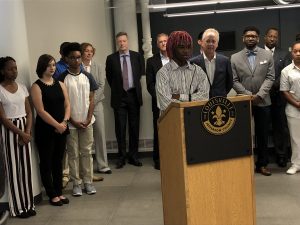 From computer coding to manufacturing and life-guarding to public finance, a record number of young people — 6,200 — gained new skills and confidence working at businesses and job sites throughout Louisville this summer as part of the SummerWorks program.
Mayor Fischer today congratulated youth and thanked the many private sector and non-profit employers who hired youth ages 16-21. That number includes 1,004 youth employed by companies and organizations that directly teamed with KentuckianaWorks and YouthBuild to provide more extensive career guidance and support.
Since its start in 2011, SummerWorks and its partner-employers have put more than 23,000 young people into summer jobs.
“SummerWorks is helping build critical skills with our young people, including many who might not otherwise have this opportunity to learn and grow in the right direction,” the Mayor said. “This effort not only helps ensure that Louisville is a city of opportunity for all our young people – it’s also helping build a pipeline of new talent which is crucial.”
At a season-closing event at the Humana Digital Experience Center, several young people shared their summer job experiences:
- Elanna Carr, 20, said her work in Public Finance at Hilliard Lyons was a “perfect real-life work fit and very beneficial,” even convincing her to major in Economics at the University of Louisville;
- Teandre Blincoe, 17, who worked in technology on the IT Service Desk at Humana, said the experience “meant a lot to me in building my customer skills and showing me possible career opportunities in the tech field.”
- Grace Hotkewicz, 17, who taught art to pre-school children at the Speed Art Museum. “I learned so much and it was a perfect fit for my career goal of creating digital animation for kids.”
Other SummerWorks’ youth worked in hospitals, restaurants, museums, banks and hotels. Working closely with supervisors and mentors, young people worked on manufacturing assembly lines and grocery check-out lanes, assisted companies with IT and human resources needs, worked in tourism and helped ship packages around the world.
Key employer-partner companies, including GE Appliances, Humana, Kentucky Kingdom, Kindred Healthcare and UPS, increased their direct hiring of SummerWorks youth from 2017. New employers included Dine Company, Hilliard Lyons, HJI Supply Chain Solutions, Kentuckiana Comfort Center, iQor, Louisville Bats, Spectrum and StoryWood Bowties.
More than 40 private-sector businesses participated this summer, and Mayor Fischer said a top goal for 2019 is to greatly increase the number of companies hiring youth.
Private donations sponsored 237 youth in jobs at dozens of non-profit organizations and public agencies, including Americana Community Center, Boys and Girls Clubs, Family Health Centers, the Food Literacy Project and Workwell Industries. TARC bus passes were provided to many youth to help get them to and from their jobs.
SummerWorks is playing a stronger role in shaping young talent through its partnership with the new Academies of Louisville initiative, which was rolled out at 14 JCPS high schools this year. The goal is for every student to have had a summer job experience by the time they graduate their Academy high school.
SummerWorks also helped build entrepreneurial skills by providing small grants to five organizations that engaged youth in summer projects ranging from bringing fresh produce to West Louisville, to providing digital skills to young women, to building a new bicycle pump track at Shawnee Park.
“We are thrilled to see this initiative grow and evolve in both the quantity of and quality of the job opportunities young people are able to experience,” said Michael Gritton, executive director of KentuckianaWorks, which operates SummerWorks in partnership with YouthBuild Louisville.
The Mayor launched SummerWorks right after taking office in 2011, in response to the elimination of federal funding for summer jobs. That first year, 200 young people were placed in jobs. The program was recognized by the U.S. Conference of Mayors in 2014 as one of the nation’s best summer jobs programs for young people.
The program’s core operating funds are approved by the Louisville Metro Council. Private donations sponsor jobs for youth in greatest need of the opportunity. Those contributors include the James Graham Brown Foundation, JPMorgan Chase Foundation, Diaz Family Foundation, Gheens Foundation, Mary Gwen Wheeler and David Jones, Jr. and other organizations and individuals.
The Mayor urged employers to make plans now to hire or support summer jobs for 2019. More information is at www.summerworks.org .

Photo: Louisville Metro Council
Neighborhood residents in two Metro Council districts will decide how a portion of the city budget is spent in their districts.
Our Money, Our Voice is an initiative of the Metro Department of Public Health and Wellness’s Center for Health Equity and Metro Councilmen David James (District 6) and Brandon Coan (District 8). Residents of those council districts will decide how $150,000 ($75,000 in each district) will be spent.
Our Money, Our Voice is the name of Louisville’s participatory budgeting initiative. Originating in Porto Alegre, Brazil in 1989, participatory budgeting is a way for members of a community to work together to better meet their needs while having a direct say in government decisions. In the process, people often find new ways of interacting with government and with each other to create solutions for all. Participatory budgeting has been practiced in the United States since 2009 in such cities as Hartford, CT; Greensboro, NC; New York and Chicago.

Photo: Louisville Metro Council
Initial funding for the initiative is coming from $100,000 in capital infrastructure funds ($50,000 from each district) and $50,000 from the Mayor’s Healthy Hometown Movement. Additional funding is being sought from foundations and private sources. Community residents will decide how to spend the money for physical improvement projects in each of the districts.
“Our Money, Our Voice is a pilot project — a new way for citizens to engage with government and decide how tax dollars are spent,” said District 8 Metro Councilman Brandon Coan. “It’s giving people real power over real money to make the decisions that affect their lives.”
“Who knows best about the needs of the community than the people who live there?” said District 6 Councilman David James. “Nobody can make better decisions about what a neighborhood needs than the residents of that neighborhood.”
The participatory budgeting process begins with the establishment of a steering committee consisting of representatives from the participating council districts. The steering committee then connects with neighborhood residents to develop ideas and create proposals for projects to benefit the neighborhoods. Finally, the residents in the metro council districts vote on how the money will be distributed among projects.
“Projects like Our Money, Our Voice are intrinsic to the work of public health,” said Dr. Sarah Moyer, director of the Department of Public Health and Wellness and the city’s chief health strategist. “Our vision is a healthy Louisville where everyone and every community thrives. Our mission is to achieve health equity and to improve the health of the people of our city. The best way to build a thriving community is to include everyone in the decision-making process from the start and participatory budgeting is a means to make that happen.”
District 6 neighborhoods participating in Our Money, Our Voice include Algonquin, California, Limerick, Old Louisville, Park Hill, Russell (the section north of Broadway Ave., south of Plymouth St., west of 22nd St. and east of 26th St.), Taylor-Berry, University and Victory Park.
Participating District 8 neighborhoods include Belknap, Bonnycastle, Alta Vista, Cherokee Triangle, Deer Park, Gardiner Lane – Upper Highlands, Hawthorne, Hayfield Dundee – Upper Highlands, Highlands Douglass, Original Highlands, Seneca Vista and Tyler Park.
Participatory budgeting was identified as a project that the community wanted to pursue during the My Dream for Lou Policy Summit hosted by the Center for Health Equity in October 2016. To learn more about the participatory budgeting process, the Department of Public Health and Wellness invites you to the kick-off event at the Heuser Hearing Institute Hearing and Language Academy at 111 E. Kentucky St. on Wednesday August 29 at 6 p.m.
Photo: Louisville Metro Council
On Saturday, August 11th The 23 Zone is ready to once again give back to the community when the next “Feed the Block, the Back to School Edition” gets underway with free food, fun and other things to help children and people in the community.
“This is a great event that brings together local businesses, community volunteers and young people to help grow a spirit of help and concern for the people of the neighborhood,” says President David James (D-6).
The 23 Zone, located at 2621 4th Street, is no stranger to hosting “Feed the Block”. This is the store’s eleventh cookout since it opened. The purpose is a simple one; many of the store’s customers want to give back to the community.
A wide range of volunteers from local youth sports and activity groups are giving of their time at the event. The store’s location is in an area that has dealt with drugs and the less fortunate who sometimes go hungry.
In addition to food, The 23 Zone has donated shoes and clothes in the past to people in need that attend the cookout. This year, there is a back to school donation drive to help low income families and needy children get a good start to the school year.
“We are truly fortunate to have The 23 Zone and dedicated volunteers help our community,” says President James. “So if you are in need, please come. If you want to give your time and help out, you can come too.”
“Feed the Block, the Back to School Edition” gets under way at 1:00pm and goes until the food runs out. The event is hosted Kentucky Ambition AAU and Kourtesy’s Kupcakes. It is sponsored by Booth and Son Concrete & JiggaMCC Entertainment.