Thursday January 22, 2026
Local Connection
 Weather
 Traffic
 @LouisvilleDispatch
 @LouisvilleDisp
 Subscribe
 Louisville Parks and Recreation is offering an affordable family golfing package at its ten golf courses during the Memorial Day Weekend.
For only $25, a family of up to four members can play nine holes at any Parks course. The $25 includes greens and cart fees, and families can take advantage of the deal after 4:30 p.m. on three days: Saturday, May 27, Sunday, May 28 and Monday, May 29.
Families are encouraged to call in advance to book a tee time at the golf course of their choice.
“Our courses are in great shape this spring, and we’re hoping for a lot of play from families this summer,” said Louisvile Parks and Recreation Director Seve Ghose. “Come out and enjoy a round of golf with the family on a great course at an affordable price!”
Louisville Parks and Recreation golf courses are open from daylight to dark seven days a week.
The four outdoor pools operated by Louisville Parks and Recreation will open for the season on Saturday, May 26. The Algonquin, Norton, Fairdale and Sun Valley Park pools are fully staffed with lifeguards, though the department is looking to hire additional staff for the pools this summer.
The department will be hosting a lifeguard training course for those who are interested from 4-9 p.m. Monday, May 21 to Friday, May 25. The course will take place at the Mary T. Meagher Aquatic Center in Crescent Hill Park. Those who take the course and become certified will have all course fees waived if they commit to working at a Louisville Parks and Recreation pool for one year. Lifeguards will be paid $10.50 per hour.
Admission is $2 for children 17 and younger and $3 for adults 18 and over. Photo identification is required for anyone age 9 or older; children 8 and under must be accompanied by a guardian 12 or older with photo identification. Metro Parks can make identification cards for children who need them for $4 per card; call (502) 897-9949 for details.
(Note: For information on the Mary T. Meagher Aquatic Center, click here.)
Parks pools will be open:
Summer 2018: May 26, 27 & 28- Memorial Day Weekend &
June 2 – August 4 pools will open with the following schedules:
Algonquin Park
1614 Cypress Street, 40210
502/772-7907
Open Daily: 11 a.m. – 4 p.m. • Closed Tuesdays
Fairdale (Nelson Hornbeck Park)
709 Fairdale Road, 40118
502/361-8270
Open Daily: 1 p.m. – 6 p.m. • Closed Mondays (but open Memorial Day)
Norton (Camp Taylor Memorial Park)
4201 Lee Avenue, 40213
502/451-0678
Open Daily: 11 a m.- 4 p m • Closed Thursdays
Sun Valley Park
6506 Bethany Lane, 40272
502/935-0302
Open Daily: 1p m – 6 p.m. • Closed Wednesdays
Prerequisites for Lifeguard Training
The following are prerequisite skills for lifeguard training; you will be asked to perform these skills on the first day of class.
- Swim 300 yards continuously– 100 freestyle, 100 breaststroke, and 100 choice of freestyle or breaststroke.
- Tread water for two minutes no hands.
- Swim 20 yards and surface dive 10 feet retrieving a 10-pound brick. Once swimmer has retrieved brick then the swimmer must swim 20 yards on their back while holding both hands on the brick to the original starting point.
- The swimmer must exit the water without using a ladder or steps. This prerequisite must be completed in 1 min and 40 seconds.
To register for the course, call Keith Smith at (502) 895-6499.

Photo: Louisville Metro Council
His high school baseball teams won six Kentucky State Baseball Championships. During his 39 year as the winningest coach in Kentucky, he posted a state record of 1,144 victories. He was the sixth winningest coach in the nation.
On Thursday night, the Louisville Metro Council approved a resolution for an honorary street signs for Bill Miller the late coach of the Pleasure Ridge Park Panthers to be placed in front of the school where he coached.
“Obviously Coach Miller is legendary based on his wins and state championships but the real measure of his achievements is the extraordinary number of lives that he touched in the process. Coach Miller helped so many students and athletes grow from boys to productive young men and hundreds of them attended the services to show their respect,” said Councilman Rick Blackwell (D-12), the primary sponsor of the Resolution.
Coach Miller was born in Louisville and attended PRP graduating in 1967. He also attended the University of Alabama and played football for legendary Coach Bear Bryant. He also played baseball while with the Crimson Tide
After college, his 39 year baseball career began as a coach when he returned to PRP first as a teacher and then as coach of the freshman and junior-varsity baseball teams. During his career, the Panthers won state championships in 1994, 1995, 1996, 2008, 2013 and 2017.
He was inducted into the Dawahares/Kentucky High School Athletic Association Hall of Fame in 2017 shortly before his passing.
By unanimous vote, the Metro Council approved the placing of honorary Street signs at the northwest corner of Greenwood Road and Waller Lane, at northwest corner of Greenwood Road and Feyhurst Place and at the entrance to PRP High School at 5901 Greenwood that read “Coach Bill Miller Way”.
“I hope the honorary signs demonstrate our community’s appreciation for Coach Miller’s dedicated service to Pleasure Ridge Park High School,” said Blackwell.
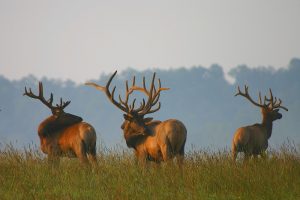
Photo: Kentucky Department Fish and Wildlife
Hunters interested in entering this year’s elk hunt drawing have until midnight (EST) April 30 to buy applications. Hunters can apply online at the department’s website, fw.ky.gov.
Kentucky residents and non-residents are eligible to apply for four permit types but can only be drawn for one. Each application costs $10.
Kentucky Fish and Wildlife will issue 700 general quota hunt permits and 10 youth permits this year through a random computer drawing conducted in early May by the Kentucky Commonwealth Office of Technology. Results will be available to applicants on the department’s website May 15.
Sixty-four percent of bull elk hunters using a gun last year enjoyed a successful hunt and 48 percent of hunters utilizing archery equipment successfully harvested a bull. The success rate for cow archery hunters was 28 percent last year and 47 percent among hunters using a firearm for cow elk.
“Our herd is strong and healthy,” said Gabe Jenkins, deer and elk program coordinator with the Kentucky Department of Fish and Wildlife Resources. “However, the herd dynamics have changed in recent years. Hunters will have to work to be successful and time spent scouting will greatly increase chances for success.”
The season limit of 250 bulls and 450 cow elk is unchanged from last year, as is the allotment among tag types.
Kentucky Fish and Wildlife will issue 150 firearms permits and 100 archery/crossbow permits for bulls; 290 firearms permits and 160 archery/crossbow permits for cow elk.
Demand is greatest for the bull firearms permit and lowest for the cow archery hunts.
The bull archery/crossbow season opens in September. The bull elk firearms seasons are spread over two separate, weeklong hunts in October while the cow elk firearms seasons are split into two weeklong hunts, both in December.
Hunters ages 15 and younger also can apply for the youth-only quota hunt during the same application period as the general elk quota hunt drawing. They may apply for the general quota elk hunt drawing as well, but cannot be drawn for both in the same year.
A landmark restoration effort re-established an elk herd in the state’s scenic southeastern region and created one of the most sought-after hunting opportunities east of the Rocky Mountains. Kentucky’s elk herd is the largest east of the Rocky Mountains and more than all the states east of the Mississippi River combined. The elk restoration zone in southeast Kentucky covers 16 counties and more than 4 million acres.
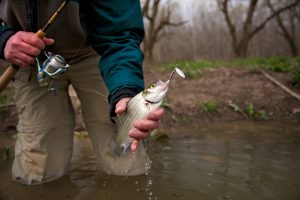
Photo: Kentucky Department Fish And Wildlife
This spring seems like one long continuation of late winter. As soon as we get a warm day, the temperature plunges and we are back in February again. It even snowed on Monday of the third week of April.
This up and down weather combined with cold rains has the spring fishing season behind by a few weeks. The spawning runs of white bass into the headwaters of reservoirs are scattershot so far this spring, with some movement followed by retreat.
“I don’t think the white bass have really had a chance to run yet,” said Ron Brooks, director of Fisheries for the Kentucky Department of Fish and Wildlife Resources. “I think the fluctuating water temperatures are screwing them up a bit. We need a sustained warm front to get them going.”
Water temperatures are in the low 50s in most reservoirs and streams across Kentucky.
Anglers fishing the headwaters of Taylorsville Lake found rewarding, but sporadic, fishing over the last week. “Last Thursday, I took home six white bass, but on Friday, I took home 10, at least four of them over 15 inches,” said Clifford Scott, internal policy analyst for Kentucky Fish and Wildlife. “I had to walk quietly out of there because I had the biggest stringer of fish.”
Scott took his fish with a combination of old-school 2-inch curly-tailed grubs in white and yellow along with a 2-inch Bobby Garland Baby Shad in pink and pearl.
“I saw small shad all over the place,” Scott said. “Once I saw them, I switched to the Baby Shad. You had to fish for the white bass, they were not on a hard run, but produced enough action to keep your interest.”
The upper part of Taylorsville Lake WMA grants bank access to anglers that produces fishing comparable to those in boats.
Mike Hardin, assistant director of Fisheries, caught some white bass in the upper reaches of Taylorsville Lake this past weekend. “We caught them above the first riffle from the impounded water,” he said. “We caught a mixed bag of different sizes and caught more in the evening than in the morning. The males were marked up in breeding colors. We caught a few females, so they are already staging for the spawn.”
White bass populations are by nature cyclic, and good fishing often erupts in lakes over the course of a year or two.
Green River Lake is one of those lakes poised for a white bass breakout. Southwestern Fisheries District biologist Eric Cummins and crew conducted white bass population sampling on the lake last year. They found excellent reproduction in 2014 for white bass, producing an expanding population of fish 14 inches and longer in the lake.
Last week, some bass anglers fishing a tournament on Green River Lake reported incidental catches of white bass while fishing crankbaits for largemouth bass. Anglers should search the Robinson Creek arm from Wilson Creek up to the KY 76 Bridge (Knifley Road) and in the Green River arm above Holmes Bend.
Bank anglers can access the upper end of the Robinson Creek arm at the Elkhorn Ramp and the Wilson Creek Recreation Area. They may also access the upper section of the Green River arm at the Snake Creek Ramp and other roads on the Green River WMA in that area.
Cave Run Lake is another reservoir with growing numbers of white bass. Population surveys conducted in 2017 show high numbers of larger fish, which should mean good fishing in 2018. Search for surface activity to find white bass in spring on the lake.
The fishing peaks in summer on Cave Run, when white bass get in the “jumps” by trapping shad against the surface and ripping through them. The confluence near the mouth of Buck Creek as well as the areas around the Clay Lick and Alfrey boat ramps make excellent places to search for them when it gets hot. Any shad imitating topwater cast into the jumps will get smoked.
Some anglers caught fish in the Broad Ford area in the headwaters of Nolin River Lake a few weeks ago, but the fishing slowed with the cold rains that accompanied major frontal passages earlier in April. The sustained warm weather in the upcoming forecast will draw waves of white bass into Nolin River Lake above Bacon Creek Ramp.
Fast and furious fishing during the spring runs makes white bass one of the most popular fish anglers pursue. When they are on, you can catch several fish on consecutive casts.
In-line spinners like the venerable Rooster Tail in white, chartreuse and pink all score white bass. You can work an in-line spinner near the surface or let it sink a few feet and retrieve. Vary the depths of the retrieve until you hit fish.
Like what Scott found last week, small shad-shaped soft plastic lures or curly tailed grubs also attract white bass. Some anglers fishing the headwaters of reservoirs suspend 1/16- to 1/32-ounce white feather or hair jigs under bobbers and let them drift in the current. Change the depth of the jig until you find white bass.
Anglers may keep 15 white bass daily, but only five of the daily limit may be longer than 15 inches. White bass fishing gives you a fantastic reason to buy your fishing license, so don’t forget to get one if you haven’t already.
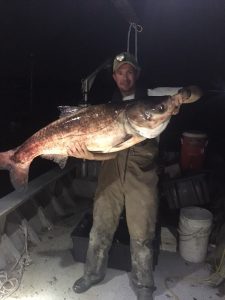 Commercial anglers netted nearly 42 tons of invasive Asian carp from Kentucky and Barkley lakes during the inaugural Carp Madness tournament in 2013.
Carp Madness returns to the lakes in June with a new twist: it’s a tournament for bow anglers. The top prize is $10,000 for the team on the winning boat in each division, with total prizes of $23,000.
The Kentucky Department of Fish and Wildlife Resources and the Tennessee Wildlife Resources Agency are partnering with the Kentucky Fish and Wildlife Foundation, Kentucky State Parks and the Bowfishing Association of America for Carp Madness 2. The tournament is set for the night of June 23-24.
The tournament is another way to remove carp from the lake while building awareness of the invasive fish.
“We anticipate that Carp Madness 2 will remove more than 100,000 pounds of Asian carp in a single night of bowfishing,” said Ron Brooks, fisheries division director for Kentucky Fish and Wildlife. “Proceeds beyond the cost of the tournament payouts and prizes will go to the Kentucky Fish and Wildlife Foundation, which works with our department on fish and wildlife habitat, the Salato Wildlife Education Center and sponsoring the department’s summer conservation camps for kids.”
The Bowfishing Association of America is sanctioning the event.
The entry fee is $150 per boat. Contestants can pay an extra $25 for entry into the big fish contest. Teams may consist of 2-4 anglers, but no passengers.
The top three weights harvested per boat from each division (lake or river) will win prize money. First place pays $10,000 per boat, followed by $1,000 for second and $500 for third. The big fish payout will be combined for both divisions and depend on the number of entries.
Contestants who weigh in Asian carp will receive a commemorative “Carp Madness 2” T-shirt. Contestants weighing in at least 250 pounds of fish will receive raffle tickets for chances at donated prizes. The Kentucky Fish and Wildlife Foundation is providing support for raffles, t-shirts and donations to the tournament. The foundation will also sell “Carp-Madness 2” T-shirts to support Asian carp removal efforts.
The tournament begins at 7 p.m. (Central time) June 23 and continues until 7 a.m. the following morning. Launch is set for the Kentucky Dam Marina Boat Ramp, located at the Kentucky Dam Village State Resort Park near Gilbertsville, Ky. Bowfishing anglers may harvest any of the Asian carp, including the silver, bighead, grass and black carp.
Pre-registration opens today on the Bowfishing Association of America website: baastore.bigcartel.com. Participants may also register at the event (cash only).
 The Kentucky Department of Fish and Wildlife Resources has opened more land for public use.
Old Trace Creek Wildlife Management Area (WMA) is a 323-acre property near the community of Emerson in Lewis County. Hunting on the WMA is allowed under statewide regulations.
The property was purchased with Kentucky Wetland and Stream Mitigation “Fee In-Lieu of” (FILO) Program funding for stream restoration. The FILO program is required by the U.S. Army Corps of Engineers to permanently protect stream restoration project sites through the acquisition of properties like the Old Trace Creek area. No general fund tax dollars or department license dollars were used.
“With the stream restoration project almost complete, the area is being opened for the public to enjoy,” said Mike Hardin, assistant Fisheries Division director with Kentucky Fish and Wildlife. “Not only is this project improving stream habitat, hunters and outdoors enthusiasts are being provided with a new place to enjoy.”
Old Trace Creek WMA is about 95 percent forested with the remaining open land primarily being creek drainages where stream restoration efforts are nearly complete. Visitors will encounter moderate to steep terrain with forested ridges and benches.
“There is abundant opportunity for game species as most of this track is made up of upland oak forest,” said Nathan Gregory, coordinator of Kentucky Fish and Wildlife’s Northeast Wildlife Region. “Turkey, squirrel and deer are going to be the big three. There’s the possibility of some rabbit and grouse, as well.”
To access Old Trace Creek WMA, take Exit 156 off Interstate 64, turn left on KY 59 and travel about six miles to Old Trace Creek Road/Old Trace Hill Road. Turn left and travel approximately one mile. The property is mostly on the right, with one small tract on the left that offers access to the creek. The property features three small parking areas off Old Trace Creek Road.
The property is free for the public to access. Hunters must have the proper license and permits. These are available online at fw.ky.gov, or at numerous vendors where sporting goods are sold.
Kentucky’s spring turkey season opens April 14 and continues through May 6. Kentucky’s spring squirrel season opens May 15 and continues through June 15.
