Monday December 8, 2025
Local Connection
 Weather
 Traffic
 @LouisvilleDispatch
 @LouisvilleDisp
 Subscribe
Although we’ve seen many warm fronts this winter with temperatures in the 60s just this past weekend, the water in our highland reservoirs is still cold.
Water temperatures are in the high 40s in Lake Cumberland, Dale Hollow and Laurel River Lake. Once water temperatures drop below 50 degrees for extended periods, threadfin shad begin to suffer from the cold water.
“Threadfin shad get thermally stressed by winter water temperatures, especially in late winter,” said Jeff Ross, assistant director of the Fisheries Division for the Kentucky Department of Fish and Wildlife Resources. “They begin to twitch and spasm as they try to fight off death.”
Smallmouth bass, as well as spotted and largemouth bass, instinctually know to eat these weakened baitfish. The float-and-fly technique imitates stressed shad in cold water as good as anything.
“Many bass lures, such as jerkbait, use twitching movement to draw strikes,” Ross said. “The little fly twitching in place is irresistible to a smallmouth in the winter.”
Born in the deep, clear lakes of east Tennessee and inspired by crappie anglers complaining of big smallmouth bass breaking off tiny hair jigs fished deep in the winter months, the float-and-fly technique employs long, light to medium-light power spinning rods and 4-pound line to present small 1/16-ounce to 1/8-ounce jigs under a bobber.
The tiny jig is the “fly” in the float-and-fly technique. For generations, smallmouth anglers in Kentucky and Tennessee call hair jigs “flies.”
The long spinning rod, from 8 to 11 feet in length, is necessary as you suspend the diminutive jig 8 to 14 feet deep. Casting such a presentation on a rod shorter than 8 feet is nearly impossible. Fly anglers use 8-weight rods to suspend 1/32- to 1/48-ounce jigs under large strike indicators, employing light fluorocarbon line as the tippet. The lighter 1/48-ounce jig is much easier for a fly angler to cast with a leader and tippet running at least 8 feet long.
The “flies” are made of either craft hair or duck feathers or a combination of both. The float-and-fly technique has grown so popular that national outfitters carry rods designed for it. Tackle shops in the Lake Cumberland and Dale Hollow Lake region sell them as well. Float-and-fly rods also make excellent crappie and panfish rods.
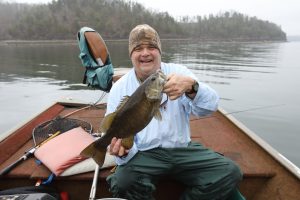 All you do is load the spinning reel with 4-pound co-polymer or fluorocarbon line and clip on a 7/8-inch pear-shaped plastic bobber 8 feet above the fly. Adjust the depth of the fly until you get a “pull down” on the bobber from a fish. There are specially weighted foam bobbers designed for the float-and-fly technique that grant better casting distance. The internal weight in these bobbers makes them roll over on their side if a big smallmouth hits the fly and moves shallower.
Lake Cumberland presents an ideal opportunity to catch smallmouth bass, as well as fat, healthy spotted bass and even hand-sized bluegill on the float-and-fly right now. During the drawdown of Lake Cumberland to repair Wolf Creek Dam several years ago, trees grew on the exposed shoreline. Now with normal water levels, these trees are at the perfect depth to offer shelter for big smallmouth and spotted bass as they await a school of baitfish to ambush.
The quivering fly hovering just above the sunken trees pulls these fish out of their lairs to strike. Female smallmouth bass need to feed in late winter to power the development of the eggs in their abdomens they will drop into nests later this spring.
The best flies on Lake Cumberland are craft hair jigs in combinations of blue, chartreuse, grey or white. White, sky blue and pink craft hair jigs also work well on this lake.
Duck feather jigs with wisps of red or pink craft hair seem to draw more strikes on Dale Hollow. These colors work well at Laurel River Lake, too. Both Dale Hollow and Laurel hold trout and some anglers believe their presence makes these fly colors work better in these lakes.
Fish the float-and-fly near the main lake in winter on these reservoirs. The best fishing occurs when your back faces lots of big, deep water.
Remember to allow your fly to strike the water’s surface on the back cast. This provides resistance on the forward cast that loads the long spinning rod, leading to much improved casting distance.
Applying a petroleum jelly-based shad scent, called “fish dope,” improves the delectability of the fly to smallmouths. Tackle shops and retailers in the Lake Cumberland or Dale Hollow region sell fish dope, but any petroleum jelly-based shad scent will work. Those with glitter in them are best.
On bright days, trimming a fly to match the bend of the hook and heavily applying dope to where the fly resembles a small stick often makes the difference between being skunked or catching fish.
A month of good float-and-fly fishing awaits anglers until warming waters puts big smallmouth or spotted bass on the prowl and willing to chase lures. This technique also fools huge largemouth bass on farm ponds and small lakes in late winter.
Remember to buy your fishing license soon. Feb. 28 is the last day of the current license year in Kentucky.
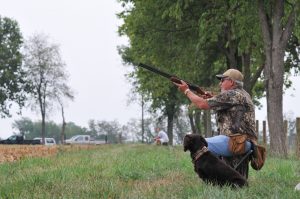 Kentucky farmers can earn some much-needed extra cash by enrolling in the Cooperative Dove Field Program. Enrollment is underway and continues through March 1.
The Cooperative Dove Field Program pays landowners to lease fields on their property for public dove hunting.
“Landowners may earn up to $10,000 in the Cooperative Dove Field Program,” said Wes Little, migratory bird biologist for the Kentucky Department of Fish and Wildlife Resources. “They earn $300 per acre planted.”
Little said the department has accepted fields ranging from six to 40 acres with additional lease payments offered for buffers around planted fields. “Fields generally run from 20 to 30 acres in size,” he explained. “But, we encourage anyone interested to apply.”
Farmers may plant sunflowers, millet or another acceptable crop for a public dove field by working with a Kentucky Fish and Wildlife private lands biologist and following some simple guidelines.
Payment amounts depend on the number of acres enrolled, crop type and fulfillment of the plot management agreement with Kentucky Fish and Wildlife.
The department is especially interested in reaching agreements with property owners who have acreage in underserved areas with significant numbers of dove hunters. In the west, this includes Caldwell, Calloway, Christian, Daviess, Fulton, Grayson, Hardin, Hart, Hickman, LaRue, Logan, Lyon, Simpson, Todd and Trigg counties. In southcentral Kentucky, this includes Boyle, Cumberland, Laurel, Lincoln, Pulaski and Wayne counties.
To get the process started, landowners must contact their Kentucky Fish and Wildlife private lands biologist or Natural Resources Conservation Service liaison. For a listing of biologists, visit the Kentucky Fish and Wildlife homepage at www.fw.ky.gov and search under the keywords, “private lands biologist.” Property owners may also call the department at 1-800-858-1549 for more information.
Five new lakes enrolled in the Fishing in Neighborhoods Program (FINs) will receive stockings of trout in February, a boon to anglers tired of being house bound.
Flemingsburg Old Reservoir, an 11-acre lake in Fleming County, gets 900 trout while Leary Lake, a 5-acre lake on Lloyd Wildlife Management Area in Grant County, gets the same amount of trout. The 9-acre Logan-Hubble Park Lake just south of Lancaster in Garrard County will receive 900 trout as well.
The 2-acre Kess Creek Park Lake in Mayfield in Graves County will get 500 trout as will the Clinton Rotary Park Lake in Clinton in Hickman County. Both of these lakes are in the Purchase Region.
“We are stocking a larger-sized trout in all of our FINs lakes for 2017,” said Dane Balsman, coordinator of the FINs program for the Kentucky Department of Fish and Wildlife Resources. “The larger trout now average about 10 to 11 inches long and one-half pound in weight.”
Kentucky Fish and Wildlife formerly stocked its traditional “stocker” trout of 9 to 10 inches in the FINs lakes. “We wanted to improve angler satisfaction and utilization as well as reducing hooking and handling mortality. These fish won’t be caught as many times and anglers are more likely to harvest a larger trout.”
Balsman cautions anglers fishing on a FINs lake to practice beneficial catch and release tactics when they catch a trout, especially as the water warms. Anglers can purchase inexpensive fish grabbers to prevent touching or squeezing a trout when removing the hook. These devices prove valuable when handling fish that may cause injury, such as a catfish or fish with teeth, such as a muskellunge.
Forty-three lakes across Kentucky are in the FINs program. They offer fantastic fishing for trout, but also excellent fishing for catfish and largemouth bass.
“We will start in March with the catfish stockings in FINs lakes,” Balsman said. “Due to hatchery expansion, we now have the capabilities to raise all of the FINs catfish in house. We will stock about 125,000 catfish in our FINs lakes.”
Largemouth bass anglers usually turn to waters such as Kentucky Lake, Barren River Lake or state-owned lakes, such as Lake Malone or Lake Kincaid, for a chance at a trophy fish.
“We see exceptional largemouth bass in the FINs lakes, many of them big bass,” Balsman said. “We saw a 9.7-pound largemouth bass from Mike Miller Park Lake this past year, my personal best I’ve seen in a FINs lake. We routinely see 6- to 8-pound bass in the spring.” Four-acre Mike Miller Park Lake lies near Draffenville in Marshall County.
Balsman recommends early spring as the time to catch these bruisers. “We stock these lakes with trout and the bass eat them and grow big,” he said. A white spinnerbait with a silver Colorado blade works well for trophy pre-spawn largemouth bass in small lakes, especially when rains colored the water a touch. A large soft-plastic swimbait in trout colors may also work well in these lakes.
Many anglers flock to Kentucky Lake or Lake Barkley each May for the redear sunfish spawn. Anglers do not need to go that far.
“Some of these lakes have really good redear sunfish in them,” Balsman said. “Three Springs Park Lake near Bowling Green and Madisonville City Park Lake South have great populations of redear sunfish. Both lakes offer trophy potential of 10-inch and longer redear sunfish.”
Lake Mingo in Nicholasville, just south of Lexington has moderate numbers of redear sunfish, commonly called shellcrackers. However, Balsman said some of them are true trophies, running 12 inches or more.
“The trout and catfish are for put and take fishing,” Balsman said. “There is trophy potential for redear sunfish and some of these lakes are great bluegill lakes as well.”
The main point of the FINs program is providing a place close to home for folks to go and have a reasonable expectation of catching fish.
“We want people to be able to go fish the FINs lakes after work in spring and summer or take the kids and fish for an hour or two on the weekends and catch fish,” Balsman said. “The convenience factor is whole point of the FINs program.”
Remember, current fishing licenses expire Feb. 28. It is a good idea to buy your fishing license soon.
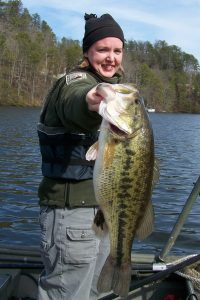
Photo From KDFW
It seems to Kentuckians that someone accidentally dropped the sun down a storm drain about three weeks ago and it hasn’t been found yet.
Day after day desolate gray skies discharged rain every few hours. Although it has been warmer than usual, this January has been a long slog.
February is the month tinges of hope arrive back in many anglers’ souls.
“Before any change of season, there are hints of the season to come,” said Mike Hardin, assistant director of Fisheries for the Kentucky Department of Fish and Wildlife Resources. “The change from late winter to spring is not abrupt. By the third week of February, you can hear spring peepers calling.”
This translates into a time when someone suffering from terminal cabin fever can catch a fish for the ages.
Warm February rains muddy the water and provide a temperature spike. “You get that good muddy water in mid- to late-February and you can pull some sows out of it,” Hardin said. “Females are gearing up for spawning. They need healthy fat reserves to get them through rigors of spawning. Instinct tells them they must eat.”
This situation is a fantastic time to catch a fat, pre-spawn female largemouth bass. Back in the day before graphite rods, bass boats or sonar units, gritty anglers would brave the weather during the first warm rains of February and employ the “jigging” technique to pull huge largemouth bass from shallow water.
They would use stout cane poles and a large hook tied to heavy black dacron line. These anglers would impale as many nightcrawlers as possible on the hook and using a skulling paddle for stealth, drop this combination beside any stump, log or other shoreline cover they could find.
Modern anglers can do the same thing with a ½-ounce black and blue jig and a flipping stick.
“That muddy water in late February is good flipping water,” Hardin said. “My uncle loved it when rains warmed the water to 51 degrees along the shoreline. He would flip a jig to the shoreline cover along those outside bends of Cave Run. That is when he caught his biggest largemouth bass. He had better weights in 51 degree water than in 70 degree water.”
Hardin said rains from the south in February also bring large muskellunge to the shoreline.
“That is when I first get my muskies,” said Hardin, who caught a 50-inch muskellunge from Cave Run Lake this past fall. “When you have a 42- to 48-degree main lake with warmer water coming in that is in the mid-50s, this is when you find fish along the shoreline.”
Some fish live suckers along the shoreline for big February muskellunge. Those anglers are strongly encouraged to employ a quick strike rig to prevent catch and release mortality. Large rattle baits, such as a muskellunge-sized Rat-L-Trap, also work well for shoreline muskellunge during this time of year.
“I also like a soft plastic bait called the Bulldawg in February,” Hardin said. “I like two-tone colors such as brown and orange. I also like the firetiger with a chartreuse tail version. I also throw jerkbaits like a Suick Thriller when they have their nose on the bank. They see that jerkbait work over their head and they hit it.”
A pronounced warm front in mid-to-late February draws big female smallmouth bass from their winter lairs into shallower water to feed heavily in lakes such as Lake Cumberland, Laurel River Lake, Dale Hollow Lake or the lower section of Green River Lake.
If warm rains accompanied the warm front, work white spinnerbaits with chrome Colorado blades right beside any submerged woody cover. This is an excellent presentation to catch huge smallmouths, especially if the water has some color to it.
If the warm front simply warms the top layer of water a degree or two without rain, big smallmouth will move up onto a flat to feed. The best flats lie adjacent to the channel on the main lake or major creek arm.
A medium-sized live shiner bottom fished in these areas is one of the best ways to catch the heaviest smallmouth bass of your life. Some anglers crawl the shiner slowly across the flat with just enough split shot weights to keep the shiner down. Others prefer still fishing shiners on the flat using a 1/4- to 3/8-ounce slip-sinker rig with a small black barrel swivel tied on the main line. An 18-inch leader of 8-pound test fluorocarbon line is tied on the other loop of the barrel swivel while the hook goes on the other end of the leader.
A size 1 Octopus-style hook works well for both presentations. You can also fish these rigs right in the middle of small cuts and tiny coves along the main lake or major creek arm for large February smallmouths.
“If you like catching big fish, February is a great month,” Hardin said. “A big fish warms you up better than a big coat.”
Remember to buy your fishing license soon. Feb. 28 is the last day of the current license year in Kentucky.
 The end of the year is a time for reflecting on the past 12 months and envisioning the possibilities for the new year.
Officials with the Kentucky Department of Fish and Wildlife Resources recently previewed what’s ahead in 2017.
From firming up long-range plans for the restoration of ruffed grouse in Kentucky and management of the state’s black bear population to expanding the popular Fishing in Neighborhoods (FINs) program and releasing thousands of rare mussels into the wild, a common theme stretches across the Fisheries and Wildlife divisions. Conserving fish and wildlife habitats and populations and expanding opportunities for hunters, anglers and others are top priorities.
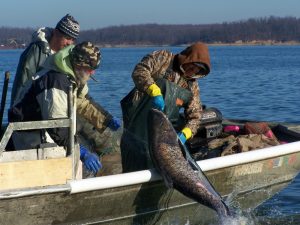
In Fisheries, Asian carp will continue to be a major focus. Commercial harvest is an effective tool for large-scale removal of the invasive fish and Fisheries director Ron Brooks said a multi-year effort to help the Asian carp processing industry expand in Kentucky is expected to bear fruit in 2017.
“We’ve been working on this for about two years and it’s finally coming around,” he said.
The department has been working with fish processors, commercial fishermen, legislators, government agencies and businesses to find ways to make a greater dent in the Asian carp population.
The proposed system would train new commercial fishermen how to harvest Asian carp and assist commercial fishermen already harvesting Asian carp while reducing costs and delays for processors, Brooks said.
“We’re reaching out to help the Asian carp-harvesting industry meet its needs and hopefully lead into expansion of their businesses, all to get rid of Asian carp,” he said. “We’re focusing a lot of our efforts on Kentucky and Barkley lakes because we believe we can have an immediate impact there. We’re trying to ensure our sportfish species aren’t taken out.”
Elsewhere in Fisheries, a long-term project to increase forage and improve fishing opportunity at Cave Run Lake will wrap up in 2017. The project focused on the Ramey’s Creek and Warix coves in 2016. Department personnel added around 1,000 trees, 500 pallet structures, 150 bucket stake attractors, 10 wooden cable spools and 50 plastic pipe trees. A map showing the locations of these fish attractors is available online at fw.ky.gov. Type “Cave Run Lake Fish Habitat Improvement Project” into the search box on the homepage.
The popular Fishing in Neighborhoods (FINs) program is adding five new lakes to its lineup: Flemingsburg Old Reservoir in Fleming County, Kess Creek Park Lake in Graves County, Leary Lake in Grant County, Logan Hubble Park Lake in Lincoln County and Rotary Park Lake in Hickman County. The addition of these lakes brings the number of FINs lakes to 43 across the state.
Anglers can start planning now where they want to fish and for what species in with the new Fishing Forecast for Kentucky’s major fisheries. The 2017 edition is available on the department’s website by clicking on the “Fish” tab and choosing “Forecast” from the dropdown menu. The annual compilation highlights new, expanding and improving fisheries across the state.
Deer hunters in Kentucky have enjoyed another successful season in 2016.
“We’re going to end up in the top 5 in terms of our overall harvest total,” said Steve Beam, Wildlife Division director for Kentucky Fish and Wildlife. “We’re producing tremendous numbers of trophy quality bucks. At the same time, our herd is healthy. Things continue to be wonderful.”
At its December meeting, the Kentucky Fish and Wildlife Commission voted to expand opportunities for youth and muzzleloader deer hunters on several wildlife management areas in 2017. The 2017-18 Kentucky Hunting and Trapping Guide, due out in July, will note these and any other pertinent changes.
John Hast was a biologist in the department’s deer and elk program before taking over as coordinator of its bear program in January 2015. He anticipates having a draft of a long-range management plan for Kentucky’s black bear population ready in 2017.
“We’ve been doing in-house research since bears returned to the state,” Hast said. “We just completed the project that’s going to provide our foundation for management for the next 15 years.
“A management plan, to me, gives me an opportunity to summarize all of that data and put it in one spot and distill it out and translate it. The plan will set forth what we’ve got but also what we’re going to be doing in the near future to refine things.”
Also in 2017, expect to hear more from the department about wild pigs in Kentucky, Beam said.
“We have re-evaluated and are in the process of increasing our efforts on wild pig eradication, working with landowners and cooperating with our partners,” he said.
In the department’s Wildlife Diversity program, led by coordinator Sunni Carr, biologists plan to conduct a statewide survey of osprey nesting locations and also start a loggerhead shrike banding project in the hopes of learning more about the migration and causes of decline for the species.
Additionally, the statewide survey for eastern whip-poor-wills and chuck-will’s-widows will be expanded to examine trends for Kentucky’s night birds. The department’s Center for Mollusk Conservation (CMC) plans to release endangered pink muckets in Kentucky for the 10th year. There are now several thousand of these mussels at more than 23 locations.
The department’s website provides a wealth of information about the work being done by each of these divisions. While there, consider purchasing a 2017-18 hunting and fishing license. The new license year starts March 1.
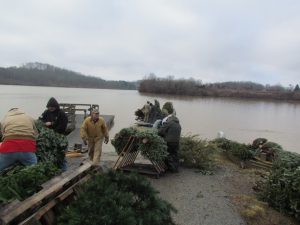 Those who enjoy a natural pine, cedar, spruce or fir tree for Christmas often don’t know what to do with it after the holidays. Many resort to putting it out on the street or chucking it in the backyard until spring.
You can dispose of your natural Christmas tree and provide habitat for fish by donating it to the Kentucky Department of Fish and Wildlife Resources instead of the tree languishing in the corner of your back yard or being ground into mulch.
“Every year we try to get a large number of Christmas trees, so we can sink them as fish habitat,” said Ron Brooks, director of fisheries for Kentucky Fish and Wildlife. “We place them on wooden pallet habitat structures to diversify the habitat or sink just the trees themselves.”
Kentucky Fish and Wildlife will accept trees at 35 locations in 29 counties across Kentucky until Jan. 15. Trees must be natural and free of lights, ornaments, tinsel, garland or any other decorations.
“We added sites this year in our two most populous counties, Jefferson and Fayette,” said Joseph Zimmerman, fisheries habitat program coordinator for Kentucky Fish and Wildlife. “We added a site at McNeely Lake in Jefferson County and at Jacobson Park in Lexington. We’ve added 15 additional collection sites across the state since 2012.”
To find a convenient location near you, visit the Kentucky Fish and Wildlife website at www.fw.ky.gov and type in the keyword “Christmas” in the search engine on the top right corner of the page
The construction of most of our state-owned lakes and large reservoirs date to the period from the end of World War II to the early 1970s. As these waterbodies age, the woody cover in them melts away, leaving them starved for habitat.
“Just about all of our reservoirs and state-owned lakes have a habitat problem,” Brooks said. “The aging lakes have a bare substrate; there is not a lot of woody habitat or aquatic vegetation left, especially in reservoirs with highly fluctuating water levels.”
The Christmas Trees for the Fishes program is part of an overall effort to remedy this problem by replacing the lost habitat with items such as Christmas trees, wooden pallet stacks, buckets filled with wooden stakes and other items.
“This is an effort that every fisheries district does,” Brooks explained. “It’s helped out on lakes as large as Kentucky Lake and Lake Barkley and on our smallest state owned lakes. The Christmas trees help make our pallet stacks more complex which provides better cover for fish.”
Brooks said algae grows on the sunken Christmas trees, creating multiple benefits for fish.
“Invertebrates lay eggs on the algae and they become a food source for smaller fish, which in turn attracts larger fish,” Brooks said. “It has a two-pronged benefit by providing habitat and a food source.”
The habitat placed in the lakes by fisheries personnel is recorded for use by anglers by plotting the Global Positioning System (GPS) coordinates on maps on the Kentucky Fish and Wildlife website at www.fw.ky.gov. Type in “Lakes with Fish Attractors” in the search engine on the homepage to use this valuable information.
Don’t chuck your Christmas tree beside the shed in the backyard until March. Drop it off at one of the collection stations and make better fishing for all Kentuckians to enjoy in the years to come.