 Weather
 Traffic
 @LouisvilleDispatch
 @LouisvilleDisp
 Subscribe
A free bulk waste and junk drop-off event will be held on Sunday, May 15, from 9 a.m. to 3 p.m. at the Waste Management Outer Loop Landfill, 2673 Outer Loop. Residents throughout Jefferson County may drop off bulky items not accepted during regular garbage collection such as appliances, furniture and mattresses.
The drop-off event is a partnership of Metro Public Works and Waste Management of Kentucky. Residents are asked to separate metal items from other junk so it can be recycled to conserve limited landfill space.
Items that will not be accepted during the drop-off event include yard waste (grass, limbs, leaves, etc.), hazardous materials, paint, tires and commercial trash.
The event is in addition to regular bulk waste disposal available throughout the year at the Waste Reduction Center located at 636 Meriwether Avenue. In the year round service, up to three bulk items per household are accepted free of charge during regular operating hours Tuesday – Friday, from 8 a.m. to 5 p.m., and Saturday from 8 a.m. to 3 p.m.
Materials such as oil and lead-based paints, lawn fertilizers, batteries and household chemicals may be taken the Household Hazardous Materials Collection Center, known as Haz Bin, at 7501 Grade Lane. The center is open Wednesdays and Saturdays from 9 a.m. to 3 p.m. There is no charge for Louisville residents for HAZ BIN services.
Today, in light of areas of serious concern dealing with potentially illegal and unethical contracting processes during the previous administration, Governor Matt Bevin announced a special investigation.
Governor Bevin has asked the Secretary of the Finance and Administration Cabinet, Col. Bill Landrum, using the extensive investigative powers given to him in KRS Chapter 45, to prepare and issue an RFP for a thorough, in-depth investigation and report by an attorney or law firm with experience in investigating activities and contracts.
Once selected, this firm will work closely with Secretary Landrum and his staff, including the Cabinet’s new Inspector General, whose appointment will be announced in the coming days, to make findings and issue a report.
Under KRS Chapter 45, such investigation will include the ability to subpoena witnesses and records as may be necessary to accomplish the investigative goals.
“A thorough, independent investigation like this can expose and cast light upon prior unsavory — and perhaps illegal — practices, but can also provide the public a degree of confidence in a fair and transparent governance that was so glaringly absent in the past administration,” said Governor Bevin.
Please find attached the Governor’s full remarks as prepared for delivery.
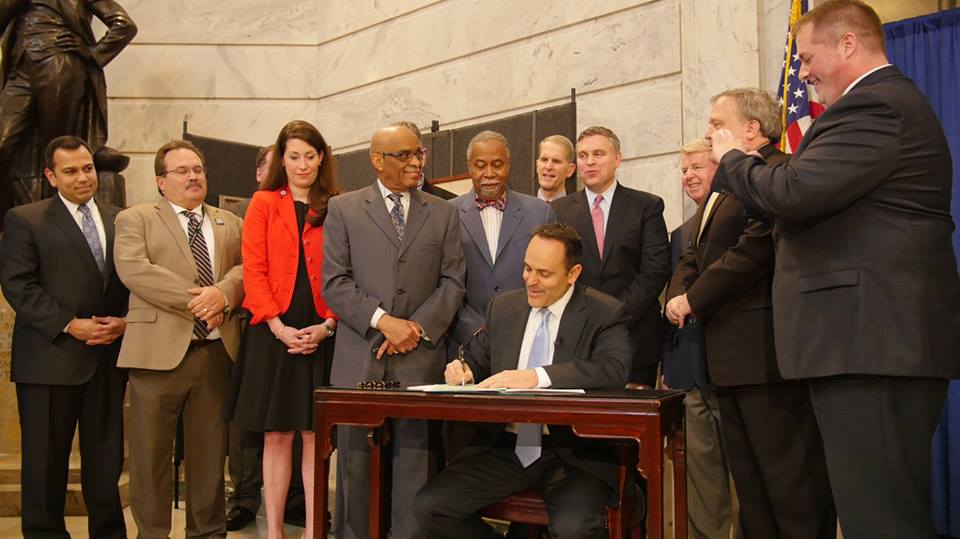 Today, Governor Matt Bevin, joined by Senate President Robert Stivers, Sen. Whitney Westerfield, Rep. Darryl Owens, Rep. David Floyd, Justice and Public Safety Sec. John Tilley and many other legislators and advocates, signed House Bill 40 into law, giving non-violent felony offenders who have paid their debt to society a second chance.
“It is a great day when doing the right thing transcends all political boundaries and all ideologies,” said Governor Bevin. “It’s an honor and privilege to be able to sign House Bill 40 into law. It is critical that there is an opportunity for redemption and second chances because America is a land that was founded on these principles. The greatness, uniqueness, beauty and extraordinary nature of America is based on the fact that we do give people an opportunity for redemption.”
House Bill 40 will allow Kentuckians convicted of certain Class D felonies who have paid their debt to society, stayed out of trouble as required by the law, and have shown that they are indeed trying to get back on track to erase their criminal records and get a second chance at jobs, housing and other opportunities sometimes denied felons.
“This bill is about redemption, good policy and workforce development,” said Justice and Public Safety Sec. John Tilley. “But if you’ve ever spoken with someone who’s been given a second chance and have had a piece of their dignity restored, you know immediately why this bill goes far beyond any policy measure, job or economic development success.”
“I’m grateful to see the passage of a bill that gives hope to tens of thousands of Kentuckians looking for a new start in their lives,” said Sen. Westerfield. “This is one of a handful of enormously consequential days I’ve had the privilege to experience while serving in the Senate, and I’m thankful for the many hands that worked to bring this to fruition.”
“I can’t say enough about how this is going to be a life-altering piece of legislation,” said Rep. Owens. “I think this is probably one of the most consequential pieces of legislation to come out of the legislature this year. The Governor’s endorsement was critical.”
Mayor Greg Fischer announced today that he has asked the Louisville Department of Public Health and Wellness to lead a community conversation on the possibility of expanding Louisville’s current smoking ban to include e-cigarettes and hookah.
“Smoking has devastated our community, causing pain, suffering and shortened lives, and saddled taxpayers with enormous healthcare costs,” the Mayor said. “I believe broadening the ban to include e-cigarettes and hookah is a logical extension of the battle to save lives from the dangers of tobacco, and today I ask the Public Health Department to begin a community conversation on this pressing issue.”
Fischer called on the department to review all available research, study other cities’ related actions, and seek public input in a broad community conversation on the issue. The department will set up meetings where citizens can hear experts discuss available research and offer their opinions on the products and a potential ban.
Kentucky’s rates of smoking and of smoking-related illnesses, such as lung cancer, are among the nation’s highest. These high rates led to Louisville’s current smoking ban, passed in 2008, which bans smoking in all indoor locations.
Reducing the prevalence of tobacco use – and resulting death rates – is “critical to the future of our citizens and our community as a whole,” Fischer said. It’s also a core element of Healthy Louisville 2020, the Mayor’s strategic plan for making Louisville a healthier city.
“Research suggests that the use of e-cigarettes and hookah may lead to use of tobacco cigarettes, and, with flavors like chocolate, cinnamon, vanilla and many others, there’s a real danger of our children being lured into a lifetime of tobacco use,” he said. Continue reading
Louisville Mayor Greg Fischer and Louisville Division of Fire Chief, Colonel Gregory W. Frederick celebrated the promotion of 11 members to new positions within the Louisville Division of Fire. We wish them the best of luck in their new roles!
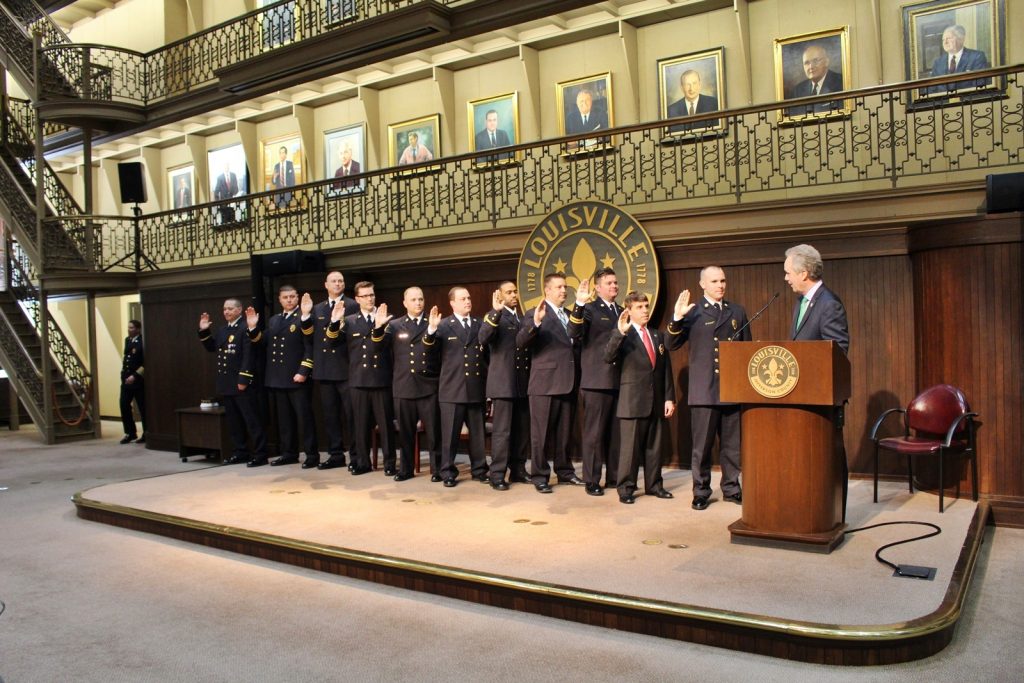
See below for members promoted and their new positions:
 Local officials are warning of a more dangerous mix of drugs circulating on Louisville streets, leading to more drug overdoses. Louisville Metro Police had to administer the drug Naloxone to reverse drug overdoses 43 times during the first 12 days of March compared to 26 times for the entire month of February and only seven times during January.
“This represents a 65 percent increase in March and the month is not yet half over. It’s important that the community, especially the families and friends of drug users, know this,” said Louisville Metro Police Chief Steve Conrad.
“While this information is still preliminary, because we don’t yet have toxicology results, through March 9, we have had 34 overdose deaths that appear to have been related to heroin use, as compared to 13 for the same period last year. This represents a 162 percent increase compared to last year,” said Conrad.
Jefferson County Coroner Dr. Barbara Weakley Jones pointed to a rise in the drugs fentanyl and gabapentin in the bloodstreams of people dying from drug overdoses. “It takes between four and six weeks for us to get blood lab results back so we don’t have confirmed results for February and March of this year,” said Dr. Jones. “However, in the last quarter of 2015 and in January of this year, we saw increasing numbers of overdose deaths in which we found fentanyl and gabapentin.”
Fentanyl is a synthetic opioid first developed in 1959, similar to but more potent than morphine. Mixing fentanyl with street heroin markedly amplifies the potency and potential dangers. Effects include: euphoria, drowsiness/respiratory depression and arrest (death), nausea, confusion, constipation, sedation, unconsciousness, coma, and addiction.
Similarly, gabapentin, also known as by its brand name Neurontin, is a drug with legitimate uses, such as for the control of seizures. Like fentanyl, it can amplify the potency and lethality when mixed with street opioids.
“Heroin is dangerous. The potency is always changing,” said Dr. Sarah Moyer, interim director of the Louisville Metro Department of Public Health and Wellness. “Every time someone injects heroin they run the risk of overdosing and dying, Family members and friends of those using drugs should direct their loved ones to the Louisville Metro Syringe Exchange, where their loved ones can get safe injection supplies, access to the medical system, and referral to drug treatment.”
Russ Read of the Kentucky Harm Reduction Coalition said that his organization distributes free Naloxone kits and conducts free training on how to use them. Naloxone can reverse the effects of a drug overdose and prevent death. The free kits and training are available to the general public. The next training will take place tomorrow, Tuesday, March 15 from 1 p.m. to 3:30 p.m. at the Department of Public Health and Wellness located at 400 E. Gray St.
Three Kentucky farmers who survived major accidents will address the 23rd annual Louis Crosier Farm Safety Symposium on Friday at 7 p.m. EST at the Elizabethtown Community and Technical College. Dale Dobson, administrator of the Kentucky Department of Agriculture’s Farm and Home Safety Program, will lead the Farm Safety Symposium and serves as president of the Dixie Fire School.
“These courageous individuals are willing to share their experiences so no one else suffers what they have suffered,” Agriculture Commissioner Ryan Quarles said. “The best way to deal with a farming accident is to prevent it from happening in the first place. That’s the purpose of KDA’s Farm and Home Safety Program – to educate people to practice safety at all times, on and off the farm.”
Gary Rock of LaRue County, Jack Trumbo of Shelby County, and Anna Ellis of Eddyville will tell how they were injured, how they endured the long and often painful road to recovery – and how their accidents could have been prevented.
The Farm Safety Symposium kicks off the 2016 Dixie Fire School, a three-day event that provides continuing education for first responders and youth on a wide variety of subjects, including rescue from grain storage facilities and large-animal emergencies. Some courses offer college credit hours.
The KDA’s Farm and Home Safety Program travels all over Kentucky to deliver farm, ATV, and lawn mower safety demonstrations. The program operates a one-of-a-kind rollover tractor simulator that demonstrates how a rollover protective structure (ROPS) and seat belt can save a tractor operator from injury or death in the event of a rollover. The program uses a miniature grain bin and gravity wagon to show the risk of becoming trapped in grain, and a power-take-off (PTO) apparatus that demonstrates the dangers of getting caught in a moving PTO, which is a rapidly rotating drive shaft used to power farm implements.