Weather
 Traffic
 @LouisvilleDispatch
 @LouisvilleDisp
 Subscribe
Metropolitan Housing Authority chairman Manfred Reid Sr. has been given the Dorothy Richardson Award for Resident Leadership, a national recognition for outstanding contributions by community leaders.
The annual awarded was presented on Friday in Columbus, Ohio, by NeighborWorks America, a Washington, D.C.-based organization dedicated to community development and affordable housing.
The Dorothy Richardson Award is given each year to people who have “invested their energies and talents to bring about specific change that positively impacts their neighborhoods and community,” according to NeighborWorks America.
“Louisville thrives based on the selfless contributions of many compassionate citizens — citizens like Manfred Reid,” Mayor Greg Fischer said. “Manfred is a Louisville icon and I’m quite pleased that his lifelong dedication to nurturing resident leadership is being recognized on a national stage.”
Reid, a real estate agent who lives in Beecher Terrace, has been active in housing, neighborhood development and other causes for decades. He was a leader of the Civil Rights movement in Louisville in the 1960s, working on issues including housing. In recent years, Reid has played a key role in broadening neighborhood involvement with the Vision Russell efforts, which aim to bring federally supported, transformative renewal to Russell.
“I can’t think of anyone more deserving than Mr. Reid,” said Tim Barry, executive director of the Louisville Metropolitan Housing Authority. “One of the kindest and most dedicated people I’ve ever met in all my years of public service.”
The U.S. Dept. of Labor has announced over $50.5 million in grant awards to 37 states to help expand apprenticeship opportunities across the U.S. – including $896,600 for Kentucky.
The proposal calls for a workforce pipeline to be created in Kentucky, increasing the number of Registered Apprentices by 1,300 individuals, including women, minorities, 16-24 year olds, individuals age 45+ or older, veterans, and people with disabilities.
“In Kentucky we recognize the value of apprenticeships and the vital role they play as the Commonwealth works to become the manufacturing hub of excellence in America,” said Gov. Bevin. “Employers across the state are in need of skilled laborers, and this funding will help train a workforce ready to fill that need. By re-committing ourselves to fully embracing the power of apprenticeships, we place ourselves in the best position to move Kentucky forward.”
“Receiving this funding is critical to the Labor Cabinet’s goal of expanding the scope of industries with Registered Apprenticeships,” Labor Sec. Derrick Ramsey stated. “We’re very proud of the approximately 1,100 employers and 150 different programs that already exist here in Kentucky, but this award will play an important role in growing those numbers. Kentucky is working toward becoming the manufacturing hub of excellence in America, and I’m proud that this vision is being endorsed by this grant award.”
U.S. Senate Majority Leader Mitch McConnell, who contacted U.S. Secretary of Labor Thomas Perez on behalf of the Kentucky Labor Cabinet, said, “there is a shortage of skilled workers in Kentucky in a number of critical industries, and this competitive funding will help the Kentucky Labor Cabinet implement employer-driven training programs for Registered Apprenticeships in the healthcare, manufacturing, and construction industries. This important project could significantly benefit those seeking a path to employment and meet the demand for skilled labor in an effort to make Kentucky a more competitive place for employers to locate and expand. I was happy to work with Governor Bevin and the Kentucky Labor Cabinet to help secure this important grant.”
Called the ApprenticeshipUSA State Expansion Grant Initiative, this is the second phase of the Dept. of Labor’s strategy to diversify Registered Apprenticeships into new sectors and engage under-served populations. According to the U.S. Dept. of Labor, the grant initiative is intended to:
Full information on the ApprenticeshipUSA State Expansion Grant Initiative can be found HERE.
For more information on Registered Apprenticeships in Kentucky, click HERE.
Statewide Mortgage, a Louisville-based mortgage lender, will build a $3.4 million corporate office in Jeffersontown and create 30 full-time jobs as it consolidates operations, Mayor Greg Fischer and Gov. Matt Bevin announced last week.
“We are thrilled that Statewide Mortgage has chosen to expand right here in Louisville, as they serve an ever-increasing number of states across the region,” said Mayor Fischer. “We’re happy that Statewide Mortgage is growing, creating new jobs and investing in our city. I look forward to seeing their continued success and growth in the years ahead.”
The planned 30,000-square-foot office building will replace the former Benihana off Linn Station Road on Lake Shore Court. The move will enable Statewide Mortgage to consolidate its Louisville sales offices and centralize its loan processing and compliance teams. The building will accommodate 30 new employees while providing space for future growth.
“From a three-person start up in 2002, Statewide Mortgage has grown to nearly 70 employees and is now building its own offices and expanding yet again,” said Gov. Bevin. “Statewide’s success through turbulent times in the housing market is a testament to their exemplary business model. We look forward to their continued growth in the years to come.”
The new building’s design will promote workflow efficiency and increase the company’s visibility along I-64 and Linn Station Road. Construction is expected to begin in November and last six to nine months. The move marks the company’s third, with previous relocations in 2005 and 2011.
“Statewide is like family to me. I love the people I work with and have such great respect for them. This is a great opportunity for us to grow and give ourselves the facilities we need,” said Keith Swisher, Statewide Mortgage president.
Swisher and his two college roommates, Lance Blincoe and Garrett Blincoe, founded Statewide Mortgage in 2002 in a little office on Dixie Highway in Louisville. In 2005, Ryan Baxter joined as a sales manager and started a first-time company growth spurt. In 2011, the company relocated to Jeffersontown and expanded its insurance services, as well as commercial and residential real estate holdings. Statewide Mortgage since grew to include 54 full-time employees across operations in four states. It provides conventional, FHA, VA, USDA, and portfolio lending. The company currently holds licenses and lends in Kentucky, Indiana, Illinois, Tennessee, Georgia, Florida and Alabama. Swisher said the firm plans to expand into Ohio and South Carolina by the end of 2016.
Jeffersontown Mayor Bill Dieruf said: “Having a company as strong as Statewide Mortgage show their lasting confidence in the market with a project as significant as adding a larger corporate headquarter presence to the continued redevelopment of the Linn Station Road corridor depicts the strength of Jeffersontown’s economy.
“As always, we are pleased to be able to partner with the Commonwealth and Metro Government to put together a package from our various entities that met the company’s needs,” Mayor Dieruf said.
To encourage the investment and job growth in the community, the Kentucky Economic Development Finance Authority (KEDFA) in August preliminarily approved the company for tax incentives up to $600,000 through the Kentucky Business Investment program. The performance-based incentive allows a company to keep a portion of its investment over the agreement term through corporate income tax credits and wage assessments by meeting job and investment targets.
Beginning one week from today Kentuckians will use healthcare.gov, instead of kynect, to purchase a Qualified Health Plan (QHP) during the 2017 open enrollment period. The Kentucky Cabinet for Health and Family Services (CHFS) expects a smooth transition to healthcare.gov. The move to the federal exchange simply changes the web portal Kentuckians will use to enroll and is projected to save more than $10 million per year in operating cost once transitioned.
“Health insurance is a vital piece of maintaining health and wellbeing,” said Health and Family Services Cabinet Secretary Vickie Yates Brown Glisson. “We want to make sure Kentuckians interested in purchasing a qualified health plan know where to shop. Anyone with questions or who encounters difficulty with enrollment is encouraged to contact a call center for assistance.”
The call center for the state exchange is available at 855-459-6328 to assist Kentuckians with questions about where to go for coverage. The call center can help prescreen for program eligibility and help with questions and information. The HealthCare.gov customer service center is also available. It can be reached by calling 800-318-2596. The healthcare.gov call center is open 24 hours a day, seven days a week.
Glisson and CHFS officials noted that nearly four out of five states now use the federal exchange for QHP enrollment. Like the old state-based exchange, the federal site requires the creation of a user account and a completed online application. Insurance can start as soon as Jan. 1, 2017, but Kentuckians will not be able to register or shop for plans until Nov. 1.
While the process for enrollment will not differ greatly, consumers will notice some changes to the amount and types of plans available for purchase in 2017 due to the decision by some insurers not to participate in the marketplace.
“People should be aware that there are fewer choices for plans this year and premiums are increasing on the exchange more than 20 percent,” said Sec. Glisson. “Cost increases were not driven by the transition from kynect to healthcare.gov. They are merely the reality of the current volatility in insurance markets as insurers react to the burdensome requirements of the Affordable Care Act. Many Kentuckians enrolling through healthcare.gov will qualify for Advanced Premium Tax Credits, which should greatly offset some of the cost of the plans.”
Kentuckians who have previously enrolled in health insurance through the state’s exchange will receive a notice by mail and/or email with details about changing to healthcare.gov. Postcard reminders with relevant dates and helpful information will be sent at regular intervals with guidance about the enrollment process.
“Only about two percent of Kentucky’s population purchases a QHP in a given year, so targeting resources to this group and doing it in the final month leading up to open enrollment and continuing through open enrollment is the most effective use of resources,” continued Secretary Glisson.
In recent months, CHFS staff has been engaged in numerous efforts to prepare for the transition from kynect to healthcare.gov. A series of eight forums were held in cities throughout the Commonwealth. The forums provided information about the transition from kynect to healthcare.gov for various stakeholders. More training and technical assistance is also being offered to assistors – previously known as kynectors – who contract with the state to provide information and help Kentuckians with enrollment assistance.
During the open enrollment period, CHFS has planned targeted outreach to QHP enrollees, including digital and radio advertising, social media messaging, text and email messaging campaigns and outreach to news media. Agents and assistors will also receive a toolkit prepared with information to assist with the transition to the federal site.
Meanwhile, the Medicaid program application process has not changed. Medicaid members may enroll throughout the year and re-enroll in accordance with their own specific re-certification schedule. Medicaid-eligible residents can apply anything by using benefind which has a pre-screening tool to help determine if a person is eligible for Medicaid or a QHP.
If a consumer submits an application to healthcare.gov and the applicant is determined to be eligible for Medicaid then the application is transferred to the state’s benefind system for eligibility determination. If the resident is determined to be eligible then benefind, the integrated system for all entitlement programs, will notify the participant and communicate next steps that need to be taken.
“It’s important to remember that kynect was not insurance. It was a website used for enrollment. Consumers should know that they cannot apply for coverage in the wrong place,” concluded Sec. Glisson. “During enrollment, the kynect website will be maintained as a landing page that will provide consumers with detailed information on how to apply and redirect appropriately, whether that is purchasing insurance at healthcare.gov or enrolling in Medicaid with benefind.”
Consumers still in need of coverage for the remainder of 2016 can enroll through the state exchange, kynect.ky.gov. Certain life changes, such as having a baby or losing coverage, have to occur to be eligible to enroll now. All 2016 plans end Dec. 31 regardless of when enrollment occurred.
Kentucky’s seasonally adjusted preliminary unemployment rate for September 2016 was 5 percent from a revised 4.9 percent in August 2016, according to the Office of Employment and Training (OET), an agency of the Kentucky Education and Workforce Development Cabinet.
The preliminary September 2016 jobless rate was 0.4 percentage points lower than the 5.4 percent rate recorded for the state in September 2015.
The U.S. seasonally adjusted jobless rate for September 2016 was 5 percent, according to the U.S. Department of Labor.
Labor force statistics, including the unemployment rate, are based on estimates from the Current Population Survey of households. It is designed to measure trends rather than to count the actual number of people working. It includes jobs in agriculture and those classified as self-employed.
In September 2016, Kentucky’s civilian labor force was 1,981,794, an increase of 12,605 individuals compared to the previous month. Employment was up by 10,571, and the number of unemployed increased by 2,034.
“The sharp increase in the labor force signals that more workers are returning to the workforce as they see the employment situation improving. For the last five months our unemployment rate has hovered around 5 percent, which is effectively full employment,” said economist Manoj Shanker of the OET. “Though there has been an uptick in labor force participation, Kentucky is still ranks near the bottom of the stack in participation rates.”
In a separate federal survey of business establishments that excludes jobs in agriculture and people who are self-employed, Kentucky’s seasonally adjusted nonfarm employment increased by 11,500 jobs in September 2016 from the month before and was up 25,800 positions since September 2015.
“Nonfarm employment, or what’s normally called the jobs number, is at a historical high. The September report delivered an unexpected boost to the flat situation we have experienced so far in 2016, “said Shanker. “The biggest increase was in professional and business services which was buoyed by jobs in temp services.”
Nonfarm data is provided by the Bureau of Labor Statistics’ Current Employment Statistics program. According to this survey, eight of Kentucky’s 11 major nonfarm North American Industry Classification System (NAICS) job sectors registered gains in employment, while two declined and one stayed the same from the previous month.
Employment in Kentucky’s professional and business services increased by nearly 3 percent with the addition of 6,200 jobs in September 2016 from a month ago. Year-over-year there was a gain of 6,000 jobs. This category includes establishments engaged in services that support the day-to-day activities of other organizations, including temporary employment services and payroll processing.
“Typically, when businesses plan to expand they test the waters by hiring more temp employees. The robust gain in temp hiring—after a nine-month decline—is reassuring,” said Shanker.
The leisure and hospitality sector gained 2,500 jobs in September 2016 from a month ago. Since September last year, the sector has expanded by nearly 2 percent with the addition of 3,500 jobs. This sector includes arts, entertainment, recreation, accommodation, and food services.
Kentucky’s trade, transportation, and utilities sector expanded by 1,200 jobs in September 2016 from a month ago. This is the largest sector in Kentucky with nearly 400,000 jobs accounting for one-fifth of all nonfarm employment. Since September 2015, this sector has expanded substantially with a gain of 9,300 jobs. Retail trade added 1,000 jobs over the previous month, and gained 7,600 jobs over the year, while transportation and warehousing added 700 jobs from a month ago and increased 2,400 positions over the year.
The manufacturing sector rose by 700 jobs in September 2016 compared to the previous month. Over the year, however, manufacturing employment declined by 1,300. Durable goods account for two-thirds of the manufacturing sector and grew by 1.5 percent from a year ago with the addition of 2,400 jobs, while nondurable goods lost 3,700 jobs over the year.
The government sector, which includes public education, public administration agencies and state-owned hospitals, increased by 600 jobs in September 2016 but declined by 2,100 positions compared to last September. Almost all of the month-to-month gain was in federal employment.
Employment in educational and health services sector was up by 500 positions in September 2016, and had a robust gain of 10,600 jobs, or 4 percent, from a year ago. Health care jobs account for about 15 percent of all nonfarm employment in Kentucky and decreased by 200 positions for the month, but showed strong gains over the year with the addition of 12,000 jobs.
The financial activities sector expanded by 300 jobs in September 2016 from a month ago. The sector has added 4,600 jobs since last September.
Mining and logging sector jobs increased by 100 in September 2016 from a month ago. The industry has declined by 2,300 positions from a year ago.
Employment in the information sector remained unchanged in September 2016. This segment has declined by 900 positions from a year ago. The industries in this sector include traditional publishing as well as software publishing; motion pictures and broadcasting; and telecommunications.
The construction sector dropped by 200 jobs in September 2016 from a month ago. Since September 2015, construction jobs have decreased by 1,800 positions.
Employment in the other services sector, which includes repairs and maintenance, personal care services, and religious organizations, decreased by 400 positions in September 2016 from a month ago. This sector has increased by 200 jobs from a year ago.
Civilian labor force statistics include nonmilitary workers and unemployed Kentuckians who are actively seeking work. They do not include unemployed Kentuckians who have not looked for employment within the past four weeks.
Kentucky’s statewide unemployment rate and employment levels are seasonally adjusted. Employment statistics undergo sharp fluctuations due to seasonal events, such as weather changes, harvests, holidays and school openings and closings. Seasonal adjustments eliminate these influences and make it easier to observe statistical trends. However, because of the small sample size, county unemployment rates are not seasonally adjusted.
Learn more about the Office of Employment and Training at http://www.kylmi.ky.gov/.
The Kentucky Historical Society (KHS) today announced six new research fellows. Each fellow will receive monetary support to conduct research for a time of one to four weeks at KHS in Frankfort.
Recipients include:
Fall 2016 Scholarly Research Fellowships
2016 Oral History Research Fellowship
2016 Churchill Weavers Fellowships
The Research Fellowship Program is funded by the Kentucky Historical Society Foundation. The program encourages and promotes advanced research on all aspects of Kentucky-related local, regional, national, transnational and comparative history using KHS collections. More information is at history.ky.gov/research-fellowships/.
 This week, three local candidates running for office held a town hall forum where they took questions from the voters. Michael Payne, Harold Bratcher, and Shane Ranschaert each had a turn at the microphone where they were able to talk not only about policies, but also about why they became involved in politics. All three candidates are running for office for the first time, and all three are unhappy with the state of politics in the Louisville area and felt that the best way to help the community is to become involved. With the election fast approaching and the Presidential race garnering so much attention, it can be easy to lose track of local races.
Harold Bratcher is running the US House of Representatives, District 3. District 3 in KY is all of Jefferson County, and therefore, all of Louisville. Representatives will go to Washington D.C. to represent all the citizens on Louisville in the United States Congress for a 2-year term. Bratcher graduated from Valley High School (class of 1991) and we worked for some trucking companies. He recently opened his own freight company and has been operating out of Louisville since 2013. Bratcher is running against incumbent John Yarmuth, who is seeking re-election for his sixth term.
Bratcher focused on three major talking points: supporting small business, preserving the Constitution, and immigration. Being a small business owner himself, Bratcher knows a lot about what is needed to run a small business. NAFTA and TPP have been brief topics in the recent presidential debates, but Bratcher has believed for years that NAFTA has negatively impacted this country’s economy and believes that the TPP will be just as bad, if not worse. “NAFTA cost a minimum of 1 million union, and non-union high paying manufacturing jobs,” he said, adding that this equals about 25% of the manufacturing capacity that was here previously. With the unemployment rate being as high as it is, he believes the answer is to invest in small business. “Giving $100 million to 100 small businesses will create more jobs than giving that money to one big corporation,” he said. He also proposes cutting taxes across the board, which he believes will create more jobs and by putting more money in consumer pockets, will result in more revenue in taxes.
Bratcher identified himself as a “Constitutional Conservative” and believes that government needs to be smaller and less involved in our everyday lives. He applies this to every Constitutional right, including the first and second amendments. He admitted that he is a new firearm enthusiast, but recognizes that the laws being proposed are already in place in some of the highest gun crime cities in the nation. “If the laws don’t work in Chicago, why would they work here,” he asked. He also believes that individual, civilian gun-ownership keeps America is safer as nation. Bratcher went on to talk about balancing the budget: “Everyone is concerned about the D and the R. This is why we have no balanced budget and this is why there is gridlock. I’m willing to work towards the middle, but it needs to be a give and take.”
Being the only candidate running for a federal office, Bratcher was the only one to talk about immigration. Bratcher understands that this is a country of immigrants and accepts immigrants who come to the United States legally. His first concern, however, is that we have millions of homeless Americans here and we should address that problem before trying to take on the task of helping other countries.
Michael Payne is running for State Representative, District 28. District 28 starts in the southern part of Pleasure Ridge Park and continues south along Dixie Highway to West Point, KY. State Representatives go to Frankfort, KY where, like the federal House of Representatives, they serve a 2 year-term where they represent a portion of Kentucky residents for state legislation. Payne is a graduate of Valley High School (class of 1990) and went on to study at both Sullivan University and University of Louisville. He has worked as an engineering specialist for UPS, an engineering manager for a local material handling firm, and currently works at Sullivan College as an instructor. Payne is running against incumbent Charles Miller, who is currently seeking re-election for his tenth term.
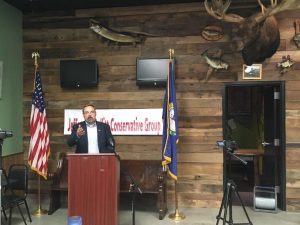 Payne focused on several major talking points: the economic depression, the education system, and crime. Payne believes that best way to address the economic issues is to attract new businesses into the state and Kentucky is having a hard time competing with the surrounding states. He stated that the best way to encourage investments into the state and to encourage entrepreneurs is to reform the tax code with a flat tax and improve the work force through training programs that promote hands on, technical skills.
When it came to education, Payne said, “Don’t throw more money at the problems.” He feels that teachers are being prevented from doing the jobs because of curriculum standards as well as social standards. He believes teachers know best on how to teach their students and that the state needs to take a step back and allow them to teach. Further, Payne says that he would like to see subject matter experts within a field to be allowed to teach without the need for certifications. He feels that this would enable students to learn more and encourage critical thinking. As for higher education, Payne said tuition rates need to be frozen and universities need to start acting like the businesses that they are, not charities. Payne also believes that public universities should be opened up to accommodate concealed carry weapons for license holders on campus while private universities should be left to decide on this issue for themselves.
The heroin epidemic and the rising crime rate has effected everyone in the community. Payne believes that law enforcement needs to be given more ability to do what is needed, and that the judicial system needs to be able to sentence certain offenders more. While believing that dealers and other distributors need to be held accountable, he believes that there needs to be a “compassionate hand to the addicts”. Once in jail, rehabilitation programs need to start and programs need to be in place that allow the addicts access to affordable treatment when they leave jail.
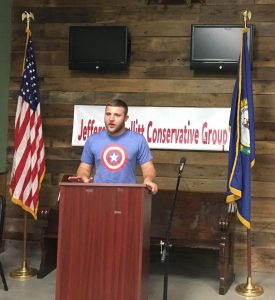 Shane Ranschaert is running for Metro Council, District 14. District 14 is in the far southwest portion of the county, including most of Valley Station west of Dixie Highway between Greenwood Rd and the Gene Snyder, south to include Valley Village, areas surrounding Jefferson Forest to the county line. Councilmembers stay in Louisville where they represent their district for a four-year term. Ranschaert is running against incumbent Cindi Fowler, who is seeking re-election for her second term.
Ranschaert also had three talking points: adequate representation for the southwest portion of the city, taxes and regulations, and the rise in crime and heroin use. Ranschaert said he is tired of seeing Southwest Louisville ignored until election time and he wants to make sure that the residents of District 14 feel like they matter all the time, not just when politicians are seeking votes. Ranschaert explained that he would like to see taxes in the city cut, stating that Louisville is the third most taxed city in the US and one of the most regulated cities in the US. He wants to cut taxes and address infrastructure issues, such as the malfunctioning flood pumps along the Ohio River. He cited a similar plan to Payne’s for addressing the rise in heroin use and crime and wants police to be able to more effectively perform their duties, and wants to see task forces developed to utilize all local agencies to make Louisville as uncomfortable as possible for drug dealers. He also wants to see addicts being helped and treated and not just pushed through the system.
If you did not have the chance to attend the town hall, all the candidates have contact information on their websites and all three candidates have Facebook pages and welcome your questions. As with any election, it is important to be informed and voters should take the time to research the candidates before making a decision. A sample ballot for your location can be found on the Jefferson County Clerk’s website. The deadline to register to vote in this election cycle was October 11. If you are not registered to vote, you can still register, but you will be eligible to vote in the next May primary.