Tuesday February 3, 2026
Local Connection
 Weather
 Traffic
 @LouisvilleDispatch
 @LouisvilleDisp
 Subscribe
Kentucky’s seasonally adjusted preliminary unemployment rate was unchanged from November 2016 to December 2016 at 4.8 percent, according to the Office of Employment and Training (OET), an agency of the Kentucky Education and Workforce Development Cabinet.
The preliminary December 2016 jobless rate was 0.9 percentage points lower than the 5.7 percent rate recorded for the state in December 2015.
The U.S. seasonally adjusted jobless rate for December 2016 was 4.7 percent, according to the U.S. Department of Labor.
Labor force statistics, including the unemployment rate, are based on estimates from the Current Population Survey of households. It is designed to measure trends rather than to count the actual number of people working. It includes jobs in agriculture and those classified as self-employed.
In December 2016, Kentucky’s civilian labor force was 2,016,835, an increase of 11,903 individuals compared to the previous month. Employment was up by 11,715, while the number of unemployed increased by 188.
“In December, our labor force increased by .6 percent,” said Kentucky Labor Market Information Director Kate Shirley Akers, Ph.D. “Over the last year, Kentucky has seen growth in both the labor force and the number of employed, with the labor force growing by 3.3 percent and employment increasing by 4.3 percent.”
In a separate federal survey of business establishments that excludes jobs in agriculture and people who are self-employed, Kentucky’s seasonally adjusted nonfarm employment increased by 800 jobs in December 2016 compared to November 2016.
“Overall, nonfarm employment has increased by 11,000 positions or .6 percent from one year ago,” said Akers. “The largest month-to-month gain in jobs was in the trade, transportation and utilities sector.”
Nonfarm data is provided by the Bureau of Labor Statistics’ Current Employment Statistics program. According to this survey, six of Kentucky’s 11 major nonfarm North American Industry Classification System (NAICS) job sectors registered gains in employment, while five declined from the previous month.
Kentucky’s trade, transportation and utilities sector expanded by 2,100 jobs in December 2016 from November 2016. This is the largest sector in Kentucky with nearly 400,000 jobs accounting for one-fifth of all nonfarm employment. Since December 2015, this sector has expanded by 8,100 jobs.
“The month-to-month increase in the trade, transportation and utilities sector was driven by gains in retail trade. This area added 2,400 jobs from November 2016 to December 2016,” said Akers.
The financial activities sector rose by 1,700 jobs in December 2016 from November 2016. The sector has added 5,700 jobs or 6 percent since December 2015.
“The financial activities sector had the largest month-to-month percent growth among the sectors at 1.7 percent,” said Akers. “The increase was in the finance and insurance subsector.”
Employment in the information sector grew by 400 in December 2016, but had a drop of 400 jobs from December 2015. The industries in this sector include traditional publishing as well as software publishing; motion pictures and broadcasting; and telecommunications.
The educational and health services sector rose by 200 positions in December 2016, and had a gain of 6,300 jobs or 2.3 percent from December 2015. Health care jobs, which account for about 13 percent of all nonfarm employment in Kentucky, increased by 7,900 jobs from December 2015 to December 2016.
Employment in Kentucky’s manufacturing sector jumped by 900 jobs in December 2016 compared to November 2016. Over the year, manufacturing employment rose by 500. Durable goods account for two-thirds of the manufacturing sector and grew by 1.6 percent from a year ago with the addition of 2,500 jobs. Nondurable goods lost 2,000 jobs from December 2015.
Mining and logging sector jobs increased by 100 in December 2016 from November 2016. The industry has declined by 1,900 positions from a year ago.
The government sector, which includes public education, public administration agencies and state-owned hospitals, decreased by 100 jobs in December 2016 and declined by 2,600 positions compared to December 2015.
The construction sector fell by 1,500 jobs in December 2016 from November 2016. Since December 2015, construction jobs have decreased by 5,000 positions.
Kentucky’s professional and business services sector lost 1,800 jobs in December 2016 from the month before but remained steady from a year ago. This category includes establishments engaged in services that support the day-to-day activities of other organizations, including temporary employment services and payroll processing.
The leisure and hospitality sector declined by 1,100 jobs in December 2016 from November 2016. Since December 2015, the sector has added by 100 jobs. This sector includes arts, entertainment, recreation, accommodation, and food services.
Employment in the other services sector, which includes repairs and maintenance, personal care services, and religious organizations, decreased by 100 positions in December 2016 compared to the month before, but gained 200 positions since December 2015.
Civilian labor force statistics include nonmilitary workers and unemployed Kentuckians who are actively seeking work. They do not include unemployed Kentuckians who have not looked for employment within the past four weeks.
Kentucky’s statewide unemployment rate and employment levels are seasonally adjusted. Employment statistics undergo sharp fluctuations due to seasonal events, such as weather changes, harvests, holidays and school openings and closings. Seasonal adjustments eliminate these influences and make it easier to observe statistical trends. However, because of the small sample size, county unemployment rates are not seasonally adjusted.
As part of his mission to seek justice for victims of sexual assault, Attorney General Andy Beshear is partnering with the University of Louisville to provide accountability in Kentucky’s efforts to address the sexual assault forensic exam (SAFE) kit backlog.
Beshear said the Kentucky SAFE Kit Backlog Research Project, announced yesterday with the university’s Department of Criminal Justice, will provide valuable data to ensure a rape kit backlog never happens again.
The project will aid Kentucky’s law enforcement and victim advocacy communities when responding to sexual assaults and further transform sexual assault investigations and prosecutions.
The overall goals of the project are to examine the outcomes of kit testing, identify data-driven, victim-centered responses to sexual assault and provide justice to victims, Beshear said.
“This important project allows us to further support sexual assault victims in the pursuit of justice and to ensure no victim ever has their courage locked in a box on a self ever again,” Beshear said. “I am proud that we are not only ending the backlog, but are also committing to do better. As a community that cares about victims, we will learn important, much-needed data from this project.”
Dr. Bradley Campbell with U of L’s Department of Criminal Justice will serve as principal investigator on the project.
“I am excited about the opportunity to work with the Commonwealth to study this under researched area,” Dr. Campbell said. “The project represents an innovative and progressive commitment from AG Beshear and his office to add a research component to statewide testing efforts. Through this funding, the University of Louisville research team will be one of the first to examine the problem of untested SAFE kits at the state level.”
Dr. Campbell said specifically the study will collect baseline data in the cases associated with untested kits, examine connections of tested cases, evaluate pre-arrest decisions, training efforts and the impact of legislation, and provide evidence-based policy recommendations.
Kentucky’s state auditor uncovered more than 3,000 SAFE kits languishing in police departments and in the Kentucky State Police crime lab in 2015.
Upon taking office, Beshear made ending Kentucky’s backlog and providing justice for rape victims a top priority.
In 2016, Beshear provided $4.5 million in settlement money to lawmakers to fund requested Kentucky State Police crime lab upgrades. The SAFE Act of 2016 ensures the submission of all SAFE kits, requires police receive training to conduct victim-centered sexual assault investigations and that timelines are set for testing kits.
Beshear’s office provided an additional $1 million from the settlement to aid law enforcement and prosecutors in the investigation and prosecution of sexual assault cases.
In launching the Kentucky SAFE Kit Backlog Research Project, Kentucky is one of the first in the nation to examine the SAFE kit backlog at the state level, and the project places Kentucky at the forefront of national efforts to respond to the problem of backlogged sexual assault kits.
To date, single jurisdictions like in Detroit, Houston, Los Angeles and New Orleans conducted studies. Kentucky’s study will most closely replicate the Houston Sexual Assault Kit Action-Research Project, but at the state level.
Like other projects, a website and regular reports with stakeholders will help to inform the public of project findings.
Kentucky’s project was established through a competitive procurement process and will be funded using nearly $50,000 from Risperdal lawsuit settlement funds, as provided for in the state budget.
Beshear said his Office of Victim Advocacy and Department of Criminal Investigations are supporting KSP, Kentucky Association of Sexual Assault Programs, local law enforcement, prosecutors and victim advocates across the state in the implementation of the Safe Act.
Beshear’s office held a SAFE summit in September and is currently helping to train those working to end Kentucky’s SAFE kit backlog on how to conduct victim-centered investigations and prosecute sexual assault offenders.
In addition to working to seek justice for victims of rape, Beshear’s core missions for the Office of the Attorney General includes safeguarding children from sexual abuse, protecting senior citizens from scams and fraud and finding solutions to the state’s drug epidemic.
Florists, hair stylists, photographers, caterers, and the many other types of vendors it takes to make a wedding come to life will gather Sunday, Jan. 22, at the Sawyer Hayes Community Center at E.P. “Tom” Sawyer State Park to showcase their wares. The event is sponsored by the Louisville Wedding Network.
Anyone interested in these services is encouraged to attend the free, public event, which is slated from 2 p.m. to 4 p.m. at 2201 Lakeland Road in the Louisville park.
The trade show will feature the many types of talent, products and services required to pull off a successful wedding, according to Tiffany Emerson, sales representative for the property.
Sawyer Hayes Community Center is a wedding venue set in 580 acres of parkland that plays host to dozens of local weddings each year, Emerson said.
“We set the stage for the best day of your life and are thrilled to welcome the vendors who are our business partners in this work,” she said.
For a second time, Secretary of State Alison Lundergan Grimes has been appointed to the executive board of the National Association of Secretaries of State. She will serve as the Southern Region vice president, a position she held in 2015. The post represents the organization’s 14 Southern states and the District of Columbia.
“I am again honored to represent the Southern states on the NASS executive board,” Grimes said. “I enjoy a great relationship with my colleagues in the South and I look forward to working with them to shine a spotlight on the initiatives our states are implementing and the issues that are important to us.”
NASS President Denise Merrill, the secretary of state of Connecticut, installed Grimes after Natalie Tennant resigned the post when her term as West Virginia’s secretary of state ended.
“It has been a pleasure to get to know and work with Secretary Grimes as fellow secretaries of state,” said Merrill. “We are very pleased she has agreed to join the NASS board and help us promote the important work and interests of our members. Secretary Grimes is known as an innovator, a coalition-builder, and a hard worker, and I know she will again be a wonderful representative for all of our Southern state offices.”
As Southern Region vice president, Grimes will represent Alabama, Arkansas, Florida, Georgia, Kentucky, Louisiana, Mississippi, North Carolina, Oklahoma, South Carolina, Tennessee, Texas, Virginia, West Virginia and the District of Columbia on the NASS executive board.
Founded in 1904, NASS is the oldest nonpartisan professional organization of public officials in the U.S. Membership is open to the 50 states, the District of Columbia and U.S. territories. NASS serves as a medium for the exchange of information between states and fosters cooperation in the development of public policy. The association has key initiatives in the areas of elections and voting, state business services, international relations and state securities regulation, as well as several well-established awards programs.
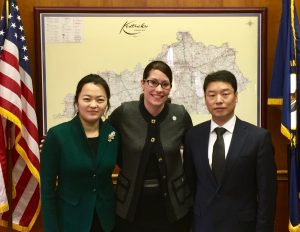 Secretary of State Alison Lundergan Grimes this week met with Chinese Embassy officials to continue to cultivate the economic and cultural relationship between Kentucky and the People’s Republic of China. Grimes is Kentucky’s chief business official.
“As Secretary of State, I look for every opportunity to help grow Kentucky’s economy and further develop connections for our state and its businesses,” Grimes said. “Kentucky’s trading relationship with China is strong and continues to grow because of the many factors that make our state a great place to do business. I am hopeful that with continued dialogue we will see even more investment in the commonwealth.”
China is the commonwealth’s 4th largest export partner with more than $1.9 billion of Kentucky exports in 2015, a growth of more than 16 percent year over year.
Grimes traveled to China in 2015 to provide information about Kentucky, its business climate and economic development opportunities in the state as part of a delegation coordinated and funded by the Chinese People’s Association for Friendship with Foreign Countries.
During the week-long trip, Grimes spent time in several cities and met with various government and business officials. Numerous Kentucky companies, including Lexmark, KFC/Yum! Brands, Brown Forman, and Ashland Oil, have offices in China.
Grimes has also made visits to Birtley Industrial Equipment Corporation’s headquarters in Lexington and offices in China. Birtley, a manufacturer of advanced coal preparation products, was the first Chinese manufacturer to locate in Kentucky, investing approximately $10 million and creating as many as 50 new full-time jobs.
“Encouraging businesses to make Kentucky their home is vital to growing jobs and opportunity in our commonwealth,” said Grimes. “There are also many opportunities for Kentucky businesses to do business abroad, further growing Kentucky’s economy, and I am committed to helping build relationships with other countries to provide the foundation for those investments.”
Gov. Matt Bevin today announced 10 appointments to the University of Louisville Board of Trustees’ 13-member board. The additional three members include student, faculty and staff representatives.
The Board is responsible for providing governance and oversight for the University’s administration and is accountable for the health, reputation and integrity of the University community in all aspects.
The following is a list of the appointments made:
- J. David Grissom, of Louisville, shall serve for a term expiring Jan. 13, 2023.
- John H. Schnatter, of Louisville, shall serve for a term expiring Jan. 13, 2022.
- Sandra Frazier, of Louisville, shall serve for a term expiring Jan. 13, 2021.
- Nitin Sahney, of Prospect, shall serve for a term expiring Jan. 13, 2021.
- Bonita K. Black, of Crestwood, shall serve for a term expiring Jan. 13, 2020.
- Brian A. Cromer, of Louisville, shall serve for a term expiring Jan. 13, 2020.
- Ulysses Lee Bridgeman, Jr., of Louisville, shall serve for a term expiring Jan. 13, 2019.
- Ronald L. Wright, MD, of Prospect, shall serve for a term expiring Jan. 13, 2019.
- James M. Rogers, of Prospect, shall serve for a term expiring Jan. 13, 2018.
- Diane B. Medley, of Ekron, shall serve for a term expiring Jan. 13, 2018.
Click here to view a video message from Gov. Bevin on the University of Louisville Board of Trustees appointments.
Gov. Bevin made these appointments pursuant to Sections 69 and 81 of the Kentucky Constitution, and KRS 164.821, as amended by SB12 during the 2017 Regular Session.
Download the executive order.
The Louisville/Jefferson County Environmental Trust is hosting a workshop on land stewardship issues on Saturday, February 4, 2017 at Historic Locust Grove, 561 Blankenbaker Lane.
The U.S. Fish & Wildlife Service, the Nature Conservancy and others estimate that the annual cost of invasive plants and animals to the U.S. economy is $120 billion a year, with over 100 million acres (an area roughly the size of California) suffering from invasive plant infestations.
Compounding the problem is that these harmful invaders spread at astonishing rates. Such infestations of invasive plants and animals can negatively affect property values, agricultural productivity, water quality, public utility operations, tourism, outdoor recreation, and the overall health of ecosystems.
Kentucky and Louisville have their share of invasive plants which are evident essentially anywhere there is a patch of dirt – parks, school yards, street and highway rights-of-way, private yards, and vacant lots. The workshop will take a look at the problem and how various agencies, nonprofit organizations and individuals are addressing it.
Who should attend this workshop?
“Whether the land you care about is a small residential yard in the city, a suburban lawn, a working farm, a scenic estate or a public park, chances are there are invasive plants that detract from the ecological and historic integrity of the land. It can be a daunting task to tackle an invasive plant removal and landscape restoration project. This workshop will give you the resources, knowledge and inspiration to get started,” said Lisa Hite, planning manager for Louisville Metro Parks and Recreation.
Speakers will report on the latest research, lessons learned and future plans for invasive plant management, ecological restoration, healthy tree canopy and historic landscape management in Louisville’s Olmsted Parks, Locust Grove, the Jefferson Memorial Forest and other Metro Parks and Recreation Natural Areas, Bernheim Arboretum and Research Forest, the Parklands of Floyds Fork, Beargrass Creek State Nature Preserve, the Lower Howard’s Creek Nature and Historic Preserve in Clark County as well as several private properties.
All sessions will include discussion and practical considerations for landowners who have questions about how to improve their own piece of the earth or those who want to help the on-going work in public parks and preserves.
Cost of the workshop is $35 for regular attendees and $15 for students and includes a box lunch. Reservations are required by January 30. To download the registration form, click here. Please call (502) 574-PARK (7275) or e-mail brandi.hornbuckle@louisvilleky.gov for more information.
