Tuesday January 27, 2026
Local Connection
 Weather
 Traffic
 @LouisvilleDispatch
 @LouisvilleDisp
 Subscribe
Credit: Louisville Metro Police
Two Louisville Metro Department of Corrections Probationary Officers were terminated on Monday, April 24, after being found in violation of the department’s Use of Force Policy.
Corrections Officers David Schwartz, 47, and Devan Edwards, 21, both hired on Sept. 8, 2017, were found to have used excessive and unnecessary force on a Metro inmate who they say failed to follow their directions in an incident on April 15.
After viewing body camera video of the incident, Corrections Director Mark Bolton made the decision to immediately terminate the two officers, who did not have contractual rights because they were under probationary employment.
“We conduct background checks, psychological tests, polygraphs, and we train our corrections officers for nine weeks to the best corrections training standards in the country, followed by a field training period with seasoned corrections officers lasting three additional weeks,” Bolton said. What I saw on that video is disturbing and is not reflective of what we expect from our staff.”
The 19-year-old inmate was cleared by the department’s medical staff, suffered no apparent serious injuries and continues to be monitored by the jail’s health care team.
Bolton said the incident has been turned over for review by Louisville Metro Police, as well as an internal investigation by the department’s Public Integrity Unit.

Credit: KY State Parks
Guests have the unique opportunity to experience a “Zip and Drop” adventure at Carter Caves State Resort Park on May 5.
The “zip” is a 200-foot zipline trip on the Smoky Bridge Highline, 50 feet above the ground. The “drop” is a 50-foot rappel from Smoky Bridge, a 120-foot long natural rock bridge at the park. Experience Smoky Bridge in a way few visitors get to see. No previous experience is necessary to participate.
“The reward is not only the adrenaline rush from being suspended by rope above the forest floor, but the scenery from this perspective is a large reason to try this,” said Paul Tierney, a naturalist at Carter Caves. “Imagine being perched on a wooden platform, looking down into Smoky Valley at the lush spring greenery peaking up from the forest floor as you’re clipped into the rigging and taking that first step off, and gliding down the rope through the valley.”
Each trip is $5 a person. Participants must be ages 6 and older and weigh 250 pounds or less. Make a reservation by calling the park at 606-286-4411. The zip and drop will be open 9 a.m. to 5 p.m.
“There’s not another place in the state you can experience this kind of adventure for only $5,” Tierney said. “It’s really a one-of-a-kind event at a beautiful location. A family of four can do something that perhaps they’ve never done before for only $20 as a family.”
Besides the zipline and rappel, Carter Caves offers cave tours and more than 30 miles of hiking trails. Early May is prime wildflower season at the park.
Carter Caves State Resort Park is located at 344 Caveland Drive in Olive Hill. The park has a lodge with a restaurant, cottages and campground. Besides cave tours, activities include hiking, boating and fishing. During summer months, swimming and horseback riding are also offered. For more information about the park, call 606-286-4411 or visit www.parks.ky.gov.
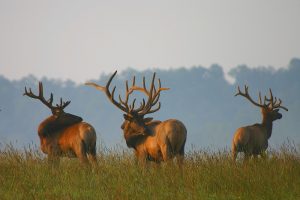
Photo: Kentucky Department Fish and Wildlife
Hunters interested in entering this year’s elk hunt drawing have until midnight (EST) April 30 to buy applications. Hunters can apply online at the department’s website, fw.ky.gov.
Kentucky residents and non-residents are eligible to apply for four permit types but can only be drawn for one. Each application costs $10.
Kentucky Fish and Wildlife will issue 700 general quota hunt permits and 10 youth permits this year through a random computer drawing conducted in early May by the Kentucky Commonwealth Office of Technology. Results will be available to applicants on the department’s website May 15.
Sixty-four percent of bull elk hunters using a gun last year enjoyed a successful hunt and 48 percent of hunters utilizing archery equipment successfully harvested a bull. The success rate for cow archery hunters was 28 percent last year and 47 percent among hunters using a firearm for cow elk.
“Our herd is strong and healthy,” said Gabe Jenkins, deer and elk program coordinator with the Kentucky Department of Fish and Wildlife Resources. “However, the herd dynamics have changed in recent years. Hunters will have to work to be successful and time spent scouting will greatly increase chances for success.”
The season limit of 250 bulls and 450 cow elk is unchanged from last year, as is the allotment among tag types.
Kentucky Fish and Wildlife will issue 150 firearms permits and 100 archery/crossbow permits for bulls; 290 firearms permits and 160 archery/crossbow permits for cow elk.
Demand is greatest for the bull firearms permit and lowest for the cow archery hunts.
The bull archery/crossbow season opens in September. The bull elk firearms seasons are spread over two separate, weeklong hunts in October while the cow elk firearms seasons are split into two weeklong hunts, both in December.
Hunters ages 15 and younger also can apply for the youth-only quota hunt during the same application period as the general elk quota hunt drawing. They may apply for the general quota elk hunt drawing as well, but cannot be drawn for both in the same year.
A landmark restoration effort re-established an elk herd in the state’s scenic southeastern region and created one of the most sought-after hunting opportunities east of the Rocky Mountains. Kentucky’s elk herd is the largest east of the Rocky Mountains and more than all the states east of the Mississippi River combined. The elk restoration zone in southeast Kentucky covers 16 counties and more than 4 million acres.
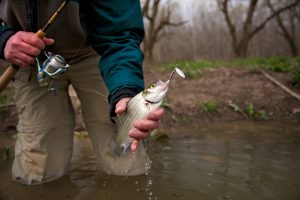
Photo: Kentucky Department Fish And Wildlife
This spring seems like one long continuation of late winter. As soon as we get a warm day, the temperature plunges and we are back in February again. It even snowed on Monday of the third week of April.
This up and down weather combined with cold rains has the spring fishing season behind by a few weeks. The spawning runs of white bass into the headwaters of reservoirs are scattershot so far this spring, with some movement followed by retreat.
“I don’t think the white bass have really had a chance to run yet,” said Ron Brooks, director of Fisheries for the Kentucky Department of Fish and Wildlife Resources. “I think the fluctuating water temperatures are screwing them up a bit. We need a sustained warm front to get them going.”
Water temperatures are in the low 50s in most reservoirs and streams across Kentucky.
Anglers fishing the headwaters of Taylorsville Lake found rewarding, but sporadic, fishing over the last week. “Last Thursday, I took home six white bass, but on Friday, I took home 10, at least four of them over 15 inches,” said Clifford Scott, internal policy analyst for Kentucky Fish and Wildlife. “I had to walk quietly out of there because I had the biggest stringer of fish.”
Scott took his fish with a combination of old-school 2-inch curly-tailed grubs in white and yellow along with a 2-inch Bobby Garland Baby Shad in pink and pearl.
“I saw small shad all over the place,” Scott said. “Once I saw them, I switched to the Baby Shad. You had to fish for the white bass, they were not on a hard run, but produced enough action to keep your interest.”
The upper part of Taylorsville Lake WMA grants bank access to anglers that produces fishing comparable to those in boats.
Mike Hardin, assistant director of Fisheries, caught some white bass in the upper reaches of Taylorsville Lake this past weekend. “We caught them above the first riffle from the impounded water,” he said. “We caught a mixed bag of different sizes and caught more in the evening than in the morning. The males were marked up in breeding colors. We caught a few females, so they are already staging for the spawn.”
White bass populations are by nature cyclic, and good fishing often erupts in lakes over the course of a year or two.
Green River Lake is one of those lakes poised for a white bass breakout. Southwestern Fisheries District biologist Eric Cummins and crew conducted white bass population sampling on the lake last year. They found excellent reproduction in 2014 for white bass, producing an expanding population of fish 14 inches and longer in the lake.
Last week, some bass anglers fishing a tournament on Green River Lake reported incidental catches of white bass while fishing crankbaits for largemouth bass. Anglers should search the Robinson Creek arm from Wilson Creek up to the KY 76 Bridge (Knifley Road) and in the Green River arm above Holmes Bend.
Bank anglers can access the upper end of the Robinson Creek arm at the Elkhorn Ramp and the Wilson Creek Recreation Area. They may also access the upper section of the Green River arm at the Snake Creek Ramp and other roads on the Green River WMA in that area.
Cave Run Lake is another reservoir with growing numbers of white bass. Population surveys conducted in 2017 show high numbers of larger fish, which should mean good fishing in 2018. Search for surface activity to find white bass in spring on the lake.
The fishing peaks in summer on Cave Run, when white bass get in the “jumps” by trapping shad against the surface and ripping through them. The confluence near the mouth of Buck Creek as well as the areas around the Clay Lick and Alfrey boat ramps make excellent places to search for them when it gets hot. Any shad imitating topwater cast into the jumps will get smoked.
Some anglers caught fish in the Broad Ford area in the headwaters of Nolin River Lake a few weeks ago, but the fishing slowed with the cold rains that accompanied major frontal passages earlier in April. The sustained warm weather in the upcoming forecast will draw waves of white bass into Nolin River Lake above Bacon Creek Ramp.
Fast and furious fishing during the spring runs makes white bass one of the most popular fish anglers pursue. When they are on, you can catch several fish on consecutive casts.
In-line spinners like the venerable Rooster Tail in white, chartreuse and pink all score white bass. You can work an in-line spinner near the surface or let it sink a few feet and retrieve. Vary the depths of the retrieve until you hit fish.
Like what Scott found last week, small shad-shaped soft plastic lures or curly tailed grubs also attract white bass. Some anglers fishing the headwaters of reservoirs suspend 1/16- to 1/32-ounce white feather or hair jigs under bobbers and let them drift in the current. Change the depth of the jig until you find white bass.
Anglers may keep 15 white bass daily, but only five of the daily limit may be longer than 15 inches. White bass fishing gives you a fantastic reason to buy your fishing license, so don’t forget to get one if you haven’t already.
Photo: Kentucky Transportation Cabinet
Kentucky’s 2018 Highway Plan will prioritize spending on more than 1,000 bridge repairs and 5,000 miles of pavement improvements over the next six years.
“The recently enacted six-year Highway Plan represents the most balanced approach released by Kentucky in decades for addressing the Commonwealth’s transportation needs,” said Gov. Matt Bevin. “This data-driven plan moves us in the right direction of prioritizing key road and bridge projects in view of actual available funding. I am grateful to state legislators and local officials who have collaborated with our administration to identify vital infrastructure needs and craft a roadmap to move Kentucky forward.”
The six-year Highway Plan (FY 2018-FY 2024) includes $8.5 billion for more than 1,400 projects, such as bridge and pavement improvements, road widening, reconstruction of existing roads, and new routes and interchanges. The plan includes $4.6 billion for mobility and safety projects, $2.3 billion for bridge and pavement repairs, $1 billion in federally dedicated programs (such as transportation enhancements and congestion reduction programs) and $600 million for federal GARVEE debt service payments. The $2.68 billion biennium spending plan (FY 2018-FY 2020) authorizes construction efforts to move forward on nearly 400 bridge repairs and replacements across the state, 1,275 lane miles of pavement improvements and 230 mobility and safety projects.
Following through on Gov. Bevin’s directive to better balance spending and revenues, the Kentucky Transportation Cabinet’s (KYTC) long-range plan slices more than $5 billion in overprogramming – projects listed but without available funds to pay for them – from the previous six-year plan.
The 2018 Highway Plan passed by the Kentucky General Assembly does not include as much overprogramming as previous long-term spending plans, which KYTC Secretary Greg Thomas said is encouraging progress. However, state lawmakers added about $1.8 billion in projects above available funds to the governor’s balanced transportation spending plan. This expanded list of projects, in addition to the state’s recommended priority list of unfunded projects, speaks to the need for additional state-generated revenue.
“We can’t count on Washington to provide more money to address these transportation challenges,” Thomas said. “As we move into the summer construction season, we have to closely monitor our cash balance due to a significant number of projects in the pipeline, as well as substantial debt payments the Cabinet owes beginning in June. Our top priorities will be limited to projects that improve safety, repair bridges and pavement and support job growth.”
Bridge, pavement improvements are safety priorities
The 2018 Highway Plan includes nearly $1 billion for significant bridge and pavement upgrades in the next two years. In all, the six-year plan includes $2.3 billion for the KYTC “Safety First” approach for bridge and pavement improvements in virtually every county across Kentucky.
More than half of the current 9,700-lane-mile backlog of poor pavement needs will be improved over the next six years. KYTC’s Preventive Maintenance Program and the plan’s unprecedented level of funding dedicated to asset management will allow KYTC to reduce a growing backlog of poor pavement miles, and road condition improvements are expected to make commutes safer and protect vehicles throughout the Commonwealth.
“Bridges that have been closed to school buses and commercial trucks because of safety concerns will soon be repaired, replaced and returned to service. Thanks to the funds that are dedicated to asset management improvement, the impact of the plan will be felt by drivers who rely on bridges and roadways daily to maintain vital links to their communities,” Thomas noted.
Adding to the Cabinet’s $265 million asset management budget outside the plan, the Highway Plan allocates $904 million in funding to improve bridges and deteriorating roadways in the FY 2018-2020 biennium for a combined investment of over $1 billion for existing roads and bridges.
The plan also demonstrates a continued commitment to large-scale projects by devoting funds to make progress on projects at a fiscally responsible pace. The 2018 Highway Plan invests funding to paint the existing Brent Spence Bridge in 2019, and in western Kentucky, right-of-way and utility funds are dedicated for the I-69 Ohio River Crossing connecting Henderson, Kentucky, and Evansville, Indiana. The Cabinet will continue plans to study an eastern bypass concept focused on economic development from I-71 in Gallatin County to the AA Highway in Campbell County.
The Highway Plan will also benefit from House Bill 385, authored by Rep. Ken Upchurch and Rep. Sal Santoro and signed by Gov. Bevin. This legislation expands the previous design-bid project limit from $30 million to $300 million and offers KYTC another option to deliver the most cost-effective, flexible approach to address transportation needs.
A SHIFT in spending priorities
Gov. Bevin previously directed the Cabinet to develop an objective and collaborative process to prioritize federal and state funding for critical infrastructure projects. The Highway Plan reflects the prioritization of the most needed projects through the use of the Strategic Highway Investment Formula for Tomorrow (SHIFT) process. More than 18 months of work went into designing the SHIFT formula and evaluating more than 1,100 projects.
The SHIFT process used quantitative measures such as crash rates, congestion, economic growth and cost-benefit ratios to rank 1,100 projects. The process also incorporated input and priority setting by local transportation leaders across the Commonwealth.
“Thousands of hours of hard work by hundreds of people at the state and local level developed this transportation blueprint that prioritizes the most pressing needs,” said KYTC Deputy Secretary Paul Looney. “This was a Kentucky team effort for the benefit of Kentuckians.”
The KYTC project team is already moving ahead to begin the 18-month SHIFT prioritization process to develop the 2020 Recommended Highway Plan. Local input from transportation leaders will continue to remain a core component of the process while project weights and scores may be refined based on the best available industry data measures. The next plan will be presented to the General Assembly in January 2020.
Additional information is available at http://transportation.ky.gov/shift.

Photo: Louisville Metro Council
Councilman Bill Hollander invites the community to attend a D9 Community Conversation on Louisville’s budget.
The meeting is Monday, April 30, beginning at 6:30 p.m., at the Girl Scouts of Kentuckiana, 2115 Lexington Road.
“Mayor Fischer will be presenting his proposed budget on April 26 and the Council’s Budget Committee, which I chair, will spend the next two months working on it,” says Hollander. “As that process begins, I’ll have some comments on the proposal at our D9 meeting but mainly I want to hear from Louisville residents about their views on how we should be spending their money.”
As with all D9 Community Conversations, discussion of any other subject is also welcome and Councilman Hollander will be available to talk with constituents about any questions, comments or concerns.
For more information about the meeting, contact Councilman Hollander’s office at 574-1109.
 Members of the Louisville Metro Council will host a formal reception to congratulate and welcome Dr. Marty Pollio as the new Superintendent of the Jefferson County Public Schools on Monday, April 23rd.
“This is an opportunity for Council members to meet with Dr. Pollio as we look forward to working with him and assisting anyway we can in educating the children of Jefferson County,” says President David James (D-6). “I support Dr. Pollio and the dynamic changes he is making for JCPS to improve education in Jefferson County.”
The formal reception will be held in the First Floor Conference Room of Historic City Hall, 601 West Jefferson Street beginning at 5:30pm.
Scarlet’s Bakery, an organization which works with victims of human trafficking and domestic abuse, will provide the appetizers for the reception.