Thursday January 22, 2026
Local Connection
 Weather
 Traffic
 @LouisvilleDispatch
 @LouisvilleDisp
 Subscribe
 WWE’s Smackdown Live is back in the Commonwealth for another round on Tuesday night. For the first time in nearly six years, a live televised WWE event will be held at Rupp Arena in Lexington.
“It’s great to have WWE back in Kentucky for another live televised show,” said Kentucky Boxing and Wrestling Commission (KBWC) Chairman Chad Miller. “More shows translate to more dollars for local economies, and the Commission is thrilled that our efforts are paying off for our wrestling fans, athletes, local businesses, and the combat sports industry in Kentucky.”
Since 2016, the Commission has repealed nearly 40 percent of the state’s combat sports regulations as part of Gov. Bevin’s Red Tape Reduction Initiative. The “cut rule,” repealed as part of the initiative, required an athlete to leave a match if he or she bled. The regulation prevented live televised matches from being held in Kentucky. Since the repeal, WWE has hosted several shows in Kentucky, including a Smackdown Live show earlier this year at the KFC Yum! Center.
“There is no doubt that the growth we are seeing in combat sports is directly tied to a transparent and fair regulatory environment,” added Miller. “The Commission continues to look for ways to promote efficiency while also ensuring athlete safety. Athletes can now apply for licenses online, and the Commission has streamlined and repealed approximately 55 percent of the forms an athlete could be required to complete for licensure. We believe that all of these measures will further a strong combat sports industry in Kentucky.”
As of Oct. 26, Governor Bevin’s Red Tape Reduction Initiative is responsible for repealing 188 regulations and targeting an additional 341 regulations for repeal. Over 2,208 of Kentucky’s 4,700 regulations have been reviewed as part of the initiative. Visit http://redtapereduction.com/ to learn more.
The KBWC oversees all professional boxing, wrestling, and full contact competitive bouts and exhibitions in Kentucky. Learn more about the commission at http://kbwa.ky.gov.

Photo: Louisville Metro Parks and Recreation
Louisville Parks and Recreation is accepting team registrations for its adult men’s winter basketball leagues. Games will be played Sunday afternoons at the Cyril Allgeier Community Center, 4101 Cadillac Court, beginning January 21, with game times of 1, 2, 3, 4 and 5 p.m.
The fee is $450 per team, and participants must be 18 or older. Deadline to register is January 12, or until leagues are filled.
For more information on how to register, please click here. Payments can be made by credit card over the phone @ 502/574-4515. You may also pay by cash or check at the Parks and Recreation athletics office located at the Cyril Allgeier Center, 4101 Cadillac Ct., 40213.
Payment must be made in full at the time of registration in order to reserve your place for the season. Registrations received after deadline will be subject to $35 processing late fee.
All information concerning league offerings, rules, and team roster sheets can be found here. For more information, please contact Michael Wade at Michael.Wade@louisvilleky.gov or call 502/574-4515.
 A milestone was reached today in the development of a soccer stadium district on about 35 underutilized acres in Butchertown. Financing was secured at a highly competitive rate for Louisville Metro Government’s sole investment in the project, $30 million. The general obligation bond anticipation notes (BANs) were sold to J.P. Morgan Securities LLC with a winning interest bid of 1.96 percent.
The city’s portion of the nearly $200 million soccer stadium district plan includes $25 million to buy and prepare the land, and $5 million to fund brownfield remediation and public infrastructure. Louisville City FC (LCFC) will develop the project, which will be anchored by a $50 million, 10,000-seat stadium. The development will also include retail, a hotel and offices, built by private investment.
In addition, LCFC will pay $14.5 million back to the city over 20 years for the land cost.
“This is a smart opportunity, and when smart opportunities to move our city forward come up, we’re going to take them. Pro soccer is an amenity that helps attract and retain young talent, and our entire city will benefit once this underutilized, highly visible space is reinvented as a bustling, vibrant soccer stadium district,” said Mayor Greg Fischer.
The project will create jobs and eliminate a brownfield currently filled with storage tanks, storage facilities and used cars. It also is expected to spark foot traffic to Butchertown, the Big Four Bridge, and Botanical Gardens. Additionally, it brings the prospect of a Major League Soccer franchise within reach.
A city-commissioned feasibility study confirmed that a soccer-specific stadium is needed to maintain and grow professional soccer in Louisville. The “stadium district,” to include the soccer stadium, Louisville Slugger Field and the Yum! Center, all within blocks of each other in the same line of sight, will build on the momentum downtown, in Nulu and Butchertown.
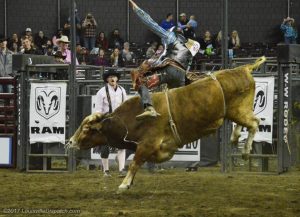 The 44th annual North American International Livestock Exposition (NAILE) saw an increase in both exhibitors and rodeo attendance during its 17-day run at the Kentucky Exposition Center. NAILE drew nearly 30,000 entries with competitors, exhibitors and attendees from 49 states and six foreign countries. The event generated an economic impact of $8.3 million to the greater Louisville region.
The Great Lakes Circuit Finals Rodeo, held in conjunction with NAILE, saw the highest attendance in five years with more than 19,000 fans enjoying the three performances in Freedom Hall.
NAILE, the world’s largest purebred livestock show, is held annually at the Kentucky Exposition Center. Included in the event are national collegiate and youth livestock judging contests, competition within ten livestock divisions and livestock sales. The event is owned and produced by Kentucky Venues.
Steve Kelly, Executive Director of Expositions for Kentucky Venues noted that renowned judges and officials from across the country evaluate the livestock and assist with the show, underscoring the event’s prestige. “NAILE serves as the livestock industry’s capstone event. Kentucky showcases its agriculture heritage by hosting the esteemed livestock show each year.”
The Sale of Champions, held the last night of NAILE, raised $64,500, with proceeds distributed to youth exhibitors of market animals (80 percent), charities (10 percent) and promotion (10 percent).
For more information, visit www.livestockexpo.org.

Photo: Kentucky Department Fish And Wildlife
The outlook for the upcoming waterfowl hunting seasons looks as promising as any seasons in recent memory.
“It is shaping up to be a phenomenal year,” said John Brunjes, migratory bird coordinator for the Kentucky Department of Fish and Wildlife Resources. “We are still at all-time highs for duck numbers with as many breeding ducks as we’ve ever had. It’s been that way for a couple of years now.”
Brunjes said biologists conducted duck population counts along the Mississippi River in Illinois last week. They produced four times the normal number of birds counted. “Usually for the second week of November in Illinois, they see about 200,000 birds,” he said. “They counted 800,000 birds along the Mississippi River last week and those birds are heading our way.”
Waterfowl of all stripes are migrating through Kentucky right now. “We are seeing white-fronted geese and even tundra swans in southeast Kentucky,” Brunjes said. “It is very rare. We have a ton of snow geese showing up in weird places this year. The birds are moving well this year.”
The duck, coot, and merganser seasons all open Thanksgiving Day, Nov. 23. The opening segment of the hunting season for ducks, coots and mergansers runs until Nov. 26. These seasons open again Dec. 4, 2017, and close Jan. 28, 2018.
The hunting season for Canada, white-fronted, brant and snow geese also open Thanksgiving Day, but do not close until Feb. 15, 2018.
“We want to remind hunters there is an extended opportunity for geese,” Brunjes said. “The extended season went into effect last year.” Traditionally, goose seasons closed in late January.
A summer devoid of long dry periods set the table for excellent waterfowl habitat this fall. “The moist soil areas and native vegetation look really good,” Brunjes said. “The crops on our wildlife management areas (WMAs) did well. We have the best crops at Ballard WMA that we’ve had in a number of years.”
Finding a place to waterfowl hunt is a challenge for the majority of Kentucky hunters. The first place to check is the public land hunting section of the 2017-2018 Kentucky Hunting Guide for Waterfowl. This section details the hunting options and regulations on public lands, mainly wildlife management areas.
Many, but not all, of the smaller state-owned or managed lakes are open to waterfowl hunting as are reservoirs operated by the U.S. Army Corps of Engineers or the U.S. Forest Service. The bigger waters hold more birds during the coldest stretches of the year, when many farm ponds or smaller lakes freeze over. Call the Kentucky Fish and Wildlife information center at 1-800-858-1549 to inquire if a lake is open to waterfowl hunting.
Those pursuing waterfowl on reservoirs must not hunt near access areas such as boat ramps or areas closed to hunting or public access by signs. Common sense and courtesy dictates waterfowl hunters avoid setting up near private residences or marinas.
Scouting is vitally important to waterfowl hunting success, especially in the first month of the season.
“If you aren’t seeing any birds in the areas you hoped to hunt prior to opening day, you likely won’t see birds on opening weekend either,” Brunjes said. “You have to find the areas birds are using and set up accordingly.”
Waste corn in cut silage fields provides excellent food for ducks and geese. Goose hunters may find agreeable farmers who consider geese a nuisance. Goose hunting in harvested cornfields provides excellent sport and peaks with the coldest weather.
Those farmers may also grant permission to hunt their ponds. From the air, farm ponds dot the Kentucky landscape as craters do the Moon. They can provide the hottest hunting, but not all farm ponds attract birds. Scouting is vital for successful farm pond hunting.
Waterfowl hunters must have a valid Kentucky hunting license, a Kentucky migratory game bird – waterfowl permit along with a Federal Duck Stamp. Federal Duck Stamps are available at post offices across Kentucky.
Waterfowl hunters must have their Harvest Information Program (H.I.P.) confirmation number recorded on either their Kentucky hunting license or on their Kentucky migratory game bird – waterfowl permit. To get your H.I.P. number, visit the Kentucky Fish and Wildlife website at www.fw.ky.gov and click on the “My Profile” tab. Answer a few questions about last season’s harvest of migratory birds to receive your confirmation number. The process takes less than 5 minutes.
“Folks in the neighboring states to our north such as Illinois, where waterfowl seasons are already open, are having great hunting so far,” Brunjes said. “It is early and a lot remains to be seen, but everything is setting up for a great season.”
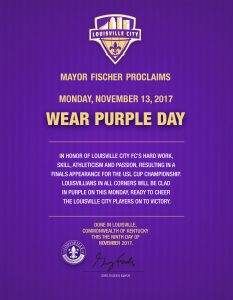 Monday, November 13, will be Wear Purple Day in Louisville to support Louisville City FC ahead of the USL championship game, Mayor Fischer said
via a city proclamation.
“Louisville City FC is on the cusp of a championship — an epic accomplishment for such a young team,” Mayor Fischer said. “I’m asking citizens to show their appreciation and support by wearing Louisville City purple on Monday, and to head to Slugger Field to cheer the players on as they bring the USL Cup home to Louisville.”
Louisville City plays for its first USL Cup championship at 9 p.m. Monday at Slugger Field against the Swope Park Rangers.
Mayor Fischer also announced that the Big Four Bridge will be lit in purple this weekend and Monday ahead of the USL championship game.
The Mayor and Louisville City FC are hosting a pep rally at 4 p.m. this Friday at Fourth Street Live. The public is invited to cheer on the players, coaches, staff and owners.
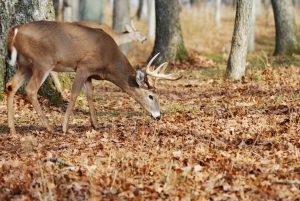
Photo: Kevin Kelly/Kentucky Department Fish and Wildlife
A burst of fall colors, frosty mornings and an uptick in deer activity recently are encouraging and telling signs for hunters.
The season that contributes the greatest percentage of Kentucky’s annual deer harvest and fills many freezers with protein-rich venison is almost here.
Modern gun deer season opens statewide Nov. 11, 2017.
“Opening day should be spot on,” said Gabe Jenkins, deer program coordinator for the Kentucky Department of Fish and Wildlife Resources. “Our gun hunters should have some fantastic deer activity. The start of the season falls early this year. It touches on the end of the chase period and continues into the peak of the rut. We should see some good movement early and late in the season.”
Kentucky’s modern gun deer season is designed to coincide with the peak of fall breeding, known as the rut. It runs for 16 consecutive days in Zones 1 and 2 and for 10 consecutive days in Zones 3 and 4.
County zone assignments are published in the annual Kentucky Hunting and Trapping Guide, available on the department’s website at fw.ky.gov and where licenses and permits are sold. The guide also provides information about license and permit requirements, hunter education and hunter orange requirements, bag limits and legal equipment for deer hunting. Also available on the department’s website is a detailed list of frequently asked questions about deer hunting in Kentucky. Type “Deer Season FAQs” into the search box on the homepage to access it.
Hunters in Kentucky have taken more than 130,000 deer annually over the past five seasons. The 2016-17 tally was the third highest on record with the modern gun season harvest accounting for more than 70 percent of that figure.
This year, the modern gun season harvest will provide biologists additional data to further assess the scope and impact of the outbreak of epizootic hemorrhagic disease (EHD) in eastern Kentucky.
As of Nov. 2, Kentucky Fish and Wildlife had received reports of more than 4,500 sick or dead deer across the state since mid-July. The outbreak was confined primarily to counties east of Interstate 75 and along and south of Interstate 64.
EHD is a virus spread by small biting flies or midges. A recent cold snap effectively ended the outbreak since frost kills the insects that carry the disease.
The virus is not transmissible to people and the meat is safe to eat. In any year, hunters are advised to avoid eating the meat from animals that appear to be overtly sick.
Hunters concerned about hunting elsewhere in the state should have no reservations whatsoever, Jenkins said. The herd remains robust.
“We’ve got a lot of deer,” he said. “I look for it to be just as strong in the rest of the state as it has been in recent years. We had a good fawn year last year, good acorns last year, a mild winter and nice summer. All factors for good survival, good antler production. Lots of goods in there.”
The statewide deer harvest from September’s record opening weekend of archery season through October was up compared to 2016. Harvest reports from the youth-only gun and early muzzleloader seasons in October were down.
A middling mast crop could play to the hunter’s favor. This year’s statewide mast survey found about a third of white oaks with acorns. Red oak acorn production was better at 63 percent. White oak acorns are the first choice for deer because they are sweeter and more palatable to deer than red oak acorns, which have higher tannic acid.
“If you find a white oak with acorns, be on it,” Jenkins said. “During the early muzzleloader season, two does came right underneath me. There was a red oak tree and a white oak tree and one of the does was just sniffing around trying to find those white oak acorns and passing up those red oak acorns. She’d find one and crunch, crunch, crunch.”
In addition to the hunter orange and hunter education requirements, as well as following the guidelines for safe handling of firearms, hunter safety during the modern gun season also extends to the use of tree stands.
Serious accidents can be prevented by following the manufacturer’s instructions for installation, use and maintenance of tree stands.
Hunter education classes offered by Kentucky Fish and Wildlife cover the basics of tree stand safety. Olivia Dangler, a conservation educator with the department, said hunters must not let their guard down.
“Do not let your excitement cause you to forget about safety,” she said. “It does not matter how good of a climber you are, or if you think it will never happen to you, always wear a harness and stay clipped into the tree because it can save your life.
“Inspect your equipment prior to use and wear a full body harness whether you are hanging, practicing or hunting from a tree stand. Once you leave the ground, your harness should be connected to the tree. According to the International Hunter Education Association, 99 percent of fall victims injured were not attached to the tree.”
Tree stands and harnesses are rated to support up to their stated weight capacities.
Keep your hands free and never carry equipment while climbing up to or down from a tree stand. Use a haul line to raise or lower equipment instead.
“Firearms should be unloaded with the safety on,” Dangler said. “Attach the haul line to the sling or stock so the muzzle is pointed down when pulling it up to you or lowering it to the ground. If using a bow while hunting, make sure it is unloaded before attaching the haul line and have arrows secured in covered quiver.”
An online tree stand safety course can provide a good introduction or refresher. A free, interactive course is available through the Treestand Manufacturer’s Association website at tmastands.com.
Hunters should choose trees that are straight and large enough to adequately support their tree stands. Avoid ash trees. The emerald ash borer has decimated the ash tree population in recent years. Any ash trees still standing should be considered unsuitable. Knowing where ash trees are in proximity to your location is another important consideration. Dead limbs can break under their own weight without warning.
Hunters who are still looking for a place to hunt can find information about public lands on the department’s website. On any wildlife management area that allows gun deer hunting, anyone hunting from inside a ground blind must now attach a hat or vest made of solid, unbroken hunter orange material to the outside so it is visible from all sides. Hunter orange clothing requirements still apply for anyone inside the blind.
Once you know where you will be hunting, it’s always a good idea to let a family member or friend know where you will be that day and when you expect to return.
“Get out there and go,” Jenkins said. “The full-swing rut is definitely here.”