Saturday January 31, 2026
Local Connection
 Weather
 Traffic
 @LouisvilleDispatch
 @LouisvilleDisp
 Subscribe
 Unemployment rates fell in 32 Kentucky counties, stayed the same in three and rose in 85 counties between August 2016 and August 2017, according to the Kentucky Center for Education and Workforce Statistics (KCEWS), an agency of the Kentucky Education and Workforce Development Cabinet.
Woodford County recorded the lowest jobless rate in the Commonwealth at 3.5 percent. It was followed by Shelby County, 3.8 percent; Campbell, Fayette, Monroe, Oldham and Scott counties, 3.9 percent each; Jessamine County, 4 percent; and Boone, Kenton and Spencer counties, 4.1 percent each.
Magoffin County recorded the state’s highest unemployment rate at 15.4 percent. It was followed by Leslie County, 12.7 percent; Elliott County, 10.7 percent, Carter and Harlan counties, 10.5 percent each; Letcher County, 9.7 percent; Breathitt County, 9.3 percent; Lewis County, 9.2 percent; Owsley County, 9.1 percent; and Jackson County 9 percent.
Kentucky’s county unemployment rates and employment levels are not seasonally adjusted because of small sample sizes. Employment statistics undergo sharp fluctuations due to seasonal events such as weather changes, harvests, holidays and school openings and closings. Seasonal adjustments eliminate these influences and make it easier to observe statistical trends. The comparable, unadjusted unemployment rate for the state was 5.2 percent for August 2017, and 4.5 percent for the nation.
Unemployment statistics are based on estimates and are compiled to measure trends rather than actually to count people working. Civilian labor force statistics include non-military workers and unemployed Kentuckians who are actively seeking work. They do not include unemployed Kentuckians who have not looked for employment within the past four weeks. The data should only be compared to the same month in previous years.
Learn more about Kentucky labor market information at https://kcews.ky.gov/KYLMI.

Photo: Louisville Housing and Community Development
Louisville Creating Affordable Residences for Economic Success (CARES) and the Louisville Affordable Housing Trust Fund (LAHTF) will be jointly hosting four informational meetings regarding the upcoming round of funding available for these two sources. This round of funding is comprised of $14.5 million dollars and is designed to provide gap and/or bridge financing to developers building affordable workforce housing or incorporating affordable workforce housing into market rate projects.
CARES and LAHTF encourage adaptive re-use of vacant and abandoned properties, energy efficiency, universal design and mixed income projects integrating low-income housing.
Meetings will be held at the following dates, times and locations:
- September 27 at 10:00 am at Middletown Firehouse (108 Urton Lane)
- September 28 at 9:00 a.m. at Edison Center (701 W. Ormsby Lane)
- September 28 at 2:00 p.m. at Southwest Regional Library (3920 Dixie Highway)
- September 29 at 10:00 a.m. at South Central Regional Library (7300 Jefferson Boulevard)
For more information, please visit https://louisvilleky.gov/government/housing-community-development
 Mayor Greg Fischer today announced a $200 million economic development plan for about 35 underused acres in Butchertown that will be anchored by a 10,000-seat, 15-acre soccer stadium, allowing Louisville to compete for an MLS franchise.
“This is an exciting, worthwhile project that takes an underused, very visible swath of land and creates a vibrant new stadium district that builds on the momentum downtown, in Nulu and Butchertown,” the Mayor said. “This is a smart opportunity, and when smart opportunities to move our city forward come up, we’re going to grab them.”
(Listen to Mayor Greg Fischer Podcast segment about the development and stadium)
Louisville City Football Club (LCFC) will build the $50 million stadium and serve as developer of the overall project, which will include retail, a hotel and offices, built by private investment.
Louisville Metro Government’s sole investment is $30 million to purchase the land for the development and do brownfield remediation and public infrastructure improvements. The project is expected to increase hotel, restaurant and retail amenities nearby and create a “stadium district” where the soccer stadium, Louisville Slugger Field and the Yum! Center are all within blocks of each other, along the same line of sight.
The city’s $30 million portion will be covered by general obligation bond — $25 million to buy the land and $5 million as a contribution to brownfield remediation and public infrastructure.
No Metro tax dollars will be used for stadium construction. In fact, LCFC will pay $14.5 million back to the city over 20 years from sales of land, rent from leases of land, and stadium rent. In addition, if the stadium hits certain financial markers, the city has an opportunity to share in the upside of that growth, up to $2 million.
(See the factsheet about the development and stadium)
On behalf of Louisville City Football Club, Chairman and President John Neace, thanked Mayor Fischer and Louisville Forward “for their commitment to the growth of professional soccer in Louisville.
“Today marks another important step in our vision to be the best United Soccer League club in the country, with the ultimate goal of bringing Major League Soccer to Louisville,” Neace said. “We look forward to building a world-class soccer stadium and surrounding development that continues revitalization in the Butchertown neighborhood.”
With Metro Council approval, the city will work with LCFC on an application to the Kentucky Economic Development Finance Authority (KEDFA) for a mixed-use TIF for the project.
To be eligible for state participation in a TIF, the local applicant (the city) must have some financial participation in the project; in this case, the city’s participation would be the money spent on land acquisition, brownfield remediation and debt service of the bonds to pay for the land.
The city will not commit any of its local property tax revenues to be included in the TIF.
Construction of the project will comply with Metro Ordinance 37.75 with respect to minority, women and local participation goals: 20 percent minority participation, 5 percent women participation, with 75 percent of the work going to residents of the Louisville MSA.
A city-commissioned feasibility study confirmed that a soccer-specific stadium is needed to maintain and grown professional soccer in Louisville. The study called for a soccer-specific stadium, with the ability to hold 10,000 seats, to be built by 2020.
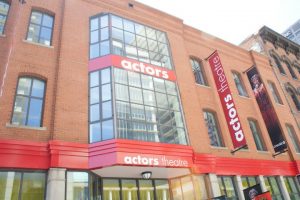
Photo: Actors Theatre of Louisville
Author: Actor’s Theatre, Laura Humble
The Most Frequently Asked Questions About This Chilling Louisville Tradition Every fall, Count Dracula takes the Bingham Theatre by storm, continuing his bloodthirsty reign of terror in a production that’s become a Louisville tradition. From our special recipes for fake blood to our four-legged cast members and talented backstage crew, here we reveal answers to some of the most frequently asked questions from Dracula Fans.
This is the first part of a five-part series.
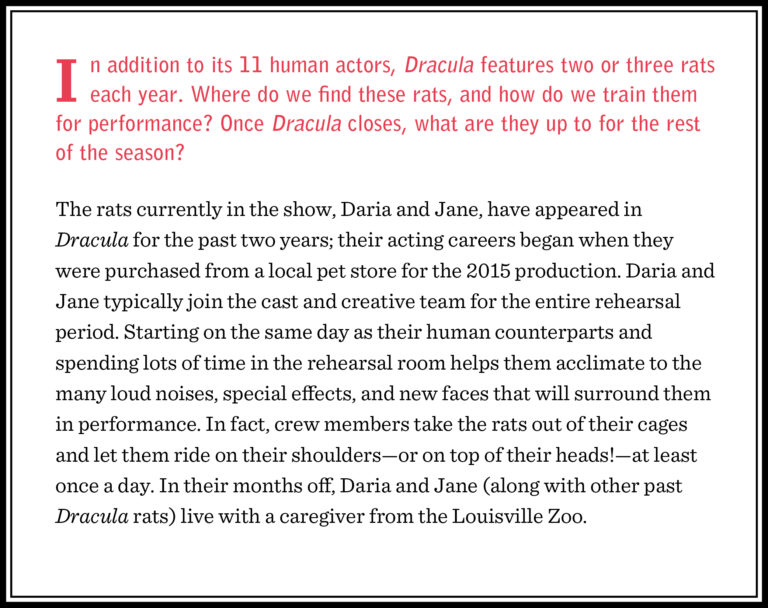


Photo: Louisville Metro Parks and Recreation
The “Canoemobile” is making its annual stop in Louisville on October 3-7, bringing fun and exploration through free trips for all ages on 24-foot Voyageur canoes on the Ohio River. The program, locally in its sixth year, is organized by Louisville Parks and Recreation’s Natural Areas Division based at Jefferson Memorial Forest in partnership with Wilderness Inquiry, Inc. of Minneapolis.
Additional funding support is being provided by the United States Forest Service through the Outdoor Foundation. The Canoemobile will offer trips from 10 a.m. – 4:30 p.m. at Shawnee Park on Friday, Oct. 6, and at Riverview Park on Saturday, Oct.7 from 10 a.m. – 4:30 p.m.
On Tuesday-Thursday, Oct. 3-5, the Louisville ECHO (Louisville is Engaging Children in the Outdoors) initiative, facilitated by JMF/Natural Areas, will host education days at Riverview Park with Chenoweth, Portland, and Coral Ridge elementary schools as part of the Canoemobile program. As part of this education day, students will canoe as well as learn about erosion and insects.
On Friday, JMF will be launching our first canoe built in our #CanoesBuildCommunity program, with assistance from Steam Exchange and Cabbage Patch Settlement House. The program inspires confidence and encourages ownership of paddling through kid-built canoes, from start to finish. With support from Canoe Kentucky, partners build canoes to keep.
“The Canoemobile program is a fun and safe way to introduce kids to the outdoors and part of our mission to expand outdoor recreation opportunities in the Louisville area,” said Seve Ghose, Director of Louisville Parks and Recreation. “We encourage everyone who is interested to come and take advantage of this great opportunity.”
The Voyageur canoes are safe, stable and can carry 9 participants per trip. Safety equipment and trained staff will be provided. Organizers suggest wearing comfortable outdoor clothing that can get wet, but no flip-flops. Water coolers will be available, so bring a refillable water bottle. Food also will be available for purchase.
Pre-registration is not required, and all trips will be offered on a first-come, first-served basis. Trips will leave every 30 minutes. All participants must sign a waiver, and those under the age of 18 must have a waiver signed by a parent or legal guardian. Forms can be found at memorialforest.com.
SCHEDULE
Friday, October 6
10 a.m.- 4:00 p.m. Shawnee Park 4501 West Broadway 40211
* Event is located at the end of Southwestern Parkway on the north side of the park
Saturday, October 7
10 a.m.- 4:30 p.m. Riverview Park 8202 Greenwood Rd 40258
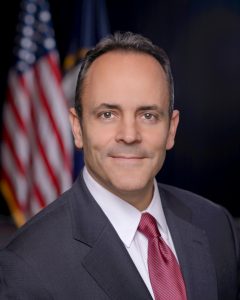 In conjunction with National Preparedness Month, Gov. Matt Bevin has proclaimed September as Preparedness Month in Kentucky.
Kentucky Emergency Management urges Kentuckians to “BE AWARE – BE PREPARED – HAVE A PLAN – MAKE A KIT.”
Kentuckians face threats to their safety and property throughout the year; from tornadoes, flooding, straight line winds, lightning, winter storms, man-made hazards, to daily emergencies. Every household and every business should be prepared to face these challenges at any given time. Disasters can occur at anytime, anywhere in Kentucky.
As we have all seen recently with Hurricanes Harvey, Irma, Jose and now impending Maria, preparedness can make the difference of saving your life or your family. Supplies such as water, non-perishable food, flashlights and batteries, radios and first aid kits are easy to store, and can be lifesavers when a crisis hits. A communication plan with family, friends and neighbors is also very important.
Michael Dossett, director of Kentucky Emergency Management (KYEM) stated, “During National Preparedness Month, the theme, ‘Disasters don’t plan ahead – You Can!’ is a great opportunity to remind our family, friends and neighbors of the importance of planning ahead, highlighted by the recent losses of Hurricanes Harvey and Irma.” Dossett went on, “ask yourself, what would you do in the next two hours, next two days and next two weeks following a disaster event to ensure the survival of your loved-ones?”
PLANNING FOR DISASTER: “BE AWARE – BE PREPARED – HAVE A PLAN”
Be Aware:
- Stay informed about risks in your communities and monitor weather forecasts.
- Own and monitor a battery backed-up or crank-type NOAA Weather Alert Radio. During threatening weather, stay tuned to your local broadcast stations.
- Discuss conditions with family members, and know their locations during dangerous weather.
Be Prepared:
- Discuss known risks with family members and neighbors.
- Develop and review your emergency plan periodically and update of necessary.
- Assemble an emergency kit(s) and refresh periodically. A kit should have enough food, water and medications for each family member for five days.
- Drill: practice your plan with household members.
Have a plan:
- Share your plan with others, including friends or relatives in another region or even another state
- Medications – prepare a list of all prescription drugs.
- Utilities – Written instructions for how to turn off electricity, gas and water; if authorities advise you to do so. (Remember, you’ll need a professional to turn them back on.)
- Shelter – Identify safe locations within and outside your residence.
- Contacts – Written contact information for relatives, neighbors, utility companies, employers/employees and local emergency contact telephone numbers.
- Evacuate – Predetermine evacuation routes. Identify where you could go if told to evacuate. Choose several places, such as a friend or relative’s home in another town, a motel or shelter.
- Children – Make backup plans for children in case you (or they) can’t get home in an emergency.
- Vehicles – Keep jumper cables in all vehicles at all times.
- Maintain at least a half tank of fuel in vehicles.
- Move vehicles away from under trees during possible wind events.
- Keep an emergency kit in all vehicles.
- During winter months, keep a blanket and bag of kitty litter in the trunk.
- Medications – prepare a list of all prescription drugs.
- Pets – have at least a 3 day supply of food and water for each pet. Have carriers, a collar or harness with ID tag, rabies tag and a leash; familiar items such as treats, toys and bedding can help reduce stress for your pet.
- Share your plan with others, including friends or relatives in another region or state.
Make an emergency kit:
- First aid kit and essential medications (to include prescription medicines).
- Canned food and can opener
- At least three gallons of water per person
- Protective clothing, rainwear and bedding or sleeping bags
- Battery or crank powered radio, flashlight and extra batteries or crank recharging stations that are capable of recharging cell phones, tablets, laptops, etc.
- Waterproof matches and candles
- Local phone book
- Special items for infants, elderly or disabled family members
- Extra set of car keys
- Cash – as much as you can afford!
For additional preparedness information, visit www.ready.gov and Kentucky Emergency Management at www.kyem.ky.gov. Follow @KYEMPIO on Twitter, like us on Facebook, and sign up for text alerts.
See Governor’s proclamation at https://kyem.ky.gov/Documents/septemberpreparednessmonth.pdf.
 A partnership between Kentuckiana Air Education (KAIRE) and Louisville Parks and Recreation has led to the creation of colorful advertisements stressing an anti-idling message that can be seen approximately a dozen parks throughout Louisville.
The message, “People Idle In Parks – Not Cars,” can be seen on pavement decals affixed to surfaces in high-traffic areas at some of Louisville busiest parks, including Joe Creason, Seneca, Thurman Hutchins and Sun Valley.
The advertisements have been placed in 16 parks with 14 more to follow in upcoming weeks.
“The advertisements are a reminder that parks are spaces where we promote the enjoyment of clean air and a healthy environment,” said Seve Ghose, Director of Parks and Recreation. “We’re encouraging our visitors to turn the engine off if they can, and possibly step outside of their car and go for a walk, and enjoy the surroundings.”
Unnecessary engine idling can create an air pollution “hot spot” in places like parking lots, school pick-up lines, and drive-thru windows. As Louisville’s overall air quality improves and vehicles become cleaner, idling is still a blind spot for many motorists.
“Modern cars don’t belch out black, smoky fumes anymore, but they still pollute the air,” said Air Pollution Control District Director Keith Talley Sr. “This is an easy way to reduce your personal pollution footprint.”
