Friday January 23, 2026
Local Connection
 Weather
 Traffic
 @LouisvilleDispatch
 @LouisvilleDisp
 Subscribe
Asks General Assembly to take action before session ends
Mayor Greg Fischer today urged the General Assembly to strengthen the reporting requirement of suspected child abuse when it involves law enforcement officers or leaders.
Current Kentucky law requires anyone who suspects that a child is being abused to report it to police, the state Cabinet for Health and Family Services or the county or commonwealth’s attorney. The law does not, however, require a local police department to report to other agencies when one of its officers is suspected of child abuse.
“This state law is intended to protect our children by requiring citizens to speak up to authorities when they reasonably believe a horrible crime is being committed against a child,” Mayor Fischer said. “This legal requirement should be extended to law enforcement agencies as well when the suspicion falls on one of their own, to ensure that all due diligence is taken to protect our young people.
“I’m calling on state lawmakers to take immediate action in the upcoming final days of this legislative session.”
Last week, Mayor Fischer appointed a special investigator to investigate sex abuse allegations in the Louisville Metro Police Explorer Program, and the circumstances surrounding the allegations. The Mayor also asked the FBI to investigate potential violations of federal law surrounding the case, and ordered a city government-wide inquiry to ensure all city programs that involve youth meet national standards.
Louisville’s strategy for reducing violence in part by focusing on high-crime areas is showing progress, including a 13 percent reduction in aggravated assaults, 16 percent reduction in burglaries and 29 percent drop in robberies in those communities.
Speaking to Metro Council, Louisville Metro Police Chief Steve Conrad also cited a 49 percent increase in arrests over the past three months in the neighborhoods where violent crime has been highest, as well as a 50 percent increase in citations issued; and 58 percent increase in self-initiated police activity.
He also noted that police have confiscated 207 guns so far this year — a 38 percent increase over the same period in 2016. Last year, LMPD confiscated 1,778 guns — a 44.7 percent increase over 2015.
While acknowledging there is much work to be done, and the city’s homicide numbers are still troubling, Chief Conrad, Rashaad Abdur-Rahman from the city’s Office for Safe and Healthy Neighborhoods, and Yvette Gentry, Chief of Community Building, told the Council today that there is positive movement in both short and long-term violence-prevention strategies.
They focused their presentation on six pillars of the overall strategy: Enforcement, intervention, prevention, community mobilization, organizational change and development, and re-entry. They also addressed Council questions on spending of public safety funds allocated in December, as part of a mid-year budget adjustment.
LMPD: Overtime is helping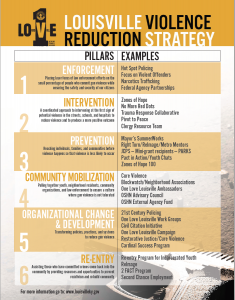
Chief Conrad said that since Nov. 1, LMPD’s newly expanded Narcotics Division has made 244 felony arrests and 59 misdemeanor arrests; and executed 169 searches, uncovering 57 pounds of heroin, 40 pounds of cocaine 73 points of meth and 125 guns.
And the additional funding allocated in December so far has covered 13,709 hours of overtime that allowed for increased patrols in the neighborhoods where violent crime has been most pressing — Park Hill, Russell, Shawnee, Shelby Park, Smoketown and Victory Park.
The Chief said he recently revised the increased patrols to be more strategic about when officers are deployed. “We want to be smart about spending these tax dollars, and mindful not to lean so heavily on overtime that we wear out our officers, who are extremely dedicated to this battle,” the Chief said.
Louisville Metro Police has hired 14 additional officers who are in training now and plans to hire 14 more this summer.
Office for Safe and Healthy Neighborhoods: Creating new pathways
Abdur-Rahman and Gentry said OSHN also is using expanded resources to focus on locations where there are more violent crimes involving youth, and efforts to create pathways away from violence through training, support and educational assistance.
They stressed that OSHN’s charge is long-term, focused on identifying and alleviating many of the root causes of violence, including economic and educational challenges as well as historic, systemic barriers to success for people in the neighborhoods most plagued by violent crime.
But they also pointed to indicators of success, including 100 people who found jobs through Zones of Hope, and 158 young people involved in ReImage, which helps stop the cycle of crime and violence by intervening with youth who’ve been charged with a crime or are at high risk of criminal behavior. Of those 158, 78 have gotten jobs, three have gotten a GED, and 17 have either completed a degree or started college.
OSHN represents a holistic approach in coordinating the efforts of many city agencies and partner organizations, ranging from Metro Parks and Recreation to the Louisville Urban League, Peace Education and Neighborhood House. Through those partnerships, OSHN is engaged with such programs as Zones of Hope, No More Red Dots, Pivot to Peace and, most recently Cure Violence, a cutting-edge method to reduce neighborhood violence by using the same health strategies used to fight infectious diseases. Cure Violence experts from Chicago were in Louisville last week for an assessment visit and training.
Funding for Cure Violence ($83,000) was part of a $625,000 allocation set aside for violence reduction efforts in the budget adjustment. Gentry and Abdur-Rahman outlined spending plans for the rest, including $120,000 to boost OSHN staffing from four full-time staffers to seven, as well as funding for Urban League and Peace Education programs, and 143,000 to external partner agencies for other, smaller programs focused on reducing violence.
“Just as there is no one reason for violence, there is no one solution for alleviating it,” Abdur-Rahman said. “Together, we’re investing in our youth, supporting young people who are trying to change their lives. That, in turn, helps all of us build a safe, more vibrant community.”
 Attorney General Andy Beshear joined AARP of Kentucky and members of the faith-based community to launch a partnership to protect local congregations and the communities they serve from con artists and the latest scams.
The Interfaith Travel Series Scam Alerts, hosted by Beshear’s Office of Senior Protection, will hold events at more than 20 different locations around the state with members of the faith-based community.
Beshear launched Scam Alerts last year as the state’s first direct messaging service that notifies Kentuckians of financial schemes by con artists to steal money or a person’s identification.
“One of my top priorities is to protect Kentucky families, especially our seniors, from the emotional and financially devastating effects that scams and financial exploitation can cause,” Beshear said. “I am proud to be partnering with AARP of Kentucky and congregations across Kentucky who want to protect their members and their communities.”
Beshear said the scam awareness events give his office the opportunity to partner with area faith-based communities and churches, and work with senior Kentuckians one-on-one through local senior ministries.
Joining Beshear at today’s announcement were: the Rev. Steve Weaver, senior pastor at Farmdale Baptist Church in Frankfort; the Rev. Ron Loughry, executive director, Fern Creek/Highview United Ministries in Louisville; the Rev. Dr. Valerie Washington, senior pastor, Hughlett Temple A.M.E. Zion Church in Louisville; and Charlotte Whittaker, of Hartford, who serves as the AARP Kentucky State President.
“I am honored to be included in the efforts of the Office of Senior Protection to help the seniors of Kentucky,” Washington said. “The Hughlett Temple African Methodist Episcopal Zion Church family is comprised of approximately 55 percent senior citizens. On a personal note, it was the Senior Protection Department in Texas that rescued my father from scam artists. For months they were taking his checks, leaving him with nothing. Lastly, due to the technology today, many of our senior citizens are targeted due to their lack of technical skills. Therefore, it behooves us to take an active part in their private and personal lives, preventing them from becoming victims. It also helps them to become more cognizant of the scams and con artists who prey on our communities.”
“One of the chief responsibilities of government is to protect its citizens,” Weaver said. “I’m thankful that the Office of the Attorney General is providing this service to the seniors of the Commonwealth which offers information to protect them from those who would prey upon them.”
“I am encouraged and excited that our Attorney General Andy Beshear, through his Office of Senior Protection, is taking this initiative to reach out across the Commonwealth, engaging in dialogue with faith communities around the concerns of older adults,” Loughry said. “My organization, Fern Creek/Highview United Ministries, along with all the community ministries that are part of the Association of Community Ministries in the Louisville Metro area, have long been concerned for and provided services for the older adult population.”
“One of AARP’s missions is to help people outsmart con artists before they strike,” Whittaker said. “Our goal is to help Kentuckians safeguard against identity theft and scams so they can keep their hard-earned money. We look forward to working with Attorney General Beshear and faith groups across the Commonwealth as we fight to end fraud and scams, and keep Kentuckians money where it belongs – in their pockets.”
Beshear is working to bring new solutions and ideas to address scams because of the severe harm they are having on Kentucky families. Just last year more than 3 million consumers were conned out of $765 million across the country. Seniors nationwide lose nearly $37 billion a year to elder financial exploitation.
To date, more than 100 nonprofit and retail organizations have joined Beshear’s initiative as a Scam Alerts partner, including Kroger, AARP of Kentucky, Lexington-Fayette Urban County Government, University of Kentucky Cooperative Extension Service, the Better Business Bureau and the United States Postal Inspection Service.
Kentuckians have recently received Scam Alerts on the Sweetheart Scam, IRS Scam, Seasonal Employment Scam and a scam targeting veterans.
Beshear hosted the first Interfaith Scam Alerts event at Shelby Christian Church in Shelbyville earlier this month.
“Protecting our seniors against fraud, scams and financial exploitation is a priority,” said Laura Witt, Commonwealth’s Attorney for Anderson, Shelby and Spencer counties. “General Beshear’s Interfaith Initiative brought that message to our local citizens. Thank you General Beshear and the Office of Senior Protection for educating our seniors and caregivers about Scam Alerts. Scam Alerts is a great way to protect yourself from predators. Thanks to the Attorney General’s Office of Senior Protection for bringing it to our community.”
Currently there are 25 congregations participating in the 2017 Interfaith Travel Series Scam Alert. The Kentucky Baptist Convention is partnering with the Office of the Attorney General on this initiative. The congregations are:
- Allen Baptist Church: Prestonsburg
- Beargrass Christian Church: Louisville
- Beaver Dam Baptist Church: Beaver Dam
- Blooming Grove Baptist Church and St. John United Methodist Church: Hopkinsville
- East Somerset Baptist Church: Somerset
- Eastwood Baptist Church: Bowling Green
- Farmdale Baptist Church: Frankfort
- First Baptist Church Bracktown: Lexington
- First Christian Church: Frankfort
- Flemingsburg Baptist Church: Flemingsburg
- Hughlett Temple A.M.E. Zion Church: Louisville
- Immaculate Conception Catholic Parish: La Grange
- Kentucky Refugee Ministries Inc.: Louisville
- Lone Oak First Baptist Church: Paducah
- New Covenant Baptist Church: Louisville
- New Hope Christian Center: Hazard
- Memorial United Methodist Church: Elizabethtown
- Sand Spring Baptist Church: Lawrenceburg
- Shelby Christian Church: Shelbyville
- Shiloh Baptist Church: Lexington
- St. Bernard Parish: Louisville
- St. Elizabeth Training and Education Center: Erlanger
- St. Stephen Church: Louisville
- The Temple AIBS: Louisville
The next event in the series will be at 10 a.m. March 16 at the Allen Baptist Church in Prestonsburg. For dates, times and locations of each upcoming event, please click here. Congregations interested in participating in the series may contact Beshear’s Office of Senior Protection at 502-696-5300.
Kentuckians may sign up for Scam Alerts by texting the words KYOAG Scam to GOV311 (468311), or enroll online at ag.ky.gov/scams and select text message or email alert.
Attorney General Andy Beshear today announced that the Child Victims’ Trust Fund helped pay for nearly 400 child sexual abuse forensic exams in 2016.
Beshear is encouraging Kentuckians to support the Fund through private donations, proceeds from the purchase of “I Care About Kids” license plates or donations made through the state income tax refund check-off program.
“One of the core missions of my office is to prevent and prosecute child abuse,” Beshear said. “We can only hope to end child abuse through the collaborative efforts of advocacy groups, government agencies, community leaders and by engaging families and Kentucky’s business community. The prevention activities and child advocacy programs supported by the Fund are critical to make children safer and to openly discuss abuse and the ways in which we can prevent it. And we must continue to impress upon everyone that it is their legal and moral duty to report abuse.”
Beshear created an Office of Child Abuse and Exploitation Prevention when he entered office in 2016.
The Child Sexual Abuse and Exploitation Prevention Board, which is administered by the Office of the Attorney General, is responsible for allocating funding from the Child Victims’ Trust Fund. It is statutorily created under Kentucky law as a 170(c)(1) nonprofit organization.
Last year, the Child Sexual Abuse and Exploitation Prevention Board approved $160,000 in statewide grants aimed at teaching parents how to discuss child sexual abuse with children and how to keep children safe on the Internet. The Fund helped support 394 children’s medical exams in 2016.
The Fund also helped support Beshear’s 2016 partnership to provide the most comprehensive statewide child abuse prevention training ever offered, training over a thousand law enforcement officers, county prosecutors, parents and child advocates on how to recognize the signs of sexual predators and intervene to protect a child.
To support victims of child sexual abuse, Kentuckians may visit their county clerk’s office and request an “I Care About Kids” license plate or check the box on their tax returns to designate a portion to the CVTF.
Governor Matt Bevin joined with Senate Judiciary Chairman Whitney Westerfield and a bipartisan group of officials this week to introduce Senate Bill 120, legislation aimed at ensuring people who leave prison can successfully rejoin society and turn away from crime.
These changes – ranging from improved reentry substance abuse supervision to removing government licensing restrictions that will expand job opportunities for those with records – will address Kentucky’s abysmal recidivism rate, which currently hovers above 40 percent. The legislation is the result of policy discussions from the bipartisan Criminal Justice Policy Assessment Council. The 23-member council was created by the Governor to find ways to make Kentucky’s justice system fairer, more effective and more efficient with Kentucky’s taxpayer dollars, while protecting public safety.
“America is a country founded on the principles of redemption and second chances,” said Gov. Bevin. “It is imperative that we see incarcerated people as individuals deserving of dignity and opportunity. We need to pursue policies that get bureaucracy out of the way, and allow those who have committed minor offenses to turn their lives around, find jobs and support their families. I am extremely grateful for the work the Criminal Justice Policy Assessment Council put into this legislation, and am proud of Chairman Whitney Westerfield. His passion for public safety and a justice system that is fair to everyone is admirable, and speaks to the best of what Kentucky has to offer.”
The bill would also establish a mechanism for private industry to operate inside prisons, giving inmates an opportunity to learn real-life job skills while also paying restitution, child support and for their own incarceration costs. Additionally, the legislation allows certain lower-level inmates serving felony sentences in county jails the chance at work release, which enables them to become employable post-sentence and able to pay restitution. Finally, the bill establishes opportunities for jails to operate reentry centers or day reporting centers to ease inmate transition back into society.
“We have reached a critical point in Kentucky,” said Sen. Westerfield. “While we must hold people accountable for their crimes, we also need to find better ways to prepare those coming out of prison to return to productive society. “This bill takes major steps toward better reentry opportunities, reducing recidivism and improving public safety across Kentucky.”
The bill includes provisions that:
- Modifies discretionary detention so it gives Probation and Parole more flexibility to use sanctions for supervision violations.
- Adjusts parole and probation credits for those who are compliant and need less supervision, which should ease a growing caseload with no negative impact on public safety. These compliance credits mirror a successful model from Missouri.
- Removes automatic bans for felons seeking professional/occupational licenses, giving discretion and providing a process for boards to determine whether a crime should prohibit licensure.
- Creates a way for the Department of Corrections to implement a reentry drug supervision pilot program (similar to drug court) for certain inmates and parolees with substance abuse disorders.
- Establishes a way for law enforcement agencies to offer “Angel Initiative” programs. These programs allow addicts to come to police departments seeking help finding treatment without fear of drug possession charges.
- Establishes a mechanism for private industry, which doesn’t compete with other Kentucky businesses, to operate inside prisons, giving inmates an opportunity to learn real-life job skills while also paying restitution, child support and for their own incarceration costs.
- Establishes authority to allow certain lower-level inmates serving felony sentences in county jails the chance at work release, thereby helping them become employable post-sentence and able to pay restitution.
- Establishes opportunities for jails to operate reentry centers or day reporting centers to ease inmate transition back into society.
Yesterday’s announcement builds on the momentum for justice reform in Kentucky, and comes on the heels of Gov. Bevin’s executive order last week to remove questions about criminal history from the initial application for state jobs. Last year, the governor signed legislation to allow for the expungement of certain low-level felonies after a person has completed the terms of their criminal sentence.

Credit: Louisville Metro Police
It is no secret that last year Louisville saw a record number of homicides. It seemed as though a new shooting or a new homicide was being reported every day, sometimes multiple times in one day. According to LMPD, Louisville, saw an increase of just under 50% to 117 homicides (123 for the entire county) during 2016, the highest since 1976 (104 total homicides). The majority of victims were black, accounting for a little more than 60% of the total. The majority of the victims were also male, approximately 79%, and more than half of the victims were between the ages of 18 and 34. LMPD was able to make 58 arrests in the homicide cases and the average suspect is the same as the average victim: a black male between the ages of 18 and 34.
Louisville also saw an increase in the number of shooting incidents, 504 compared to 353 last year. 504 shooting incidents is also the highest that has been recorded in the past five years. Of those 504 shootings, 102 were fatal.
Since gun control has been a hot topic the past year due to the election and a small group of Kentucky Mayors asking for the State Legislature to change state law regarding gun control, many of the other violent crime categories seemed to have been ignored by the local news. Here are some of the crime statistics and how they compare to last year:
- Robbery – 1,873, roughly the same as last year;
- Aggravated Assault – 2,921, up from 2,558;
- Rape – 149, down from 163;
- Property Crime – 29,890, up slightly from 28,055;
- Burglary – 5,884, down slightly from 6,229;
- Larceny – 19,808, up slightly from 18,751;
- Motor Vehicle Theft – 4,198, up from 3,075
According to Mayor Fischer, violent crime is “tragically acute in a few specific neighborhoods.” Looking at the maps by LMPD division, all eight divisions have been affected by homicide and shooting incidents. However, it appears that the majority of the homicides, shooting, and aggravated assaults occurred in the 1st (mainly north of Broadway and between I-264 on the east and west) and 2nd divisions (mainly west end). Taken in total, Louisville saw an overall increase by 9% in all violent crimes and a 46% increase in homicides. This appears to be outpacing the national average. Nationwide data is still pending, but as of June 2016, the country saw an overall increase in violent crime by 5% in general, and a 5% increase in the number of homicides when compared to the first six months of 2015. If the data is limited to only cities that are comparable in size to Louisville, there was a 5% increase in all violent crimes and only a 2% increase in homicides.
After averaging about ten homicides per month last year, Louisville has registered 15 homicides as of February 15, which is about the same as last year. While we are not seeing decrease in number of homicides as of now, hopefully, we will not see another record-breaking year.
Kentucky Justice Secretary John Tilley announced this week that every law enforcement agency certified through the Kentucky Law Enforcement Foundation Program Fund has met new requirements on sexual assault policies – a key turning point in addressing the backlog of rape evidence kits.
The policies were mandated under Senate Bill 63 – known as the SAFE Act – which passed in the 2016 General Assembly. It required all agencies that participate in the Kentucky Law Enforcement Foundation Program Fund to adopt a sexual assault response policy by Jan. 1. That includes nearly every law enforcement agency in the state.
Thanks to proactive support from the Department of Criminal Justice Training (DOCJT), every certified agency has met the deadline with time to spare.
“The survivors of sexual assault should never have to endure the uncertainty of another backlog,” Secretary Tilley said. “I’m proud that the Department of Criminal Justice Training and Kentucky’s law enforcement agencies are setting a high new standard on handling evidence kits and helping survivors find justice. DOCJT’s effort to help facilitate these polices has been outstanding.”
The new policies will guide collection and transport of evidence kits. They will also govern the process for notifying victims when test results become available.
Last year, DOCJT was tasked with collecting and reviewing each agency’s policy to assist with meeting the deadline. Instead of waiting for agencies to submit acceptable policies, DOCJT took an active role in helping agencies become compliant under the new law.
“I am exceedingly proud of our staff, who met this responsibility with the professionalism and diligence this important issue deserved,” said DOCJT Commissioner Mark Filburn. “The nearly-impossible feat of assisting every law enforcement agency across the commonwealth with meeting such a tight deadline – and succeeding – is just another example of how committed the DOCJT staff is to our clients.”
A Sexual Assault Response Team Advisory Committee, also established under SB 63, finalized a model policy on Oct. 19. With less than 3 months to meet the deadline, DOCJT worked fast to send the model to every law enforcement agency along with instructions on how to adopt and submit their own approved policies.
The committee’s model policy and two other models were added to the DOCJT website along with details of the new requirements and helpful resources. A dedicated phone line and email address were established for law enforcement executives to ask questions and receive immediate assistance. Staff members made personal presentations to multiple DOCJT classes and meetings of law enforcement executives to assist them further with this process.
Between Oct. 19 and Dec. 31, DOCJT staff collected all the submitted policies, which the department’s legal and executive staff then reviewed and approved.
“SB 63 was passed to improve the criminal justice response to victims of sexual assault,” said Eileen Recktenwald, executive director of the Kentucky Association of Sexual Assault Programs. “Now that law enforcement agencies in Kentucky have policies in place that ensure a trauma-informed approach to the investigation of this crime, it could mean that lifelong consequences for the victim can be decreased and it increases the possibility that more cases are cleared and successfully prosecuted, making Kentucky a safer place to live.”
Jefferson County Sheriff’s Office’s Chief Examiner, Jeff Prewitt, lauded DOCJT’s efforts to assist local agencies with meeting this new requirement.
“Instead of demanding compliance in an autocratic way, DOCJT facilitated compliance in a participatory and collegial way,” Prewitt said. “How refreshing!”
DOCJT Assistant General Counsel Deaidra Douglas said the department serves more than 400 law enforcement agencies across the commonwealth.
“In less than three months, every KLEFPF agency submitted their policy for review and met the deadline,” Douglas said. “From the cooperation we received across the state to the flawless communication with all the involved DOCJT staff, it was an exceptional team effort.”
SB 63 succeeded in the 2016 General Assembly thanks to Sen. Denise Harper Angel and Senate Judiciary Chairman Whitney Westerfield, who both played a crucial role in the final legislation. The legislature also supported a request from Gov. Matt Bevin to allocate $4.5 million toward reducing the backlog. That money will provide much-needed staffing and resources for the Kentucky State Police crime lab.
The next stage in meeting SB63’s new mandates will focus on training requirements for responding to sexual assault. DOCJT’s 2017 training schedule includes a new 40-hour course, which will be taught 19 times this year, both at the DOCJT Richmond campus and regionally across the state.
