Wednesday December 17, 2025
Local Connection
 Weather
 Traffic
 @LouisvilleDispatch
 @LouisvilleDisp
 Subscribe
Now that the Kentucky-based teams are no longer in the NCAA basketball tournament, the Final Four isn’t nearly as exciting, and somewhat depressing, to watch.
The best cure for any bruised feelings left by March Madness is to get out in early April and chase largemouth bass. A huge largemouth bass shaking its head vigorously trying to throw your white spinnerbait soothes any broken basketball heart.
Water temperatures range from 52 degrees at Lake Cumberland in the east to 58 degrees on Kentucky Lake in the west. In other words, it is prime time.
“With water temperatures in the mid-50s, the big female largemouth bass are staging,” said Jeff Ross, assistant director of Fisheries for the Kentucky Department of Fish and Wildlife Resources. “They are moving from their deeper winter locations to spawning locations in the shallows. They definitely work their way shallow in stages, but a cold front can push them back for a short period.”
At this time of year, the male largemouth bass move shallow first to build nests, followed by the female bass to lay their eggs.
“Recently, I caught a lot of largemouth bass, but they were all small male bass,” said Easton Copley, aquatic education program coordinator for Kentucky Fish and Wildlife. “When you look at their lips, they were roughed up and bloodied. They looked like they had lipstick on them from making spawning beds.”
Copley recommends looking for those staging areas to catch the large female largemouths. Female largemouth bass stage where large mud flats drop-off into deeper water. This is especially true on smaller state-owned lakes.
“At this time of year, I am not looking for numbers of bass,” Copley explained. “I am fishing for big females.”
Ross said to hit the secondary points or ledges near shallow water on the larger reservoirs, such as Kentucky Lake or Barren River Lake. “When the females hit those secondary points in spring, they are pretty close to spawning,” he said.
Copley said when water temperatures climb to 60 degrees, the larger female bass move into their shallow water spawning areas. “I look for rocky banks and transitional banks from rocky to mud,” he said. “If you can find a laydown tree on this kind of bank, all the better.”
Copley throws a variety of lures when spawning bass are up shallow. “I’ve caught a lot of bass on a square-billed crankbait in the Sexy Shad color,” he said. “I also catch quite a few on jigs. Black and blue is my go-to jig color for lakes with some color to the water. In clear water, I like the Cumberland Craw color for my jigs at this time of year.”
White spinnerbaits with a white and chartreuse trailer also draw strikes from shallow spring largemouth bass.
“When the bite gets tough, I pull out a Shakey head with a black and blue 7-inch straight-tailed worm,” Copley said.
Anglers who plan to release their catch need to release the female largemouth bass back to the same area during the spawn. “Take a photo and get them back in the water as soon as possible so they can get back to their spawning,” Copley said. “They are full of eggs.”
Kentucky anglers have oodles of options to catch spring largemouth bass. Check the 2017 Fishing Forecast
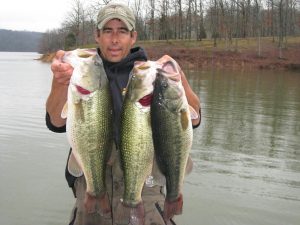
Photo: Kentucky Department Fish and Wildlife
for productive largemouth bass lakes near you.
Copley’s favorite lake is south-central Kentucky’s Green River Lake. He also likes 784-acre Cedar Creek Lake in Lincoln County. “Guist Creek Lake near Shelbyville has lots of big fish, but can be tough to fish because of high fishing pressure,” he said.
Kentucky Lake and Lake Barkley ranked number 4 in the Southeast Region for 2016 on Bassmaster Magazine’s Best Bass Lakes in the Country rankings. These lakes offer arguably the best chance in Kentucky to catch largemouth bass 4 pounds and larger
“We have many lakes where you don’t need a 20-foot bass boat to catch a big bass,” Ross explained. “Our smaller state-owned lakes, such as Kincaid Lake in northern Kentucky and Lake Malone in western Kentucky, are trophy largemouth bass lakes. Both of these lakes have excellent facilities for anglers at Lake Malone State Park and Kincaid Lake State Park. Beshear Lake, mainly located inside Pennyrile State Forest in western Kentucky, is always a big bass producer. Cranks Creek Lake in southeastern Kentucky also has some huge bass in it.”
The Final Four may be a bummer for Kentuckians this year, but warm days and trophy largemouth bass will put the NCAA tournament in the rearview mirror.
Remember to buy your 2017-2018 fishing license if you haven’t already.
 Louisville has been chosen to host the 27th annual Congress for the New Urbanism, an international placemaking conference, in the spring of 2019. Recent Congress host cities include Seattle, Detroit, Dallas and Buffalo. The event will bring over 1,500 attendees–including urban planners, architects and landscape architects, environmental consultants, engineers and real estate developers–to Louisville from across the country and the world.
CNU’s annual Congress is the premiere international event on planning, designing, and building walkable communities, mixed-use development, and sustainable, equitable cities.
“The arrival of the Congress for New Urbanism could not come at a better time for Louisville,” Mayor Greg Fischer said. “Many of the country’s most innovative and creative urban experts will be in our city and they can witness the renaissance happening across our neighborhoods while contributing their talents to areas of our city needing more attention.”
Each year, CNU members work with the host city to organize and to execute two to four Congress Legacy Projects which identify crucial roadblocks, engage local residents in visioning, and generate top-of-the-line design and placemaking strategies. Through multi-day workshops, CNU members engage with city officials, business owners, developers, neighborhood leaders, and members of the public to form a plan to enhance a corridor, section of a neighborhood, or other land use challenges chosen by the city’s host committee.
“Hosting CNU 27 is both an honor and a remarkable opportunity for Louisville,” Host Committee Chair David Tomes said. “Our city will have the chance to showcase New Urbanist neighborhoods like Norton Commons and Liberty Green, as well as dynamic redevelopment initiatives like Russell, Portland, NuLu, and SoBro, while also focusing worldwide attention on iconic places such as the Cherokee Triangle and Old Louisville. Most important, the visiting leaders of CNU will offer practical proposals to improve the livability of this city we love.”
Louisville’s host committee includes over 100 public officials, community leaders, academics, and representatives from the planning and urban design industries.
For more information on the Congress for the New Urbanism, please visit https://www.cnu.org/
Yesterday, Mayor Greg Fischer joined more than 4,500 city and county leaders nationwide in recognition of the National Day of Service.
The Corporation for National and Community Service (CNCS) sponsors this day of recognition to highlight the value of national service and the positive impact of Senior Corps and AmeriCorps.
Mayor Fischer said programs such as the Foster Grandparent Program (FGP) and RSVP (Retired & Senior Volunteer Program) are examples of Louisville’s decades-long commitment to service and volunteerism. Administered by the city’s Department of Community Services, FGP and RSVP connect residents 55 years and older with the people and organizations that need them most.
“Great cities have the social muscle that creates opportunities and overcomes adversities — and one way we build up that social muscle is through volunteerism and service,” Mayor Fischer said. “RSVP volunteers and foster grandparents are examples to our entire city of the impact that personal, selfless deeds can have when considered as a whole.
“As we prepare for the April 15th launch of our Give A Day Week of Service, I wanted to say thank you to RSVP volunteers and foster grandparents and all citizens who commit their time and energy to compassion.”
More than 130 FGP members serve about 135,000 hours annually, volunteer in area schools, after school programs and childcare centers to assist children who need additional help with age-appropriate reading or social skills. Volunteers also mentor troubled teenagers and young mothers, and provide care for premature infants and children with disabilities. During the summer, FGP volunteers help day camp participants stay academically engaged while enjoying the seasonal break.
The approximately 550 members of Louisville Metro RSVP serve nearly 71,000 hours annually at 60 active locations of public service, faith-based and community need agencies. Thirty members serve at the Robley Rex Veterans Administration Medical Center (VAMC). A hundred members serve with the Louisville Metro Senior Nutrition Program, packing and/or delivering lunches to other homebound senior adults including the Meals on Wheels Program.
“I am proud to be working with Louisville as we continue to strengthen communities through national service,” said Kim Mansaray, Acting CEO of the Corporation for National and Community Service. “Mayors are leaders who get things done. They know first-hand the value of national service in tackling local problems. I commend Mayor Fischer for working with us to improve lives and strengthen communities through national service.”
People 55 or older who are interested in volunteering with either FGP or RSVP can go online to https://louisvilleky.gov/government/community-services/volunteer-help to complete an initial application for a follow-up call. Or, call (502) 574-1933 for FGP information and (502) 574-7305 for a no-obligation information packet from RSVP.
Applications are now being accepted for the spring and summer sessions of the Louisville Etsy Craft Entrepreneurship Program. The three-week program provides micro-business training to underemployed, low-income adults who have creative skills, to help supplement their income by selling their crafts on the Etsy online platform.
“Our Etsy program is making an impact for our creative entrepreneurs, opening pathways to global customers through an ever-expanding online market place,” said Mayor Fischer. “Our graduates are as diverse as the crafts they create, and we’re proud of the creativity and drive it takes to complete this program.”
The program has had more a dozen successful classes, graduating 73 artists with marketable products. Forty graduates of the program have opened their own stores on Etsy.com, with several more in the works. Many graduates of the program have branched out to participate in local makers events, including the Made Market and the Mini Maker Faire.
Dates for the six-class spring and summer sessions include:
- April 10, 12, 17, 19, 24, 26
- May 8, 10, 15, 17, 22, 24
- July 10, 12, 17, 19, 24, 26
All classes meet on Mondays and Wednesdays at the Nia Center, 2900 W. Broadway, from 4– 6 p.m.
Registration for the program is open, but space is limited. To qualify, participants must be Jefferson County residents over 18 years of age, attend all six classes, have access to a computer, a digital camera or smart phone, and have a handmade craft product to sell.
For more information on the Etsy Craft Entrepreneurship Program, including registration and class schedule, visit
https://louisvilleky.gov/government/louisville-forward/etsy-craft-entrepreneurship
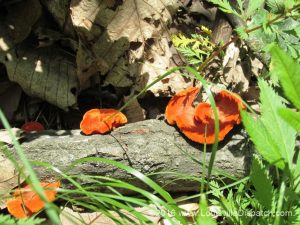 Make plans to bring your family to a Kentucky State Resort Park for the annual Easter buffet on April 16 for a great meal.
The menu at the resort park restaurants includes roast beef carved on the line; baked country ham; catfish and hushpuppies; and a chef’s favorite entree selection. The meal will also include fresh fruit, a cheese bar, garden vegetables, salad and desserts.
The price for adults is $19.50, and children (12 and under) are $9.50, not including tax. The price includes a beverage. The buffet will be served starting at 11 a.m.
General Butler State Resort Park will have seatings at 11:30 a.m., 1 p.m., 2:30, 4, and 5:30. Please call 502-732-4384. Buckhorn Lake will have a slightly different menu.
Here are the Easter buffet closing times for all of the resort parks:
Buffet closes at 4 p.m.: Buckhorn Lake, Pine Mountain.
Buffet closes at 5 p.m.: Lake Cumberland, Kenlake, Kentucky Dam Village.
Buffet closes at 6 p.m.: Pennyrile Forest.
Buffet closes at 7 p.m.: Natural Bridge, General Butler, Carter Caves.
Buffet closes at 8 p.m.: Dale Hollow, Barren River, Rough River, Cumberland Falls, Jenny Wiley, Blue Licks Battlefield, Lake Barkley.
Several parks are planning egg hunts and other activities for guests in April and on Easter Sunday. For more information, or to make lodging reservations, visit www.parks.ky.gov.
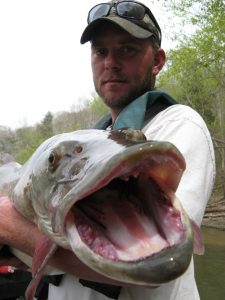
Photo: KDF
Spring break for many conjures thoughts of traveling somewhere warm and catnapping on a beach between rounds of golf.
A staycation sounds much better if you’re a muskellunge angler from Kentucky. The state’s muskellunge fishery has earned a reputation that extends beyond its borders, and experienced anglers know spring is one of the can’t-miss times of the year.
“Your odds of catching a trophy are better in the spring and fall,” said Tom Timmermann, northeastern fisheries district biologist for the Kentucky Department of Fish and Wildlife Resources. “In the fall, they’re packing on that weight to get through the winter. In the spring, if you catch those females before they release their eggs, they’re full of eggs. Either way, you’re looking at a chance at some bigger fish.”
Kentucky lies within the natural range of the Ohio strain of muskie, but the population in lakes and streams now is supported with stocking.
The bloodlines of these young predators trace to broodstock collected each spring from the Licking River. Kentucky Fish and Wildlife’s Minor Clark Fish Hatchery at the foot of Cave Run Lake Dam raises every muskellunge stocked in Kentucky.
Buckhorn, Cave Run, Dewey and Green River lakes are managed as trophy fisheries and there is a 36-inch minimum size limit in place on each. A 30-inch size limit for muskellunge is in effect elsewhere in the state
Cave Run Lake reaches into parts of Bath, Menifee, Morgan and Rowan counties and it produced the current state record in 2008. The 47-pound bruiser measured 54 inches.
Mike Hardin grew up fishing the lake and this past fall released a 50-incher caught on a homemade inline spinner.
“I believe they’re probably right there and ready to go pretty soon,” said Hardin, an assistant fisheries division director with Kentucky Fish and Wildlife. “The cold weather may slow things down a little bit but they’re already making that march.”
The longer periods of daylight and water temperatures climbing past 50 degrees trigger the muskellunge’s instincts to move shallow. Many anglers do well focusing on larger embayments, secondary cuts and flats because they warm up first.
Look for areas that offer food, vegetation or timber, warmer water and close proximity to deeper water. Scotts Creek, Warix Run, Buck Creek and Leatherwood on Cave Run Lake are popular spots in spring. Start at the points and work back to the shallows, casting to the bank and any structure or sub-surface features along the way.
“Those fish run up into the hollows seeking that flowing water,” Timmermann said. “The males are up there early and the females come up second. If you see a bunch of males, you know you’re still a little ways off from the big fish getting up there.”
Kentucky Fish and Wildlife is studying the impact of a 2010 regulation change that adjusted the size limits on Buckhorn, Cave Run and Green River lakes to 36 inches.
The same size limit went into effect last year on Dewey Lake in Floyd County. It is maturing as a muskie fishery after receiving its first muskie stocking in 2014. Sampling conducted this past fall found some of those fish had reached the minimum size limit.
At Buckhorn Lake in Leslie and Perry counties, catch rates have been better in the lower lake due to the habitat. “We have some larger shallow flats and there’s a lot of woody debris on those,” Kentucky Fish and Wildlife fisheries biologist Joseph Zimmerman said.
At Green River Lake in Adair and Taylor counties, the areas around the Emerald Isle and state marinas produce some of the better catch rates on the lake while the upper reaches of the Robinson Creek, Casey Creek and Green River arms offer large shallow flats worth exploring.
“The area behind the state marina is a good spot,” said Eric Cummins, southwestern fisheries district biologist with Kentucky Fish and Wildlife. “It’s wind protected and heats up quicker than some other parts of the lake.
“In the upper ends of the lake, you have warmer water dumping in at the mouths of those feeder creeks. If you have some stained water, muskie will slide up a little shallower and generally be more available to your shallower presentations.”
Many a bass angler pitching a crankbait or plastic frog has been surprised by a muskie. To have a fighting chance, it’s best to pair a 6-foot-6 or longer medium-heavy or heavy action rod with a 4.2:1 or 5.2:1 ratio baitcasting reel spooled with 65-pound or heavier braid. Wire leaders of 9- to 18-inches are a necessity because of the muskie’s sharp teeth.
Up-sized rattling lipless crankbaits, large soft-plastic swimbaits, minnow-imitating crankbaits, jerk and glide baits, spinnerbaits and in-line spinners are enough to cover just about any situation in the spring.
Anglers should dip the rod tip into the water as a lure gets to within a few feet of the boat and draw a figure eight. Muskie are prone to stalk a lure and the figure eight can entice a boat-side strike.
“I don’t know how many fish I’ve had hit right at the boat and I’ve never seen them until I’ve made the turn,” Hardin said.
A guide once told Timmermann that muskellunge anglers should not be married to one spot in spring.
“If you’re not catching fish, if you’re not seeing fish on your electronics, if you’re not raising fish, keep moving,” Timmermann said. “This time of year, jump from big hollow to big hollow.”
On Cave Run and Dewey lakes, anglers should inspect their boats and lures and discard any weeds before running to a new spot because of the presence of hydrilla, an invasive aquatic plant. Hydrilla was discovered just last year in Cave Run Lake.
“This is not a good thing for the lake,” Timmermann said. “Pay attention to what you’re moving and when you’re moving it. Clean your motors and trolling motors off before you move to a new spot and clean those weeds off of your baits.”
Furthermore, boaters can fight the spread of hydrilla by clearing any plant material from their boats before launching and removing all plant material from boats, motors and trailers after pulling their boats from the water. Spray or scrub off any remnants of plant material on boats before storing them.
One more thing to remember before trying for the muskellunge of a lifetime this spring in Kentucky is a fishing license. The new license year started March 1. Consult the Kentucky Fish and Boating Guide for complete licensing information. It is available online at fw.ky.gov and wherever licenses are sold.
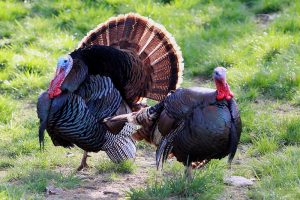
Photo From KDF
Spring turkey hunting is slipping into position before daybreak and sitting still as the sun eases over the hills.
It is breaking the silence with a call and getting a response that sends a shock of excitement down your spine. It is coaxing a love-struck gobbler closer and keeping your wits as it struts into range.
“There’s something about that drumming, spitting, gobbling turkey in front of you that makes the ground shake,” said Jason Lupardus, Midwest Conservation Field Supervisor with the National Wild Turkey Federation who has regional biologist duties in Kentucky. “I live for those moments. Favorite time of year, by far. You can’t beat it.”
The spring turkey season is something of an obsession among hunters who have experienced those magical mornings many times over or dream about it happening their first time out this year.
In Kentucky, the 2017 season is right around the corner. Hunters ages 15 and younger are first up. The youth-only season is the weekend of April 1-2. The general statewide season opens April 15 and runs through May 7.
“I’ve got high hopes,” said Zak Danks, wild turkey program coordinator with the Kentucky Department of Fish and Wildlife Resources.
The state’s turkey flock numbered fewer than 2,400 birds when restoration efforts began in 1978. The restoration continued until 1997, and today turkeys can be found in all 120 counties. The statewide turkey flock is estimated from 200,000 to 240,000.
Kentucky Fish and Wildlife monitors turkey reproduction through annual brood surveys conducted every summer.
A wet spring and early summer affected nest success and brood survival in 2016. The number of turkey poults per hen averaged 1.6 across the state, down from 2.3 the year before. What that means for this spring is fewer jakes but a strong crop of older, more experienced gobblers.
“We should have plenty of 2-year-old birds out there gobbling and providing good opportunity for folks,” Danks said. “I’m pretty excited about it. Of course, we’re going to cross our fingers and hope for good weather. The early season weather really impacts things. If we get good weather, people will get out and should have some good action.”
Lupardus is even more bullish about the upcoming season.
“We may have our banner year,” he said. “There were reports last spring of lots of jakes running around. That tells me that banner production from two years ago was still in place. Therefore, we should have a lot of 2-year-old birds out there gobbling this year. I’m thinking this could be our 10-year high.”
Kentucky’s spring turkey harvest has remained stable since the 2010 season when hunters took a record 36,097 birds.
The average spring harvest for the six years before 2010 was 26,887. In the six years since, the average spring harvest was 31,600. Hunters checked 31,047 birds last spring.
Kentucky times its spring season to give gobblers ample opportunity to breed hens before subjecting them to hunting pressure. The mild winter and subsequent early green up this year has ramped up anticipation.
“I’m sure people have been seeing a lot of birds strutting, hearing some gobbling, and that may have them wondering why we don’t start hunting them sooner like some other states,” Danks said. “But we really feel like we have a good handle on our season. We’re trying to strike a balance between hunting opportunity and protecting the resources.”
A strong mast crop this past fall combined with the mild winter should translate into hens being in tip-top physical condition for the breeding season.
“Which hopefully could bode well for their clutch sizes,” Danks said. “When hens are in better condition, they lay better eggs with more yolk reserves and hopefully that leads to better poults. We would like to think that we’re coming into a really good spring in that respect.”
Hunters are allowed a limit of two bearded birds during the spring season. Any combination of male turkeys, or female turkeys with visible beards, may be included in the season limit. No more than one bird may be taken per day.
Shooting hours are 30 minutes before sunrise to 30 minutes after sunset, but hunters may be in the field before and after shooting hours.
While many hunters focus their efforts on the early season and early morning hours, Bo Spencer does not overlook the mid-morning and late-season opportunities.
“I tend to really like mid to late mornings and the second half of our spring season,” said Spencer, who works in Kentucky Fish and Wildlife’s Information Center and is an avid turkey hunter. “The first week or two of the spring season, hens are roosting with and staying with gobblers until mid-morning. After about 9:30 or so, the hens have left the gobblers. Often times this will result in a gobbler becoming more willing to answer and come to calls.”
He continued: “The second half of our spring season, hens are on the nest and those gobblers are still in breeding mode. Late-season birds can be more willing to work to calls. They might not be as vocal and gobble as much as pre-season and early season but they will come looking. These late-season birds can come in quietly and all of the sudden there is a gobbler in range that you didn’t know was even in the area.”
Hunters are encouraged to consult the 2017 Kentucky Spring Hunting Guide before the season or going afield. The guide provides information about current regulations, licenses and permits, legal equipment, safety tips and more. It is available online at fw.ky.gov and wherever licenses are sold.
Kentucky Fish and Wildlife helps take the worry out of finding a place to hunt. It owns, leases or manages more than 80 public hunting areas across the state, and all but a few are open under statewide hunting regulations for the spring turkey season. These exceptions are noted in the guide. A complete listing of public hunting areas can be found on the department’s website.
Be sure to tune in to Kentucky Educational Television (KET) on Saturday, March 25 for a special “Kentucky Afield” TV half-hour call-in show focusing on the spring turkey season. The live show airs at 8:30 p.m. Eastern/7:30 p.m. Central.
Danks and a representative from Kentucky Fish and Wildlife’s Law Enforcement Division will join host Chad Miles to field phone calls from hunters across the state.
