Wednesday December 17, 2025
Local Connection
 Weather
 Traffic
 @LouisvilleDispatch
 @LouisvilleDisp
 Subscribe
Governor Matt Bevin joined with Senate Judiciary Chairman Whitney Westerfield and a bipartisan group of officials this week to introduce Senate Bill 120, legislation aimed at ensuring people who leave prison can successfully rejoin society and turn away from crime.
These changes – ranging from improved reentry substance abuse supervision to removing government licensing restrictions that will expand job opportunities for those with records – will address Kentucky’s abysmal recidivism rate, which currently hovers above 40 percent. The legislation is the result of policy discussions from the bipartisan Criminal Justice Policy Assessment Council. The 23-member council was created by the Governor to find ways to make Kentucky’s justice system fairer, more effective and more efficient with Kentucky’s taxpayer dollars, while protecting public safety.
“America is a country founded on the principles of redemption and second chances,” said Gov. Bevin. “It is imperative that we see incarcerated people as individuals deserving of dignity and opportunity. We need to pursue policies that get bureaucracy out of the way, and allow those who have committed minor offenses to turn their lives around, find jobs and support their families. I am extremely grateful for the work the Criminal Justice Policy Assessment Council put into this legislation, and am proud of Chairman Whitney Westerfield. His passion for public safety and a justice system that is fair to everyone is admirable, and speaks to the best of what Kentucky has to offer.”
The bill would also establish a mechanism for private industry to operate inside prisons, giving inmates an opportunity to learn real-life job skills while also paying restitution, child support and for their own incarceration costs. Additionally, the legislation allows certain lower-level inmates serving felony sentences in county jails the chance at work release, which enables them to become employable post-sentence and able to pay restitution. Finally, the bill establishes opportunities for jails to operate reentry centers or day reporting centers to ease inmate transition back into society.
“We have reached a critical point in Kentucky,” said Sen. Westerfield. “While we must hold people accountable for their crimes, we also need to find better ways to prepare those coming out of prison to return to productive society. “This bill takes major steps toward better reentry opportunities, reducing recidivism and improving public safety across Kentucky.”
The bill includes provisions that:
- Modifies discretionary detention so it gives Probation and Parole more flexibility to use sanctions for supervision violations.
- Adjusts parole and probation credits for those who are compliant and need less supervision, which should ease a growing caseload with no negative impact on public safety. These compliance credits mirror a successful model from Missouri.
- Removes automatic bans for felons seeking professional/occupational licenses, giving discretion and providing a process for boards to determine whether a crime should prohibit licensure.
- Creates a way for the Department of Corrections to implement a reentry drug supervision pilot program (similar to drug court) for certain inmates and parolees with substance abuse disorders.
- Establishes a way for law enforcement agencies to offer “Angel Initiative” programs. These programs allow addicts to come to police departments seeking help finding treatment without fear of drug possession charges.
- Establishes a mechanism for private industry, which doesn’t compete with other Kentucky businesses, to operate inside prisons, giving inmates an opportunity to learn real-life job skills while also paying restitution, child support and for their own incarceration costs.
- Establishes authority to allow certain lower-level inmates serving felony sentences in county jails the chance at work release, thereby helping them become employable post-sentence and able to pay restitution.
- Establishes opportunities for jails to operate reentry centers or day reporting centers to ease inmate transition back into society.
Yesterday’s announcement builds on the momentum for justice reform in Kentucky, and comes on the heels of Gov. Bevin’s executive order last week to remove questions about criminal history from the initial application for state jobs. Last year, the governor signed legislation to allow for the expungement of certain low-level felonies after a person has completed the terms of their criminal sentence.
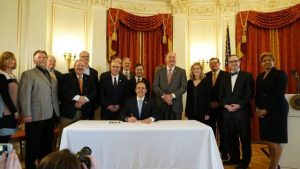 Yesterday, Gov. Matt Bevin ceremonially signed House Bill 1, which provides right-to-work guarantees to all Kentucky workers, in a midday gathering with legislators, economic developers and business advocates from across the state.
This historic new law protects employees in the Commonwealth from being forced to pay union dues in order to keep their jobs. Kentucky becomes the 27th state to enact such protections, and experts say the measure will spur economic growth while boosting individual incomes.
“This is an extraordinary opportunity to ceremonially sign something that has been a long time coming,” said Gov. Bevin. “We have gotten, almost on a daily basis, unsolicited comments from economic development, workforce development and site selection folks who have said: ‘Wow, now we believe it—Kentucky is open for business.’”
“This will mean incredible new opportunities for the Commonwealth. We are already talking to people who were not going to come and consider us until this was done.”
Supported by a host of business and economic development advocates, House Bill 1 represents a crucial step in Kentucky’s efforts to recruit and retain well-paying jobs. The majority of Kentucky’s border states—Indiana, Missouri, Tennessee, Virginia and West Virginia—have also enacted right-to-work legislation.
“Passage of right-to-work legislation in Kentucky was a critical step toward job growth and business investment across the state,” said House Speaker Jeff Hoover. “Not only does the bill position Kentucky on level ground with our neighbors in the fight for jobs, but it creates additional freedom for Kentucky workers by allowing them the choice to join a union or not—and as a result take home more money. Kentuckians deserve every opportunity to have access to, and benefit from, good paying jobs. I’m proud to have played my role to ensure passage of this game-changing bill.”
“Right-to-work legislation has been something we have passed in the Senate for many years, only to fall on deaf ears at the hands of the former Democratic majority,” said Senate President Robert Stivers. “We have seen how right-to-work can grow businesses and create jobs in other states, so we knew we had to pass this bill once the House flipped. I applaud the work of Speaker Hoover, the rest of my colleagues in the legislature, and Governor Bevin, for helping make Kentucky right-to-work and open for business.”
“Right-to-work legislation is vital to attracting higher levels of advanced manufacturing jobs to the Commonwealth,” said Rep. Jim DeCesare, chair of the House Committee on Economic Development and Workforce Investment. “It was a privilege for me to shepherd this legislation through the Economic Development and Workforce Investment Committee, as well as on the floor.”
Studies examining Bureau of Labor Statistics (BLS) data show that right-to-work states report faster per capita income growth, greater capital expenditures, lower unemployment, fewer work stoppages and faster growth in manufacturing and non-agricultural jobs than non-right-to-work states.
Contrary to critics who claim that right-to-work protections eliminate opportunities to affiliate with a union, 2015 BLS data also shows that union membership in right-to-work states actually grew more quickly than in non-right-to-work states.
By a unanimous vote, The Louisville Metro Council last week approved a resolution of support for any future expansion of the National Basketball Association in Metro Louisville.
“There is every indication the NBA may be ready to move forward with expansion team possibilities in the future and I think it is in our best interest to show that our city would fully support any new effort,” says Councilman Dan Johnson (D-21), the primary sponsor of the Resolution.
The resolution highlights the city’s love of the sport of basketball and points out the city has the facilities to accommodate a new NBA franchise. The resolution says the KFC YUM! Center is one of the best arenas in the country and the NBA would be an enhancement to local businesses and the city’s economy.
Last week, Johnson told the Community Affairs, Housing, Health and Education Committee that the recently finalized collective bargaining agreement agreed upon by the NBA and players mentions expansion over 100 times.
“There are many cities that are now beginning to send a message to the NBA that they would be supportive of any future expansion. We should always be prepared to be in the hunt,” said Johnson.
The resolution simply states, “That Metro Louisville would support an NBA/WNBA basketball franchise and the economic development it would bring to our community.”
The resolution passed with bipartisan support.
Yesterday, on behalf of Gov. Matt Bevin, Lt. Gov. Jenean Hampton joined Department for Local Government (DLG) Commissioner Sandy Dunahoo in a Capitol rotunda ceremony to announce over $5.7 million in Community Development Block Grants (CDBG) for 13 new projects in Kentucky. These grants impact multiple regions and counties across the Commonwealth.
“We are excited to announce 13 new Community Development Block Grant projects. Each project is designed to aid critical infrastructure needs across the Commonwealth, such as water safety, public facilities and local health resources,” said Gov. Bevin. “These block grants will not only have a significant impact on improving quality of life for Kentuckians, but will create economic opportunity and jobs as well. Great things happen when we work together.”
“It has been a true joy over the last year visiting different communities in Kentucky and hearing their stories,” said Lt. Gov. Hampton. “These grants have created wonderful opportunities for communities across the Commonwealth in terms of economic development, tourism, education, the environment, and more.”
“I’m pleased by the governor’s announcement of these projects to help address many of the community challenges and infrastructure needs facing Kentucky,” said DLG Commissioner Dunahoo. “We are always looking at ways to coordinate our efforts with local regions for community projects and economic development. This grant assistance does that in a big way.”
The 13 projects include:
- Hawesville WWTP in Hancock Co., $800,000.
- Cumberland Hope Community in Harlan Co., $220,000.
- Hickory Hill Recovery Center for Men (Recovery Kentucky) in Knott Co., $220,000.
- Madison Co. God’s Outreach Food Bank Expansion Project in Madison Co., $300,000.
- Gamiliel City Hall and Community Ctr Architectural Barrier Removal Project in Monroe Co., $85,000.
- Centertown Water Tank Project in Ohio Co., $403,000.
- Hartford Water System Capital Improvements Project in Ohio Co., $896,250.
- Apple Patch Education Adult Day Program Relocation Project in Oldham Co., $405,000.
- Mt. Olivet Wastewater Treatment Plant Renovation and Expansion in Robertson Co., $634,500.
- Morehead Inspiration Ctr (Recovery Kentucky) in Rowan Co., $220,000.
- Fritz Winter Rail Spur Development in Simpson Co., $997,000.
- Todd County Health Department Expansion Project in Todd Co., $500,000.
- Guthrie Koppers Natural Gas Line Project in Todd Co., $100,000.
The CDBG program provides assistance to communities for use in revitalizing neighborhoods, expanding affordable housing and economic opportunities, providing infrastructure and/or improving community facilities and services.
Applications for CDBG funds are also submitted to DLG. To learn more, visit https://kydlgweb.ky.gov/FederalGrants/CDBG_cities.cfm.
Attorney General Andy Beshear announced the launch of a statewide competition that challenges Kentucky’s legal community to donate food and funds to aid Kentucky families and children suffering from hunger.
Beshear announced the Legal Food Frenzy campaign at the Capitol Rotunda as part of the Kentucky Association of Food Banks (KAFB) Rally to Solve Hunger.
The competition is a collaborative effort among the Office of the Attorney General, KAFB, Kentucky Bar Association Young Lawyers Division and the Office of the Secretary of State.
Beshear said his office and partner organizations launched the campaign to help address the lack of access to enough food that nearly one in six adults and one in five children in Kentucky face.
“My first priority is to protect Kentucky families and children, and each day far too many are struggling to obtain enough food for a healthy, active life,” said Beshear. “The Legal Food Frenzy is an opportunity for the state’s legal community to challenge each other outside the courtroom for the noble cause of reducing hunger.”
Rebecca Schafer, chair of Kentucky Bar Association Young Lawyers Division said the goals of the campaign are to raise 600,000 pounds of food or $150,000 from March 27 to April 7, 2017.
“We are excited to partner with so many great organizations to provide the first statewide hunger relief effort by Kentucky’s legal community,” said Schafer. “The campaign, with the support of attorneys across the Commonwealth, will help bring Kentucky one step closer to ensuring that all of its citizens have access to adequate food.”
Every $1 donated through the competition will return $8 or more in food to the community. Kentucky law firms, law schools and legal organizations are encouraged to sign-up online.
Proceeds and goods generated from the competition will directly aid the members of the KAFB – an organization that distributes over 50 million meals to 1 in 7 Kentuckians annually in partnership with a network of 800 local charitable feeding organizations. Its members serve all 120 counties in Kentucky.
Tamara Sandberg, executive director of KAFB, hosted the rally and said this campaign will help food banks prepare for the increase demand for food assistance during the summer months.
“Only one in 13 school-aged children who receive free and reduced-priced lunch during the school year have access to such meals during the summer months,” said Sandberg. “We are grateful to Kentucky’s legal community for taking action against hunger and helping the food banks go into summer strong and well-stocked to meet the increased demand for food among families with school-aged children.”
The organization or firm that raises the most food and funds will win the Attorney General’s Cup, signifying their accomplishment in aiding hunger-relief in Kentucky.
Secretary of State Alison Lundergan Grimes, the Kentucky Bar Association Board of Governors and Kentucky Supreme Court Justices also attended today’s event to support the Legal Food Frenzy and rally.
The Rally to Solve Hunger also included remarks from Commissioner of Agriculture Ryan Quarles; Mark Barker, Farm Credit mid-America; Kurt Reiber, chair of the Kentucky Association of Food Banks; and Debbie Fannin with Grayson County Alliance Food Pantry.
To learn more about the Legal Food Frenzy and view a complete list of competition rules and award categories, visit http://kyfoodfrenzy.com.
Secretary of State Alison Lundergan Grimes on Tuesday urged lawmakers to renew a Kentucky law that provides tax incentives to Kentucky farmers who donate to food banks. Grimes was a prominent backer of legislation creating the incentives.
“Kentucky farmers grow some of the best agricultural products in the country and the world,” said Grimes. “And knowing that as many as one in six Kentuckians is impacted by lack of food, the Farms to Food Banks tax credits for farmers who donate to Kentucky food banks are more important than ever. We should not only renew the credits, but increase their value.”
Grimes is joining Agriculture Commissioner Ryan Quarles in lobbying the legislature for the renewal of the tax credits that House Bill 141 created in 2013. The Kentucky Nonprofit Network recognized Grimes for her work on the legislation last year.
Joining other Kentucky constitutional officers and legislators, Grimes also announced at the rally that her office will launch a Commonwealth of Kentucky Bowl food drive this fall. The drive will be held amongst Kentucky businesses and community organizations to help food banks at an important time of need – just before the holidays.
“One in four Kentucky children don’t always know where their next meal will come from,” said Grimes. “We have to do better. That’s why I will be calling on the more than 200,000 businesses that make up the Commonwealth’s business community to help us feed the children and their families this holiday season.”
Grimes is partnering with the Kentucky Association of Food Banks, which hosted Tuesday’s rally, for the bowl. She is challenging local chambers of commerce to participate by coordinating donations with their members.
Grimes has been a champion for solving Kentucky’s hunger issues since she took office in 2012 and before she was elected to public office. She is a longtime volunteer at the Salvation Army, serving the Thanksgiving meal at her local service center every year. She also has served on the board of God’s Pantry Food Bank in Lexington.
At the rally, Grimes thanked the farmers who participate in the tax credit program and Kentucky’s food banks for their tireless work to help eradicate hunger and food insecurity in the Commonwealth.
“Scripture calls us to help feed those who are hungry. Every Kentuckian that doesn’t worry about when they will eat their next meal or how they will feed their family has a role to play in ensuring no other citizen of this Commonwealth has those worries,” said Grimes.
 Mayor Greg Fischer announced a new city partnership with IFTTT, a San Francisco-based web and mobile platform that allows users to transform how they experience and manage their homes and habits.
IFTTT allows users to customize their experience with other services and tools — including Twitter, Google Drive, email digest and Philips Hue light bulbs — without coding.
Starting today, Louisville’s real-time air quality data will be available on IFTTT. Residents will be able to use IFTTT to create their own “Applets” using this data — for example, they could receive a push notification or send a Tweet when the air quality reaches a specific level.
The city plans to provide more feeds of city data to IFTTT soon, allowing residents more options to integrate city data into their daily lives. The IFTTT partnership is part of Louisville Metro’s Smart City efforts, which seek to use technology and information to improve services and increase opportunity for citizens. Louisville Metro’s Office of Civic Innovation is also currently partnering with CNET to explore the interaction of smart homes and Smart Cities.
“Cities are platforms for creating opportunity, and this partnership with IFTTT is another example of how we’re using the open data we collect, and putting it into citizens’ hands in accessible ways,” Mayor Fischer said. “I’m eager to see the clever ways citizens take advantage of this partnership to improve their lives, and the lives of others.”
Grace Simrall, the city’s chief of innovation, said: “We’re focused on bringing data and technology to citizens where they live —making it intuitive, accessible, inclusive and equitable. We’re excited about this partnership because it’s a small step in that direction, and we expect much more to come.”
Linden Tibbets, founder and CEO of IFTTT, said: “IFTTT is thrilled to have the city of Louisville join the platform. We believe that cities harnessing their own data can create countless possibilities for their residents. Louisville is leading the way in this regard. We look forward to partnering over the next months as they add more and more to their service.”
IFTTT is available at http://ifttt.com or in app stores.