Wednesday December 17, 2025
Local Connection
 Weather
 Traffic
 @LouisvilleDispatch
 @LouisvilleDisp
 Subscribe
The Department of Alcoholic Beverage Control (ABC) has been selected by the National Conference of State Liquor Administrators (NCSLA) to host the group’s 2017 Northern/Southern Regional Conference.
The conference will be held at the historic Brown Hotel in Louisville from Nov. 5-8 and will bring together regulators, producers, and distributors from 26 states. This year’s meeting will focus on the industry’s top issues and will provide attendees with a forum to collaborate and share best practices.
“The regional NCSLA conference presents our state with a unique opportunity to lead the discussion on the most important topics impacting the alcohol industry,” said ABC Commissioner Christine Trout. “As this year’s hosts, we look forward to welcoming our sister states and showcasing the best of Kentucky.”
NCSLA expects approximately 150 attendees to travel to Louisville for the conference. The four-day meeting will include breakout sessions, guest speakers, and visits to local tourist attractions. Kentucky has been home to NCSLA meetings in the past, hosting annual conferences in both 1950 and 1963.
For more information on the Kentucky Department of Alcoholic Beverage Control, visit http://abc.ky.gov.
Secretary of State Alison Lundergan Grimes, Kentucky’s chief business official, is reminding Kentucky businesses and those authorized to do business in Kentucky that they must file an annual report with the Secretary of State’s office and pay a $15 filing fee no later than June 30, 2017.
Businesses can quickly file their 2017 annual reports by visiting the Secretary of State’s website. The online report includes information generated from businesses’ prior filings, eliminating the need to enter the same information every year.
“We set a record in 2016 for the number of annual reports filed online – nearly 150,000 – saving both time and money for those businesses and the state,” said Grimes. “You can quickly view your report, make necessary changes, and file it.” Businesses may also file and pay in person or via U.S. mail.
The filing requirement applies to the more than 200,000 corporations, limited liability companies, partnerships, limited liability partnerships, business trusts and professional service corporations registered in the commonwealth.
Businesses that fail to file an annual report before the deadline will be listed in bad standing with the Secretary of State and receive a final 60-day notice. Failure to comply with the 60-day notice results in administrative dissolution of the business entity or revocation of authority to do business in Kentucky.
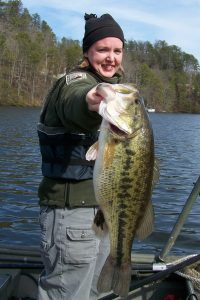
Photo From KDFW
It seems to Kentuckians that someone accidentally dropped the sun down a storm drain about three weeks ago and it hasn’t been found yet.
Day after day desolate gray skies discharged rain every few hours. Although it has been warmer than usual, this January has been a long slog.
February is the month tinges of hope arrive back in many anglers’ souls.
“Before any change of season, there are hints of the season to come,” said Mike Hardin, assistant director of Fisheries for the Kentucky Department of Fish and Wildlife Resources. “The change from late winter to spring is not abrupt. By the third week of February, you can hear spring peepers calling.”
This translates into a time when someone suffering from terminal cabin fever can catch a fish for the ages.
Warm February rains muddy the water and provide a temperature spike. “You get that good muddy water in mid- to late-February and you can pull some sows out of it,” Hardin said. “Females are gearing up for spawning. They need healthy fat reserves to get them through rigors of spawning. Instinct tells them they must eat.”
This situation is a fantastic time to catch a fat, pre-spawn female largemouth bass. Back in the day before graphite rods, bass boats or sonar units, gritty anglers would brave the weather during the first warm rains of February and employ the “jigging” technique to pull huge largemouth bass from shallow water.
They would use stout cane poles and a large hook tied to heavy black dacron line. These anglers would impale as many nightcrawlers as possible on the hook and using a skulling paddle for stealth, drop this combination beside any stump, log or other shoreline cover they could find.
Modern anglers can do the same thing with a ½-ounce black and blue jig and a flipping stick.
“That muddy water in late February is good flipping water,” Hardin said. “My uncle loved it when rains warmed the water to 51 degrees along the shoreline. He would flip a jig to the shoreline cover along those outside bends of Cave Run. That is when he caught his biggest largemouth bass. He had better weights in 51 degree water than in 70 degree water.”
Hardin said rains from the south in February also bring large muskellunge to the shoreline.
“That is when I first get my muskies,” said Hardin, who caught a 50-inch muskellunge from Cave Run Lake this past fall. “When you have a 42- to 48-degree main lake with warmer water coming in that is in the mid-50s, this is when you find fish along the shoreline.”
Some fish live suckers along the shoreline for big February muskellunge. Those anglers are strongly encouraged to employ a quick strike rig to prevent catch and release mortality. Large rattle baits, such as a muskellunge-sized Rat-L-Trap, also work well for shoreline muskellunge during this time of year.
“I also like a soft plastic bait called the Bulldawg in February,” Hardin said. “I like two-tone colors such as brown and orange. I also like the firetiger with a chartreuse tail version. I also throw jerkbaits like a Suick Thriller when they have their nose on the bank. They see that jerkbait work over their head and they hit it.”
A pronounced warm front in mid-to-late February draws big female smallmouth bass from their winter lairs into shallower water to feed heavily in lakes such as Lake Cumberland, Laurel River Lake, Dale Hollow Lake or the lower section of Green River Lake.
If warm rains accompanied the warm front, work white spinnerbaits with chrome Colorado blades right beside any submerged woody cover. This is an excellent presentation to catch huge smallmouths, especially if the water has some color to it.
If the warm front simply warms the top layer of water a degree or two without rain, big smallmouth will move up onto a flat to feed. The best flats lie adjacent to the channel on the main lake or major creek arm.
A medium-sized live shiner bottom fished in these areas is one of the best ways to catch the heaviest smallmouth bass of your life. Some anglers crawl the shiner slowly across the flat with just enough split shot weights to keep the shiner down. Others prefer still fishing shiners on the flat using a 1/4- to 3/8-ounce slip-sinker rig with a small black barrel swivel tied on the main line. An 18-inch leader of 8-pound test fluorocarbon line is tied on the other loop of the barrel swivel while the hook goes on the other end of the leader.
A size 1 Octopus-style hook works well for both presentations. You can also fish these rigs right in the middle of small cuts and tiny coves along the main lake or major creek arm for large February smallmouths.
“If you like catching big fish, February is a great month,” Hardin said. “A big fish warms you up better than a big coat.”
Remember to buy your fishing license soon. Feb. 28 is the last day of the current license year in Kentucky.
 It’s often said these are the good old days for deer hunting in Kentucky, but for those of a certain age, or new to hunting, it’s all they have ever known.
The world was tip-toeing into a new millennium the last time Kentucky’s deer harvest did not break 100,000 for a season. The 2016-17 season cleared that mark and surpassed 130,000 for the fifth consecutive season.
Hunters combined to take more than 139,000 deer before the book closed Jan. 16 on one of the three best seasons on record in Kentucky. The only seasons with higher harvest totals were the 2013-14 and 2015-16 seasons.
“We’ve been harvesting a lot of deer and that’s a reflection of how many deer we have on the landscape,” said Gabe Jenkins, big game program coordinator with the Kentucky Department of Fish and Wildlife Resources. “The good thing is our quality is still up. I’ve talked to a lot of folks who saw a lot of nice deer harvested this season.”
The 2015-16 season produced new records at nearly every turn, including the overall harvest record. Archery hunters kept the trend going this past September by starting the 2016-17 season with a record opening weekend.
A slowdown ensued as unseasonably warm temperatures set in. High winds, an ample acorn crop and a full moon added to the challenge for early muzzleloader season in mid-October and the two-day take was down sharply from the previous year.
Cooler temperatures arrived for modern gun season in November and coincided with the peak of breeding activity across the state.
Hunters responded by checking 41,796 deer the first weekend of modern gun season and 102,848 for the modern gun season overall. Both figures were the second highest on record behind the 2015-16 season.
“I think the warm weather possibly shifted some early season hunters to later,” Jenkins said. “I’ll have to look at that when I start digging into the numbers. I would venture to say that a lot of folks who normally take deer in September and October didn’t and waited until November.”
For the first time in 18 seasons, Owen County did not lead the state in the number of deer taken. Pendleton County finished ahead of it.
Harvest totals in the northern Kentucky county have been on the upswing for several seasons, and the recent results bring added attention to the fact. Hunters there reported taking more than 3,200 deer this past season. Owen, Crittenden, Graves and Christian counties completed the top-five.
Hunters took more than 5,500 deer on public lands across the state, according to telecheck harvest results. Two areas of interest entering this past season were Big Rivers WMA and State Forest in Crittenden and Union counties and the new Rolling Fork WMA in Nelson and LaRue counties.
Kentucky Fish and Wildlife debuted a first-of-its-kind quota hunt for archery and crossbow deer hunting this past season at Big Rivers, which expanded in 2016 with the addition of the 841-acre Jenkins-Rich tract in Crittenden County.
“It was a pretty big move for us,” Jenkins said. “When we looked at this one, it wasn’t people shooting five or six deer. It was one person coming and shooting one deer, and it was a lot of people doing that. So it was strictly a numbers game.”
The action achieved the intended result: the deer harvest on Big Rivers was reduced by 38 percent this season.
Rolling Fork WMA came online this past September and allows modern gun hunting for deer. Of the 27 deer taken with a modern gun on the area, 19 were bagged on the more rugged LaRue County side of the property. A total of 32 deer – 15 male, 17 female – were taken on the WMA across all seasons.
Hunters reporting their harvest to Kentucky Fish and Wildlife through the telecheck process this past season were asked for additional information if they were checking male deer with or without antlers. Their answers will help biologists.
“We will be able to get a better feel for age-at-harvest more than we ever have,” Jenkins said. “It will allow us to analyze how we’ve been estimating in the past through our collections in the field compared to what our hunters are reporting. It will be beneficial to make those comparisons.”
Hunters who took a trophy deer this past season are encouraged to submit the necessary information for recognition in the trophy deer list that will appear in the next Kentucky Hunting and Trapping Guide. The deadline for submissions is May 1.
To be eligible, a hunter must have taken a white-tailed deer in Kentucky this past season that net scored 160 or higher typical or net scored 185 or higher non-typical going by the Boone and Crockett scoring system. The completed and signed score sheet along with a photo should be sent to Kentucky Hunting and Trapping Guide, #1 Sportsman’s Lane, Frankfort, KY 40601. Include the county in which the deer was taken and the equipment used to harvest the deer. Emailed submissions to info.center@ky.gov also are accepted.
Neace Ventures, the parent company of Falls City Brewing Company, has signed a letter of intent (LOI) to acquire ownership in the building that houses the Heine Brothers’ Coffee headquarters. The move would bring 100 percent of Falls City’s brewing operations back to Louisville.
This joint venture would occur in the building located at 1301 W. Main St., where Heine Brothers’ moved its corporate headquarters in late 2016. The building is located directly across from the Falls of the Ohio, the namesake of the beer-brewing company.
“We are excited to announce that Falls City Brewing Company’s full-scale production is coming back to where the brand was born,” said Falls City President Shane Uttich. “With four different packaged offerings and a constantly revolving draft-only series, our brand is gaining significant traction, and the time is right. We’re proud to support the progression of the Portland neighborhood with our new neighbors, Heine Brothers’ Coffee. A Louisville-based coffee brand and a Louisville-based beer brand rubbing shoulders at 1301 W. Main will definitely create some wonderful smells.”
The joint venture is also indicative of future economic growth for Louisville.
“The brand Falls City is a symbol of early economic development for our community, one of our first local brewers,” said Mayor Greg Fischer. “Today we raise our glass in celebration of their history and bold renaissance of this iconic homegrown brand.”
Built in 1927, the two-story, 80,000 square foot structure would house both companies. Heine Brothers’ Coffee President Mike Mays is thrilled. “Falls City Beer is one of Louisville’s most iconic brands, and they share our love of this great city. We can’t wait for them to open their brewery in the 1301 W. Main Building in Portland. We look forward to working together to make good things happen in Louisville.”
The LOI is under contract to close in 45 to 60 days, said Neace Ventures President Brad Estes.
“In conjunction with Falls City Brewing Company, we are proud to announce our intentions to acquire ownership in the 1301 W. Main building,” Estes said. “We look forward to the opportunity to expand both our real estate and food and beverage portfolios in partnership with another great Louisville brand, Heine Brothers’ Coffee. Being able to do all of this in support of the development initiatives in Portland is just icing on the cake.”
Mayor Greg Fischer and Gov. Matt Bevin today announced Diversified Consultants Inc. (DCI), a collection services company servicing major-name telecom clients, will locate a new operation in Louisville with a $6.65 million investment expected to create 433 jobs.
“Louisville’s economy continues to thrive with the addition of a new business services company in south central Louisville. As we usher in a new year, we are proud to welcome DCI to our community,” Fischer said. “We are especially excited to welcome home DCI’s chief operating officer, Gordon Beck, a Louisville native and a graduate of Fern Creek High School.”
DCI will lease the bulk of a 60,000 square-foot building in the Commerce Crossings business park. The new DCI office will not only employ customer service agents but office-support staff, including HR, quality administration, compliance and other functions.
“DCI’s commitment to exceptional service makes it a great fit for Kentucky,” said Gov. Bevin. “Their high standard of customer care will make them a terrific partner for the commonwealth’s dedicated workforce. We welcome DCI to Kentucky and look forward to seeing both their client base and workforce grow in the years ahead.”
Beck said he plans to quickly fill all available positions. Buildout of the space could begin in late February, and Beck said he and aims to open the new office by April 1. His Kentucky roots and confidence in the local workforce played into the decision to open the new office.
“Ours is an industry that too often gets a negative reputation. DCI is changing that in how we treat our customers and through our own company culture. We got to the top of our industry by being nice. We focus on the customer experience and are legal, moral and ethical,” Beck said. “The reason we’re opening this office in Louisville is our company is looking to expand its customer base, and we know we can recruit the kind of employees who want to be a part of our company.”
Founded in 1992 in Jacksonville, Fla., DCI is a family owned telecom collection services company. Charlotte Zehnder has acted as the company’s CEO since 2010, and the company is a certified member of the Women’s Business Enterprise National Council as a woman-owned business. DCI has quadrupled in size since 2009, currently employing 930 people across three locations in Jacksonville, as well as operations in Portland, Ore., and in the Philippines. Of those, 835 employees are located in the U.S.
To encourage the investment and job growth in the community, the Kentucky Economic Development Finance Authority (KEDFA) in January preliminarily approved the company for tax incentives up to $1 million through the Kentucky Business Investment program. The performance-based incentive allows a company to keep a portion of its investment over the agreement term through corporate income tax credits and wage assessments by meeting job and investment targets.
For more information on DCI, visit www.DCIcollect.com
To read more about Louisville’s business services sector, visit https://louisvilleky.gov/government/louisville-forward/business-services
Mayor Greg Fischer, Louisville Asset Building Coalition and AARP announced the opening of free tax preparation sites yesterday, starting as of Monday, Jan. 23, that will provide federal and state income tax assistance to eligible residents.
“Every hard-working Louisvillian should be able to benefit from all tax credits that apply to them, and by offering this free assistance we can make sure that happens,” said Mayor Greg Fischer. “This is money they can use to start a savings account, buy a car, get braces for a child, pay for books and college tuition — or start a college tuition fund for their children. It’s huge for that family and huge for our community.”
Metro Councilwoman Cindi Fowler of District 14 is a longtime VITA volunteer and champion of the program.
“I have greatly enjoyed the nine years I have spent with VITA to help families prepare their tax returns,” Fowler said. “We work hard to ensure that we are maximizing their returns, allowing them to reinvest that money locally and boost our economy.”
Louisville Asset Building Coalition’s Volunteer Income Tax Assistance, or VITA, and AARP Tax Aide programs utilize trained, IRS-certified volunteers who offer free tax services at more than 20 free sites across the city. The free service is available to individuals and families who earned less than $64,000 in 2016.
Appointments are recommended for VITA free tax assistance service and can be made now by calling (502) 305-0005 or scheduling online at https://louisvillekyvita.cascheduler.com.
Starting Monday, the VITA free tax preparation sites are located at:
- Americana Community Center, 4801 Southside Dr.
- Bates Community Development Center, 1228 S. Jackson St.
- Louisville Urban League, 1535 W. Broadway St.
- Portland Promise Center, 1831 Baird St.
- Salt & Light Community Development Center, 3025 B Gerald Dr.
- Sun Valley Community Center, 6505 Bethany Lane
- Wesley House Community Services, 5114 Preston Highway
For a complete list of VITA locations, including mobile sites, as well as hours of operation, visit http://labcservices.org/ or call Metro United Way’s 211 help referral service.
Also visit the website at https://www.labcservices.org/index.php/free-tax-filing-at-labc-services for information about a free service for those interested in filing their own taxes online. Starting Monday, two software packages — MyFreeTaxes and Turbo Tax Freedom Edition — will be available for those who meet eligibility.
In addition to the VITA sites, AARP Tax Aide’s mission is to serve any person comes through the door, with special attention to those 60 and older. AARP sites will open Feb. 1 at the following locations:
- Buechel Park Baptist Church, 2403 Hikes Lane
- Central Government Center, 7201 Outer Loop
- Clifton Christian Church, 131 Vernon Ave.
- East Government Center, 200 Juneau Dr.
- Iroquois Branch Library, 601 W Woodlawn Ave.
- Jeffersontown Senior Center, 10631 Watterson Trail
- Lyndon Baptist Church, 8025 New LaGrange Rd.
- Portland Branch Library, 3305 Northwestern Parkway
- Shively Municipal Building, 3920 Dixie Highway
- Southwest Government Center, 7219 Dixie Highway
For a full AARP schedule and listing, including mobile sites, visit http://www.aarp-tax-aide-lou.org or call (502) 394-3443.
VITA and AARP volunteers will help determine if residents are eligible for the EITC (Earned Income Tax Credit), a refundable federal tax credit for low- and middle-income working individuals and families. Eligibility for the EITC is based on income, the number of family members and other criteria, as is the amount of your credit. Working families who earn about $53,000 or less may be eligible, with average credits last year more than $2,400.
Collectively, tax refunds filed by Louisville residents last year through the VITA campaign and AARP sites processed over 20,000 returns, adding over $19 million to the local economy, including more than $6 million in Earned Income Credits to residents.
To help preparers accurately determine EITC eligibility and prepare returns, individuals should bring:
- Picture ID and Social Security cards for everyone listed on the return
- Copy of 2015 tax return with all attachments and schedules
- W-2s and 1099s from your employers
- Other 1099s for interest, dividends, state tax refund or other income
- 1095 for health insurance
- 1098 for education credit, plus detailed financial statement from the school
- Bank account number and routing number for direct deposit
- Child care information, including Provider ID and actual amounts paid
- Summarized list of other income/expenses for those who itemize or are self-employed
- Additional tax information that may be required
Visit http://labcservices.org/ or http://www.aarp-tax-aide-lou.org for more information about the required documentation.
The work of the Louisville Asset Building Coalition and the AARP Tax Assistance Program is made possible by Metro United Way, Louisville Metro Government, the IRS, the AARP Tax-Aide Foundation and dozens of other partners.