Wednesday December 17, 2025
Local Connection
 Weather
 Traffic
 @LouisvilleDispatch
 @LouisvilleDisp
 Subscribe
Gov. Matt Bevin has signed into law seven historic bills sent to his desk by the Kentucky General Assembly, following a record-setting first week of work in Frankfort.
The legislation includes transformative measures protecting the lives of unborn children, positioning the Commonwealth for economic growth, strengthening the University of Louisville’s governing structure and establishing a new era of transparency for public servants.
“This is truly a new day in Kentucky, as our General Assembly has worked in an unprecedented manner to advance the people’s business,” said Gov. Bevin. “It is an honor for me to sign into law these historic pieces of legislation that protect our most vulnerable, guarantee important freedoms for workers and set our Commonwealth on a course for unparalleled opportunity and prosperity.”
Pro-life legislation includes Senate Bill 5 (protecting children after 20 weeks of gestation) and House Bill 2 (requiring an ultrasound before a pregnancy is terminated).
Pro-business measures include House Bill 1 (providing right-to-work guarantees to all Kentucky workers), Senate Bill 6 (paycheck protection for employees of labor organizations) and House Bill 3 (repealing prevailing wage requirements for public works projects).
Senate Bill 12 authorizes a fresh start for the University of Louisville board of trustees, and Senate Bill 3 opens state legislator pensions to public scrutiny for the first time.
All of these laws contain emergency clauses and thus, take effect immediately.
Important Notice: Please be advised that House Bill 2, the Ultrasound Informed Consent Act, as passed by the Kentucky General Assembly, was signed by Governor Matt Bevin and became effective on Monday, January 9, 2017. This bill requires a signed form before a patient can have an abortion.
The link to the form is here: http://chfs.ky.gov/NR/rdonlyres/246DB74A-7FAA-4C73-A971-BC2EA7C8FA4A/0/HB2form.pdf.
For more information on House Bill 2 use this link: http://www.lrc.ky.gov/record/17RS/HB2.htm
Gov. Matt Bevin’s Communications Office announced the launch of a new interactive website—www.BevinAnnualReport.com—highlighting the accomplishments of the Bevin Administration’s first year in office.
“We are excited to unveil this innovative look back at a hugely transformative year in the Commonwealth,” said Communications Director Amanda Stamper. “We invite you to take a moment to browse the site and read about the great accomplishments that have helped make Kentucky shine during Gov. Bevin’s first year in office.”
The site, titled “A Fresh Start,” recaps the Bevin Administration’s numerous achievements of 2016, grouped into six primary priorities:
- Strengthening Kentucky’s Financial Foundation,
- Growing Our Economy,
- Creating a Healthier Kentucky,
- Protecting Our Communities,
- Investing in Education and Workforce Development, and
- Serving Those Who Serve Us
The report includes statistics and details about key programs and projects, a comprehensive photo gallery, and a seven-minute year in review highlight video.
 The end of the year is a time for reflecting on the past 12 months and envisioning the possibilities for the new year.
Officials with the Kentucky Department of Fish and Wildlife Resources recently previewed what’s ahead in 2017.
From firming up long-range plans for the restoration of ruffed grouse in Kentucky and management of the state’s black bear population to expanding the popular Fishing in Neighborhoods (FINs) program and releasing thousands of rare mussels into the wild, a common theme stretches across the Fisheries and Wildlife divisions. Conserving fish and wildlife habitats and populations and expanding opportunities for hunters, anglers and others are top priorities.
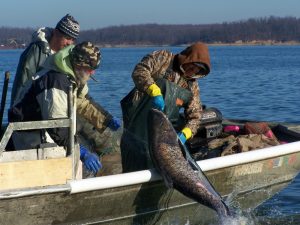
In Fisheries, Asian carp will continue to be a major focus. Commercial harvest is an effective tool for large-scale removal of the invasive fish and Fisheries director Ron Brooks said a multi-year effort to help the Asian carp processing industry expand in Kentucky is expected to bear fruit in 2017.
“We’ve been working on this for about two years and it’s finally coming around,” he said.
The department has been working with fish processors, commercial fishermen, legislators, government agencies and businesses to find ways to make a greater dent in the Asian carp population.
The proposed system would train new commercial fishermen how to harvest Asian carp and assist commercial fishermen already harvesting Asian carp while reducing costs and delays for processors, Brooks said.
“We’re reaching out to help the Asian carp-harvesting industry meet its needs and hopefully lead into expansion of their businesses, all to get rid of Asian carp,” he said. “We’re focusing a lot of our efforts on Kentucky and Barkley lakes because we believe we can have an immediate impact there. We’re trying to ensure our sportfish species aren’t taken out.”
Elsewhere in Fisheries, a long-term project to increase forage and improve fishing opportunity at Cave Run Lake will wrap up in 2017. The project focused on the Ramey’s Creek and Warix coves in 2016. Department personnel added around 1,000 trees, 500 pallet structures, 150 bucket stake attractors, 10 wooden cable spools and 50 plastic pipe trees. A map showing the locations of these fish attractors is available online at fw.ky.gov. Type “Cave Run Lake Fish Habitat Improvement Project” into the search box on the homepage.
The popular Fishing in Neighborhoods (FINs) program is adding five new lakes to its lineup: Flemingsburg Old Reservoir in Fleming County, Kess Creek Park Lake in Graves County, Leary Lake in Grant County, Logan Hubble Park Lake in Lincoln County and Rotary Park Lake in Hickman County. The addition of these lakes brings the number of FINs lakes to 43 across the state.
Anglers can start planning now where they want to fish and for what species in with the new Fishing Forecast for Kentucky’s major fisheries. The 2017 edition is available on the department’s website by clicking on the “Fish” tab and choosing “Forecast” from the dropdown menu. The annual compilation highlights new, expanding and improving fisheries across the state.
Deer hunters in Kentucky have enjoyed another successful season in 2016.
“We’re going to end up in the top 5 in terms of our overall harvest total,” said Steve Beam, Wildlife Division director for Kentucky Fish and Wildlife. “We’re producing tremendous numbers of trophy quality bucks. At the same time, our herd is healthy. Things continue to be wonderful.”
At its December meeting, the Kentucky Fish and Wildlife Commission voted to expand opportunities for youth and muzzleloader deer hunters on several wildlife management areas in 2017. The 2017-18 Kentucky Hunting and Trapping Guide, due out in July, will note these and any other pertinent changes.
John Hast was a biologist in the department’s deer and elk program before taking over as coordinator of its bear program in January 2015. He anticipates having a draft of a long-range management plan for Kentucky’s black bear population ready in 2017.
“We’ve been doing in-house research since bears returned to the state,” Hast said. “We just completed the project that’s going to provide our foundation for management for the next 15 years.
“A management plan, to me, gives me an opportunity to summarize all of that data and put it in one spot and distill it out and translate it. The plan will set forth what we’ve got but also what we’re going to be doing in the near future to refine things.”
Also in 2017, expect to hear more from the department about wild pigs in Kentucky, Beam said.
“We have re-evaluated and are in the process of increasing our efforts on wild pig eradication, working with landowners and cooperating with our partners,” he said.
In the department’s Wildlife Diversity program, led by coordinator Sunni Carr, biologists plan to conduct a statewide survey of osprey nesting locations and also start a loggerhead shrike banding project in the hopes of learning more about the migration and causes of decline for the species.
Additionally, the statewide survey for eastern whip-poor-wills and chuck-will’s-widows will be expanded to examine trends for Kentucky’s night birds. The department’s Center for Mollusk Conservation (CMC) plans to release endangered pink muckets in Kentucky for the 10th year. There are now several thousand of these mussels at more than 23 locations.
The department’s website provides a wealth of information about the work being done by each of these divisions. While there, consider purchasing a 2017-18 hunting and fishing license. The new license year starts March 1.
Tolling on the Louisville – Southern Indiana Ohio River Bridges Project is scheduled to begin tomorrow. Tolling is scheduled to begin at 4 a.m. Friday, December 30 on the new SR 265 Lewis and Clark Bridge, the new I-65 Abraham Lincoln Bridge and the improved I-65 Kennedy Bridge.
The Kennedy and Lincoln bridges provide 12 lanes of I-65 traffic connecting Downtown Louisville and Southern Indiana. The Lincoln Bridge carries six lanes of I-65 North traffic, and the Kennedy carries six lanes of I-65 South traffic. The Lewis and Clark Bridge, which opened to traffic Dec. 18, connects the Gene Snyder Freeway in Prospect, Ky. with State Road 265 in Utica, Ind.
RiverLink is all-electronic tolling, with no toll booths, no coin machines, no lines and no stopping.
Information for Drivers
It’s important for drivers to remember that tolling will not change their commute. They should not slow or stop while approaching the tolled bridges. All-electronic tolling means all drivers are able to move at the speed of traffic, with no slowing and no delays.
Drivers with transponders will pay the lowest rates. Sensors read transponders, and the appropriate toll is deducted from prepaid accounts. Cameras will capture the license plates of drivers without transponders, and bills will be sent in the mail.
Toll rates range from $2-12, depending on the size of the vehicle and whether the driver has a RiverLink account and transponder. A driver in a passenger vehicle with a transponder will pay $2 to cross a tolled bridge. A driver in a passenger vehicle without a transponder will pay $4.
Drivers have the option of selecting a RiverLink local transponder or a RiverLink E-ZPass transponder. A RiverLink local transponder is free, one per registered vehicle. The small sticker adheres to the inside of the windshield, is non-transferable and works only on the Lewis and Clark, Lincoln and Kennedy bridges.
A RiverLink E-ZPass transponder is $15. It’s portable from vehicle to vehicle registered to a single account and works in all 16 E-ZPass states. All E-ZPass transponders are accepted by the RiverLink system.
Drivers can register additional license plates to their RiverLink E-ZPass transponders online at www.riverlink.com, by phone or in person at a customer service center.
Mounting Transponders
Drivers need to have their transponders properly mounted before the start of tolling. Transponders are placed on the inside of the windshield near the rearview mirror, as high and as central as possible. It may be placed on the driver side or passenger side.
Transponders should be mounted three inches away from any metal, tint, antenna or defroster.
Drivers should avoid extreme temperatures when mounting their transponders. During cold weather, drivers can warm their car for a few minutes before mounting their transponder.
Drivers Waiting for Transponders
Thousands of drivers have opened RiverLink accounts over the past several days. Not all drivers have received their transponders. If accounts have been processed and transponders have been assigned to licenses plates, drivers will receive the lowest rates until they receive their transponders.
License plates will be scanned and the transponder rate applied until transponders are delivered. Drivers must receive and properly mount their transponders before crossings count toward the frequent-user discount.
Drivers Who Need to Open Accounts
It’s not too late for drivers to open their RiverLink accounts. They will begin paying the lowest rates as soon as an account is processed, and a transponder is assigned to the license plate. The sooner accounts are opened, the faster savings will begin.
Drivers can open accounts online at www.RiverLink.com, by phone at 855-RIV-LINK or in person at one of two customer service centers. The website is the fastest option to open an account. It’s open 24 hours a day/7 days a week with no wait. Customers opening accounts online or by phone will have their transponders mailed to them.
More than 150,000 RiverLink transponders have been requested to date, including more than 125,000 RiverLink local transponders and nearly 28,000 RiverLink E-ZPass transponders. Nearly 67,000 families and more than 2,200 businesses have opened RiverLink accounts.
Just over 110,000 drivers are expected to use the tolled bridges each day.
Customer service centers are located at 400 E. Main St. in Louisville and 103 Quartermaster Ct. in Jeffersonville. The centers are open 7 a.m. – 7 p.m. Monday – Friday. They are also open 8 a.m. – 2 p.m. Saturday.
With tolling starting on December 30, customer service centers and the RiverLink call center will be open, as normal, on Saturday, December 31 (8 a.m. – 2 p.m.) and Monday, January 2 (7 a.m. – 7 p.m.).
The city has awarded loans totaling nearly $168,000 to nine small businesses to help them renovate or expand. The loans have been awarded by Louisville Forward Economic Development’s Metropolitan Business Development Corporation (METCO) and the Department of Community Services’ Microbusiness Development Program.
METCO loans have been awarded to the following businesses:
- Two loans were approved for Pointe Havens, LLC for its property located at 1600 Story Avenue. The loans will allow the owner to improve the façade of the building and make interior improvements to prepare the space for future commercial usage.
- $53,824 façade loan
- $40,000 KEOZ loan
- $34,286 energy efficiency loan was approved for Jackie Green and Cindy Baker for their property located at 2833 South 4th Street. The loan will allow the owners to place solar panels on the roof of the building. The addition of solar panels will help reduce energy consumption and lower the energy cost.
Microbusiness loans have been awarded to the following businesses:
- $15,000 loan to Trimen Solutions, LLC dba Trimen Career Placement Services located at 332 West Broadway, Suite 605. The loan will allow the owner, TraShaun Spencer, to expand services and assist with insurance, computer software and marketing.
- $5,000 loan to Mimi The Tax Lady, a start-up business offering full tax services, located at 1153 ½ South Second Street. The loan will allow the owner, Tamika Reed, to operate her business with purchase of equipment and computer software.
- $5,000 loan to Flex Bill, LLC, a start-up medical billing business privately owned by Roselena McGruder. The loan will help with the purchase of computer software, insurance and inventory for business operations.
- $5,000 loan to Pure Polish, a start-up residential and commercial green cleaning service. The loan will allow the owner, Andrea Moran, to purchase equipment and inventory.
- $5,000 loan to Oasis T. Shirts, a start-up t-shirt and graphic design business. The loan will help the owner, Orlando Sisney, purchase supplies, inventory and equipment.
- $3,000 loan to An Angels Touch, a start-up business in janitorial services. The loan will allow the owner, Bryanna Thomas, to purchase equipment and supplies.
- $1,500 loan to The Glory Shoppe, which started in 2016 as an Etsy on-line shop for purchasing handcrafted home décor. This loan will allow the owner, JoAnn Jackson, to purchase supplies.
The Metropolitan Business Development Corporation (METCO) governs metro government’s small business loans, which include facade, accessibility and gap financing loans. Because metro government is not the primary lender, the loan program allows many public-private partnerships between government and private business ventures that further the vitality and quality of life in the Louisville community.
The METCO board meets the fourth Thursday of each month. Meetings are held at 9:00 a.m. at the offices of Louisville Forward, located at 444 S. 5th Street, Suite 600. Meetings for 2017 are scheduled for January 26, February 23, March 23, April 27, May 25, June 29, July 27, August 24, September 28, October 26 and December 14.
To learn more about the METCO loan program, visit https://louisvilleky.gov/government/louisville-forward/local-loan-programs
Louisville Metro’s Microbusiness Development Program helps low and moderate income business owners with starting and growing small businesses. A microbusiness employs five or fewer people, including the owner. The program includes training, technical assistance and an opportunity to apply for a loan.
Many microbusinesses have little or no access to the commercial banking sector, and this loan program helps businesses owners who need capital. Loans range from $500 to $15,000. Borrowers have a choice of two programs, one for businesses which have been open for at least one year, and the one for start-up businesses.
For more information about Community Services’ microbusiness program, visit https://louisvilleky.gov/government/community-services/microbusiness-program.
Free training to quickly prepare Louisville residents for good jobs in construction, manufacturing and other fields is available in west Louisville, and new classes are starting soon, Mayor Greg Fischer announced today.
Applications are being accepted now for training courses that range from two to seven weeks and will help participants connect to the many jobs created by the city’s building boom, or in manufacturing at companies such as GE, Ford, Algood Foods, Dakkota Integrated Systems and other companies.
Also, the REimage re-entry program is enrolling young people involved in the court system to help them stay in school, get a job or in dealing with family and social issues – with the goal of breaking the cycle of violence.
Job training and re-entry programs are Louisville Metro Government priorities and were high on the recently released 10-point plan of suggestions to reduce violence from the Brothers Reaching Brothers and Community Connections citizens’ group.
“Giving an individual the basic skills, support and connections to opportunities that are out there right now can turn that person’s life around, change their family’s outlook, and change their neighborhood,” said Mayor Fischer. “Most people just need that one break, that one opportunity. Incrementally, that helps reduce the hopelessness and violence, one person at a time.”
Classes for Kentuckiana Builds, which prepares people for construction-related jobs, are based at the Nia Center, 2900 W. Broadway. The manufacturing training is being held at Nia and at the Kentucky Manufacturing Career Center, 160 Rochester Dr., in south Louisville.
More on the programs:
- Kentuckiana Builds is a seven-week program with participants receiving training that prepares them for building trades such as plumbing, pipefitting and carpentry. Students meet four hours each day, five days a week. Those completing the training receive job placement assistance and other supportive services, such as financial empowerment and housing assistance. The next trainings are Jan. 23 for a class meeting in the evenings, and a daytime class starting on Feb. 6. Persons interested should attend an orientation session, held twice weekly at the Louisville Urban League, 1535 W. Broadway. For more information, call 566-3371 or go to kentuckianabuilds.org.
Kentuckiana Builds is a partnership between the Louisville Urban League, KentuckianaWorks, The Kentucky Education and Workforce Development Cabinet, the Jesus and a Job program and New Legacy Re-Entry Corporation.
The program is designed to get more people, especially women and minorities, quickly prepared to work on major projects under way or planned, including the expansion of the Kentucky International Convention Center, the Omni Hotel and many other hotel projects and new bourbon distilleries and tourism facilities.
- Manufacturing training is available through a shorter, two-week program, the Manufacturing Training and Employment Connection (M-TEC) and a more intensive 30-day program, the Certified Production Technician (CPT) course. In 2016, the two programs have graduated more than 150 individuals, with more than 105 securing jobs with an average hourly pay of about $14.25. The next classes begin Jan. 3 with additional offerings in February, March and May. For more information or to enroll in either training program, call 276-9711, extension 4001.
- REimage is a city-funded initiative that helps stop the cycle of crime and violence by intervening with youth, ages 14-24, who have been charged with a crime or are at high risk of criminal behavior. Case managers and adult volunteer mentors work with the young people in the program.
Recruitment for REimage, which is run by KentuckianaWorks, focuses on the Russell, Shawnee and Park Hill neighborhoods of west Louisville, although eligible youth from any neighborhood can participate. Young people wanting to enroll in the program or adults who would like to volunteer as mentors can call 574-4115 or apply online at kentuckianaworks.org.
“These training programs are designed to quickly get people prepared and employed in business sectors where there is high demand and a clear path to job and wage growth,” said Michael Gritton, executive director of KentuckianaWorks, the region’s workforce development agency. “The bottom line is helping people succeed, and helping our community and region succeed.”
“Identifying and helping minorities secure jobs that will improve their family’s standard of living is a strong focus for the Louisville Urban League,” said Sadiqa Reynolds, president and CEO of LUL. “This often requires developing training programs and initiatives that can prepare minority groups to seize opportunities.”
Kentuckiana Builds orientations and classes:
- Orientation: Thurs., Dec. 29,, 5:30 p.m. at Louisville Urban League, 1535 W. Broadway
- Orientation: Thurs., Jan. 5, 10 a.m. at Louisville Urban League
- Jan. 23 – evening class begins at Nia Center, 2900 W. Broadway
- Feb. 6 – daytime class begins at Nia Center
M-TEC manufacturing classes in 2017:
- 3 – 13 at the NIA Center, 2900 W. Broadway
- 13 – 24 at the Kentucky Manufacturing Career Center, 160 Rochester Drive,
- March 6 – 17 at the Kentucky Manufacturing Career Center
CPT manufacturing classes in 2017:
- 9 – Feb. 3 at the Kentucky Manufacturing Career Center
- March 6 – 31 at the NIA Center
- May 1 – 26 at the Kentucky Manufacturing Career Center
Louisville Sterling, LLC has purchased two city-owned historic properties at 1300-1306 Bardstown Road in the Highlands’ commercial district, with plans to open a small brewing operation and event space.
Louisville Sterling purchased the properties for $425,000 and plans to fully restore both buildings, which were built in 1900, returning approximately 15,000 square feet of commercial space into newly designed and productive use. Plans for the buildings include Sterling’s offices, a tasting room and gathering house, event space and small brewing operation.
“Whenever we can return vacant and historic properties to productive reuse and beautiful restoration, the community wins on many levels,” said Mayor Greg Fischer. “These buildings will once again house an active use and bring people together on an already active commercial corridor.”
The buildings most recently were used as offices for the Communications division of Louisville Metro’s Emergency Management Administration. Metro Council declared the properties surplus in November 2015.
Louisville Sterling acquired the Sterling Brand in 2012, after the brand had changed hands many times and moved from Louisville to Evansville and ultimately was part of the Pittsburg Brewing Company.
Sterling Brewing started in Louisville in 1863 as one of several small breweries and grew to become a regional brand referred to by many as the “Beer of the South.” Now brewed in Stevens Point, Wisc., by the award-winning Stevens Point Brewery, Louisville Sterling’s goal is to restore the historical structures on Bardstown Road mainly for the purpose of establishing a craft house and tasting room. The company plans later to relocate production to its original home of Louisville.
The City of Louisville purchased 1300 Bardstown Road from the Louisville Ballet in 1995 for $235,000. The building was originally built as a telephone exchange for BellSouth, while 1306 Bardstown Road was built as a police station by the city, and has remained under city ownership until this transaction. The MetroSafe communications offices previously housed at this location were moved to MetroSafe’s Newburg Road facility in late 2012.
