Wednesday December 17, 2025
Local Connection
 Weather
 Traffic
 @LouisvilleDispatch
 @LouisvilleDisp
 Subscribe
As of January 1, 2017, the Louisville Metro Air Pollution Control District (APCD) will no longer maintain an ambient air monitor in Louisville/Jefferson County to measure the level of airborne lead.
An analysis of data collected from the APCD lead monitoring site on Cannons Lane in Louisville indicates that levels of airborne lead are far below the National Ambient Air Quality Standard (NAAQS) for the pollutant. The current national standard for airborne lead is 0.15 micrograms per cubic foot of air (μg/m3) on a rolling three-month average.

To exceed the lead standard, a three-month rolling average must be greater than 0.15 μg/m3. At the Cannons Lane site, the maximum three-month rolling average was 0.008 μg/m3 during the period depicted. While airborne lead was once a major air pollutant of concern, it is no longer used in motor vehicle fuels in the U.S., prompting levels of airborne lead to drop precipitously over the past several decades. It is not anticipated that levels of airborne lead will ever approach or exceed the federal standard here in Louisville/Jefferson County, hence the decision to cease monitoring for it.
Additionally, in February 2016, the U.S. Environmental Protection Agency (EPA) discontinued a requirement to measure for large particles of airborne lead (Pb-PM10) at monitoring sites in its National Core Multipollutant Network due to extremely low concentrations being measured at these sites, which include the Cannons Lane monitor.
The public is welcome to comment about this action.
Comments may be submitted to:
Billy Dewitt, Air Monitoring Program Manager
Louisville Metro Air Pollution Control District
701 W. Ormsby Ave., Suite 303
Louisville, Ky. 40203
The public may also submit comments via email at air@louisvilleky.gov
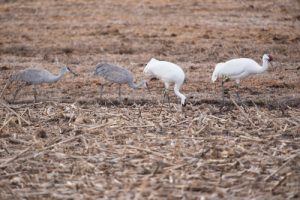 With sandhill crane hunting season opening the third weekend in December, the Kentucky Department of Fish and Wildlife Resources is issuing its annual advisory to hunters to watch out for federally protected whooping cranes.
The whooping crane is an endangered bird that may not be hunted. The Eastern Population of whooping cranes migrates between Wisconsin and Florida, with their main migration corridor taking them through west-central Kentucky. There are 107 whooping cranes known in this population.
Wildlife biologists have confirmed the presence of six whooping cranes in Hopkins County. In previous years, whooping cranes have also been sighted in several other locations, including Barren County.
Kentucky’s sandhill crane hunting season begins Dec. 17 and continues through Jan. 15. The season will end sooner if the quota of 400 birds is taken prior to Jan. 15. Hunters who have applied for this quota hunt and been drawn to participate must successfully complete an online sandhill crane identification course before they can receive a permit.
Whooping cranes are solid white with black wingtips. They have a red crown. Adults may have a wingspan of 7½ feet and stand up to 5 feet tall on stilted legs. Juvenile birds are similar to the adults, but will have patches of brown or tan mixed in with the white.
Whooping cranes are similar in silhouette to sandhill cranes. However, sandhill cranes have gray bodies and are smaller than whooping cranes. Whooping cranes may associate with sandhill cranes so caution must be used while hunting sandhill cranes.
Hunters should always be sure of their target before firing a gun, regardless of the species being hunted.
Mayor Greg Fischer announced yesterday that Louisville is receiving a $29.5 million implementation grant through the U.S. Department of Housing and Urban Development’s (HUD) Choice Neighborhoods Initiative program.
The federal funding is expected to leverage more than $200 million in private, foundation, nonprofit and public dollars to fully implement Vision Russell, a comprehensive transformation plan for the neighborhood, starting with a phased deconstruction and redevelopment of the Beecher Terrace public housing site. Vision Russell was developed over the past two years by Louisville Metro Government, the Louisville Metro Housing Authority (LMHA) and community residents, agencies and leaders.
“We are ecstatic. This is a huge day not just for Russell, not just for west Louisville, but for our entire city,” Mayor Fischer said. “Being selected by HUD for a Choice implementation grant validates all the hard work and commitment that community leaders, residents, this administration and many other stakeholders have invested over the past two years in efforts to transform and revitalize one of our most historic neighborhoods.
“Our city is experiencing a renaissance, with $9 billion in capital investment, almost 60,000 new jobs and 2,600 new businesses in the past six years,” the Mayor added. “The Choice grant and the rippling investment it brings will further ensure west Louisville’s part in that renaissance.”
The Mayor announced the grant during a celebratory press conference this afternoon at Baxter Community Center, surrounded by HUD officials, government and civic leaders, and community leaders and individual residents who helped create Vision Russell.
Noting that Louisville Central Community Centers will be a development partner in Vision Russell, the Mayor added, “Our collective goal is to use this opportunity to replace the so-called ‘Ninth Street Divide’ with a beautiful new bridge of opportunity and hope.”
Vision Russell efforts will focus on several key components in transforming the neighborhood, including:
- Tearing down and redeveloping Beecher Terrace into a sustainable, multi-generational, mixed-income, mixed-use development;
- Developing one-for-one, off-site replacement housing for Beecher Terrace residents in their neighborhoods of choice;
- Increasing safety and security;
- Re-creating strong retail and service centers within the neighborhood;
- Improving educational and health outcomes for Beecher Terrace and Russell households; and
- Improving community connectivity.
“This is a much larger-scale version of projects that have successfully brought new vitality to other neighborhoods in Louisville, like Liberty Green, Sheppard Square and Park Duvalle,” said LMHA executive director Tim Barry, “and it will directly benefit the people who live in Beecher Terrace and the surrounding community.”
Construction in Russell will start in mid- to late 2017 and continue for seven years. At least 25 percent of the work will be performed by minority-owned businesses, 10 percent by female-owned businesses, and a half percent by businesses owned by disabled people.
The strategies and goals included in Louisville’s Choice implementation grant application, sent to HUD this summer, were identified by a committee comprised of Russell residents, community and business leaders, and city and LMHA officials. This two-year planning process was funded through a $425,000 planning grant that HUD awarded to the Housing Authority in January 2015 and a $600,000 leveraged contribution from Louisville Metro Government.
In June, HUD awarded LMHA an additional $1 million action activities grant to kick-start efforts to enhance and accelerate other redevelopment within the Russell neighborhood. Louisville Metro Government leveraged an additional $375,000 for that effort.
And in August, the agencies were notified that Louisville was one of five cities selected as a finalist for implementation funding. Today, HUD announced that Louisville and all four of the other cities – Camden, N.J., Boston, Denver and St. Louis – will receive implementation grants, for a total of $132 million.
“The Choice program has proven an effective tool in transforming neighborhoods that were once littered with abandoned and crumbling properties into vibrant communities that offer quality housing options and are rich with retail services and other amenities,” said HUD
Secretary Julián Castro. “The work and investment that is being made through this program in cities like Louisville will benefit millions of residents for generations to come.”
Congressman John Yarmuth (KY-3) said he believes Louisville’s track record of redeveloping public housing sites into mixed income multi-family housing provided the community with a competitive advantage against other communities that applied.
“From the Park DuValle redevelopment to Sheppard Square, LMHA and Metro Louisville are considered national leaders in transforming blighted and distressed areas into vibrant neighborhoods that attract additional investment and interest,” said Yarmuth. “The selection process for the Choice implementation grant is extremely competitive. The fact that Louisville was selected speaks well to the work, engagement and support needed to make this award possible.”
Manfred Reid, Sr., chairman of the board of commissioners for LMHA and a lifelong Russell resident, said the grant is an enormous affirmation for the community.
“The strategies identified in our Russell transformation plan are a result of 90 community meetings, forums and other feedback we have received from over 600 residents and other stakeholders on the type of neighborhood they want Russell to be,” said Reid. “This grant says it can be done. And we believe we can again make Russell one of Louisville’s finest neighborhoods. I could not be more proud of my city today.”
Reaction from Louisville Metro Council members:
“The announcement today of the Choice Neighborhood Grant is a game changer for our community and an achievement that should be celebrated by the entire City of Louisville. This accomplishment is a direct result of the proven leadership of the Louisville Metro Housing Authority, the collaborative work of a number of community-based nonprofit organizations and more importantly, the citizens of the Russell neighborhood, and it will prove to be a major catalyst on moving economic development forward in West Louisville.” Councilman David Tandy (D-4).
“I’m delighted that Louisville has been selected for the HUD Choice implementation grant. After having undergone an intensive local planning process, which involved a great deal of community outreach and input into the vision for the neighborhood, it is exciting to know that the Russell community will receive the funds necessary to implement the transformation plan, to redevelop the historic Russell neighborhood and continue the momentum that is currently underway.” Councilwoman Cheri Bryant Hamilton (D-5).
“I’m excited about the City of Louisville being awarded this HUD grant for the Russell neighborhood. This will give the city the opportunity to invest millions of dollars in an area of our city that desperately needs revitalization. I congratulate Tim Barry and the citizens of Russell on a job well done.” Councilman David James (D-6).
Mayor Greg Fischer, joined by representatives of the University of Louisville and local and international compassion organizations, today announced a new Compassionate Cities Index.
The Index, a project from U of L’s Institute for Sustainable Health & Optimal Aging, in partnership with Louisville Metro Government, the University of Louisville School of Medicine, the International Center for Compassionate Cities, Compassionate Louisville and the International Charter for Compassion, is a comprehensive study designed to measure compassion at the city level within the context of individual communities.
Fischer and the Louisville Metro Council formally committed to the international Charter for Compassion in 2011, and today, for the fifth year in a row, was named a Model City for Compassion by the Charter of Compassion.
Louisville was honored for its focus on compassion and for programs such as the Mayor’s Give A Day Week of Service, and the success of Compassionate Louisville, a grassroots network of organizations that have adopted the Compassion Resolution.
“Compassion is one of our three city pillars, reflecting our commitment to ensuring that all in our city have the opportunity and resources necessary to reach their full human potential,” Mayor Fischer said. “We are honored to be named a model for that work, and we’re excited about this new tool for measuring that work.”
The Compassionate Cities Index carries this work further by defining and measuring the components that make cities compassionate. University of Louisville Drs. Joe D’Ambrosio and Anna Faul, both with the Institute of Sustainable Health & Optimal Aging, plan a comprehensive study that looks beyond dollars donated and hours volunteered, to measure how people feel and act with compassion within the context of their specific community.
“This study is unique because we are capturing both subjective and objective measures that indicate compassion,” said Faul who is executive director of the institute. Data will be gathered from the 37 standard ZIP codes in Jefferson County, with the goal of 67 survey responses per ZIP code.
D’Ambrosio, director of health innovation and sustainability for the institute, explained the goals of the research: “This will allow us to understand how people practice compassion within the context of their neighborhood and examine how the city as a whole is promoting a culture of compassion.”
“The Compassionate Cities Index answers the call from cities around the world for an adaptable tool that measures their definition of compassion. It is an honor for Louisville to be the first location to implement the Index,” said Corinne Witzel of the International Center for Compassionate Cities.
“There is a strong correlation between individual health and the quality of life for a community’s citizens as they grow older. Compassion is a key component of both quality of health and quality of life. This index will provide valuable guideposts for improving wellbeing for all of us at every stage of our lives,” said Toni Ganzel, M.D., M.B.A., dean of the UofL School of Medicine.
Participants in the study must be over the age of 18 residing in Jefferson County. Participants can complete the survey online at http://www.optimalaginginstitute.org/meaure-compassion or contact the institute at (502) 852-5228 to receive a paper survey to complete.
Study volunteers also are needed to participate in a 30-minute semi-structured interview. If you are interested in being interviewed, please contact Lauren Humpert, study coordinator, at (502)852-5228 or lauren.humpert@louisville.edu.
Metro Councilmembers Bill Hollander (D-9) and Cheri Bryant-Hamilton (D-5) announced today that they have introduced an ordinance relating to Louisville Metro trees.
Adoption of such an ordinance was the very first of 41 recommendations in the 2015 Louisville Urban Tree Canopy Assessment. It was also recommended by the Louisville Metro Tree Advisory Commission, after a lengthy review of ordinances in dozens of other cities, including several in Kentucky.
“We have seen a significant loss in tree canopy in Louisville Metro and this ordinance will help focus attention on the issue, protect the trees we have and reduce the possibility of more losses,” Councilman Hollander said. “It recognizes that trees are important to quality of life and to our health”.
“Our community needs more trees, desperately. Studies have shown that it makes a difference and it will reduce the temperature in the City,” said Councilwoman Hamilton. “We need to do a better job of getting people to connect the dots between our environment and our health and this ordinance will help.”
The proposed ordinance covers “public trees”, which includes trees located on Metro Government owned or controlled land or in public right-of-way areas, except for parks and parkways under the jurisdiction of Louisville Metro Parks.
It consolidates Louisville’s tree efforts into the Metro Division of Community Forestry, to provide oversight and comprehensive coordination for tree and forestation issues. Among other things, the Division will create a management plan to outline goals and concerns regarding trees, tree canopy and forestation.
A new Louisville Metro Tree Advisory Committee — appointed by the Mayor and approved by Metro Council — would assist in those efforts.
The ordinance also establishes policies and standards for public trees, clarifying and replacing the provisions of several existing ordinances. For example, the ordinance includes a common sense provision that new trees that grow to a height of more than 25 feet not be planted within 15 feet of an overheard utility line. Currently required tree removal permits would be conditioned on replacement of the public tree, unless a waiver is granted.
“A healthy tree canopy contributes mightily to a healthy community, improving air and water quality, reducing the urban heat island effect, and providing a more pleasant place to live, work, learn, and play,” Cindi Sullivan, Executive Director of the non-profit TreesLouisville, said. “To improve our community tree canopy, we must protect our existing trees and plant new trees.”
The ordinance would also create a Community Forestry Escrow Fund, which would establish and maintain a landowner assistance program, intended to help defray the cost of mandated tree removal or remedial action on behalf of indigent property owners. The fund would receive all monetary penalties related to trees and could also accept donations from the public.
Property owners could voluntarily protect historic and specimen trees on private property. The only other provision which affects trees on private property deals with trees that are a public nuisance or a threat of the spread of disease or infestation to other trees.
Hollander noted that the ordinance is just part of the effort to increase Louisville Metro’s tree canopy. Metro Council has recently made changes in the Land Development Code which protect trees in proposed Conservation Subdivisions. Other changes in the Land Development Code are under consideration, including as part of the adoption of a new Comprehensive Plan.
The ordinance will be assigned to a Metro Council committee and be considered early next year.
Hunters who illegally transport deer or elk carcasses into Kentucky from states infected with chronic wasting disease (CWD) risk prosecution.
Hunters must not bring whole deer or elk carcasses from infected states to taxidermists or processing operations in Kentucky.
CWD is a contagious and fatal neurological disease that affects deer, elk and other cervids native to North America. Currently, there is no evidence that CWD can be transmitted to humans.
Chronic wasting disease has been detected in 24 states, including Ohio, Arkansas, Michigan, Missouri, Illinois, West Virginia, Virginia and Pennsylvania. The disease has also been found in the Canadian provinces of Alberta and Saskatchewan.
Kentucky, which does not have the disease in its animals, prohibits the importation of whole carcasses or high-risk cervid parts such as the brain, spinal cord, eyes, lymphoid tissue from deer or elk killed in CWD–infected states and provinces.
Hunters may bring back deboned meat, hindquarters, antlers attached to a clean skull plate, a clean skull, clean teeth, hides and finished taxidermy products. To help prevent the entry of CWD into the state, the Kentucky Department of Fish and Wildlife Resources discourages hunters from bringing back high-risk parts of deer or elk taken in any state, regardless of CWD status.
Several proactive steps have been taken by Kentucky Fish and Wildlife, the Kentucky Department of Agriculture and captive cervid owners to prevent the introduction of the disease into the state.
Kentucky Fish and Wildlife monitors wild deer and elk herds while the Kentucky Department of Agriculture monitors the captive herds. Since 2002, Kentucky has tested more than 26,000 deer and elk for the presence of the disease. All results have been negative.
Regulations enacted to reduce the likelihood of CWD in Kentucky have included a ban on importation of live cervids from CWD-positive states, mandatory CWD monitoring of captive herds and prohibiting the importation of high-risk carcass parts from CWD-positive states into Kentucky.
This disease can persist in the environment and may be contracted from contaminated soil or vegetation or through contact with infected cervid parts. The movement of live animals, either through the captive deer trade or natural migration, is one of the greatest risk factors in spreading the disease to new areas.
Mayor Greg Fischer, TreesLouisville and the Community Foundation of Louisville announced today that an anonymous donor has contributed $1 million for tree planting throughout the city, and the community is launching an effort to match that donation.
“That’s an ambitious goal, but we know that trees are very important for our environment, our economy and civic pride, and if all citizens participate, we can get it done,” Mayor Fischer said.
Susan Barry, president and CEO of the Community Foundation, said her agency will accept donations to match the $1 million. TreesLouisville will manage the outreach and focus of the initiative.
“Now is the time for all of us to get fired up about planting and caring for trees,” said TreesLouisville Executive Director Cindi Sullivan, “We need trees if we want to have a healthy place to live, learn, work and play. So the question is: have you planted a tree today?”
While the city will continue planting trees on public land through city agencies such as Brightside, the Division of Community Forestry and Metro Parks, the Mayor stressed that the city also needs more trees on private land.
And to reach the city’s goal of a 45 percent tree canopy, he urged residents and businesses to plant trees in their yards and community greenspaces. (Louisville’s tree canopy is currently about 37 percent.)
“I’m asking residents and businesses to recommit themselves in growing our tree canopy by contributing their funds to this effort to buy trees, or their time to plant and maintain them,” the Mayor said. “I am grateful to the private and corporate citizens who have started this effort, and ask the community to match the contribution and more.”
Adding trees has many benefits for a community. Economically, the shade trees provide can lower energy costs and, because they are aesthetically pleasing, trees increase property values and attract business to the neighborhood. Environmentally, trees provide better air quality, a reduction in our city’s heat island effect and a habitat for wildlife. Trees also put more pride into neighborhoods and promote the beauty of city streets.
Local advertising agency Red7e has provided creative services for this initiative.
To donate to the tree planting initiative, please visit https://treeslouisville.org/