Monday February 2, 2026
Local Connection
 Weather
 Traffic
 @LouisvilleDispatch
 @LouisvilleDisp
 Subscribe
Louisville Metro Community Services announced this week that the popular Fifth Third Bank Financial Empowerment Mobile, the eBus, will be visiting Louisville Feb. 13 through Feb. 17 and will be open to the public.
The eBus is a 40-foot retrofitted city bus equipped with onboard computer workstations and internet connectivity. It is staffed by professionals who provide free one-on-one personalized counseling, credit scores, financial coaching, budgeting, job search and other services.
The scheduled stops for the eBus are as follows:
- Mon., Feb. 13, NorthWest Neighborhood Place, 4018 W. Market St., 9 a.m. – 1 p.m.
- Tues., Feb. 14, Nia Center, 2900 W. Broadway, 12:30 – 4:30 p.m.
- Wed., Feb. 15, Baxter Community Center, 1125 Cedar St., 10 a.m. – 4 p.m.
- Thurs., Feb. 16, Charmoli Center Neighborhood Place, 200 Juneau Dr., Suite 200, 9 a.m. – 3 p.m.
- Fri., Feb. 17, Edison Center, 701 W. Ormsby Ave., 10 a.m. – 3 p.m.
“We are excited to be partnering with Fifth Third Bank to provide residents with this easy and accessible way to gather the tools and information they need to make informed financial decisions”, stated Tina Lentz who leads several financial empowerment initiatives for Louisville Metro Community Services. “We encourage all Louisvillians to take a few moments to experience the eBus and see first-hand all that it has to offer.”
Once onboard the eBus, visitors will be able to:
- Request a credit report and review it with a professional
- Receive personalized evaluation of finances
- Gain information about fraud awareness and prevention
- Receive internet banking and bill payment demonstrations
- Participate in home ownership seminars and foreclosure prevention sessions
- Conduct online job searches and learn how to create an effective resume
“We are committed to empowering our community through financial education, says Mike Ash, Kentucky Regional President, Fifth Third Bank. “The eBus allows us to serve people where they live and work, and provide the knowledge and tools to help take control of their financial futures.”
For more information about the eBus schedule and features, contact Adam Hall, Community Development Relationship Manager with Fifth Third Bank, at 502-562-5584 or adam.hall@53.com.
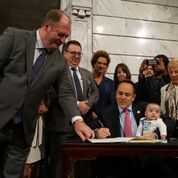 Flanked by more than a dozen state legislators and an overflow crowd filling three levels of the Capitol rotunda, Gov. Matt Bevin today ceremonially signed two historic pro-life measures during the Kentucky Right to Life Association’s “Rally for Life.”
Gov. Bevin commemorated the recently enacted Senate Bill 5 and House Bill 2, which both passed with broad bipartisan support in the first week of this year’s General Assembly.
He applauded legislators for their unwavering commitment to protect the most vulnerable members of society and noted that despite political controversy, “the sanctity of human life is worth fighting for.”
“We have a chance to lead this nation from a moral and spiritual perspective that is desperately needed,” said Gov. Bevin. “We must continue to fight this scourge that is the taking of innocent life. It’s worth it, America is worth it, and Kentucky is going to lead the way.”
Senate Bill 5 prohibits physicians from terminating pregnancies after 20 weeks of gestation—a timeframe in which experts say that a fetus can feel pain. House Bill 2 requires physicians to offer an ultrasound to patients prior to performing an abortion, allowing women to make a truly informed medical decision. (Patients may choose not to have the ultrasound by signing a form to opt out.)
“Kentucky citizens elected the members of the General Assembly to pass responsible legislation that falls in line with Kentucky values,” said Senate President Robert Stivers. “Senate Bill 5, along with House Bill 2, protects the integrity and intrinsic value of human life. It is our duty as elected leaders to protect our most vulnerable, and we have made steps towards accomplishing that goal by passing this momentous legislation.”
“Studies have shown over and over that unborn children at 20 weeks of gestation are sensitive to pain,” said Sen. Brandon Smith, primary sponsor of Senate Bill 5. “The Pain Capable Unborn Child Act offers one more protection to those who cannot protect themselves. Kentuckians value the sanctity of life, and I am proud that we in the Kentucky Senate are committed to safeguarding the lives of all our citizens.”
“This session, common sense legislation to protect life and provide women with appropriate medical information has passed the Kentucky General Assembly,” said Rep. Addia Wuchner, chair of the House Health and Family Services Committee. “Just like our passage of an informed consent bill last session, this bill demonstrates a further commitment from the House to providing women with all of the medical information available before undergoing an abortion.”
Since taking office, Gov. Bevin has signed three important pieces of pro-life legislation into law. In addition to this year’s measures, he signed Senate Bill 4 (“informed consent”) in 2016, requiring medical personnel to provide face-to-face consultation to women 24 hours before an abortion is performed.
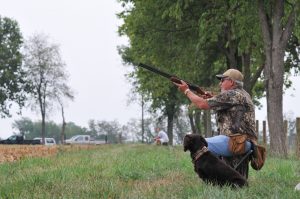 Kentucky farmers can earn some much-needed extra cash by enrolling in the Cooperative Dove Field Program. Enrollment is underway and continues through March 1.
The Cooperative Dove Field Program pays landowners to lease fields on their property for public dove hunting.
“Landowners may earn up to $10,000 in the Cooperative Dove Field Program,” said Wes Little, migratory bird biologist for the Kentucky Department of Fish and Wildlife Resources. “They earn $300 per acre planted.”
Little said the department has accepted fields ranging from six to 40 acres with additional lease payments offered for buffers around planted fields. “Fields generally run from 20 to 30 acres in size,” he explained. “But, we encourage anyone interested to apply.”
Farmers may plant sunflowers, millet or another acceptable crop for a public dove field by working with a Kentucky Fish and Wildlife private lands biologist and following some simple guidelines.
Payment amounts depend on the number of acres enrolled, crop type and fulfillment of the plot management agreement with Kentucky Fish and Wildlife.
The department is especially interested in reaching agreements with property owners who have acreage in underserved areas with significant numbers of dove hunters. In the west, this includes Caldwell, Calloway, Christian, Daviess, Fulton, Grayson, Hardin, Hart, Hickman, LaRue, Logan, Lyon, Simpson, Todd and Trigg counties. In southcentral Kentucky, this includes Boyle, Cumberland, Laurel, Lincoln, Pulaski and Wayne counties.
To get the process started, landowners must contact their Kentucky Fish and Wildlife private lands biologist or Natural Resources Conservation Service liaison. For a listing of biologists, visit the Kentucky Fish and Wildlife homepage at www.fw.ky.gov and search under the keywords, “private lands biologist.” Property owners may also call the department at 1-800-858-1549 for more information.
Seeking to lead by example and give convicted felons a chance at meaningful employment, Governor Matt Bevin issued an executive order last Wednesday that removes questions about criminal history from the initial application for state jobs in the executive branch.
The order – known as the Fair Chance Employment Initiative – means that applicants will not be required to check the box for criminal convictions on the initial state application.
“Ours is a nation of second chances, founded upon core principles that include mercy and redemption,” said Gov. Bevin. “The simple act of removing this box will help to level the playing field for all applicants, and it is my sincere hope that many of the private employers in our state will consider doing the same thing.”
Gov. Bevin stressed the importance of Kentucky leading the way in removing barriers for felons to become gainfully employed, which helps reduce recidivism and improve public safety.
Executive branch agencies may still inquire about criminal records before interviewing an applicant, and may consider criminal history when making hiring decisions. However, postponing that inquiry until after the initial application provides applicants with a better opportunity to explain their backgrounds.
“We want to make sure everyone gets fair consideration for the jobs that make our Commonwealth run,” said Personnel Secretary Tom Stephens.
Conservative estimates from the National Employment Law Project indicate that nearly 70 million people in the United States have a criminal record of some type. Employment is a key factor in keeping people from reoffending, according to several national studies.
“When ex-offenders are able to find stable jobs, they are able to support their families and find new purpose for their lives,” said Justice Secretary John Tilley. “Studies show that removing that box and giving a person a chance at an interview increases the likelihood they will get a job.”
Twenty-four states and more than 150 cities and counties – including Metro Louisville – have adopted fair chance hiring practices.
Gov. Bevin’s order builds on Kentucky’s effort to enact smart criminal justice reforms that enhance public safety while also rehabilitating offenders. Last year, the governor signed legislation to allow for expungement of certain low-level felonies after a person has completed the terms of their criminal sentence. The legislature also is expected to consider a criminal justice reform bill when they return to session next week.
Gov. Bevin issued the executive order on the new approach to state hiring during a press conference in the Rotunda Wednesday morning, prior to the final meeting of the Criminal Justice Policy Assessment Council, which he formed last June.
The 23-member council worked for six months, at the Governor’s direction, to prepare suggestions for smart-on-crime initiatives. A bill incorporating many of those suggestions is expected to be filed next week by Sen. Whitney Westerfield.
Five new lakes enrolled in the Fishing in Neighborhoods Program (FINs) will receive stockings of trout in February, a boon to anglers tired of being house bound.
Flemingsburg Old Reservoir, an 11-acre lake in Fleming County, gets 900 trout while Leary Lake, a 5-acre lake on Lloyd Wildlife Management Area in Grant County, gets the same amount of trout. The 9-acre Logan-Hubble Park Lake just south of Lancaster in Garrard County will receive 900 trout as well.
The 2-acre Kess Creek Park Lake in Mayfield in Graves County will get 500 trout as will the Clinton Rotary Park Lake in Clinton in Hickman County. Both of these lakes are in the Purchase Region.
“We are stocking a larger-sized trout in all of our FINs lakes for 2017,” said Dane Balsman, coordinator of the FINs program for the Kentucky Department of Fish and Wildlife Resources. “The larger trout now average about 10 to 11 inches long and one-half pound in weight.”
Kentucky Fish and Wildlife formerly stocked its traditional “stocker” trout of 9 to 10 inches in the FINs lakes. “We wanted to improve angler satisfaction and utilization as well as reducing hooking and handling mortality. These fish won’t be caught as many times and anglers are more likely to harvest a larger trout.”
Balsman cautions anglers fishing on a FINs lake to practice beneficial catch and release tactics when they catch a trout, especially as the water warms. Anglers can purchase inexpensive fish grabbers to prevent touching or squeezing a trout when removing the hook. These devices prove valuable when handling fish that may cause injury, such as a catfish or fish with teeth, such as a muskellunge.
Forty-three lakes across Kentucky are in the FINs program. They offer fantastic fishing for trout, but also excellent fishing for catfish and largemouth bass.
“We will start in March with the catfish stockings in FINs lakes,” Balsman said. “Due to hatchery expansion, we now have the capabilities to raise all of the FINs catfish in house. We will stock about 125,000 catfish in our FINs lakes.”
Largemouth bass anglers usually turn to waters such as Kentucky Lake, Barren River Lake or state-owned lakes, such as Lake Malone or Lake Kincaid, for a chance at a trophy fish.
“We see exceptional largemouth bass in the FINs lakes, many of them big bass,” Balsman said. “We saw a 9.7-pound largemouth bass from Mike Miller Park Lake this past year, my personal best I’ve seen in a FINs lake. We routinely see 6- to 8-pound bass in the spring.” Four-acre Mike Miller Park Lake lies near Draffenville in Marshall County.
Balsman recommends early spring as the time to catch these bruisers. “We stock these lakes with trout and the bass eat them and grow big,” he said. A white spinnerbait with a silver Colorado blade works well for trophy pre-spawn largemouth bass in small lakes, especially when rains colored the water a touch. A large soft-plastic swimbait in trout colors may also work well in these lakes.
Many anglers flock to Kentucky Lake or Lake Barkley each May for the redear sunfish spawn. Anglers do not need to go that far.
“Some of these lakes have really good redear sunfish in them,” Balsman said. “Three Springs Park Lake near Bowling Green and Madisonville City Park Lake South have great populations of redear sunfish. Both lakes offer trophy potential of 10-inch and longer redear sunfish.”
Lake Mingo in Nicholasville, just south of Lexington has moderate numbers of redear sunfish, commonly called shellcrackers. However, Balsman said some of them are true trophies, running 12 inches or more.
“The trout and catfish are for put and take fishing,” Balsman said. “There is trophy potential for redear sunfish and some of these lakes are great bluegill lakes as well.”
The main point of the FINs program is providing a place close to home for folks to go and have a reasonable expectation of catching fish.
“We want people to be able to go fish the FINs lakes after work in spring and summer or take the kids and fish for an hour or two on the weekends and catch fish,” Balsman said. “The convenience factor is whole point of the FINs program.”
Remember, current fishing licenses expire Feb. 28. It is a good idea to buy your fishing license soon.
The Council on Postsecondary Education elected Sherrill Zimmerman as its new chair and Ben Brandstetter as vice chair Friday.
Zimmerman, of Prospect, chairs both the Council’s Tuition Development Work Group and Committee on Equal Opportunities, and is the past chair of the Strategic Agenda Work Group. She is a retired educator from Jefferson County Public Schools where she served as a teacher, assistant principal and magnet program coordinator.
“It will be an honor and a privilege to serve as chair of the Council on Postsecondary Education,” said Zimmerman. “I look forward to working with our students, campuses, Council members and staff to advance the educational, workforce and economic opportunities for all Kentuckians.”
Brandstetter, of Hebron, joined the Council in September. He is president of Brandstetter Carroll, Inc.
“It is a privilege to serve the Commonwealth in this role. Higher education is one of the most important tools that we have to improve the economy of the state, and I look forward to helping advance this for everyone,” said Brandstetter.
Zimmerman replaces outgoing member Glenn Denton of Paducah, who served two terms on the Council and chaired the Council in 2015 and 2016. Brandstetter replaces Donna Moore of Lexington who remains on the Council.
Zimmerman and Brandstetter will serve in their positions for the next year.
The Council also approved the Tuition Setting Timeline and the Tuition and Mandatory Fee Policy. The timeline calls for the Council to take action on tuition and fee ceilings March 31, followed by action on individual campus tuition and mandatory fee rates at the June 16 meeting.
In other items, the Council:
- Updated the Academic Program Approval Policy, which takes effect July 1.
- Approved a proposed amendment to Kentucky Administrative Regulation 13 KAR 2:110 regarding the approval process for advanced practice doctoral degree programs at the public comprehensive universities.
- Heard the following reports: Student Loan Default and Repayment in Kentucky, Future Skills Report, a proposal from Morehead State University related to tuition, legislative update, Committee on Equal Opportunities and an Executive Committee report. A KDE Report, Council President Report and campus reports were also available.
The Council’s next meeting will be March 30-31 at Northern Kentucky University.
Caroline King, an Audubon Traditional Elementary School kindergarten teacher, is the second recipient of the Excellence in Classroom and Educational Leadership (ExCEL) Award for 2017. Representatives from Jefferson County Public Schools (JCPS) and from the award sponsors — LG&E KU and WHAS11 — honored the teacher last week during a ceremony at the school.
“Ms. King is a wonderful kindergarten teacher who models integrity, respect, creativity and accountability,” Audubon Principal Tiffany Marshall said. “She is a leader in the building who supports the students inside and outside of the classroom. Students know they have to learn and are willing to be challenged to reach their potential.”
Ms. King is active in the Audubon community beyond the classroom. In addition to serving as kindergarten team leader, she supports the school technology team; provides schoolwide professional developments throughout the year; and attends math and reading professional development sessions from the district and other math organizations to continually improve and become an even better teacher.
And she has earned accolades for her work, winning the JCPS School of Innovation Design Competition from the Louisville Reach Academy in 2014, and being voted ‘Best Presentation’ at the Indiana Southeast University Student Conference in 2012.
“Ms. King has a passion for teaching and helping students realize their full potential by creating a safe and engaging learning environment that inspires students to excel,” said Audubon counselor Robin Divine. “Her positive attitude and enthusiasm for learning enhances the Audubon Traditional School environment.”
As an ExCEL Award winner, King will receive a $1,000 instructional grant from LG&E KU.