Saturday January 24, 2026
Local Connection
 Weather
 Traffic
 @LouisvilleDispatch
 @LouisvilleDisp
 Subscribe
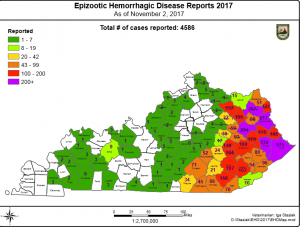 The recent cold snap experienced across Kentucky effectively ended the state’s worst outbreak of epizootic hemorrhagic disease in white-tailed deer in a decade.
Epizootic hemorrhagic disease (EHD) is a viral disease transmitted to deer by biting flies or midges. It does not affect people or pets, and outbreaks cease at the first frost, which kills the bugs.
The Kentucky Department of Fish and Wildlife Resources receives and confirms EHD deer mortalities each year but the outbreak this year was severe by comparison. The department started receiving reports of sick or dead deer in some east Kentucky counties in July. August brought confirmation that a common strain of the EHD virus was to blame.
The department encouraged the public to report suspected cases, and the public responded. Kentucky Fish and Wildlife fielded 1,822 individual reports and documented 4,586 suspected EHD cases through phone calls and an online reporting system.
“Kentucky Fish and Wildlife would like to thank the public for its assistance,” said Dr. Iga Stasiak, state wildlife veterinarian with Kentucky Fish and Wildlife. “The incredible response we received was invaluable in helping us gauge the extent and intensity of this year’s severe outbreak. The public’s feedback through those outlets helped biologists monitor the situation in real-time and generate incredibly helpful maps.”
This year’s outbreak affected multiple states across the Appalachian Plateau. In Kentucky, it was primarily confined to counties along and south of Interstate 64 and east of Interstate 75. The epicenter of the outbreak in Kentucky appeared to be in Floyd and Pike counties.
The severity of this year’s outbreak in east Kentucky is comparable to that seen in other parts of the state in 2007. While EHD can cause significant regional population die-offs, populations recover with time, Stasiak said.
“The herd is resilient,” said Gabe Jenkins, deer program coordinator with Kentucky Fish and Wildlife. “We had probably the highest densities of deer that we’ve ever seen in that part of the state. Yes, it knocked them back pretty hard but the population will rebound.”
Herd estimates after the 2016-17 hunting season pegged the statewide deer population at about 850,000 animals.
Kentucky’s deer seasons are continuing as scheduled this year.
“Department biologists will be looking closely at harvest data and monitoring the deer herd ahead of next year’s hunting season,” Stasiak said. “We will also be monitoring deer at several check stations throughout the hunting season to identify deer that may have been exposed to the disease and assess the degree of immunity in the herd.”
Although EHD is not transmissible to people, the department reminds hunters to avoid eating animals that appear to be sick and asks that sick deer be reported to the department either by calling 1-800-858-1549 between 8 a.m.-4:30 p.m. (Eastern) weekdays or contacting their local private lands or public lands biologist, depending on where the animal was observed.

Photo: Louisville Metro Parks and Recreation
Louisville Metro is looking for someone to donate the large Christmas tree that will stand in Jefferson Square Park through the holidays.
“It is always the main attraction of our Light Up celebration,” said Mayor Greg Fischer. “We hope someone will come forward with just the right tree.” The tree should be a spruce or fir, about 40 feet tall and well-shaped.
The city will cut and transport the tree to its prominent spot in Jefferson Square Park. Anyone interested in donating a tree should call MetroCall 311. The tree donor will attend the Light Up Louisville sponsor reception and be a featured guest of Mayor Fischer for the Light Up celebration.
Light Up Louisville is held annually on the day after Thanksgiving. This year, the event, in its 37th year, will be held on Friday, Nov. 24. The tree will be moved with the support of Bob Ray Company and LG&E.
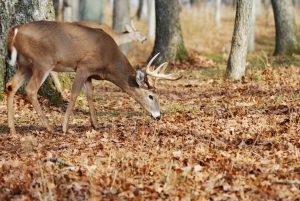
Photo: Kevin Kelly/Kentucky Department Fish and Wildlife
A burst of fall colors, frosty mornings and an uptick in deer activity recently are encouraging and telling signs for hunters.
The season that contributes the greatest percentage of Kentucky’s annual deer harvest and fills many freezers with protein-rich venison is almost here.
Modern gun deer season opens statewide Nov. 11, 2017.
“Opening day should be spot on,” said Gabe Jenkins, deer program coordinator for the Kentucky Department of Fish and Wildlife Resources. “Our gun hunters should have some fantastic deer activity. The start of the season falls early this year. It touches on the end of the chase period and continues into the peak of the rut. We should see some good movement early and late in the season.”
Kentucky’s modern gun deer season is designed to coincide with the peak of fall breeding, known as the rut. It runs for 16 consecutive days in Zones 1 and 2 and for 10 consecutive days in Zones 3 and 4.
County zone assignments are published in the annual Kentucky Hunting and Trapping Guide, available on the department’s website at fw.ky.gov and where licenses and permits are sold. The guide also provides information about license and permit requirements, hunter education and hunter orange requirements, bag limits and legal equipment for deer hunting. Also available on the department’s website is a detailed list of frequently asked questions about deer hunting in Kentucky. Type “Deer Season FAQs” into the search box on the homepage to access it.
Hunters in Kentucky have taken more than 130,000 deer annually over the past five seasons. The 2016-17 tally was the third highest on record with the modern gun season harvest accounting for more than 70 percent of that figure.
This year, the modern gun season harvest will provide biologists additional data to further assess the scope and impact of the outbreak of epizootic hemorrhagic disease (EHD) in eastern Kentucky.
As of Nov. 2, Kentucky Fish and Wildlife had received reports of more than 4,500 sick or dead deer across the state since mid-July. The outbreak was confined primarily to counties east of Interstate 75 and along and south of Interstate 64.
EHD is a virus spread by small biting flies or midges. A recent cold snap effectively ended the outbreak since frost kills the insects that carry the disease.
The virus is not transmissible to people and the meat is safe to eat. In any year, hunters are advised to avoid eating the meat from animals that appear to be overtly sick.
Hunters concerned about hunting elsewhere in the state should have no reservations whatsoever, Jenkins said. The herd remains robust.
“We’ve got a lot of deer,” he said. “I look for it to be just as strong in the rest of the state as it has been in recent years. We had a good fawn year last year, good acorns last year, a mild winter and nice summer. All factors for good survival, good antler production. Lots of goods in there.”
The statewide deer harvest from September’s record opening weekend of archery season through October was up compared to 2016. Harvest reports from the youth-only gun and early muzzleloader seasons in October were down.
A middling mast crop could play to the hunter’s favor. This year’s statewide mast survey found about a third of white oaks with acorns. Red oak acorn production was better at 63 percent. White oak acorns are the first choice for deer because they are sweeter and more palatable to deer than red oak acorns, which have higher tannic acid.
“If you find a white oak with acorns, be on it,” Jenkins said. “During the early muzzleloader season, two does came right underneath me. There was a red oak tree and a white oak tree and one of the does was just sniffing around trying to find those white oak acorns and passing up those red oak acorns. She’d find one and crunch, crunch, crunch.”
In addition to the hunter orange and hunter education requirements, as well as following the guidelines for safe handling of firearms, hunter safety during the modern gun season also extends to the use of tree stands.
Serious accidents can be prevented by following the manufacturer’s instructions for installation, use and maintenance of tree stands.
Hunter education classes offered by Kentucky Fish and Wildlife cover the basics of tree stand safety. Olivia Dangler, a conservation educator with the department, said hunters must not let their guard down.
“Do not let your excitement cause you to forget about safety,” she said. “It does not matter how good of a climber you are, or if you think it will never happen to you, always wear a harness and stay clipped into the tree because it can save your life.
“Inspect your equipment prior to use and wear a full body harness whether you are hanging, practicing or hunting from a tree stand. Once you leave the ground, your harness should be connected to the tree. According to the International Hunter Education Association, 99 percent of fall victims injured were not attached to the tree.”
Tree stands and harnesses are rated to support up to their stated weight capacities.
Keep your hands free and never carry equipment while climbing up to or down from a tree stand. Use a haul line to raise or lower equipment instead.
“Firearms should be unloaded with the safety on,” Dangler said. “Attach the haul line to the sling or stock so the muzzle is pointed down when pulling it up to you or lowering it to the ground. If using a bow while hunting, make sure it is unloaded before attaching the haul line and have arrows secured in covered quiver.”
An online tree stand safety course can provide a good introduction or refresher. A free, interactive course is available through the Treestand Manufacturer’s Association website at tmastands.com.
Hunters should choose trees that are straight and large enough to adequately support their tree stands. Avoid ash trees. The emerald ash borer has decimated the ash tree population in recent years. Any ash trees still standing should be considered unsuitable. Knowing where ash trees are in proximity to your location is another important consideration. Dead limbs can break under their own weight without warning.
Hunters who are still looking for a place to hunt can find information about public lands on the department’s website. On any wildlife management area that allows gun deer hunting, anyone hunting from inside a ground blind must now attach a hat or vest made of solid, unbroken hunter orange material to the outside so it is visible from all sides. Hunter orange clothing requirements still apply for anyone inside the blind.
Once you know where you will be hunting, it’s always a good idea to let a family member or friend know where you will be that day and when you expect to return.
“Get out there and go,” Jenkins said. “The full-swing rut is definitely here.”

Credit: KY State Parks
The 27th Annual Civil War Days at Columbus-Belmont State Park is Oct. 13-15.
The weekend will include battle re-enactments, history and museum tours, soldier camps, entertainment, food and more. Admission is free.
This three-day event begins with an Education Day on Friday. There will be cannon and rifle demonstrations, life of a soldier, and dance instruction. Students, scouts, and groups are encouraged to participate, but everyone is invited to attend and take a closer look at history by taking a step back in time.
The opening ceremony is Friday evening with food and entertainment. Cannons will fire from the bluffs to end the ceremony and then there will be a Ghost Walk through the Confederate earthworks with lanterns lighting the way.
Events are scheduled throughout Saturday including music and the Ladies Tea at 11 a.m.
The Civil War Ball on Saturday night will feature music and dance instruction so you don’t have to be experienced to participate. The band for the evening is The 52nd Regimental String Band.
If you want to shop, you can find everything you need on “Sutler Row” where there will be tents set up with period clothing and accessories. There will be a Beautiful Belle and Handsome Gent contest before the dance and a Best Beard and Scraggly Beard contest during intermission.
Sunday begins with a morning service as well as a memorial service in Columbus Cemetery.
The battles are at 2 p.m. on Saturday and Sunday. They will feature guns firing, cannons blasting, horses running, and tents burning.
The Civil War Days event is co-sponsored by Columbus-Belmont State Park, Civil War Days Committee, and the Hickman County Judge Executive’s office/Hickman County Fiscal Court. The park is located on the Mississippi River in western Kentucky at the junction of highways 58, 80, and 123.
For more information, contact the park office at 270-677-2327 or email cindy.lynch@ky.gov or visit www.parks.ky.gov
Photo: Kentucky Department Fish and Wildlife
Viewers of “Kentucky Afield” television picked up their phones and took to social media last weekend to submit more than 200 questions for the annual fall hunting call-in show.
Kentucky Department of Fish and Wildlife Resources wildlife biologists Gabe Jenkins and John Morgan, along with Sgt. Rufus Cravens of the department’s Law Enforcement Division, joined “Kentucky Afield” host Chad Miles for the hour-long show that aired live on Sept. 16 on Kentucky Educational Television. The panel could not get to all of the questions before the credits started rolling.
Below, Kentucky Fish and Wildlife personnel answered a handful of the questions that did not make it on-air. Viewers who missed the live show can watch a full replay on YouTube. Enter “KYAfield” in the search box on the YouTube homepage.
Will Kentucky Fish and Wildlife consider adjusting deer seasons due to the EHD (Epizootic Hemorrhagic Disease) outbreak? – Eddie from Morgan County
GABE JENKINS, Deer and Elk Program Coordinator, Kentucky Fish and Wildlife: We will not be implementing an emergency regulation to shorten or close deer season in 2017 in any county due to the EHD outbreak. We encourage folks to report all dead deer they find using our online reporting system.
After the outbreak has ceased, we will evaluate the number reported along with the harvest data from the 2017 season and make our recommendations for the 2018 season at the December meeting of the Fish and Wildlife Commission. Deer are prolific breeders, and the population will rebound within a couple years.
Lastly, if your area has experienced a severe die-off, I would encourage hunters to participate in some self-restraint and pass once you have taken enough deer to fill your freezer for the year.
How far west have elk traveled in Kentucky? – Wayne from Marion County
JENKINS: We receive reports of elk outside the elk zone almost every year. In the early years of elk restoration, we saw elk leave the elk zone more frequently. We’ve had reports of elk as far west as Lake Cumberland and one elk went to North Carolina. We have had elk harvested outside the elk zone in Bath, Carter, Laurel, Madison, Wayne and Wolfe counties.
What resources are available through Kentucky Fish and Wildlife to assist with wildlife habitat improvement? – Gary from Grayson
BEN ROBINSON, Wildlife Division Assistant Director, Kentucky Fish and Wildlife: Kentucky Fish and Wildlife is committed to assisting landowners with wildlife habitat improvement on their property. We employ more than 30 wildlife biologists who specialize in assisting private landowners with habitat management projects. From tips about improving food sources for deer and turkey to navigating cost share programs through the federal Farm Bill, we have someone available to assist you.
For more information, visit our web site at fw.ky.gov or call 1-800-858-1549 and ask for the phone number of your local private lands or farm bill biologist.
Does prescribed burning on private and public lands benefit wild turkeys? Where can I find more information? – Tony from Montgomery County
ROBINSON: Kentucky Fish and Wildlife considers prescribed fire an essential management tool for private landowners and publicly managed Wildlife Management Areas. Prescribed fires are carefully planned and managed by highly trained burn crews for containment to select areas.
We regularly use prescribed burning on grasslands and timbered areas to benefit a host of game and non-game species, including wild turkey.
Prescribed fire has many benefits. Fire removes old vegetation and stimulates new growth, providing a lush food source for wildlife. Fire promotes oak regeneration in our forests resulting in more acorns, a staple food source for many species. By removing dead vegetation, fire also creates bare ground, a necessity for bobwhite quail and other ground dwelling birds.
For more information on prescribed fire in Kentucky, visit the Kentucky Prescribed Fire Council’s website www.kyfire.org.
Why was bear season closed in McCreary County on public land? – David from McCreary County
JOHN HAST, Bear Program Coordinator, Kentucky Fish and Wildlife: Bear numbers are still low in McCreary County. Kentucky Fish and Wildlife’s philosophy on bear management is to allow as much hunter opportunity as the bear population will allow. What we may sacrifice in hunter opportunity in McCreary County for a few years will pay off when bears have a chance to grow within the county and expand more fully into surrounding counties, such and Pulaski and Rockcastle.
Great bear habitat lies just to the north of McCreary County within the Daniel Boone National Forest and it has the potential to provide a great place for bears and bear hunters in the future.
A population of bears is very slow in its growth and patience is necessary to see any big leaps in the season quota. You can rest assured that Kentucky Fish and Wildlife is actively monitoring bears in McCreary County in order to improve our population models. When the bear population is ready, hunters will once again be able to hunt public land.
 The Kentucky Fuel Corporation properties in eastern Kentucky are no longer open to public hunting.
Kentucky Fuel’s hunting access agreement with the Kentucky Department of Fish and Wildlife Resources is no longer active, returning the property to private status.
The change occurred after publication of the 2017-18 Kentucky Hunting and Trapping Guide. Kentucky Fish and Wildlife has updated its online version of the guide to reflect this change. The guide is available at the department’s website, fw.ky.gov.
Hunters are asked to respect Kentucky Fuel Corporation private property and not trespass on it.
Kentucky Fish and Wildlife still has 20 areas open for public hunting in the southeast region of the state, including more than 100,000 acres for elk hunting. Maps and detailed information on each area are available online at fw.ky.gov.
Photo: Louisville Metro Parks and Recreation
The “Canoemobile” is making its annual stop in Louisville on October 3-7, bringing fun and exploration through free trips for all ages on 24-foot Voyageur canoes on the Ohio River. The program, locally in its sixth year, is organized by Louisville Parks and Recreation’s Natural Areas Division based at Jefferson Memorial Forest in partnership with Wilderness Inquiry, Inc. of Minneapolis.
Additional funding support is being provided by the United States Forest Service through the Outdoor Foundation. The Canoemobile will offer trips from 10 a.m. – 4:30 p.m. at Shawnee Park on Friday, Oct. 6, and at Riverview Park on Saturday, Oct.7 from 10 a.m. – 4:30 p.m.
On Tuesday-Thursday, Oct. 3-5, the Louisville ECHO (Louisville is Engaging Children in the Outdoors) initiative, facilitated by JMF/Natural Areas, will host education days at Riverview Park with Chenoweth, Portland, and Coral Ridge elementary schools as part of the Canoemobile program. As part of this education day, students will canoe as well as learn about erosion and insects.
On Friday, JMF will be launching our first canoe built in our #CanoesBuildCommunity program, with assistance from Steam Exchange and Cabbage Patch Settlement House. The program inspires confidence and encourages ownership of paddling through kid-built canoes, from start to finish. With support from Canoe Kentucky, partners build canoes to keep.
“The Canoemobile program is a fun and safe way to introduce kids to the outdoors and part of our mission to expand outdoor recreation opportunities in the Louisville area,” said Seve Ghose, Director of Louisville Parks and Recreation. “We encourage everyone who is interested to come and take advantage of this great opportunity.”
The Voyageur canoes are safe, stable and can carry 9 participants per trip. Safety equipment and trained staff will be provided. Organizers suggest wearing comfortable outdoor clothing that can get wet, but no flip-flops. Water coolers will be available, so bring a refillable water bottle. Food also will be available for purchase.
Pre-registration is not required, and all trips will be offered on a first-come, first-served basis. Trips will leave every 30 minutes. All participants must sign a waiver, and those under the age of 18 must have a waiver signed by a parent or legal guardian. Forms can be found at memorialforest.com.
SCHEDULE
Friday, October 6
10 a.m.- 4:00 p.m. Shawnee Park 4501 West Broadway 40211
* Event is located at the end of Southwestern Parkway on the north side of the park
Saturday, October 7
10 a.m.- 4:30 p.m. Riverview Park 8202 Greenwood Rd 40258