Saturday January 24, 2026
Local Connection
 Weather
 Traffic
 @LouisvilleDispatch
 @LouisvilleDisp
 Subscribe
 Advance tickets and parking for the 2017 Kentucky State Fair are now discounted and on sale at:
- Kentucky State Fair’s new app now through midnight Aug. 16, app is available on Google Play and the App Store.
- www.ticketforce.com now through midnight Aug. 16.
- Participating Kroger locations now through 10 p.m. Aug. 16.
Save with each advance ticket purchased.
Ticket Advance After Aug. 16
Adult $7 $10
Child (6-12)* $7 $10
Senior $7 $10
Parking $5 $10
*Children 5 and under are free.
 Residential garbage, recycling and yard waste collection within the Louisville Metro Urban Services District (former Louisville city limits) will be collected one hour earlier than usual for the balance of this week due to extreme weather conditions.
With daily high temperatures flirting with the 100-degree mark this week, waste collection will begin at 5 a.m. Wednesday, July 19 and through the rest of the week. That is one hour earlier than the usual 6 a.m. start. This measure will lower the risk of heat related illness for Solid Waste Division workers by reducing exposure to rising temperatures.
Residents should place waste out for collection anytime between 4 p.m. on the day preceding collection and 5 a.m. on collection day. Project Pickup bulk waste collection, which usually begins at 7 a.m., will instead begin at 6 a.m.
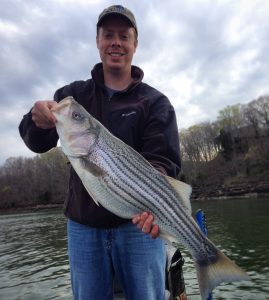
Photo: Kentucky Department Fish and Wildlife
The Kentucky Fish and Wildlife Commission proposed several new fishing regulations at a special called meeting today.
The commission recommends all hunting, fishing and boating regulations for approval by the General Assembly and approves all expenditures by the Kentucky Department of Fish and Wildlife Resources. All recommendations must be approved by legislators before they become law.
If approved by legislators, fisheries regulations proposed at the meeting would take effect March 1, 2018.
In fisheries-related business, commissioners recommended reducing the statewide daily creel limit on crappie to 20 fish per angler per day. They also proposed modifying the statewide daily creel limit on brown trout to one fish per day with a 16-inch minimum size limit. Rainbow trout will be under an 8-fish daily creel limit. Anglers will be able to use dip nets to collect baitfish statewide.
Commission members also proposed changing the way anglers tag jugs, limb lines or trot lines. Instead of using their name and address, anglers using these fishing methods can use the “Customer Identification Number” provided on their fishing licenses to tag their jugs, limb lines or trot lines.
In addition, the commission recommended increasing the crappie minimum size limit to 10 inches on Taylorsville Lake. They also proposed placing channel and blue catfish in Barren River Lake under a 15-fish daily creel limit; only one fish may be longer than 25 inches.
They also proposed removing the 15-inch minimum size limit on largemouth bass on Beaver Lake in Anderson County and placing Benjy Kinman Lake in Henry County under statewide regulations for crappie, bluegill and sunfish.
On Beech Fork Reservoir, also known as Staunton Reservoir, in Powell County, the commission recommended instituting a 15-inch minimum size limit on largemouth bass and a 15-fish daily creel limit on bluegill.
Another proposal recommended placing special regulations on Willisburg Park Pond in Washington County: a 4-fish daily creel limit on channel catfish with no minimum size limit; a 15-fish daily creel limit on sunfish with no minimum size limit; and a 1-fish daily creel limit, 15-inch minimum size limit on largemouth bass.
Recommendations also included restricting the use of live shad for bait on all Fishing in Neighborhoods (FINs) lakes. All restrictions on using shad for bait refer to live shad, not dead or packaged shad, used for bait.
In wildlife-related business, the commission recommended the implementation of a three-tiered classification system for wildlife management areas (WMAs). The system would allow the public to better understand whether an area is actively or passively managed, and the staffing levels for each area.
Finally, commissioners proposed implementation of regulations restricting the movement and rehabilitation of rabies-vector species the U.S. Department of Agriculture surveillance area in eastern Kentucky.
The next Kentucky Fish and Wildlife Commission meeting is currently scheduled for 8:30 a.m. (Eastern time), Friday, Sept. 8, 2017. Meetings are held at Kentucky Fish and Wildlife headquarters, 1 Sportsman’s Lane off U.S. 60 in Frankfort.

Photo: CHFS
As part of the 52 Weeks of Public Health campaign, the Kentucky Department for Public Health (DPH), within the Cabinet for Health and Family Services (CHFS), along with local health departments across the state, is reminding the public about the potential for rabies exposure from contact with infected wildlife.
Wildlife rabies cases, primarily in bats, raccoons, skunks and foxes, have been identified in the U.S., and these result in human and animal exposures requiring thousands of human rabies post-exposure treatments and animal euthanasia or quarantines.
“Rabies is relatively rare in the U.S., but a dangerous, and often life-threatening condition, if contracted,” said Kelly Giesbrecht, state veterinarian with DPH. “We want to highlight the importance of rabies prevention and control efforts in our communities, while also reminding Kentuckians of the existing dangers of coming into contact with rabid wildlife. They should not be handled or treated as pets to avoid possible rabies exposure.”
Rabies, a viral disease of humans, pets and wild animals, is transmitted from animals to humans by the saliva of a rabid animal, usually from a bite. State law requires that all dogs, cats and ferrets maintain a current rabies vaccination. In Kentucky, there have been no human rabies cases from exposure to a rabid dog since dog vaccination became required by law in 1954. For more information about rabies, visit the DPH website at http://www.chfs.ky.gov/dph/epi/rabies.htm.
“We want the public to understand that rabies is still a serious public health concern, and we need to do everything we can to prevent it,” said Dr. Giesbrecht. “It is extremely important that we vaccinate all dogs, cats and ferrets in order to maintain this invisible barrier between rabid wildlife and humans.”
Contact bites from bats are the most common source of rabies exposure to humans in the United States. To minimize the risk for contracting rabies, it is best never to handle any bat. To prevent bats from entering your home, carefully examine your home for holes that might allow bats to enter the residence. Any openings larger than a quarter-inch by a half-inch could allow for bat entry. These openings should be blocked either with stainless steel wool or caulking in the fall or winter so you do not unintentionally trap bats within your home. Common ways for bats to enter homes include down the chimney, through openings around the chimney, through vents, through openings behind shutters, under doors, under siding, under eaves and under shingles.
There is no known medical cure for rabies once clinical symptoms are present. Symptoms include strange sensations at the site of the bite from a rabid animal, hallucinations and fear of water, all of which are quickly followed by death.
It is estimated that more than 59,000 people around the world die from rabies each year. Worldwide, more people die from rabies than from polio, diphtheria and yellow fever combined.
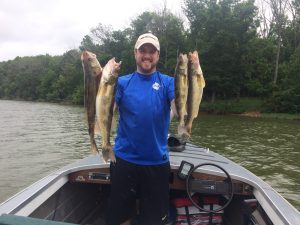
Photo: Kentucky Department Fish and Wildlife
With every passing season, anglers are building their knowledge base about how to catch saugeye stocked in a handful of central and northern Kentucky lakes.
A saugeye is a fast-growing cross between a walleye and sauger that can reach 15 to 19 inches in its second year. The hybridization is evident in the species’ physical appearance. Saugeye display the faint saddle markings of a sauger and the white fin tips of a walleye. Unlike either, it features black smudges on its dorsal fin.
Three lakes – 317-acre Guist Creek Lake in Shelby County, 148-acre Bullock Pen Lake in Owen County and 175-acre A.J. Jolly Lake in Campbell County – received experimental stockings of the species in 2013 and five have been stocked this year by the Kentucky Department of Fish and Wildlife Resources.
Guist Creek Lake received more than 15,000 fingerlings this spring. Anglers have reported good success in recent weeks fishing jigs off mud flats in 4 to 10 feet of water.
Paul Wilkes and Dane Balsman had never tried fishing for saugeye before they visited Guist Creek Lake one day in late June. They spoke with other anglers and studied bottom contour maps available on Kentucky Fish and Wildlife’s website at fw.ky.gov beforehand.
“We were able to identify some flats that we wanted to hit and then went out and graphed some baitfish near the drop-offs of those flats,” said Wilkes, fisheries program coordinator with Kentucky Fish and Wildlife. “We went out there with a mindset of if we caught one or two we were going to be pumped because this was a new species for us.”
The two reeled in 11 saugeye, including one that weighed 4.5 pounds and two others that weighed better than 3 pounds.
“We went out there and tried it and tried a few different drop-offs we mapped,” Wilkes said. “We stuck to the basics of jigging slowly in the areas we had identified. Strikes were kind of a thud, where you almost thought you were hung up until you really pulled it in. Once we found the fish, it seemed like they were in small schools. You’d catch several.”
Minnow or worm-tipped jigs or small shad-imitating crankbaits are good options for saugeye, as are small suspending jerkbaits or swimbaits in grey and white. Wilkes and Balsman, urban fisheries program coordinator with Kentucky Fish and Wildlife, found bladed jig heads with chartreuse bodies worked best for them.
Mike Hardin enjoyed similarly good fortune on Guist Creek Lake this spring fishing a little deeper in 8 to 10 feet of water.
“If you look at the fishing reports from saugeye lakes in Kentucky and Ohio, you see a lot of reports of anglers finding them in shallow water on crankbaits,” said Hardin, assistant Fisheries Division director with Kentucky Fish and Wildlife. “For a long time, I looked and looked and fished extremely shallow water jigging and picking up the occasional saugeye.
“We pulled off the bank and found wads of baitfish in 8- to 10-feet of water and it was game on. Fish close to the bottom, just like walleye fishing.”
He’s also had caught saugeye on Taylorsville Lake. Fisheries biologists believe good saugeye fishing could be in the cards this fall on Salt River above Taylorsville Lake based on population sampling from last fall.
“It seemed like there was definitely a push up there in the river. There’s going to be crappie and saugeye and bass, a little bit of everything,” said David Baker, Central Fisheries District biologist with Kentucky Fish and Wildlife. “Honestly, I think we’re going to be getting a lot of phone calls about saugeye in Taylorsville here in the next year or two.”
This year, the Kentucky Department of Fish and Wildlife Resources stocked more than 150,000 fingerlings in five lakes with Taylorsville Lake receiving more than 115,000 saugeye fingerlings.
Also receiving saugeye fingerlings were Guist Creek Lake, 92-acre Boltz Lake in Grant County and A.J. Jolly Lake in Campbell County. Lake Carnico, a 114-acre lake in Nicholas County, received its first saugeye stocking this year.
“It was a ton of fun and we were able to get on some really nice fish,” Wilkes said. “It definitely exceeded our expectations.”
For more information about saugeye fishing in Kentucky, including special regulations, consult the current Kentucky Fishing and Boating Guide. It is available online at fw.ky.gov and wherever licenses are sold.
 In a continuous effort to keep families and their children safe from lead-based paint and other home health and safety hazards, Lead Safe Louisville, a partnership between the Office of Housing and Community Development and the Louisville Metro Department of Public Health and Wellness., received $2.9 million from the U.S. Department of Housing and Urban Development (HUD) to eliminate lead hazards that exist in both owner-occupied and rental units. HUD awarded more than $127 million to 48 state and local government agencies
The grant funding announced today will reduce the number of children with elevated blood lead levels, and protect nearly 7,600 families living in homes with significant lead and other home health and safety hazards. HUD’s Lead Based Paint Hazard Control grant programs have a proven history of success, filling critical needs in communities where no other resources exist to address substandard housing that threatens the health of the most vulnerable residents.
Today in Washington, DC, HUD Secretary Ben Carson announced the new funding during an event that featured a panel discussion about the importance of public and private partnerships to the work of healthy homes. With HUD celebrating June’s National Healthy Homes Month, Carson said he wants to make lead paint hazard removal a top priority.
In a national release HUD Secretary Ben Carson said, “Children perform better at school and in life if they live in a healthy home. A healthy start at home translates to a successful life outside of the home. HUD is committed to working with local communities to eradicate lead paint poisoning to make sure our homes are safe and ensure positive outcomes for families and their kids.”
Also in that release, Jon L. Gant, Director of HUD’s Office of Lead Hazard Control and Healthy Homes said, “Millions of families and children are seeing their hope for the future threatened by poor health simply because of where they live. This round of funding includes awards to eight cities that are receiving grant awards for the first time. We are pleased the program is expanding into these previously unserved communities.”
Housing improvements, such as removing lead help prevent injuries and illnesses, reduce associated health care and social services costs, reduce absentee rates for children in school and adults at work, and reduce stress—all which help to improve the quality of life.
The purpose of the Lead-Safe Louisville Program is to eliminate lead hazards that exist in both owner-occupied and rental units in the Metro Louisville area, especially those in which children under six years of age reside. Houses and apartments built before 1978 are most likely to have lead-based paint which can create a hazard to its inhabitants. Key risk factors are chipping or peeling paint on doors, windows, woodwork or exterior siding. Children are particularly prone to lead poisoning in such environments.
Eligible units are based on the following:
- Built prior to 1978
- A child 5 years or younger or pregnant woman lives in the home or a child 5 years or younger visits a minimum of 6 hours a week
- Occupant is low income 80% AMI based on size of family
For more information on Lead Safe Louisville, please call 574-1965 or visit https://louisvilleky.gov/government/housing-community-development/lead-s…
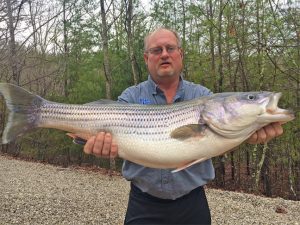
Photo: Kentucky Department Fish and Wildlife
Few things in the outdoors in Kentucky can top being on Lake Cumberland at daybreak on a summer morning, watching a planer board or large bobber disappear, followed by the sound of a slipping drag.
Striped bass pull like no other fish in Kentucky and landing a 22-inch or longer keeper brings a rush of adrenaline that gives you the shakes. Now in the fourth year of normal water levels since the drawdown to repair Wolf Creek Dam, the striped bass in Lake Cumberland are well on the way to returning to the glory days.
“The striped bass in Lake Cumberland are doing great,” said John Williams, Southeastern Fisheries District biologist for the Kentucky Department of Fish and Wildlife Resources. “There are multiple year classes in the lake with many keepers over 22 inches. We are getting more fish over 30 inches. Their body condition is fantastic.”
Although striped bass are in good numbers in Lake Cumberland, the spring fishing proved frustrating in the lake this year.
“Some guides had a hard time this spring finding fish, but now they are on fish, they found them,” Williams said. “Because we had so much rain this year and they released so much water from the lake, it spread the fish throughout the water column. This leads to spotty fishing.”
Williams said a recent temperature profile of the lake shows a gradual temperature change through the depths. “There is only a 10 degree temperature drop from 20 feet deep to 60 feet deep,” he said. “The water temperature is 70 degrees at 20 feet and 60 degrees at 60 feet deep. They have a wide range of the water column that changes only a few degrees. Usually, the temperature changes are much more abrupt as you descend in the water column in summer. They have 40 feet of depth to roam now.”
Anglers fishing live bait in the middle of this range are catching stripers. “I had my first ever triple on my boat this last weekend,” said Joe McWilliams, an avid striped bass angler who has a vacation home on the lake. “I’ve been fishing about 40 to 50 feet deep.”
McWilliams uses an old school method to judge his depth. “My rods are 7 feet long, so I do 7 pulls of line the length of the rod to get my depth right now,” he said. “In summer, I usually put two rods out at 10 to 15 feet, two more out from 28 to 35 feet and then two more out at 42 to 48 feet or so and adjust until I find fish.” McWilliams typically fishes the mid-lake region from Harmon Creek up to Fall Creek.
He employs three planer boards on each side of his boat with two large bobber rigs drifting off the back, all rigged with live threadfin shad or alewives on 3/0 circle hooks. A light drag helps keep the marauding stripers from snapping off the 20-pound leaders McWilliams uses.
A remote controlled trolling motor helps McWilliams slowly troll the bait he gathers in the pre-dawn via a casting net and a green light mounted under his boat slip. “I check my lines every 20 to 25 minutes or so,” McWilliams said. “I want fresh, lively bait on at all times.”
The river channel is key to finding the schools of baitfish stripers rip through with abandon. “The baitfish in summer seem to relate to the old Cumberland River channel,” Williams, the biologist, said. “The stripers will be close to the baitfish.”
A good sonar unit helps locate these schools. It is common in summer on Cumberland to see small scattered blobs of bait suspended over flats adjacent to the old river channel. However, once the boat cruises over the drop down into the river channel, the screen often fills with large blobs of bait. Study the depth of the blobs and start fishing.
“Modern sonar units are so good at finding schools of baitfish,” Williams said. “They really help narrow down where to fish.”
You do not have to troll to catch striped bass in summer. Once you find the baitfish, cast 1/2-ounce white and light blue doll flies down the points nearest the bait. Some anglers use downriggers to deep troll large white doll flies with a white or chartreuse curly tailed grub as a trailer.
No matter the technique employed, the early bird gets the worm for summer striped bass fishing. “You have to be out there early at this time of year,” Williams said. “You need to have your bait in the water before the sun rises. The bite is usually done by 9 a.m. or so.”
Lake Cumberland striped bass are under a 22-inch minimum size limit and a 2-fish daily creel limit. “Keep your keeper-sized fish and quit fishing when you reach your two fish daily limit,” Williams said. “Striped bass don’t release well anyway, but when you are pulling them out of deep water the pressure and temperature change really stresses them in summer.”
If you want a thrill like no other, get on Lake Cumberland this summer and hear your drag sing from a strong striped bass pulling with all its might.