Tuesday December 16, 2025
Local Connection
 Weather
 Traffic
 @LouisvilleDispatch
 @LouisvilleDisp
 Subscribe
January is National Radon Action month. The Louisville Metro Department of Public Health and Wellness wants you to know the dangers of radon and encourages you to test your home. The department is offering free radon test kits while the supply lasts. You can request a kit online by clicking this link: https://louisvilleky.wufoo.com/forms/qoixf410qzn3z/ or by calling 574-6650.
Radon is a colorless, odorless radioactive gas that is naturally found in soil. It can enter the home through small cracks in the home’s foundation and can cause lung cancer through prolonged exposure. Radon is the second leading cause of lung cancer in the United States, behind smoking, and the leading cause of lung cancer among non-smokers, causing between 15,000 and 22,000 lung cancer deaths each year.
The entire state of Kentucky is at high risk for radon exposure with about 40 percent of homes estimated to have unsafe levels. The only way to know if radon exists at dangerous levels in your home is to test for it.
“We encourage everyone to test their homes for radon, “said Dr. Joann Schulte, director of the Louisville Metro Department of Public Health and Wellness. “People can’t see or smell radon so they may be unaware that it might exist at dangerous levels in their homes and be exposing them to deadly health effects.”
The lung cancer risk factors of tobacco smoke and radon are related. More radon-related lung cancers occur in individuals with a history of exposure to tobacco smoke. If you smoke and your home has high radon levels, your risk of lung cancer is especially high.
Lung cancer is the second most commonly diagnosed cancer in the United States, with the highest mortality rate of any cancer. Kentucky has the highest incidence rate of lung cancer in the nation with a rate of 93.4 per 100,000 compared to the national average of 59.4. The death rate from lung cancer in Kentucky is 69.5 per 100,000 compared to the national average of 43.4. In Louisville our lung cancer incidence and mortality rates are also well above the national average. According to the Kentucky Cancer Registry the incidence rate of lung cancer in Louisville is 94.8 per 100,000 compared to 59.4 nationally. The death rate is 61.7 compared to 43.4 nationally.
.Here are a few tips to help prevent radon in your home:
- Stop smoking and discourage smoking in your home.
- Smoking significantly increases the risk of lung cancer from radon.
- Increase air flow in your house by opening windows and using fans and vents to circulate air.
- Natural ventilation in any type of house is only a temporary strategy to reduce radon.
- Seal cracks in floors and walls with plaster, caulk, or other materials designed for this purpose.
- Seek a qualified contractor to help remove the radon from your home. Mitigation costs generally range from $1,200 to $2,500 depending on the size and foundation of the home. Consult the Kentucky Association of Radon Professionals or the American Association of Radon Scientists and Technologists National Radon Proficiency Program to locate approved contractors near you.
 The end of the year is a time for reflecting on the past 12 months and envisioning the possibilities for the new year.
Officials with the Kentucky Department of Fish and Wildlife Resources recently previewed what’s ahead in 2017.
From firming up long-range plans for the restoration of ruffed grouse in Kentucky and management of the state’s black bear population to expanding the popular Fishing in Neighborhoods (FINs) program and releasing thousands of rare mussels into the wild, a common theme stretches across the Fisheries and Wildlife divisions. Conserving fish and wildlife habitats and populations and expanding opportunities for hunters, anglers and others are top priorities.
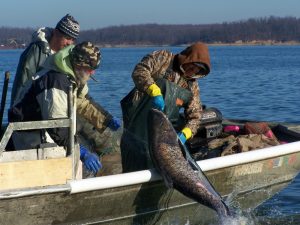
In Fisheries, Asian carp will continue to be a major focus. Commercial harvest is an effective tool for large-scale removal of the invasive fish and Fisheries director Ron Brooks said a multi-year effort to help the Asian carp processing industry expand in Kentucky is expected to bear fruit in 2017.
“We’ve been working on this for about two years and it’s finally coming around,” he said.
The department has been working with fish processors, commercial fishermen, legislators, government agencies and businesses to find ways to make a greater dent in the Asian carp population.
The proposed system would train new commercial fishermen how to harvest Asian carp and assist commercial fishermen already harvesting Asian carp while reducing costs and delays for processors, Brooks said.
“We’re reaching out to help the Asian carp-harvesting industry meet its needs and hopefully lead into expansion of their businesses, all to get rid of Asian carp,” he said. “We’re focusing a lot of our efforts on Kentucky and Barkley lakes because we believe we can have an immediate impact there. We’re trying to ensure our sportfish species aren’t taken out.”
Elsewhere in Fisheries, a long-term project to increase forage and improve fishing opportunity at Cave Run Lake will wrap up in 2017. The project focused on the Ramey’s Creek and Warix coves in 2016. Department personnel added around 1,000 trees, 500 pallet structures, 150 bucket stake attractors, 10 wooden cable spools and 50 plastic pipe trees. A map showing the locations of these fish attractors is available online at fw.ky.gov. Type “Cave Run Lake Fish Habitat Improvement Project” into the search box on the homepage.
The popular Fishing in Neighborhoods (FINs) program is adding five new lakes to its lineup: Flemingsburg Old Reservoir in Fleming County, Kess Creek Park Lake in Graves County, Leary Lake in Grant County, Logan Hubble Park Lake in Lincoln County and Rotary Park Lake in Hickman County. The addition of these lakes brings the number of FINs lakes to 43 across the state.
Anglers can start planning now where they want to fish and for what species in with the new Fishing Forecast for Kentucky’s major fisheries. The 2017 edition is available on the department’s website by clicking on the “Fish” tab and choosing “Forecast” from the dropdown menu. The annual compilation highlights new, expanding and improving fisheries across the state.
Deer hunters in Kentucky have enjoyed another successful season in 2016.
“We’re going to end up in the top 5 in terms of our overall harvest total,” said Steve Beam, Wildlife Division director for Kentucky Fish and Wildlife. “We’re producing tremendous numbers of trophy quality bucks. At the same time, our herd is healthy. Things continue to be wonderful.”
At its December meeting, the Kentucky Fish and Wildlife Commission voted to expand opportunities for youth and muzzleloader deer hunters on several wildlife management areas in 2017. The 2017-18 Kentucky Hunting and Trapping Guide, due out in July, will note these and any other pertinent changes.
John Hast was a biologist in the department’s deer and elk program before taking over as coordinator of its bear program in January 2015. He anticipates having a draft of a long-range management plan for Kentucky’s black bear population ready in 2017.
“We’ve been doing in-house research since bears returned to the state,” Hast said. “We just completed the project that’s going to provide our foundation for management for the next 15 years.
“A management plan, to me, gives me an opportunity to summarize all of that data and put it in one spot and distill it out and translate it. The plan will set forth what we’ve got but also what we’re going to be doing in the near future to refine things.”
Also in 2017, expect to hear more from the department about wild pigs in Kentucky, Beam said.
“We have re-evaluated and are in the process of increasing our efforts on wild pig eradication, working with landowners and cooperating with our partners,” he said.
In the department’s Wildlife Diversity program, led by coordinator Sunni Carr, biologists plan to conduct a statewide survey of osprey nesting locations and also start a loggerhead shrike banding project in the hopes of learning more about the migration and causes of decline for the species.
Additionally, the statewide survey for eastern whip-poor-wills and chuck-will’s-widows will be expanded to examine trends for Kentucky’s night birds. The department’s Center for Mollusk Conservation (CMC) plans to release endangered pink muckets in Kentucky for the 10th year. There are now several thousand of these mussels at more than 23 locations.
The department’s website provides a wealth of information about the work being done by each of these divisions. While there, consider purchasing a 2017-18 hunting and fishing license. The new license year starts March 1.
As temperatures drop and the risk for carbon monoxide poisoning increases, Kentuckians are urged to be aware of the dangers of carbon monoxide (CO) poisoning due to improper use of heating or cooking devices.
Items such as kerosene or propane gas stoves and ovens have been used as alternative heat sources indoors, sometimes with tragic results. Since these devices emit a colorless, odorless gas called carbon monoxide as a by-product, improper use can lead to severe cases of carbon monoxide poisoning. The Kentucky Department for Public Health (DPH), which is part of the Cabinet for Health and Family Services (CHFS) advises Kentuckians to follow these steps taken from guidelines issued by the National Center for Environmental Health to prevent carbon monoxide poisoning:
- Don’t use a generator, charcoal grill, camp stove or other gasoline or charcoal-burning device inside your home, basement or garage or outside near a window.
- Don’t run a car or truck inside a garage attached to your house, even if you leave the door open.
- Don’t use a fireplace that isn’t properly vented.
- Don’t heat your house with a gas oven.
Be sure to carefully follow manufacturers’ instructions for kerosene heaters, making sure the wick is set at the proper level and is clean. Ensure your kerosene heater is only operated in a well-vented area. Kerosene heaters require 1-K grade kerosene fuel and fuel should be clear, not colored or cloudy. To avoid the risk of fire, place kerosene heaters several feet away from all furniture, curtains, paper, clothes, bedding and other combustible materials. Infants, small children and pets should be kept away from heaters to avoid serious burns.
Seek immediate medical attention if you suspect carbon monoxide poisoning and are experiencing symptoms of carbon monoxide poisoning. Early symptoms include headache, nausea, vomiting and fatigue. Carbon monoxide poisoning is treatable.
Install a battery-operated carbon monoxide detector in your home and replace the battery when you change the time on your clocks each spring and fall for daylight savings time. If the detector sounds, leave your home immediately and call 911. On average, carbon monoxide detectors should be replaced about every five years.
“Carbon monoxide is a colorless and odorless gas that can be deadly and should be taken seriously,” said Hiram C. Polk, Jr. M.D., commissioner, Kentucky Department for Public Health (DPH). “We urge Kentuckians to take steps to prevent exposure to carbon monoxide such as allowing adequate ventilation to prevent carbon monoxide poisoning and avoiding fire hazards.”
If you are experiencing symptoms of carbon monoxide poisoning, call 911 or contact the Poison Control hot line at (800) 222-1222.
More information about carbon monoxide poisoning can be found on the Centers for Disease Control and Prevention’s website.
 In Kentucky, the coldest weather of the year often coincides with the best waterfowl hunting. This should prove especially true this year with the unusually warm start to the waterfowl hunting season that opened Thanksgiving Day.
“Late winter seems to be our best duck and goose hunting due to the lower temperatures,” said Wes Little, migratory bird biologist for the Kentucky Department of Fish and Wildlife Resources. “We should have birds moving south now with the bitter cold and snow to the north of us.”
Hunters have an extra luxury this year of concentrating on ducks in January and geese in February as there are now two extra weeks to pursue geese. Duck season closes statewide on Jan. 29 while goose season doesn’t close until Feb. 15.
“You used to wonder in January, ‘Do I hunt ducks or do I hunt geese?’, but now you can hold off the hunting pressure on geese until February,” Little said.
Ducks and geese both locate in predictable places in the late season. Food resources and open water draw birds during the stressful times of January and February.
“Find a harvested crop field that is holding birds,” Little said. “You can find both ducks and geese in corn fields when the ground is frozen.”
Little related a January goose hunt last year in a harvested corn field. “Mallard ducks were using it and we didn’t even know,” he said. “Five of us had our mallard limit in 45 minutes along with some black ducks. Some geese wanted to be about 100 yards from us, but we still harvested several of them. It was an awesome hunt.”
Hunters may take up to four mallard ducks as part of their six duck daily bag limit.
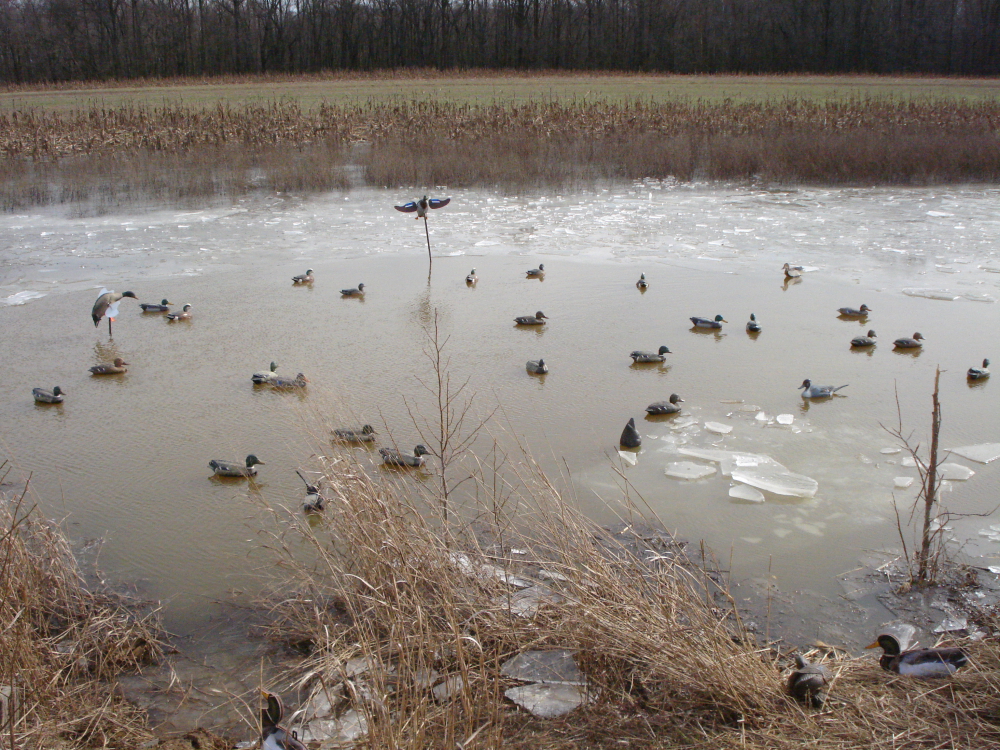
“My favorite thing in the late season is using a small number of decoys. You don’t need a mega spread,” Little said. “If you find birds while scouting, try and mimic what you saw. Are they spread out? Are they grouped together? Then, set out your decoys accordingly.”
The Ohio River also draws many ducks and geese in winter. “The Ohio River is awesome for goose hunting and ducks as well,” Little said. “If everything is frozen up, the Ohio really shines.”
The many crop fields near the river provide food for waterfowl and the river itself provides rest and loafing areas during the cold months. This draws many diving duck species not often seen by hunters in other parts of Kentucky. Hunters may harvest canvasbacks, scaup, redheads, ring-necks and occasionally a rare goldeneye.
With a hard freeze to the north and a snow line, geese also flock to the Ohio, setting up potentially fantastic goose hunting. “You have to have the right equipment,” Little said. “Hunting the Ohio River is no cake walk.”
The Ohio River is not a place for a 12-foot johnboat with a narrow beam. Wakes from barges combined with strong winds can swamp a small johnboat. Hunters pursuing waterfowl from shore must scout to find a hard bottom in the area they plan to hunt. The Ohio River drops off into deep water quickly in many places. The shoreline is often saturated with deep muck.
Zac Campbell, boating education coordinator for Kentucky Fish and Wildlife, cautions waterfowl hunters in boats to keep in mind some common sense principles while on the water.
“Don’t overload your boat with gear and people,” he said. “Plan your hunt, then hunt your plan and tell someone where you are going and how long you plan to hunt. If possible, stay near shore and don’t cross large expanses of water. Most importantly, always wear your lifejacket, the water is freezing.”
Spring-fed farm ponds that don’t freeze also provide excellent late season hunting. A couple of decoys and a homemade ground blind near the pond provide all the elements for a successful hunt.
“It is critical to use a jerk string from a decoy or an electric shaker to provide a ripple on the water if there is no wind,” Little said. “You must have some movement or the birds won’t come to your decoys.”
The weather outside may be frightful, but the waterfowl hunting is delightful in the late season. Get out and shake off the winter blues by putting some birds in the bag.
Metro Public Works will provide curbside pickup of Christmas Trees within the Urban Services District (the old City of Louisville boundaries) after the holiday. Beginning Tuesday, December 27, residents with City curbside yard waste pickup may set their Christmas trees and greenery out on their regular collection day. Trees must not be in plastic bags, and all decorations must be removed.
Drop-off sites will also be available for all Louisville/Jefferson County residents at three locations. Two of the three drop-off sites will also instantly recycle trees in to mulch that will be offered back to citizens for home use.
Those wishing to receive mulch must bring an appropriate container in which to carry it. This mulch performs particularly well for acid-loving plants such as azaleas and rhododendrons. Trees picked up from curbside will also be recycled but not offered as mulch. All lights and ornaments should be removed from trees before they are set out or dropped off.
Residents normally serviced by private waste haulers should check with those companies to see whether and when tree pickup is available.
Christmas tree vendors may recycle their unsold trees on Tuesday, December 27 ONLY, and only at the Hubbard’s Lane site.
DROP OFF LOCATIONS
East District Recycling Center, 595 N. Hubbards Lane (Bring containers to take home fresh mulch.)
Southwest Government Center, 7219 Dixie Highway (Bring containers to take home fresh mulch.)
Waste Reduction Center – 636 Meriwether Avenue (Tree drop-off only. Mulch is not available at this location.)
DATES
- December 27 through 30 and January 3 at Hubbards Lane and Dixie Hwy sites
- Through January 14 at Waste Reduction Center
TIME
9:00 a.m. to 4:00 p.m.
 Those who enjoy a natural pine, cedar, spruce or fir tree for Christmas often don’t know what to do with it after the holidays. Many resort to putting it out on the street or chucking it in the backyard until spring.
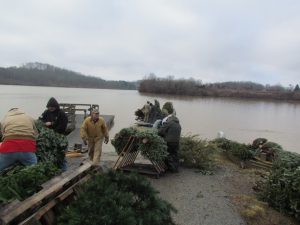
You can dispose of your natural Christmas tree and provide habitat for fish by donating it to the Kentucky Department of Fish and Wildlife Resources instead of the tree languishing in the corner of your back yard or being ground into mulch.
“Every year we try to get a large number of Christmas trees, so we can sink them as fish habitat,” said Ron Brooks, director of fisheries for Kentucky Fish and Wildlife. “We place them on wooden pallet habitat structures to diversify the habitat or sink just the trees themselves.”
Kentucky Fish and Wildlife will accept trees at 35 locations in 29 counties across Kentucky until Jan. 15. Trees must be natural and free of lights, ornaments, tinsel, garland or any other decorations.
“We added sites this year in our two most populous counties, Jefferson and Fayette,” said Joseph Zimmerman, fisheries habitat program coordinator for Kentucky Fish and Wildlife. “We added a site at McNeely Lake in Jefferson County and at Jacobson Park in Lexington. We’ve added 15 additional collection sites across the state since 2012.”
To find a convenient location near you, visit the Kentucky Fish and Wildlife website at www.fw.ky.gov and type in the keyword “Christmas” in the search engine on the top right corner of the page
The construction of most of our state-owned lakes and large reservoirs date to the period from the end of World War II to the early 1970s. As these waterbodies age, the woody cover in them melts away, leaving them starved for habitat.
“Just about all of our reservoirs and state-owned lakes have a habitat problem,” Brooks said. “The aging lakes have a bare substrate; there is not a lot of woody habitat or aquatic vegetation left, especially in reservoirs with highly fluctuating water levels.”
The Christmas Trees for the Fishes program is part of an overall effort to remedy this problem by replacing the lost habitat with items such as Christmas trees, wooden pallet stacks, buckets filled with wooden stakes and other items.
“This is an effort that every fisheries district does,” Brooks explained. “It’s helped out on lakes as large as Kentucky Lake and Lake Barkley and on our smallest state owned lakes. The Christmas trees help make our pallet stacks more complex which provides better cover for fish.”
Brooks said algae grows on the sunken Christmas trees, creating multiple benefits for fish.
“Invertebrates lay eggs on the algae and they become a food source for smaller fish, which in turn attracts larger fish,” Brooks said. “It has a two-pronged benefit by providing habitat and a food source.”
The habitat placed in the lakes by fisheries personnel is recorded for use by anglers by plotting the Global Positioning System (GPS) coordinates on maps on the Kentucky Fish and Wildlife website at www.fw.ky.gov. Type in “Lakes with Fish Attractors” in the search engine on the homepage to use this valuable information.
Don’t chuck your Christmas tree beside the shed in the backyard until March. Drop it off at one of the collection stations and make better fishing for all Kentuckians to enjoy in the years to come.
The Kentucky Fish and Wildlife Commission will meet in Frankfort for a special called session at 8:30 a.m. (Eastern time) Jan. 6 to discuss proposed changes to the state’s elk regulations.
Items on the agenda for discussion include:
- Compress or reduce the elk season;
- Eliminate elk hunting in January;
- Establish a regulation to eliminate elk hunting during deer season;
- Establish a regulation to mandate a minimum bull size of 3 points on one side;
- Establish a regulation to mandate wounding an elk ends that hunt if the animal is not successfully retrieved. Convicted hunters get substantial penalties, plus lose the right to hunt elk. Guides lose guide license for 10 years;
- Establish a wanton waste regulation for elk, deer and bear with substantial penalties;
- Establish a regulation to establish refuge (no hunting) areas at tourist/viewing areas;
- Requests for management and data collection plans to be developed by the Department for Commission Discussion;
- Meet in executive session if necessary.
Kentucky Fish and Wildlife Commission meetings are open for the public. Sessions are conducted at the Arnold Mitchell Building on the main campus of the Kentucky Department of Fish and Wildlife Resources. Kentucky Fish and Wildlife headquarters is located at 1 Sportsman’s Lane (formerly 1 Game Farm Road) in Frankfort. The entrance is located off U.S. 60, approximately 1½ miles west of U.S. 127.
