Tuesday January 27, 2026
Local Connection
 Weather
 Traffic
 @LouisvilleDispatch
 @LouisvilleDisp
 Subscribe
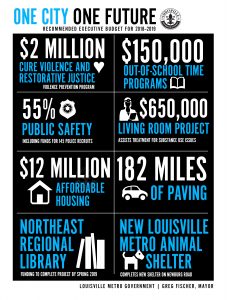 Mayor Greg Fischer proposed a 2018-2019 city budget that builds on the city’s momentum and commitment to public safety and growing jobs, despite the significant challenges of rising insurance costs and a $9.4 million bump in pension expense.
This $623 million general fund budget — with the theme “One City, One Future”— anticipates $26 million in new revenue, with 55 percent earmarked for public safety: LMPD, the Office for Safe and Healthy Neighborhoods, the Louisville Fire Department, Corrections, Emergency Services, the Criminal Justice Commission and Youth Detention Services.
“Public safety is our No. 1 priority, as evidenced by this budget and the ones before it,” the Mayor said about his eighth budget presentation, adding that the investments, and the strategy that accompanies them, is returning tangible results.
“In 2017, we saw our numbers on crime overall and violent crime in particular start to decline,” he said. “And while there’s lots of work ahead, I’m glad to say that this positive trend is continuing in 2018.”
The budget also includes investments in affordable housing, paving and workforce development, and funding to complete the Northeast Regional Library. When it opens in 2019, 90 percent of city residents will live within five miles of a full-service library.
In his remarks, the Mayor acknowledged budget challenges, including the serious impact of the state’s pension crisis and a $9.6 million employer health care cost increase. Though the budget avoids layoffs, he said, 49 positions will be eliminated through attrition. “We’ve worked to implement cuts and reductions in a way that‘s fair and minimizes the impact on city services,” the Mayor said.
The Mayor opened his presentation by highlighting Louisville’s economic momentum, evidenced by more than 72,000 new private sector jobs, 2,500 new businesses and nearly $13 billion in capital investment happening throughout the city since 2014, including a record investment of $800 million in west Louisville.
(Read the Recommended Executive Budget for 2018-19)
That progress, along with the revenue growth and smart financial planning, “allows us to continue to invest in ourselves and in key development opportunities,” he said, ranging from the Russell neighborhood transformation, including the planned Track on Ali, as well the Soccer Stadium District in Butchertown and redevelopment of Colonial Gardens in south Louisville.
(Read Mayor Fischer’s full remarks)
The budget maintains a high level of local dollars — $22.5 million — in paving roads, fixing sidewalks and creating bike lanes in the city, which reflects a commitment to the “fix it first” strategy of Move Louisville. And it provides funding to relocate LMPD headquarters, as well as the city’s vehicle impound lot.
In accordance with the city’s recently released plan to address the impact of substance use disorder, the budget increases funding to the Living Room Project, a partnership with Centerstone that helps people struggling with opioids or other substance use get treatment and mental health support instead of going to jail or the emergency room.
“We also have to continue supporting efforts to make sure citizens can meet basic needs, like housing,” the Mayor said, noting that in last three years, the city has invested nearly $30 million in the Affordable Housing Trust Fund and Louisville Cares, and is continuing that commitment this year by investing another $12 million in affordable housing.
Other budget highlights:
- Proposes $2 million for the Office for Safe & Healthy neighborhoods to fund restorative justice and violence prevention programs, including Cure Violence
- Continues commitment to the Russell neighborhood with $750,000 for private development efforts and job creation.
- Funds SummerWorks, which employed over 5,200 youth in 2017.
- Buys $7 million in first responder vehicles and equipment, such as police cars, ambulances, fire trucks, computers, defibrillators and other equipment.
- Provides $6 million to complete a new animal shelter on Newburg Road.
- Funds $2.2 million in parks upgrades, maintenance needs and repairs including a $500,000 match for the Olmsted Parks Conservancy.
- Continues funding of $1 million to gain control of vacant and abandoned properties.
- Invests $600,000 to plant trees to combat urban heat island, and improve health.
Mayor Fischer cautioned that while he remains optimistic about Louisville’s future, the state pension crisis “will be a drag on our budget for the foreseeable future” without accelerated revenue growth.
“Our economic momentum and our readiness for the future require more substantive and comprehensive revenue-producing tax reform,” he said, stressing that reform must include more local control, so that Louisville’s citizens and leaders can craft and implement strategies that work for the city.
“It would be easy in a challenging budget cycle like this to just focus on the needs of the moment. And certainly we have to address the concerns and opportunities facing our citizens today,” the Mayor said. “At the same time, we have to also keep an eye to the future. That’s been our approach from Day One, and it’s helped us work with our partners across the city to create a growing economy with tremendous potential for our city.”
 Volunteers cleaned neighborhoods, built beds for children and collected canned goods for the hungry. They donated bicycles to refugees, fed the homeless from food trucks and collected inspiring stories and scarves for women facing cancer.
Across Louisville, such projects and deeds during Mayor Greg Fischer’s seventh-annual Give A Day Week of Service amounted to more than 205,000 acts of volunteerism or compassion during the week that ended on April 22. That surpassed last year’s record of about 180,000 volunteers and acts of compassion.
Mayor Fischer, who started Give A Day in 2011 and has since expanded it to eight days that now occur as part of the Kentucky Derby Festival, said the turnout once again showed why Louisville has become known as a compassionate city that seeks to lift up all parts of the community.
“I am beyond grateful to every citizen, school, business and community group who helped make Louisville a better place during Give A Day week,” the Mayor said. “It’s inspiring to see the selfless service put forth by our community growing each year.”
Among the turnout this year: More than 19,000 joined the Brightside & Passport Health Plan Spring Community Wide Cleanups, removing litter and debris from neighborhoods, parks and schools. Dare to Care collected 30,500 pounds of food at local Kroger stores.
And 58,422 JCPS students and teachers – often entire schools and classes – again joined thousands more private and Catholic school students on service projects. WE Day’s walk of compassion drew about 3,250, mostly students who participated in service projects that collected personal care items, comprising nearly 20,000 hours of service.
Meantime, employees at local companies such as GE, Computershare and LG&E spread across the city for projects, joining Louisville Metro Government and local churches. Presbyterian Center USA brought 483 volunteers to assemble thousands of hygiene kits, while the Southern Baptist Theological Seminary sent nearly 500 volunteers on cleanups throughout Louisville.
The annual count is an estimate based on volunteers and groups who reported their work and acts of compassion, such as donated meals and other items. The success of Give A Day would not be possible without the support and coordination of Metro United Way, which matches volunteers with needy projects and organizations through the website, www.mygiveaday.com.
“Our hearts are filled with gratitude for everyone who gave time, talent, and treasure to improve our community this week,” said Theresa Reno-Weber, president and CEO of Metro United Way. “You inspire us to keep fighting each and every day for the education, financial independence and health of every person in the seven counties we serve. We know that, unfortunately, the need in our community does not last for only one week or one month – it’s here all year long. So, we invite you to continue working with us and making change by visiting metrounitedway.org and exploring ways to give, advocate and volunteer. This is how we live united!”
2018 Give A Day week of service — Notable Numbers:
30,500 – Pounds of food donated through Kroger and Dare to Care food drive
19,464 — Brightside volunteers who helped clean up Louisville
58,422 – JCPS students and teachers who participated in service projects
15,000 – Families served by personal hygiene items collected and distributed as part of WE Day
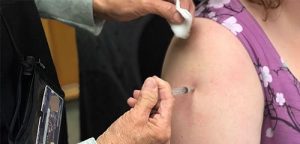
Photo: Louisville Metro Public Health And Wellness
An employee of the White Castle restaurant located at 3701 Seventh St. Rd. has been diagnosed with acute hepatitis A. As a result, customers who ate at the restaurant from April 6 to April 20, 2018 may have been exposed to the hepatitis A virus.
Symptoms of hepatitis A are fatigue, decreased appetite, stomach pain, nausea, darkened urine, pale stools and jaundice (yellowing of the skin and eyes). People can become ill 15 to 50 days after being exposed to the virus. Anyone experiencing symptoms should seek medical attention.
Hepatitis A is usually transmitted by putting something in your mouth such as an object, food or drink, which has been in contact with the feces of an infected person. In November, the Kentucky Department for Public Health declared a statewide hepatitis A outbreak. Since the outbreak began there have been 281 cases diagnosed in Louisville and more than 14,000 vaccinated.
“The best ways to prevent hepatitis A infection are to get vaccinated and to practice good handwashing,” said Dr. Lori Caloia, medical director. “Washing your hands thoroughly and often with warm water and soap, especially before preparing meals or eating, after using the bathroom or changing a diaper is a proven way to prevent the spread of diseases. Hand sanitizer is not as effective as hand washing against hepatitis A.”
The Department of Public Health and Wellness recommends anyone working in the hospitality industry, particularly those who serve or prepare food and beverages, protect themselves and others by getting the hepatitis A vaccine. White Castle will provide free hepatitis A vaccinations for their employees in the Louisville Metro area.
The department and the University of Louisville Global Health Center have partnered to offer below-cost vaccinations to all hospitality workers. The cost of the hepatitis A vaccine has been reduced from $65 to $25. Businesses with more than 20 employees can have a nurse come to their site to provide the immunizations. Businesses with fewer than 20 employees may designate vaccine for their employees to be immunized at U of L’s walk-in clinic. To arrange these employee immunizations, contact Dr. Ruth Carrico at 502-852-1324.
To date more than 50 local food service establishments have chosen to provide their employees the hepatitis A vaccine through this effort.
For more information about hepatitis A visit https://louisvilleky.gov/government/health-wellness/hepatitis or call 211.
Credit: Louisville Metro Police
Two Louisville Metro Department of Corrections Probationary Officers were terminated on Monday, April 24, after being found in violation of the department’s Use of Force Policy.
Corrections Officers David Schwartz, 47, and Devan Edwards, 21, both hired on Sept. 8, 2017, were found to have used excessive and unnecessary force on a Metro inmate who they say failed to follow their directions in an incident on April 15.
After viewing body camera video of the incident, Corrections Director Mark Bolton made the decision to immediately terminate the two officers, who did not have contractual rights because they were under probationary employment.
“We conduct background checks, psychological tests, polygraphs, and we train our corrections officers for nine weeks to the best corrections training standards in the country, followed by a field training period with seasoned corrections officers lasting three additional weeks,” Bolton said. What I saw on that video is disturbing and is not reflective of what we expect from our staff.”
The 19-year-old inmate was cleared by the department’s medical staff, suffered no apparent serious injuries and continues to be monitored by the jail’s health care team.
Bolton said the incident has been turned over for review by Louisville Metro Police, as well as an internal investigation by the department’s Public Integrity Unit.
Credit: KY State Parks
Guests have the unique opportunity to experience a “Zip and Drop” adventure at Carter Caves State Resort Park on May 5.
The “zip” is a 200-foot zipline trip on the Smoky Bridge Highline, 50 feet above the ground. The “drop” is a 50-foot rappel from Smoky Bridge, a 120-foot long natural rock bridge at the park. Experience Smoky Bridge in a way few visitors get to see. No previous experience is necessary to participate.
“The reward is not only the adrenaline rush from being suspended by rope above the forest floor, but the scenery from this perspective is a large reason to try this,” said Paul Tierney, a naturalist at Carter Caves. “Imagine being perched on a wooden platform, looking down into Smoky Valley at the lush spring greenery peaking up from the forest floor as you’re clipped into the rigging and taking that first step off, and gliding down the rope through the valley.”
Each trip is $5 a person. Participants must be ages 6 and older and weigh 250 pounds or less. Make a reservation by calling the park at 606-286-4411. The zip and drop will be open 9 a.m. to 5 p.m.
“There’s not another place in the state you can experience this kind of adventure for only $5,” Tierney said. “It’s really a one-of-a-kind event at a beautiful location. A family of four can do something that perhaps they’ve never done before for only $20 as a family.”
Besides the zipline and rappel, Carter Caves offers cave tours and more than 30 miles of hiking trails. Early May is prime wildflower season at the park.
Carter Caves State Resort Park is located at 344 Caveland Drive in Olive Hill. The park has a lodge with a restaurant, cottages and campground. Besides cave tours, activities include hiking, boating and fishing. During summer months, swimming and horseback riding are also offered. For more information about the park, call 606-286-4411 or visit www.parks.ky.gov.
 The Kentucky Derby Festival is underway and the Kentucky Exposition Center plays host to four popular events.
Kentucky Derby Festival Race Expo & Packet Pick Up: Thursday, April 26 – Friday, April 27 4 p.m. – 8 p.m. – Thursday 11 a.m. – 9 p.m. – Friday More than 15,000 Kentucky Derby Festival Marathon and miniMarathon participants and their families stop by this annual event to pick up required information for the two races. During this time, attendees can visit exhibitors featuring fitness resources, tools and apparel. Located in the West Wing and Pavilion.
U.S. Bank Great Balloon Glow: Friday, April 27 6 p.m. Gates open 9 p.m. Glow begins Spectators watch as pilots fill hot-air balloons that glow against the evening sky, set to a special musical score. Visitors are invited to meet the pilots and ask questions. The balloons are parked in Lots C and D.
Thorntons Great Bed Races: Monday, April 30 4 p.m. Official tailgate party 6 p.m. Parade of the beds 7 p.m. Races begin Crowds cheer as teams dressed in costumes push decorated beds in a 600-yard dash to the finish line. Awards are presented for fastest course times, best decorated, most entertaining and more. The races take place in Broadbent Arena.
Republic Bank Pegasus Parade Preview Party Presented by Mega Caverns: Tuesday, May 1 5 – 9 p.m. Open to the public Visitors get a sneak peek at inflatables and floats, complete with dancing costumed characters. Children can also get an autograph or photo of the Derby Festival Queen and Royal Court. The preview party is held in South Wing C.
Admission to all events is free with a 2018 Kentucky Derby Festival Pegasus Pin. Parking at the Kentucky Exposition Center is $8 per vehicle and $20 per bus.
For more information about the Kentucky Derby Festival, visit www.kdf.org.

Photo: Kentucky Department Fish and Wildlife
Hunters interested in entering this year’s elk hunt drawing have until midnight (EST) April 30 to buy applications. Hunters can apply online at the department’s website, fw.ky.gov.
Kentucky residents and non-residents are eligible to apply for four permit types but can only be drawn for one. Each application costs $10.
Kentucky Fish and Wildlife will issue 700 general quota hunt permits and 10 youth permits this year through a random computer drawing conducted in early May by the Kentucky Commonwealth Office of Technology. Results will be available to applicants on the department’s website May 15.
Sixty-four percent of bull elk hunters using a gun last year enjoyed a successful hunt and 48 percent of hunters utilizing archery equipment successfully harvested a bull. The success rate for cow archery hunters was 28 percent last year and 47 percent among hunters using a firearm for cow elk.
“Our herd is strong and healthy,” said Gabe Jenkins, deer and elk program coordinator with the Kentucky Department of Fish and Wildlife Resources. “However, the herd dynamics have changed in recent years. Hunters will have to work to be successful and time spent scouting will greatly increase chances for success.”
The season limit of 250 bulls and 450 cow elk is unchanged from last year, as is the allotment among tag types.
Kentucky Fish and Wildlife will issue 150 firearms permits and 100 archery/crossbow permits for bulls; 290 firearms permits and 160 archery/crossbow permits for cow elk.
Demand is greatest for the bull firearms permit and lowest for the cow archery hunts.
The bull archery/crossbow season opens in September. The bull elk firearms seasons are spread over two separate, weeklong hunts in October while the cow elk firearms seasons are split into two weeklong hunts, both in December.
Hunters ages 15 and younger also can apply for the youth-only quota hunt during the same application period as the general elk quota hunt drawing. They may apply for the general quota elk hunt drawing as well, but cannot be drawn for both in the same year.
A landmark restoration effort re-established an elk herd in the state’s scenic southeastern region and created one of the most sought-after hunting opportunities east of the Rocky Mountains. Kentucky’s elk herd is the largest east of the Rocky Mountains and more than all the states east of the Mississippi River combined. The elk restoration zone in southeast Kentucky covers 16 counties and more than 4 million acres.