Sunday January 25, 2026
Local Connection
 Weather
 Traffic
 @LouisvilleDispatch
 @LouisvilleDisp
 Subscribe
 Mayor Greg Fischer announced changes meant to reduce the role of Louisville Metro Police in providing traffic details and security for special events.
Under new guidelines, organizers of special events in the city will be asked to increase volunteer participation during their events for positions that may not require a sworn police officer. Additionally, organizers will be asked to use private security companies when possible. Organizers will also be encouraged to use pre-designated routes that will need a limited or reduced number of sworn law enforcement.
“The sheer number of events throughout the city each week is a sign of vibrancy and community,” Mayor Fischer said. “But we must balance that with the need for LMPD to spend fewer hours covering special events.
“This new process allows our public safety teams to better coordinate with community groups to provide a better experience for participants and other citizens, while freeing up police officers to focus on other pressing needs.”
Earlier this year, the special events permitting process moved to Louisville Metro Emergency Services from Louisville Metro Codes and Regulations. Within Emergency Services, recently appointed Deputy Director Kelly Jones will oversee special events permitting, along with his other duties.
Jones will work with community groups to find appropriate venues for special events, with the goal of reducing LMPD involvement and street closures. The change will also allow for better internal coordination of city services for special events.
Jones retired last year from Louisville Metro Police. His most recent role included leading the city’s law enforcement details for special events, including Thunder Over Louisville and the Kentucky Derby and Oaks. He also played a large role in this past summer’s commemoration of boxing legend Muhammad Ali.
“Louisville Metro is committed to facilitating safe experiences for event participants,” Jones said. “I’m pleased to return to public service, and to lend my experience coordinating logistics and security for events.”
More information about special events policies can be found here: https://louisvilleky.gov/government/emergency-services/special-events
 The Home, Garden & Remodeling Show opened this morning at the Kentucky Exposition Center. The show features home improvement and landscaping exhibitors from all over the nation, but the majority are from right here in Kentucky. The more than 300 exhibitors will showcase their products and services, which include everything from hot tubs and roofing materials to fire places, landscaping and deck furniture.
The show also features many information sessions that will cover gardening and landscaping tips, insect control (as well as what not to control), and cooking classes. L&N Federal Credit Union will be sponsoring a tree giveaway: 4,000 saplings of several varieties will be given to show guests who stop by their booth.
The Kids Craft Area for children up to 10 years of age provides the opportunity to take home a flower that they planted themselves, and a bug house that will feature tropical insects. If you need a break from all of the information, there will also be multiple performances each day that will feature performing Frisbee dogs.
The show exhibits occupy the Kentucky Exposition Centers’s south wing halls B & C all weekend. Show hours today and Saturday are from 10 AM to 9 PM and Sunday from 10 AM until 5 PM.
Pets, excluding service animals, will not be allowed into the show area. Admission is $10 per person (16 and older) with free admission for children accompanied by an adult. Those with a military ID will be admitted free and seniors will receive a discount. Credit cards will not be accepted at the Ticket Gate. Advanced tickets are available online through Facebook with a Buy 1, Get 1 Offer or through the show page with a $2 discount along with a one year subscription to one of four magazines. Kentucky Exposition Center parking is $8 per car.
Follow Louisville Dispatch on Facebook for more details and additional photos from the 2017 Louisville Home, Garden, and Remodeling Show. Continue reading
 The Louisville Water Works and Pumping Station and a historic section of downtown Louisville are subjects of three historical markers that the Kentucky Historical Society (KHS) will dedicate in early March.
A new marker at the Water Tower will recognize the contributions of George Warren Fuller to Louisville’s modern water filtration system. Fuller, now known as “the father of sanitary engineering,” conducted the first scientific testing of water filtration at the site between 1895 and1897. The data he collected led to a three-part system that includes sand and gravel filtration. This system purified Ohio River water so well that when filtering began in 1909, the number of deaths from typhoid fever declined by 60 percent. Fuller’s purification system formed the basis of modern water filtration. The Louisville Water Co., sponsors the marker.
A second marker will be unveiled at the same event to replace one previously at the site. It tells the story of the Louisville Water Co., pumping station and water tower. Both have been National Historic Landmarks since 1971. Friends of the Water Tower sponsor this marker.
The dedication will be at 10 a.m., Wednesday, March 1 at 3005 River Road.
A third new marker tells the history of a section of the Shelby Park neighborhood which C.P. Moorman, a distiller, developed between 1884 and 1885. It includes Italianate residences, Queen Anne row houses and commercial buildings.
The reverse side of the marker pays tribute to Mason Maury (1846-1919), a prominent Louisville architect credited with building the neighborhood. Maury was a Louisville native known for his use of the “Chicago School” design style. He began his career around 1880. By 1902, he had more than 700 buildings to his credit. Among his notable designs are the Kaufman-Straus and the Louisville Trust Building. The Shelby Park Neighborhood Association sponsors the marker.
The dedication will be at 1 p.m., Saturday, March 4, in the 300 block of St. Catherine St.
More than 2,400 historical markers statewide tell Kentucky’s history. More information about the marker application process and a database of markers and their text is available at history.ky.gov/markers. Also available on the site is the Explore Kentucky History app, a source of supplemental information about marker topics and virtual tours of markers by theme. KHS administers the Kentucky Historical Marker Program in cooperation with the Kentucky Transportation Cabinet.
Shelter life is not easy for any animal. It takes a toll on them. Imagine yourself cooped-up in a kennel. Staff members and volunteers at Louisville Metro Animal Services do their best to interact and engage with the shelter animals, but it’s not enough. That’s why LMAS Foster Coordinator, Stephanie Jackson, wanted to organize a Yoga Cats event. “The benefits of an event like this are four-fold. It promotes adopting and fostering, raises money for our foster program, and gives our shelter animals a chance to socialize.”
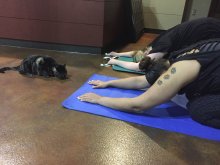 LMAS will release its shelter cats to roam freely as yogis practice. Picture yoga mats, dim lighting, relaxing music and calming scents, with curious kitties thrown into the mix. “We hosted our first Yoga Cats event on February 13th and it was such a success, we decided to host another! Everyone had a smile on their face as they interacted with cats and enjoyed yoga. This is such a unique event that benefits everyone involved.”
LMAS’ next Yoga Cats class is set for Monday, March 13, from 6:30 p.m.-8 p.m. at the LMAS Animal House Adoption Center (3516 Newburg Rd.) A $20 donation to benefit the LMAS foster program will grant you a spot in the class. To secure your spot, please send an email to stephanie.jackson@louisvilleky.gov. LMAS has room for 40 yogis. All participants must sign a waiver to interact with cats during the class. Please bring your own yoga mat.

Photo from Louisville Metro Parks and Recreation
Award-winning country/folk band Old Crow Medicine Show will be paying homage to the legendary Bob Dylan when they make a tour stop at the Iroquois Amphitheater on Friday, June 2.
The platinum-selling band, who are two-time Grammy Award winners, are embarking on a 29-date tour, during which they will be playing Dylan’s iconic album Blonde On Blonde in its entirety at each stop.
The band is also promoting its own recreation of the album that was recorded live at the CMA Theater inside the Country Music Hall of Fame and Museum located in Nashville in May 2016. Fans can order the album, titled 50 Years of Blonde on Blonde at the Old Crow Medicine Show online store and everywhere else on Friday, February 24.
Tickets will also go on sale for the show at the Iroquois Amphitheater at 10 a.m. on Friday, February 24 at www.ticketfly.com. Tickets are $39.50 for the uncovered section of the amphitheater and $49.50 for the covered portion.
Fans can also buy tickets at the Iroquois Amphitheater box office, 1080 Amphitheater Road right off New Cut Road in Iroquois Park, from 9 a.m. to 4 p.m. Monday through Friday.
Gates for the show will open at 6:30 p.m. on Friday June 2, and the show will start around 8 p.m. No coolers or outside beverages are allowed inside of the amphitheater, although a full range of concessions, including alcoholic beverages, will be for sale.
Tickets to two other upcoming shows – Shovels and Rope (Friday, May 12) and Louder Than Life Presents: Skillet with Starset and Sylar (Sunday, May 21) will also go on sale at the Tickefly website on Friday morning.
About Old Crow Medicine Show
Old Crow Medicine Show is comprised of members Ketch Secor, Morgan Jahnig, Chance McCoy, Cory Younts, Kevin Hayes and Critter Fuqua. The Country Music Roots band and Grand Ole Opry members have five studio albums to their credit, Old Crow Medicine Show (2004), Big Iron World (2006), Tennessee Pusher (2008), Carry Me Back (2012), Remedy (2014) and appeared on countless albums by other artists. They’ve established a global tour following, received the Americana Music Association Trailblazer Award and shared the stage with artists such as Willie Nelson, Brandi Carlile, Mumford & Sons, The Lumineers, John Prine and The Avett Brothers. The PLATINUM selling band are two-time GRAMMY-winners including Best Folk Album in 2014.

Photo: KHS
Last week, the Kentucky Historical Society (KHS) announced recipients of the first grants from the Kentucky Local History Trust Fund (KRS 171.325), a funding pool that supports local history organizations’ efforts to preserve and tell Kentucky’s stories.
Seventeen organizations from 16 counties across the Commonwealth received grants totaling $9,504.30. Individual amounts range from $290 to $1,000 for projects related to collection conservation, education, promotion, exhibits and strategic planning.
Kentucky Local History Trust Fund grant recipients include:
- Appalshop, Inc., $1,000, Letcher County, for collection management
- Highlands Museum and Discovery Center, $1,000, Boyd County, for collection management
- The Friends of Audubon, $1,000, Henderson County, for exhibit artifact conservation
- Ben E. Clement Mineral Museum, $909, Crittenden County, for educational programming
- McDowell House Museum, Inc., $700, Boyle County, for collections management
- American Printing House for the Blind, $700, Jefferson County, for exhibit installation
- Bluegrass Heritage Museum, $600, Clark County, for collection management
- Boone County Public Library, $500, Boone County, for collection management
- Shelby County Historical Society, $500, for organization development/management
- Montgomery County Historical Society, $500, Montgomery County, for exhibit artifact conservation
- Erlanger Historical Society, $355.30, Kenton County, for collections management
Six groups received $290 each to enroll in the American Association for State and Local History Standards and Excellence Program for History Organizations field-based standards program. Participation in a standards-based program such as this one is one of the requirements for grant eligibility.
- Duncan Tavern Historic Center, Bourbon County
- Historic Paris-Bourbon County/Hopewell Museum, Bourbon County
- Hickman County Historical and Genealogical Society, Hickman County
- Riverview at Hobson Grove, Warren County
- Allen County Historical Society, Allen County
- Kentucky Railway Museum, Inc., Nelson County
Local History Trust Fund money comes from Kentuckians who donate a portion of their state income tax refund (as little as $1 or as much as the entire refund). The Kentucky Historical Society administers the Local History Trust Fund, accepting applications and awarding grants. For this work, it may reserve 15 percent of the annual contributions to cover administration costs.
Although we’ve seen many warm fronts this winter with temperatures in the 60s just this past weekend, the water in our highland reservoirs is still cold.
Water temperatures are in the high 40s in Lake Cumberland, Dale Hollow and Laurel River Lake. Once water temperatures drop below 50 degrees for extended periods, threadfin shad begin to suffer from the cold water.
“Threadfin shad get thermally stressed by winter water temperatures, especially in late winter,” said Jeff Ross, assistant director of the Fisheries Division for the Kentucky Department of Fish and Wildlife Resources. “They begin to twitch and spasm as they try to fight off death.”
Smallmouth bass, as well as spotted and largemouth bass, instinctually know to eat these weakened baitfish. The float-and-fly technique imitates stressed shad in cold water as good as anything.
“Many bass lures, such as jerkbait, use twitching movement to draw strikes,” Ross said. “The little fly twitching in place is irresistible to a smallmouth in the winter.”
Born in the deep, clear lakes of east Tennessee and inspired by crappie anglers complaining of big smallmouth bass breaking off tiny hair jigs fished deep in the winter months, the float-and-fly technique employs long, light to medium-light power spinning rods and 4-pound line to present small 1/16-ounce to 1/8-ounce jigs under a bobber.
The tiny jig is the “fly” in the float-and-fly technique. For generations, smallmouth anglers in Kentucky and Tennessee call hair jigs “flies.”
The long spinning rod, from 8 to 11 feet in length, is necessary as you suspend the diminutive jig 8 to 14 feet deep. Casting such a presentation on a rod shorter than 8 feet is nearly impossible. Fly anglers use 8-weight rods to suspend 1/32- to 1/48-ounce jigs under large strike indicators, employing light fluorocarbon line as the tippet. The lighter 1/48-ounce jig is much easier for a fly angler to cast with a leader and tippet running at least 8 feet long.
The “flies” are made of either craft hair or duck feathers or a combination of both. The float-and-fly technique has grown so popular that national outfitters carry rods designed for it. Tackle shops in the Lake Cumberland and Dale Hollow Lake region sell them as well. Float-and-fly rods also make excellent crappie and panfish rods.
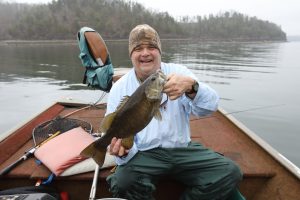 All you do is load the spinning reel with 4-pound co-polymer or fluorocarbon line and clip on a 7/8-inch pear-shaped plastic bobber 8 feet above the fly. Adjust the depth of the fly until you get a “pull down” on the bobber from a fish. There are specially weighted foam bobbers designed for the float-and-fly technique that grant better casting distance. The internal weight in these bobbers makes them roll over on their side if a big smallmouth hits the fly and moves shallower.
Lake Cumberland presents an ideal opportunity to catch smallmouth bass, as well as fat, healthy spotted bass and even hand-sized bluegill on the float-and-fly right now. During the drawdown of Lake Cumberland to repair Wolf Creek Dam several years ago, trees grew on the exposed shoreline. Now with normal water levels, these trees are at the perfect depth to offer shelter for big smallmouth and spotted bass as they await a school of baitfish to ambush.
The quivering fly hovering just above the sunken trees pulls these fish out of their lairs to strike. Female smallmouth bass need to feed in late winter to power the development of the eggs in their abdomens they will drop into nests later this spring.
The best flies on Lake Cumberland are craft hair jigs in combinations of blue, chartreuse, grey or white. White, sky blue and pink craft hair jigs also work well on this lake.
Duck feather jigs with wisps of red or pink craft hair seem to draw more strikes on Dale Hollow. These colors work well at Laurel River Lake, too. Both Dale Hollow and Laurel hold trout and some anglers believe their presence makes these fly colors work better in these lakes.
Fish the float-and-fly near the main lake in winter on these reservoirs. The best fishing occurs when your back faces lots of big, deep water.
Remember to allow your fly to strike the water’s surface on the back cast. This provides resistance on the forward cast that loads the long spinning rod, leading to much improved casting distance.
Applying a petroleum jelly-based shad scent, called “fish dope,” improves the delectability of the fly to smallmouths. Tackle shops and retailers in the Lake Cumberland or Dale Hollow region sell fish dope, but any petroleum jelly-based shad scent will work. Those with glitter in them are best.
On bright days, trimming a fly to match the bend of the hook and heavily applying dope to where the fly resembles a small stick often makes the difference between being skunked or catching fish.
A month of good float-and-fly fishing awaits anglers until warming waters puts big smallmouth or spotted bass on the prowl and willing to chase lures. This technique also fools huge largemouth bass on farm ponds and small lakes in late winter.
Remember to buy your fishing license soon. Feb. 28 is the last day of the current license year in Kentucky.
