Friday January 30, 2026
Local Connection
 Weather
 Traffic
 @LouisvilleDispatch
 @LouisvilleDisp
 Subscribe
Photo: Louisville Metro Parks and Recreation
Metro Parks & Recreation is offering an affordable family golfing package at its nine golf courses on Tuesday, July 4.
For only $25, a family of up to four members can play nine holes at any Metro Parks course. The $25 includes greens and cart fees, and families can take advantage of the deal after 4:30 p.m. on July 4.
Families are encouraged to call in advance to book a tee time at the golf course of their choice.
“Our courses are in great shape, and we’re hoping for a lot of play from families this summer,” said Metro Parks and Recreation Director Seve Ghose. “This special leaves plenty of room to play nine holes and enjoy a family barbecue and even fireworks at night.”
Metro Parks golf courses are open from daylight to dark seven days a week.
ABOUT METRO PARKS GOLF:
Louisville’s nine public golf courses offer a quality golfing experience at some of the most affordable prices in the nation. Each course has its own unique character, and some consistently rank among Kentucky’s best and most challenging courses. The nine municipally-owned golf courses meet the needs of everyone from beginners to scratch golfers. For more information, visit https://louisvilleky.gov/government/parks/golf-courses
Bobby Nichols Golf Course, 4301 E. Pages Lane, 502/937-9051 (9 holes)
Charlie Vettiner Golf Course, 10207 Mary Dell Lane, 502/267-9958 (18 holes)
Cherokee Golf Course, 2501 Alexander Road, 502/458-9450 (9 holes)
Crescent Hill Golf Course, 3110 Brownsboro Road, 502/896-9193 (9 holes)
Iroquois Golf Course, 1501 Rundill Road, 502/363-9520 (18 holes)
Long Run Golf Course, 1605 Flat Rock Road, 502/245-9015 (18 holes)
Seneca Golf Course, 2300 Pee Wee Reese Blvd, 502/458-9298 (18 holes)
Shawnee Golf Course, 460 Northwestern Parkway, 502/776-9389 (18 holes)
Sun Valley Golf Course, 6505 Bethany Lane, 502/937-9228 (18 holes)

Credit: KY State Parks
Let the Kentucky State Parks help you celebrate the 4th of July weekend this year!
Several state parks are planning special events that include fireworks displays, picnics, entertainment and more.
These parks are planning fireworks shows: Kenlake, Kentucky Dam Village, My Old Kentucky Home, Lake Barkley, Lake Cumberland, Barren River Lake and Rough River Dam.
There will also be special events at campgrounds as well as entertainment and recreational activities.
For a list of July 4th events at state parks, visit: http://parks.ky.gov/fourth-of-july/
For more information about Kentucky State Parks, including lodging and camping reservations, visit: www.parks.ky.gov
 The nationwide opioid epidemic continued taking its lethal toll on the Commonwealth last year, driving up overdose deaths to unprecedented levels with an ever-stronger mix of fentanyl, heroin and prescription pills.
According to a report released by the Kentucky Office of Drug Control Policy, fatal overdoses totaled 1,404 in 2016, a 7.4 percent increase from the previous year. Of those cases, toxicology data was available for 1,330 deaths.
Fentanyl, an extremely potent opioid that is often blended with heroin and other drugs, contributed to nearly half of all fatalities during the year. It was a factor in 623 lethal overdoses, up from 459 in 2015. Heroin was involved in 456 deaths.
“Nearly every community in Kentucky experienced a fatal drug overdose last year— if that’s not a wake-up call, I don’t know what is,” said Gov. Matt Bevin. “We don’t have the luxury of pretending there isn’t a massive problem. The consequences of the opioid crisis are far-reaching, affecting every corner of our communities. We must stand united against the opioid scourge and work together to find solutions. Failure is not an option.”
The numbers are part of the 2016 Overdose Fatality Report, which was compiled with data from the Kentucky Medical Examiner’s Office, the Kentucky Injury Prevention & Research Center and the Kentucky Office of Vital Statistics. A copy of the full report is available here.
It shows that Louisville, Lexington and Northern Kentucky experienced the highest number of lethal overdoses, but nearly every community suffered fatalities. Leslie County had the highest number of deaths on a per capita basis, followed by Bell, Powell, Gallatin and Campbell counties.
Those most likely to lose their lives to a drug overdose were people between the ages of 35 and 44. More than 400 in that age group died in 2016.
“These are mothers and fathers, veterans, co-workers and friends,” said Kentucky Justice Secretary John Tilley. “We are in a daily battle to reach them before we lose them, and we must continue tapping every available resource to confront this problem with both force and compassion.”
Fentanyl, a Schedule II narcotic, began overtaking heroin in 2015 as the leading contributor to overdose deaths in Kentucky. The drug is 30 to 50 times more potent than heroin and can prove deadly at very low levels, according to the U.S. Drug Enforcement Administration (DEA).
At the same time, illicit drug cartels have been producing newer and more potent fentanyl analogues, which further increases the risk of death. Carfentanil, for instance, is approximately 100 times more potent than fentanyl, the DEA reports.
Van Ingram, executive director for the Kentucky Office of Drug Control Policy, said fentanyl is frequently mixed with heroin or pressed into a pill form, leaving many users unaware that they are ingesting the drug. That has escalated an already deadly crisis of opioid abuse that started more than a decade ago with prescription painkillers.
“Fentanyl’s impact is really unprecedented,” Ingram said. “Users have no way of knowing what drugs they are taking, and even the smallest amounts can trigger a lethal reaction. We’ve seen cases where a bad batch of drugs has led to dozens of overdoses in a single community overnight.”
Naloxone, a lifesaving antidote that can reverse an opioid overdose, is now widely available in many Kentucky communities; however, it is not always effective against fentanyl, Ingram said. Emergency responders are seeing cases that require several doses of naloxone to revive the victim.
“Government, healthcare, law enforcement – we are all working furiously to save lives,” Ingram said. “But even the best policies and medications have limits. That’s why it is critical that we continue taking a multi-faceted approach, and every Kentuckian can help by spreading the word about the dangers of these drugs.”
Kentucky is a national leader in drug control policy, and the Bevin Administration has worked with the Kentucky General Assembly over the past two years to ramp up the fight against opioids.
This year, the legislature passed House Bill 333, which gives the state flexibility to schedule new fentanyl analogues as they arrive on the streets. It also limits opioid prescriptions for acute pain to a three-day supply unless a doctor provides written justification in medical records for a larger amount.
In 2016, Gov. Bevin and the General Assembly also increased funding for anti-drug efforts in the state budget, allocating $15.7 million to combat opioids in the current fiscal year, up from $10 million the previous year. Another $16.3 million has been allocated for fiscal year 2018.
Among other significant findings in today’s report:
• Jefferson County had the most overdose deaths of any county with 364, up from 268 in the 2015 report. It also had the largest year-to-year increase in overdose fatalities.
• The largest decrease occurred in Kenton County, which had 22 fewer fatalities in 2016 compared to the previous year. Other counties with significant declines include Bell County, which declined by 10, and Knox County, which declined by 8.
The top five counties for heroin-related overdose deaths, using data from the Kentucky Medical Examiner and coroner reports, were:
- Jefferson County – 122
- Fayette County – 48
- Kenton County – 20
- Campbell County – 17
- Boone County – 12
The top five counties for overdose deaths by county, per capita, were:
- Leslie County – 66.25
- Bell County – 58.53
- Powell County – 56.51
- Gallatin County – 56.19
- Campbell County – 52.05
The top five counties for fentanyl-related deaths were:
- Jefferson County – 182
- Fayette County – 59
- Kenton County – 26
- Boone County – 25
- Campbell County – 21
The top five counties for deaths related to heroin and fentanyl in combination were:
- Jefferson County – 59
- Campbell County – 21
- Fayette County – 20
- Boone County – 12
- Kenton County – 11
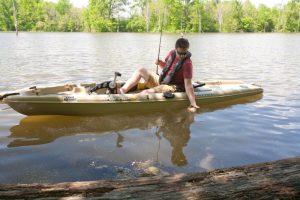
Photo: Kentucky Department Fish and Wildlife
A car, truck or sport utility vehicle with a couple of kayaks on the roof with fishing poles visible through the back window is an increasingly common sight on Kentucky highways.
Sales data shows kayak fishing and related kayak accessories increasing in popularity. Some of this popularity has to do with many baby boomers reaching retirement age and wanting a new hobby.
Price is another aspect of the rise in popularity of kayak fishing. They are a replacement for a fishing boat for many people scared off by the rising cost of power boats.
While many associate kayaks with flowing water, a huge number buy a kayak to fish small lakes, the backwaters of reservoirs, rivers and large farm ponds.
“If you want to fish mainly flatwater, the longer, the better for a kayak,” said Nathan Depenbrock, co-owner of Canoe Kentucky, an outfitter along the banks of famed Elkhorn Creek near Frankfort. “Length in a kayak gives you speed and tracking. By speed, we don’t mean miles per hour. Speed in a kayak how far you go without paddling. It is also called the glide.”
Length is relative to kayaks. Two feet of length makes a big difference in how the boat performs. “The ideal length for Kentucky is 12 to 13 feet,” Dependbrock, who’s paddled waters from Rio Grande River north to the Great Lakes, explained. “A major consideration is to buy a boat you can get to the water. Make sure it fits in the bed of your truck or on top of your vehicle. A kayak that is too heavy is no good because you won’t use it.”
As kayaks go longer than 14 feet, they also get narrower. “The long kayaks are designed for paddling long distances, not for stability,” Depenbrock said. “They can get squirrely at rest.”
This is why for fishing, the 12- to 13-foot long kayak makes the best choice. It is long enough for speed, but short enough for width and stability.
“I really would not go less than 11 feet long,” Depenbrock said. “Being in a boat of 10 or 11 feet is a really frustrating way to paddle on flatwater. They don’t perform well at all.”
He also prefers a sit-on-top or the relatively new hybrid kayaks for flatwater paddling and fishing. “Stay away from the sit in kayaks,” Depenbrock explained. “They are not meant to fish out of.”
Depenbrock also said anglers fishing lakes, rivers or reservoirs out of a kayak must keep in mind their low profile and short length makes a kayak hard to see.
“We blend in so much in kayaks, especially on our big lakes,” Depenbrock said. “Kayaks can get down in between waves and not be seen. Color is important. Make sure you have a safety flag, a bright paddle or even one of those bright safety vests so other boaters can see you. Always wear something bright.”
Practice getting back into your kayak from the water before launching. “On bigger lakes, it is really important,” Depenbrock said. “You have to be able to get back in the kayak if something happens and are far from the bank.”
Depenbrock enjoys flatwater kayaking on several spots in Kentucky. “Grayson Lake is one of my best places to paddle,” he said. “The scenery is unbelievable. A lot of the rock grottos and other really cool spots are only accessible by kayak.”
He also loves the Kentucky River. “Every pool in the Kentucky River has its own unique features,” Depenbrock said. “Everywhere on the Kentucky River is beautiful, but Pool 6 upstream to Pool 10 is some of the most spectacular scenery in Kentucky. The area in Pool 7 around Camp Nelson is unbelievable. The Kentucky River has a ton of access for paddlers to use as well.”
In fall, Depenbrock moves down river to Pool 2. “There is good wildlife in Pool 2,” he said. “We see bald eagles, coyotes, white-tailed deer, wild turkeys, waterfowl and other kinds of birds.”
Depenbrock is also exploring the forks of the Kentucky River. “The forks of the Kentucky are really looking good, especially the North Fork of the Kentucky River,” he said. “They are really improving. The cleanups are starting to show. I am going to enjoy exploring more of the forks in the coming years.”
No matter which of these scenic spots Depenbrock is paddling, he always wears his PFD (personal floatation device), commonly called a lifejacket. “No matter what time of year, I never paddle without my PFD,” he said.
Summer is a time of enjoying water sports. Keep these tips in mind if you plan to get a kayak to fish the many smaller state-owned lakes, reservoirs and rivers in Kentucky.
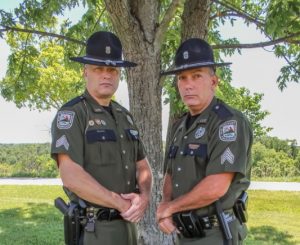
Photo: Kentucky Department Fish and Wildlife
Fast action by conservation officers with the Kentucky Department of Fish and Wildlife Resources saved the life of a volunteer who collapsed June 17 at a Northern Kentucky sporting event for children. An ambulance transported the victim to St. Elizabeth Hospital-Edgewood Campus for treatment.
“Everyone is proud of these officers,” said Kentucky Fish and Wildlife Commissioner Gregory Johnson. “Their training and quick response turned a potentially tragic situation into one of hope.”
The incident occurred Saturday morning during the annual Youthfest at Lloyd Wildlife Management Area (WMA) near Crittenden. Kentucky Fish and Wildlife Sgt. Scott Horn was assisting with the event when he saw a volunteer with the Boone County Bow Hunters Club collapse to the ground.
Horn summoned fellow department Sgt. Chris Fossitt, who radioed for an ambulance. Horn and Fossitt could detect no pulse on the victim. The two immediately began performing the chest compressions they learned as part of their professional training. Kentucky Fish and Wildlife Capt. Charles Phillips placed a CPR mask on the victim to assist with breathing.
The officers continued their CPR efforts 10-15 minutes. Phillips assisted with a defibrillator in an attempt to restart the victim’s heart, but it proved unsuccessful. The officers continued CPR efforts until the arrival of an ambulance. By this time, thanks to the continuous chest compressions applied by Horn and Fossitt, Phillips detected a pulse.
The victim, who is not being named due to federal privacy laws, is currently recovering at St. Elizabeth Hospital.
The Fifth District Federation of the League of Kentucky Sportsmen sponsors Youthfest. Fifth District Director Mike Coyle, who witnessed the events, credited the actions of the Kentucky Fish and Wildlife officers with saving the man’s life. “Without their superior training and quick action,” Coyle said, “I don’t believe the outcome would be the same.”

Photo: Muhammad Ali Center
In the Shadows: Photography Exhibit by Howard Bingham opens to the public during a special “Night at the Museum” on Wednesday, July 5th from 5:00-8:00 p.m. at the Muhammad Ali Center. The exhibit, which is on display until January 21, 2018 and included in admission, contains over 50 carefully selected images photographs by Muhammad Ali’s best friend, who was also his personal photographer for over 50 years. Bingham passed away in December 2016.
In the Shadows features never-before-seen photos taken over four decades of Bingham’s career, capturing significant historical events in the United States, from social activism to pop culture, while revealing intimate photos of Muhammad Ali. This exhibit illuminates the relationship that the Ali Center shared with Howard in his role as the Center’s Honorary Curator of Photography, former Board Member of the Center, and as an unforgettable longtime friend of Muhammad Ali.
“Having Howard’s photographs displayed at the Center in the year following both he and The Champ’s passing is a demonstration of the greatness that both men have achieved during their time here on earth and the bond they shared for decades,” said Jeanie Kahnke, spokesperson for the Ali Center. “We hope that the community can come to experience new dimensions of both Howard and Muhammad’s intertwined legacies.”
The exhibit opens during a special preview night as part of the “I Am Ali” Festival on July 5th. “Night at the Museum” includes “open air” gallery talks throughout the evening about In the Shadows and Howard Bingham with the Center’s collections department, a discount admission price of $7 to the Center’s exhibits, and a performance by Commonwealth Theatre Center at 6:30 p.m. The performance will consist of a series of staged readings devised by artists and playwrights based on community reflections about Muhammad Ali’s Six Core Principles.
 As people make preparations for Fourth of July celebrations, Louisville Metro Animal Services asks that you keep your pets in mind. Each year, pets across the country find their way into shelters during this festive time. While many look forward to the traditional celebratory sights and sounds of fireworks glowing and booming across the sky, this can be a scary experience for pets.
Louisville Metro Animal Services is bracing for an influx of stray animals to hit the streets of Jefferson County. The loud noises associated with this holiday weekend often result in a spike in stray animals. When dogs experience a large amount of fear and anxiety at once, their initial response is to retreat. However, there are some preventative measures you can take to protect your pet(s) and keep them feeling safe.
- Leave pets inside
- Close all windows and curtains to muffle the sound of fireworks, and always provide plenty of food and water. Turning on a radio, television or fan also may help calm your pet. For pets who experience severe anxiety, owners may want to consult their veterinarian about prescribing a mild sedative to ease the pets’ stress. Owners who are leaving town for the holiday should consider boarding their pets.
- Leave pets at home during firework displays
- Animals have a heightened sense of hearing. The loud “booming” noise can be deafening and cause pets to panic and want to hide. Take pets for quiet walks before the festivities begin or after they end.
- Distract distressed or anxious pets
- If pets exhibit uncharacteristic behaviors, such as incessant pacing, crying or whining, owners should help distract them through play or another enjoyable pet activity. There are several products designed to help reduce anxiety in dogs, such as relaxing music and snug calming vests.
- Make sure pets are wearing collars with identification tags at all times
- This even applies to pets who only live indoors. The ID tag should include the owner’s current address and phone number. Microchipping is also important, in case pet’s collars or tags are lost.
- Keep pets away from alcohol
- Alcohol is extremely dangerous to dogs. Small amounts of alcohol can cause your dog to become dangerously intoxicated, go into a coma, or in severe cases, die from respiratory failure. Even beer is toxic. Fermented hops and ethanol are poisonous to dogs and cats.
- Clean up firework debris before letting pets outside
- If pets eat the debris, it may cause digestive problems or serious injuries. Owners should contact their veterinarian immediately if their pets have been exposed to any potentially toxic or poisonous substances.