Thursday January 22, 2026
Local Connection
 Weather
 Traffic
 @LouisvilleDispatch
 @LouisvilleDisp
 Subscribe
 Louisville Metro Police and Public Health and Wellness officials are encouraging residents served by the LMPD Third Division to safely dispose of medications on April 12 from 5:30 pm to 8:00 pm. People can drive up and drop off any unused and expired medications at 7219 Dixie Highway, LMPD Third Division headquarters. LMPD’s Third Division includes the neighborhoods of Fairdale, Iroquois, Iroquois Park, Kenwood Hill, PRP, Southland Park, Southside, Yorktown and Valley Station.
“Drug “take-back” events provide a safe, convenient and responsible way of disposing of prescription medications,” said LMPD Chief Conrad. “It gives the public an opportunity to prevent pill abuse and theft by ridding their homes of potentially dangerous expired, unused and unwanted prescription drugs.”
“This is a simple way to address a vital public safety and public health issue,” said Dr. Joann Schulte, director of the Louisville Metro Department of Public Health and Wellness. “We have an opioid abuse epidemic in Louisville and around the nation. Disposing of prescription medicines properly is one of the best ways to ensure they aren’t accidentally used or intentionally misused by someone else. Most people who get addicted start with the narcotics they find in other people’s medicine cabinets.”
“It’s also important that people properly and safely dispose of medications,” Schulte added. “Flushing them down the toilet or throwing them in the trash is not the best way. Our local police collect these drugs and ensure they are properly destroyed.”
LMPD’s last drug take-back event was in October. 700 pounds of medications were collected. More events to help residents safely dispose of medication will be hosted throughout the city this year.
For more information and links to permanent safe disposal sites that can be accessed year round, go to https://louisvilleky.gov/government/health-wellness/safe-medication-disposal.
 A Louisville Metro Police Department officer injured in a crash Tuesday night has died.
Officer Nick Rodman, a 2005 graduate of Holy Cross High School, was injured in a crash at 26th and Duncan around 8 PM last night during a vehicle pursuit.
Rodman, a three year veteran of the department, was rushed to University Hospital following the the crash, where he succumbed to his injuries Wednesday afternoon, leaving behind a wive and two young children.
LMPD Chief Steve Conrad said the incident began Tuesday night with reports of shots fired and an assault. As Rodman joined the pursuit and traveled through an intersection, his cruiser was hit by another vehicle, causing his injuries. Details are unavailable regarding others who may have been involved in the crash.
Metro Council President David Yates called today “an incredibly sad day for all of us in Metro Louisville,” noting that Officer Rodman “was a good and honorable police officer whom served with pride and distinction,” who followed in his father’s footsteps, who also served as an LMPD officer.
A memorial is being held for Officer Rodman Thursday morning at the Jefferson Square Police Memorial.
Credit: Louisville Metro Police
Mayor Greg Fischer appointed former U.S. Attorney Kerry B. Harvey to conduct a wide-ranging special investigation into allegations surrounding the LMPD Explorer program.
The Mayor also ordered a separate extensive inquiry into all city programs that involve children and teenagers. This inquiry will determine if adequate steps are in place to protect youth and will review and recommend national best practices and policies.
Mayor Fischer has also asked the FBI’s Louisville Office to investigate potential violations of federal law related to sexual abuse allegations in the LMPD Explorer program.
“We have to get to the bottom of these disturbing allegations — for ourselves, for our citizens, for the thousands of LMPD officers who are honest, compassionate, courageous people of integrity,” Mayor Fischer said. “We need to know the truth. And, most importantly, for the victims of anyone who may have committed a crime while wearing an LMPD uniform.
“We have to get the whole story — and we will.”
Special investigator appointed
Until this year, Harvey served as the U.S. Attorney for the Eastern District of Kentucky, a position from which he oversaw the high-profile investigations of former state Personnel Cabinet Secretary Tim Longmeyer and state Agriculture Commissioner Richie Farmer.
Louisville Metro Government today contracted Harvey to examine the allegations of sexual abuse in the LMPD Explorer program, and also actions of city employees and others regarding the alleged abuse.
Mayor Fischer’s office began discussion with Harvey on Tuesday and signed a contract today. Harvey will also periodically update the Metro Council Government Accountability committee on his work.
“Kerry Harvey has a reputation for conducting dogged investigations and holding public institutions accountable,” Mayor Fischer said. “That’s exactly what I expect he’ll do here — conduct a full, comprehensive investigation that will lead to accountability.”
Harvey is being commissioned to look into LMPD and other city entities — conducting interviews, reviewing documents and other activities — to fully ascertain what happened within and around the Explorer program. His investigation will parallel a criminal investigation of the allegations underway by Louisville Metro Police.
“The allegations surrounding the Explorer program, if true, represent unacceptable conduct involving children, and the citizens of Louisville deserve to know what happened,” said Harvey, who assumed the U.S. Attorney post in 2010 and currently is with the Lexington office of the Dickinson Wright law firm.
Citywide inquiry to ensure safety
A separate inquiry will examine all city departments and agencies that have programs for children and teens — or interactions with youth — to determine if adequate steps are in place to protect youth.
The inquiry will also lead to recommendations of national best practices and policies.
“I believe the vast majority of our programs operate effectively, safely and are following best practices, but I am extremely disturbed about the allegations that have surfaced in the Explorer program,” Fischer said. “My concern is that children are protected – and I want parents and grandparents to know that we are taking the welfare of their children seriously.”
The review will be wide-ranging because many departments offer programs for or interact with youth, from Metro Parks to LMPD to Youth Detention Services. The inquiry will also appraise the policies of agencies that partner with Louisville Metro Government, to ensure that they align with the best practices followed by the city.
The first step will be an inventory of all programs involving youth, which the city’s Human Resources Department will undertake. Then, the city will hire an outside national agency to review the programs.
The Mayor said the inquiry is necessary because Louisville Metro Government offers programs or partners with many local agencies on children and youth programming – and a fresh perspective is important. He will direct that the inquiry is both comprehensive and undertaken swiftly.
Fischer said that “no stone will be left unturned” as the city investigates the allegations that have surfaced in the Explorer program. The Mayor also said that transparency is of utmost importance. That is why he asking the courts to unseal the civil lawsuit while the criminal investigation continues.
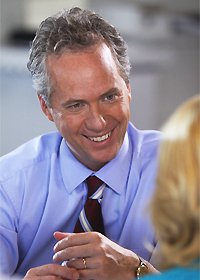 Mayor Greg Fischer announced changes meant to reduce the role of Louisville Metro Police in providing traffic details and security for special events.
Under new guidelines, organizers of special events in the city will be asked to increase volunteer participation during their events for positions that may not require a sworn police officer. Additionally, organizers will be asked to use private security companies when possible. Organizers will also be encouraged to use pre-designated routes that will need a limited or reduced number of sworn law enforcement.
“The sheer number of events throughout the city each week is a sign of vibrancy and community,” Mayor Fischer said. “But we must balance that with the need for LMPD to spend fewer hours covering special events.
“This new process allows our public safety teams to better coordinate with community groups to provide a better experience for participants and other citizens, while freeing up police officers to focus on other pressing needs.”
Earlier this year, the special events permitting process moved to Louisville Metro Emergency Services from Louisville Metro Codes and Regulations. Within Emergency Services, recently appointed Deputy Director Kelly Jones will oversee special events permitting, along with his other duties.
Jones will work with community groups to find appropriate venues for special events, with the goal of reducing LMPD involvement and street closures. The change will also allow for better internal coordination of city services for special events.
Jones retired last year from Louisville Metro Police. His most recent role included leading the city’s law enforcement details for special events, including Thunder Over Louisville and the Kentucky Derby and Oaks. He also played a large role in this past summer’s commemoration of boxing legend Muhammad Ali.
“Louisville Metro is committed to facilitating safe experiences for event participants,” Jones said. “I’m pleased to return to public service, and to lend my experience coordinating logistics and security for events.”
More information about special events policies can be found here: https://louisvilleky.gov/government/emergency-services/special-events
Louisville’s strategy for reducing violence in part by focusing on high-crime areas is showing progress, including a 13 percent reduction in aggravated assaults, 16 percent reduction in burglaries and 29 percent drop in robberies in those communities.
Speaking to Metro Council, Louisville Metro Police Chief Steve Conrad also cited a 49 percent increase in arrests over the past three months in the neighborhoods where violent crime has been highest, as well as a 50 percent increase in citations issued; and 58 percent increase in self-initiated police activity.
He also noted that police have confiscated 207 guns so far this year — a 38 percent increase over the same period in 2016. Last year, LMPD confiscated 1,778 guns — a 44.7 percent increase over 2015.
While acknowledging there is much work to be done, and the city’s homicide numbers are still troubling, Chief Conrad, Rashaad Abdur-Rahman from the city’s Office for Safe and Healthy Neighborhoods, and Yvette Gentry, Chief of Community Building, told the Council today that there is positive movement in both short and long-term violence-prevention strategies.
They focused their presentation on six pillars of the overall strategy: Enforcement, intervention, prevention, community mobilization, organizational change and development, and re-entry. They also addressed Council questions on spending of public safety funds allocated in December, as part of a mid-year budget adjustment.
LMPD: Overtime is helping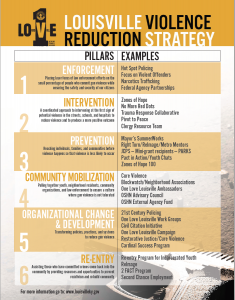
Chief Conrad said that since Nov. 1, LMPD’s newly expanded Narcotics Division has made 244 felony arrests and 59 misdemeanor arrests; and executed 169 searches, uncovering 57 pounds of heroin, 40 pounds of cocaine 73 points of meth and 125 guns.
And the additional funding allocated in December so far has covered 13,709 hours of overtime that allowed for increased patrols in the neighborhoods where violent crime has been most pressing — Park Hill, Russell, Shawnee, Shelby Park, Smoketown and Victory Park.
The Chief said he recently revised the increased patrols to be more strategic about when officers are deployed. “We want to be smart about spending these tax dollars, and mindful not to lean so heavily on overtime that we wear out our officers, who are extremely dedicated to this battle,” the Chief said.
Louisville Metro Police has hired 14 additional officers who are in training now and plans to hire 14 more this summer.
Office for Safe and Healthy Neighborhoods: Creating new pathways
Abdur-Rahman and Gentry said OSHN also is using expanded resources to focus on locations where there are more violent crimes involving youth, and efforts to create pathways away from violence through training, support and educational assistance.
They stressed that OSHN’s charge is long-term, focused on identifying and alleviating many of the root causes of violence, including economic and educational challenges as well as historic, systemic barriers to success for people in the neighborhoods most plagued by violent crime.
But they also pointed to indicators of success, including 100 people who found jobs through Zones of Hope, and 158 young people involved in ReImage, which helps stop the cycle of crime and violence by intervening with youth who’ve been charged with a crime or are at high risk of criminal behavior. Of those 158, 78 have gotten jobs, three have gotten a GED, and 17 have either completed a degree or started college.
OSHN represents a holistic approach in coordinating the efforts of many city agencies and partner organizations, ranging from Metro Parks and Recreation to the Louisville Urban League, Peace Education and Neighborhood House. Through those partnerships, OSHN is engaged with such programs as Zones of Hope, No More Red Dots, Pivot to Peace and, most recently Cure Violence, a cutting-edge method to reduce neighborhood violence by using the same health strategies used to fight infectious diseases. Cure Violence experts from Chicago were in Louisville last week for an assessment visit and training.
Funding for Cure Violence ($83,000) was part of a $625,000 allocation set aside for violence reduction efforts in the budget adjustment. Gentry and Abdur-Rahman outlined spending plans for the rest, including $120,000 to boost OSHN staffing from four full-time staffers to seven, as well as funding for Urban League and Peace Education programs, and 143,000 to external partner agencies for other, smaller programs focused on reducing violence.
“Just as there is no one reason for violence, there is no one solution for alleviating it,” Abdur-Rahman said. “Together, we’re investing in our youth, supporting young people who are trying to change their lives. That, in turn, helps all of us build a safe, more vibrant community.”
Credit: Louisville Metro Police
It is no secret that last year Louisville saw a record number of homicides. It seemed as though a new shooting or a new homicide was being reported every day, sometimes multiple times in one day. According to LMPD, Louisville, saw an increase of just under 50% to 117 homicides (123 for the entire county) during 2016, the highest since 1976 (104 total homicides). The majority of victims were black, accounting for a little more than 60% of the total. The majority of the victims were also male, approximately 79%, and more than half of the victims were between the ages of 18 and 34. LMPD was able to make 58 arrests in the homicide cases and the average suspect is the same as the average victim: a black male between the ages of 18 and 34.
Louisville also saw an increase in the number of shooting incidents, 504 compared to 353 last year. 504 shooting incidents is also the highest that has been recorded in the past five years. Of those 504 shootings, 102 were fatal.
Since gun control has been a hot topic the past year due to the election and a small group of Kentucky Mayors asking for the State Legislature to change state law regarding gun control, many of the other violent crime categories seemed to have been ignored by the local news. Here are some of the crime statistics and how they compare to last year:
- Robbery – 1,873, roughly the same as last year;
- Aggravated Assault – 2,921, up from 2,558;
- Rape – 149, down from 163;
- Property Crime – 29,890, up slightly from 28,055;
- Burglary – 5,884, down slightly from 6,229;
- Larceny – 19,808, up slightly from 18,751;
- Motor Vehicle Theft – 4,198, up from 3,075
According to Mayor Fischer, violent crime is “tragically acute in a few specific neighborhoods.” Looking at the maps by LMPD division, all eight divisions have been affected by homicide and shooting incidents. However, it appears that the majority of the homicides, shooting, and aggravated assaults occurred in the 1st (mainly north of Broadway and between I-264 on the east and west) and 2nd divisions (mainly west end). Taken in total, Louisville saw an overall increase by 9% in all violent crimes and a 46% increase in homicides. This appears to be outpacing the national average. Nationwide data is still pending, but as of June 2016, the country saw an overall increase in violent crime by 5% in general, and a 5% increase in the number of homicides when compared to the first six months of 2015. If the data is limited to only cities that are comparable in size to Louisville, there was a 5% increase in all violent crimes and only a 2% increase in homicides.
After averaging about ten homicides per month last year, Louisville has registered 15 homicides as of February 15, which is about the same as last year. While we are not seeing decrease in number of homicides as of now, hopefully, we will not see another record-breaking year.
They are simple devices designed to keep firearms safe and protect children from tragedy at home. Five members of the Louisville Metro Council are making sure free gun locks and trigger blocks are available in homes where children may be tempted to play with a firearm.
Council members Jessica Green (D-1), Mary C. Woolridge (D-3), David Tandy (D-4) Cheri Bryant Hamilton (D-5) and David James (D-6) have appropriated more than $2000 to purchase an initial order of 300 gunlocks to be given to residents of LMPD’s Second Division.
“This is a simple way to avoid a tragedy. Many times children do not know the difference between a lethal gun and a toy. A gun lock will make sure a child does not get hurt, especially at Christmas time. We want to avoid any unintended tragedies in the home,” says Hamilton.
Second Division officers are working with the Board for Change, “Little Hands, Little Feet” program to make sure the free gun locks will be given to families who need to keep firearms safe.
First priority is given to residents in the Second Division neighborhoods of Park DuValle, Parkland, Hallmark, California, Chickasaw, Shawnee, Algonquin, Parkhill, Cane Run, and Victory Park.
“I’m happy to be working with “Little Hands, Little Feet” program to teach gun safety in our neighborhoods. This program can save lives,” says James.
Council members approved funding for 150 cable locks and 150 trigger blocks. Future give a ways are planned as a way to help the community stay safe.
“Many of us know the stories of how a tragedy happened when a child played with a gun. There is no reason why anyone who owns a gun and lives around children, should not be using a gun lock,” says Woolridge. “We have made it easier to keep your home safe.”
Over the summer, the “Little Hands, Little Feet” program walked with LMPD officers on Peace Walks in West Louisville to distribute free gun locks and let parents and adults know how gun locks can keep children safe in the home.
“Citywide, we have had three children under the age of five that have been shot accidentally by unsecured firearms this year. In the district, An 8 year old was accidentally shot because of a careless unsecured firearm. The individual that had the gun was 18 years old and mishandled it. Then, a 12 year old was accidentally shot and killed because of an unsecured firearm,” says Major Jimmy Harper, Commander of the LMPD Second Division.
“The more gun locks we can put into the homes of people who have guns, the safer it will be for everyone,” says Green. “It’s tough to justify not having a gun lock, when they are free, especially if you have children.”
On Tuesday, December 13th, at 12:00pm, Council members and officers of the Second Division will present the “Little Hands, Little Feet” gun safety program with the gun locks for distribution. The presentation will be made at the Second Division, 3419 Bohne Avenue.
Luther Brown, Director and Founder of the Board for Change and “Little Hands. Little Feet”, makes gun safety presentations to organizations, churches and any interested group for free.
People interested in obtaining a free gun lock can contact Luther Brown at 502-290-7979 or llbrownjr16@gmail.com