Monday December 15, 2025
Local Connection
 Weather
 Traffic
 @LouisvilleDispatch
 @LouisvilleDisp
 Subscribe
 The University of Louisville grounds keeping staff will show off its environmentally friendly lawn equipment March 28 at a free Green Lawn Maintenance Vendor Fair on Belknap Campus.
The event, from 12:30 p.m. to 2 p.m., will be held at the UofL Grounds Shop, 1820 Arthur St.
“We will be demonstrating how advanced ‘clean’ has become,” said Greg Schetler, supervisor of UofL’s Grounds Shop.
UofL’s fleet of lawnmowers runs on propane rather than gasoline, a change made in 2011 to use less fuel and help reduce the university’s carbon footprint.
The event is sponsored by the Partnership for a Green City, a collaboration among UofL, Louisville Metro Government, Jefferson County Public Schools and Jefferson Community & Technical College.
For more information, contact Brent Fryrear, 502-852-8854 or visit louisville.edu/sustainability.
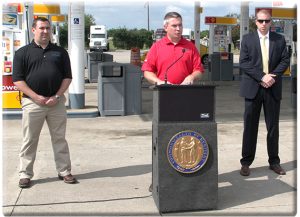 National Ag Day is today, and it is a good time to reflect on some of the many ways agriculture affects us every day.
Agriculture is a major economic driver in Kentucky and the United States. Nationally, it is one of few sectors that can boast a trade surplus. In Kentucky, agricultural exports totaled an estimated $1.46 billion in 2015. A University of Kentucky report found that agriculture and related industries in Kentucky had an estimated economic impact of $45.6 billion and accounted for more than 258,000 jobs in 2013.
Agriculture, of course, feeds us all. We rely on farmers and food manufacturers to produce the abundant and affordable foods and beverages that we all depend on – and often take for granted. Thanks to the productivity and efficiency of U.S. agriculture, Americans spend an average of only 9.7 percent of their income on food – the lowest in the world.
Of course, that is not true of all Americans. The lowest 20 percent of the population based on earnings pay as much as 35 percent of their income to feed themselves and their families. Some have to make hard choices to make ends meet. This situation is intolerable, and that is why we launched the Kentucky Hunger Initiative and assembled the Hunger Task Force last year. You can help by checking the box on Line 33 of Form 740 to donate part of your state tax refund to the Kentucky Farms to Food Banks Trust Fund. Together, we can make a difference in the lives of Kentuckians in need.
If you want to learn more about Kentucky agriculture, follow the Kentucky Department of Agriculture’s #KyAg365 campaign on Facebook and Twitter. We launched #KyAg365 at the beginning of the year to raise awareness of how agriculture affects every single person 365 days a year! This campaign educates the public on the Kentucky Department of Agriculture’s initiatives as well as the importance of agriculture in the lives of all Kentuckians.
We thank everyone who has liked, shared, and retweeted our posts! Many organizations, businesses, and individuals have used the hashtag to mark their own Kentucky ag-related posts. We hope you will watch for more #KyAg365 posts and discover amazing facts about Kentucky agriculture.
On National Ag Day, I hope you will take a moment to consider how your food is produced and where it comes from. And as always, if you like to eat, thank a farmer!
What do pawpaw trees, river birches and devil’s walkingstick trees have in common? They are all woody plants that are native to our region.
Using native trees, shrubs, vines, hedges, grasses, ferns and flowering plants in landscapes large and small helps conserve water, attract wildlife and reduce the use of fertilizers and pesticides.
The public is invited to learn more about the native plants of Kentucky, Ohio and Indiana at a free workshop March 20 on the University of Louisville’s Belknap Campus.
The 1 p.m. event will be held inside the Cultural Center Multipurpose Room next to UofL’s Garden Commons community garden. Margaret Shea, owner of Dropseed Native Plant Nursery in Goshen, will be the speaker.
“Native species are so important to our environment, even right here on our urban campus,” said Justin Mog, assistant to the provost for sustainability initiatives. “Margaret has more than 25 years of training and practical experience in natural areas management, restoration and biological inventory. We are thrilled she is coming here to speak to students, faculty, staff and members of the public.”
For more information, contact Mog at justin.mog@louisville.edu or visit louisville.edu/sustainability.
 St. Patrick’s Day will take on a special meaning this year as a time to celebrate the wearing of the green but also to make the city a little greener, too.
As a way to help Metro Louisville expand its tree canopy, Councilman Brandon Coan (D-8) has announced Planting O’ The Green, an initiative to plant 88 trees during the week leading up to this year’s St. Patrick’s Day Parade, and 364 trees over the next four parade cycles.
“In honor of this year’s 44th annual St. Patrick’s Day Parade, the Planting O’ The Green partners and I are planting 44 trees in District 8 and 44 trees in District 1,” said Coan. “Next year, we’ll plant 45 trees in District 8 and 45 trees in another Metro Council district, and so on. I believe this pay-it-forward approach is the only way to solve our citywide tree problem, and I hope Planting O’ The Green becomes a tradition for many years to come.”
The Councilman made the announcement with Councilwoman Jessica Green (D-1) and representatives of Brightside, MSD, Olmsted Parks Conservancy, TreesLouisville, Bellarmine University and the Ancient Order of the Hibernians on Monday.
“I am pleased to be part of this effort because we all know trees are important to all of our neighborhoods. Trees bring us closer to nature and remind us of the beauty that can be found on any street or corner. What better way to celebrate the wearing of the green than making sure our community is a little greener,” said Green.
In District 1, 44 trees will be planted at Farnsley Middle School, led by Planting O’ The Green partner Trees Louisville.
“TreesLouisville is thrilled to be a part of the Planting O’ The Green project,” TreesLouisville Executive Director Cindi Sullivan said. “We applaud Councilman Coan and Councilwoman Green for sharing our vision of a healthier and more livable community for current and future generations through a robust community tree canopy. Collaborative projects like this one are an excellent, strategic means to plant trees that will benefit students at Farnsley Middle School, the neighborhood residents that utilize the walking path we will be shading, and all Louisville residents.”
In District 8, 24 trees will be planted in Cherokee Park, led by the Olmsted Parks Conservancy, and 20 trees will be planted on neighborhood streets in Deer Park and Tyler Park, led by Brightside. Additionally, Brightside is organizing an extra effort to pick-up litter after the parade, led by students from Bellarmine University.
“What a great opportunity to work with such an impressive group of public and private partners to help grow and sustain Louisville’s urban tree canopy,” said Olmsted Parks Conservancy President Rachel Kennedy, “As you know the Conservancy’s mission is to connect nature to neighborhoods within the nationally significant network of Olmsted Parks and we cannot think of a better way to do this than partnering with Metro Council and other nonprofits to green our neighborhoods and parks this St Patrick’s Day.”
“Brightside is thrilled to join with Metro Council, Ancient Order of Hibernians and community partners on this new community beautifying event,” Brightside Director Gina O’Brien said. “Keeping litter off the streets and trees in the ground are two pillars of Brightside and we love that this event focuses on both.”
John O’Dwyer, President of the Father Abram J. Ryan Division of the Ancient Order of Hibernians, reflected on the meaning of the St. Patrick’s Day Parade and the impact of Planting O’ The Green.
“We strive to open the spring season each year with the St. Patrick’s Day Parade, often called the People’s Parade, and it is a time for fun and community. Now we are turning the Greenest Parade into the greenest parade as the next evolution of this charity event give back to our fine city,” O’Dwyer said. “Partnering in the Planting O’ The Green initiative will have lasting impact for generations to come. It will increase recycling on Parade Day and improve our tree canopy year-round. The Hibernians are proud to lead the way in being charitable and improving the environment.”
The 44th annual St. Patrick’s Day Parade is Saturday, March 11. For more information about Planting O’ The Green and related activities during the week leading up to the parade, contact Councilman Coan’s office at 574-1108.
 The Energy and Environment Cabinet today announced two contests to protect the environment and to celebrate Earth Day.
For middle school students, the “Capture the Earth” photo contest seeks original photographs and for high school students, the “Capture the Earth” video contest seeks original videos. Both contests seek to celebrate the beauty and diversity of Kentucky.
Submissions should attempt to move viewers to care about the environment in Kentucky. The deadline for submissions for both contests is April 7, 2017 at 4:30 p.m.
You can enter the photo contest by sending your photo as an attachment to kidsphotocontest@ky.gov. Your photograph must be saved as a jpeg file. File sizes may not exceed 5MB. The subject line of your email should read STUDENT EARTH DAY PHOTO CONTEST.
You can enter the video contest by uploading your video to YouTube, making it public and emailing the link to: Lanny.Brannock@ky.gov. Your video must be saved as a YouTube link.
The subject line of your email should read STUDENT EARTH DAY VIDEO CONTEST.
For more details about the contest, please visit the Facebook page.
Additional information is available at http://eec.kentucky.gov
 In response to the growing litter problem in Louisville, crews from the Solid Waste Division of Metro Public Works are diverting their efforts from yard waste collection to litter cleanup for a period of two weeks.
Yard waste collection in the Urban Services District (former Louisville city limits) is suspended and will resume on March 13, 2017. During the suspension period, citizens should not put yard waste out for collection. Any yard waste problems should be reported as usual to MetroCall at 311 or 574-5000.
The suspension is possible because it is occurring at a time when yard waste volume is low. This will allow Solid Waste to temporarily direct additional resources to the effort to clear our streets and roads, including interstate highways, of litter in advance of spring.
Once mowing season begins, litter abatement along the interstates in Louisville will be performed by the Kentucky Transportation Cabinet as it is every year. Metro crews will then focus solely on arterial and connector surface roads in the city.
Although we’ve seen many warm fronts this winter with temperatures in the 60s just this past weekend, the water in our highland reservoirs is still cold.
Water temperatures are in the high 40s in Lake Cumberland, Dale Hollow and Laurel River Lake. Once water temperatures drop below 50 degrees for extended periods, threadfin shad begin to suffer from the cold water.
“Threadfin shad get thermally stressed by winter water temperatures, especially in late winter,” said Jeff Ross, assistant director of the Fisheries Division for the Kentucky Department of Fish and Wildlife Resources. “They begin to twitch and spasm as they try to fight off death.”
Smallmouth bass, as well as spotted and largemouth bass, instinctually know to eat these weakened baitfish. The float-and-fly technique imitates stressed shad in cold water as good as anything.
“Many bass lures, such as jerkbait, use twitching movement to draw strikes,” Ross said. “The little fly twitching in place is irresistible to a smallmouth in the winter.”
Born in the deep, clear lakes of east Tennessee and inspired by crappie anglers complaining of big smallmouth bass breaking off tiny hair jigs fished deep in the winter months, the float-and-fly technique employs long, light to medium-light power spinning rods and 4-pound line to present small 1/16-ounce to 1/8-ounce jigs under a bobber.
The tiny jig is the “fly” in the float-and-fly technique. For generations, smallmouth anglers in Kentucky and Tennessee call hair jigs “flies.”
The long spinning rod, from 8 to 11 feet in length, is necessary as you suspend the diminutive jig 8 to 14 feet deep. Casting such a presentation on a rod shorter than 8 feet is nearly impossible. Fly anglers use 8-weight rods to suspend 1/32- to 1/48-ounce jigs under large strike indicators, employing light fluorocarbon line as the tippet. The lighter 1/48-ounce jig is much easier for a fly angler to cast with a leader and tippet running at least 8 feet long.
The “flies” are made of either craft hair or duck feathers or a combination of both. The float-and-fly technique has grown so popular that national outfitters carry rods designed for it. Tackle shops in the Lake Cumberland and Dale Hollow Lake region sell them as well. Float-and-fly rods also make excellent crappie and panfish rods.
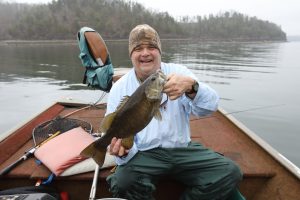 All you do is load the spinning reel with 4-pound co-polymer or fluorocarbon line and clip on a 7/8-inch pear-shaped plastic bobber 8 feet above the fly. Adjust the depth of the fly until you get a “pull down” on the bobber from a fish. There are specially weighted foam bobbers designed for the float-and-fly technique that grant better casting distance. The internal weight in these bobbers makes them roll over on their side if a big smallmouth hits the fly and moves shallower.
Lake Cumberland presents an ideal opportunity to catch smallmouth bass, as well as fat, healthy spotted bass and even hand-sized bluegill on the float-and-fly right now. During the drawdown of Lake Cumberland to repair Wolf Creek Dam several years ago, trees grew on the exposed shoreline. Now with normal water levels, these trees are at the perfect depth to offer shelter for big smallmouth and spotted bass as they await a school of baitfish to ambush.
The quivering fly hovering just above the sunken trees pulls these fish out of their lairs to strike. Female smallmouth bass need to feed in late winter to power the development of the eggs in their abdomens they will drop into nests later this spring.
The best flies on Lake Cumberland are craft hair jigs in combinations of blue, chartreuse, grey or white. White, sky blue and pink craft hair jigs also work well on this lake.
Duck feather jigs with wisps of red or pink craft hair seem to draw more strikes on Dale Hollow. These colors work well at Laurel River Lake, too. Both Dale Hollow and Laurel hold trout and some anglers believe their presence makes these fly colors work better in these lakes.
Fish the float-and-fly near the main lake in winter on these reservoirs. The best fishing occurs when your back faces lots of big, deep water.
Remember to allow your fly to strike the water’s surface on the back cast. This provides resistance on the forward cast that loads the long spinning rod, leading to much improved casting distance.
Applying a petroleum jelly-based shad scent, called “fish dope,” improves the delectability of the fly to smallmouths. Tackle shops and retailers in the Lake Cumberland or Dale Hollow region sell fish dope, but any petroleum jelly-based shad scent will work. Those with glitter in them are best.
On bright days, trimming a fly to match the bend of the hook and heavily applying dope to where the fly resembles a small stick often makes the difference between being skunked or catching fish.
A month of good float-and-fly fishing awaits anglers until warming waters puts big smallmouth or spotted bass on the prowl and willing to chase lures. This technique also fools huge largemouth bass on farm ponds and small lakes in late winter.
Remember to buy your fishing license soon. Feb. 28 is the last day of the current license year in Kentucky.